
Stop Losses Aren’t Just Protection. They’re How You Control Risk
Most people think stop losses are about limiting losses. That’s only part of the story. A stop loss defines where your idea is wrong and, more importantly, how much you’re risking before you even enter a trade. Once you understand how to pair stop placement with position sizing, you stop reacting to the market and start managing it. This is how you stay consistent, especially in volatile markets like gold and NQ.

Learning Path Stage 4: Risk & Mindset
Learning Level 2: Understanding
Primary Learning Objective
By the end of this lesson, you will be able to explain the dual role of stop losses as risk protection and as the mechanism that defines position sizing and risk-to-reward ratio.
Most explanations of stop losses are technically correct, but psychologically misleading.
“They limit your losses.”
True. But if that’s the entire explanation, stop losses start to feel like punishment. Like the thing standing between you and what would have been a “good trade” if the market had just cooperated for another twelve seconds.
This negative perspective breeds an unhealthy relationship with risk management. Beginners start treating stops like an enemy to avoid, hide, or constantly widen, rather than a core component of the trade’s actual blueprint.
The turning point for my own trading came when I realized this: a stop loss is not a safety net. It is the precise mechanism that defines the trade design itself. Without a clear stop, you cannot calculate how much money you are risking, you cannot determine if a trade setup makes mathematical sense, and you cannot build a process that is remotely sustainable over time. Without it, you aren't managing risk. You are just improvising with money attached.
Defining the Invalidation Point
A stop loss exists to answer one objective question: “At what exact point is my technical hypothesis completely proven wrong?” It does not exist to answer emotional questions like:
“How much money am I comfortable losing today?”
“Where should I plan to panic gracefully?”
“How far away can I hide this line so the market leaves me alone?”
The stop exists solely to define where the logic behind your trade breaks. Shifting your mindset to this definition changes everything. You stop reacting to a loss after the fact, and instead define your parameters before you ever click entry.
In product design, there is always a definitive moment where you can look at user behavior and say, "This interaction model has failed." If users consistently abandon a checkout flow at the exact same step, the evidence has officially invalidated your design assumption.
Trading functions identically. Your stop loss is simply the structural level where the live market provides clean, unfiltered feedback: “The technical condition you were betting on is no longer true.”
That is not punishment. It is feedback. Painful feedback sometimes, yes. The market is not especially known for its warm interpersonal communication style. But still feedback.
The beginner approach vs the structural approach
A lot of newer traders place their stop losses based entirely on emotional comfort. They look at their account and think, "I only want to risk $50 on this trade, so I will place my stop exactly 10 ticks away from my entry." The problem is that the market doesn’t know—or care—what arbitrary dollar amount feels emotionally safe to your brain. Price structure is built by aggregate participant behavior, not your personal comfort level.
A structured approach sounds entirely different: "If price breaks below this specific overnight session low, the structural reason I entered this trade no longer exists."
By anchoring your stop to market structure instead of an arbitrary dollar value, you move from emotional guesswork to objective, behavioral logic.
Risk is defined before you enter
Every trade has two components:
the idea
the risk attached to the idea
The stop loss is what connects them.
Once the stop is defined, you can determine:
how much you are risking
whether the trade offers a reasonable reward relative to that risk
and how large your position should actually be
Without this sequence, position sizing becomes random. And random sizing creates emotional inconsistency very quickly. Especially after losses, when the human brain suddenly develops very creative theories about “making it back.”
The Position Sizing Shift: Keeping Risk Constant
One of the biggest mental hurdles to clear in trading is understanding that your position size should fluctuate, but your total dollar risk must remain perfectly constant.
Most people intuitively default to trading the exact same position size every single time because it feels simple. But that rigid approach only works if every single trade setup has identical volatility and the exact same stop distance. Markets are never that cooperative.
Most people intuitively think:
“I always trade the same size.”
But that only works if every setup has identical volatility and identical stop distance.
Markets are not nearly that cooperative.
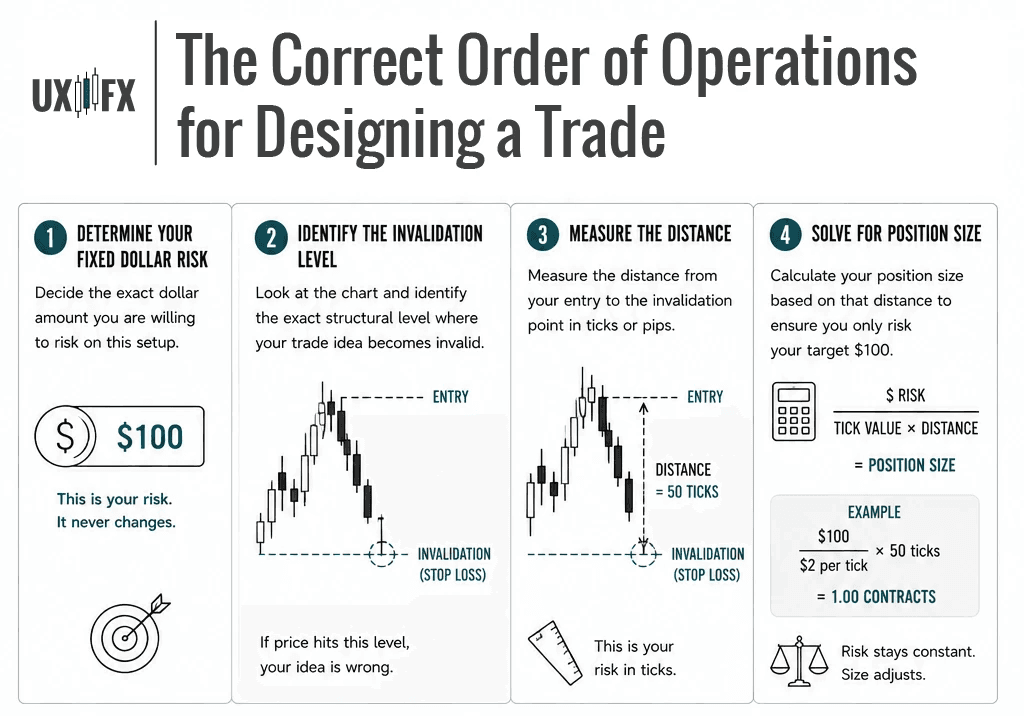
The actual order of operations for designing a trade looks like this:
Determine the fixed dollar amount you are willing to risk on a single setup (e.g., $100).
Look at the chart and identify the exact structural level where your trade idea becomes invalid.
Measure the distance from entry to that invalidation point.
Solve for position size based on that distance to ensure you only risk your target $100.That is the actual order of operations.
Not:
“I like this setup, so I’ll trade larger and hope discipline appears later.”
Historically, that strategy has not performed especially well for humanity.
This structure reveals a mathematical truth that completely flips beginner psychology: wider stops are not automatically riskier than tight stops.
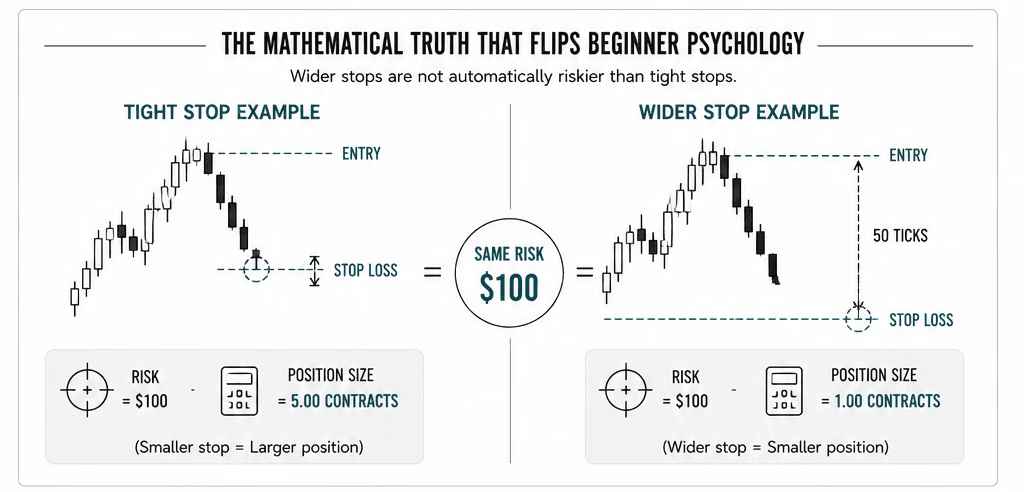
A 10-tick stop and a 50-tick stop can represent the exact same $100 risk. The only variable that changes is your position size. A wider stop requires a smaller position; a tighter stop allows for a larger position.

Wider stops are not necessarily riskier
Wider stops are often simply more appropriate for highly volatile markets. Trying to use the exact same tight stop on Gold or Nasdaq futures that you use on a slower currency pair usually results in one predictable outcome: getting stopped out by completely normal market noise before the move ever happens.
This is where the math starts correcting the psychology.
A 10-pip stop and a 50-pip stop can represent the exact same dollar risk.
The difference is position size.
Wider stop → smaller position
Tighter stop → larger position
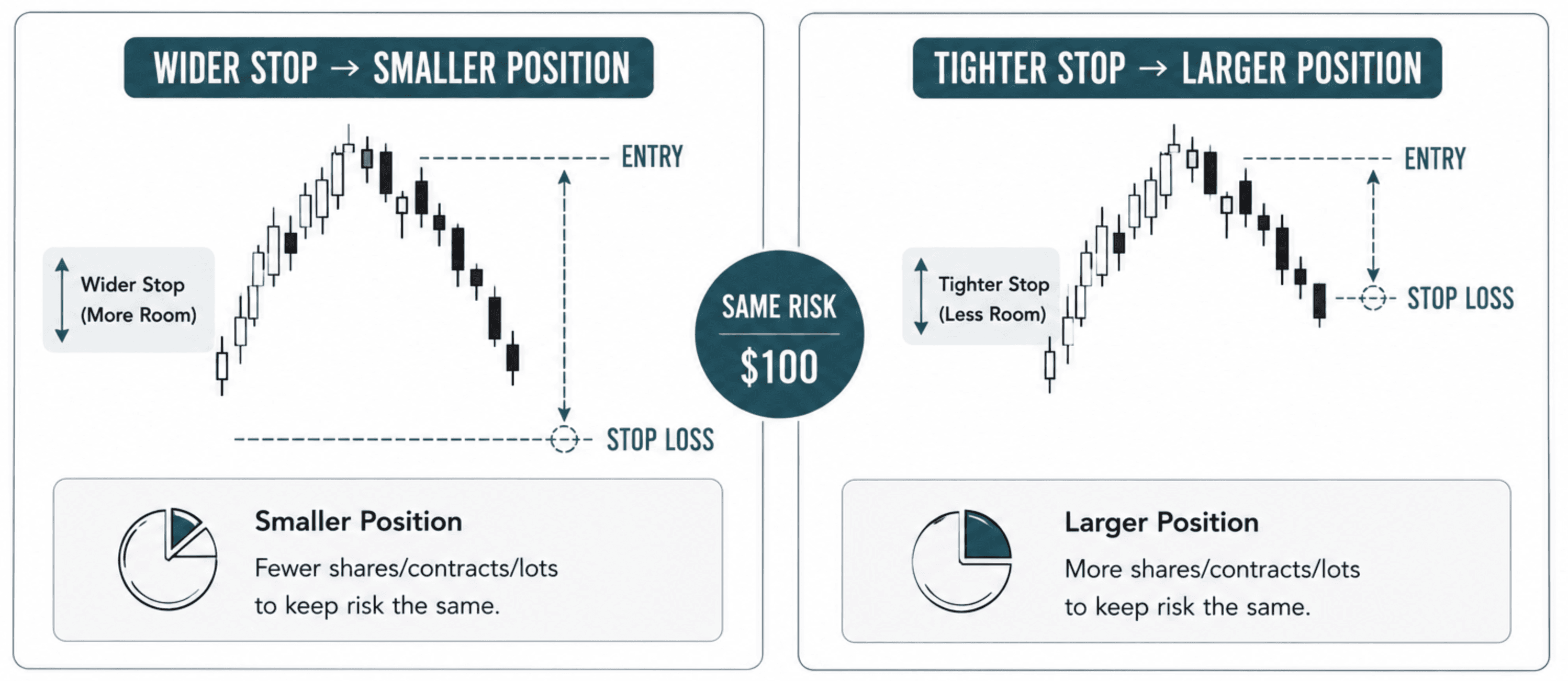
That means a wider stop is not automatically “more dangerous.” Sometimes it is simply more appropriate for the volatility of that market. This matters because different instruments move very differently.
Something like EUR/USD behaves differently from gold. Gold behaves differently from NQ futures. NQ occasionally behaves like it drank too much espresso and discovered existential uncertainty.
Using the same tight stop across every market usually leads to one outcome: Getting stopped out by completely normal movement.
Volatility matters
A stop should account for the natural movement of the instrument you are trading.
If volatility expands:
stops generally need more room
position sizes generally need to shrink
That keeps total risk stable while respecting the behavior of the market itself.
Otherwise, traders end up placing structurally invalid stops simply because they want the position size to stay emotionally satisfying. Which is understandable. But not especially sustainable.
Stop losses reduce cognitive load
One of the greatest benefits of a stop loss has absolutely nothing to do with capital preservation. It is pure cognitive relief.
In both user experience and educational design, aggressively reducing cognitive load is how you improve human decision quality. Trading is no different. Without a hard, automated stop loss active in your platform, your brain stays trapped in a continuous, exhausting negotiation loop the moment a trade moves against you:
“Maybe it will bounce back if I give it a few more seconds.”
“Maybe I should just hold it until the next session open.”
“Maybe the market is wrong and my bias is right.”
A predefined stop completely destroys this mental loop. It removes the need for real-time emotional intervention because the system has already processed the parameters before the trade became active. You already decided where the thesis fails, how much capital is at risk, and what outcome is acceptable. The platform handles the mechanical exit—not your panic.
A practical framework for placing stops
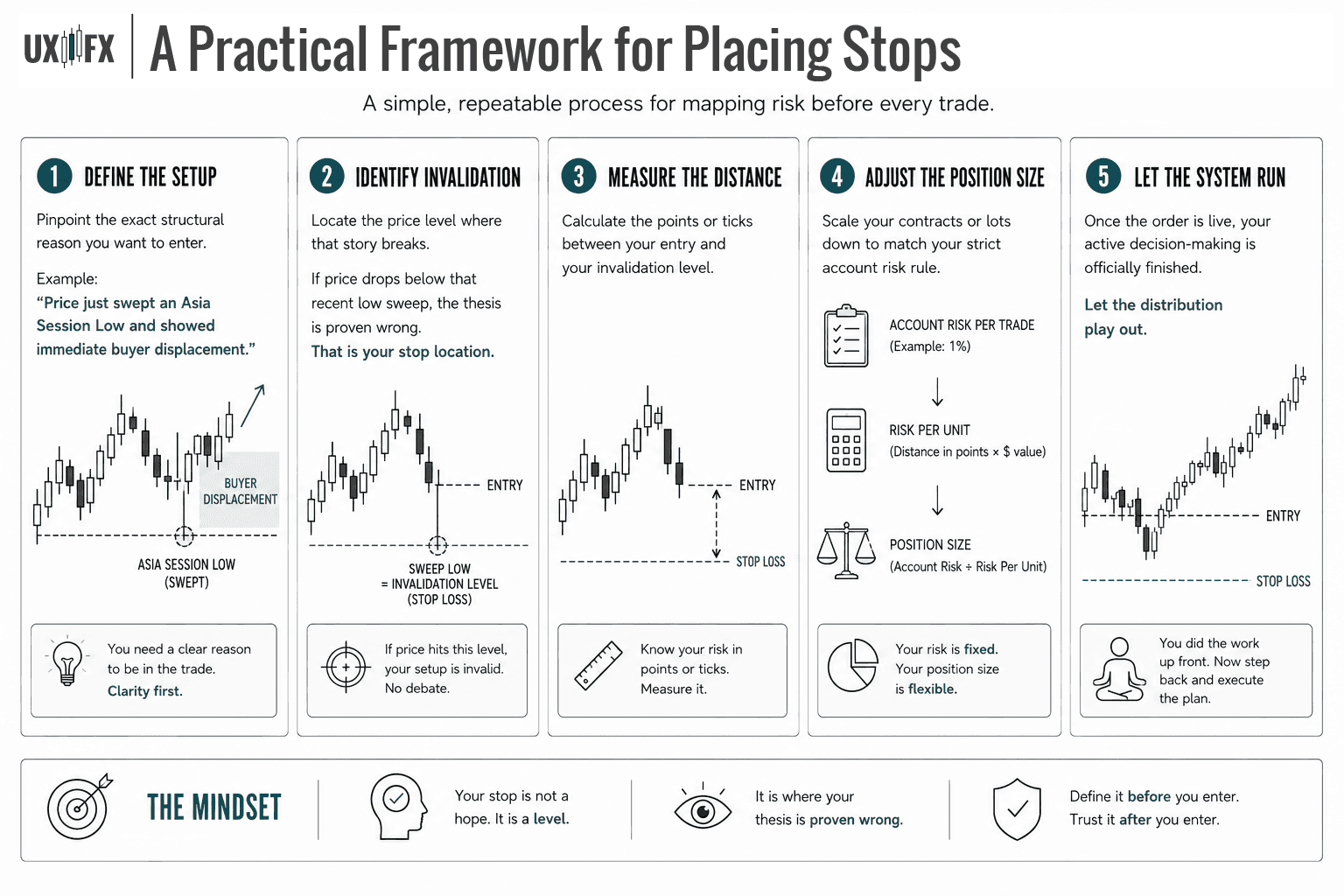
A clean, low-friction process for mapping your risk looks like this:
Define the Setup: Pinpoint the exact structural reason you want to enter. For example: "Price just swept an Asia Session Low and showed immediate buyer displacement."
Identify Invalidation: Locate the price level where that story breaks. If price drops below that recent low sweep, the thesis is proven wrong. That is your stop location.
Measure the Distance: Calculate the points or ticks between your entry and your invalidation level.
Adjust the Position Size: Scale your contracts or lots down to match your strict account risk rule.
Let the System Run: Once the order is live, your active decision-making is officially finished. Let the distribution play out.
The real skill
Using stop losses effectively is not about avoiding losses. Losses are part of trading.
The real skill is maintaining consistency in how risk is defined and managed across many trades over time. That consistency is what keeps a system survivable. Because trading is not usually destroyed by individual losses. It is destroyed by uncontrolled ones.
Closing thought
A stop loss is a proactive design decision. It explicitly defines your risk, protects your psychological capital, and ensures your process can survive long enough for statistical probabilities to work in your favor.
When a stop gets hit, the market isn't out to get you. It just means you tested a hypothesis, the market provided data, and the setup failed its validation requirements. Moving your stop loss out of the way of a falling market isn't "giving the trade room"—it's overriding your own product architecture because you don't like the user testing data.
Accepting the invalidation is not a failure. It is the process functioning exactly as it was engineered to do.
Success Criteria
After completing this lesson, you should be able to place a stop loss based on market structure rather than arbitrary dollar amounts, and explain how stop placement affects every other variable in a trade.
Common Misconception
A stop loss is primarily about limiting how much money you can lose on a given trade.
The Truth: Its primary function is defining the logical invalidation point for the trade thesis; the loss limitation follows from that, rather than the other way around.
FAQ's
Q: Where should you place a stop loss?
Q: What is the relationship between stop loss placement and position size?
Q: What is a stop loss and why is it important?
Table of Contents
About Me

Krista Weber
After a career as a VP of UX and EdTech executive, I retired early—and quickly realized the traditional world of trading education is fundamentally broken.
As someone with a Master’s in HCI who specialized in the design of e-learning systems, I saw a massive gap: beginners aren't failing because trading is impossible; they’re failing due to massive cognitive overload and terrible instructional design.
This site bridges that gap. I’m applying the principles of learning science, systems thinking, and minimalist UX to strip away the market noise and teach trading the way it actually should be taught.
Stay in Touch
Some of the pages on my travel blog contain affiliate links. Whenever you buy something through one of these links, I get a small commission at no extra cost to you. As an affiliate, I only recommend products and services that I feel are high quality and helpful to my readers. Thanks for your support.
Read More

Open almost any trading platform and you'll see EUR/USD sitting next to XAU/USD, NQ, ES, and a dozen CFDs on stocks you've heard of. They all show up as candlesticks moving left to right, which quietly implies they're all the same kind of thing. They aren't. Before going deeper into any one of them, it's worth drawing the map.
Updated on Sep 6, 2026

Futures are standardized contracts tied to defined specifications and a future settlement date. They can look complex at first, but the mechanics become much clearer once you know what the contract specification controls. Here's what you actually need to know.
Updated on Sep 6, 2026

CFDs appear everywhere in retail trading – but most new traders couldn't explain exactly what they are or why that matters. Here's a plain-language breakdown, including the parts that most introductions skip.
Updated on Sep 6, 2026