

After a career in UX leadership and educational technology, I became fascinated by the challenge of learning the markets.
About Me
The Origin Story Behind UX to FX
I didn’t come into trading looking for a shiny new identity, a desperate second career, or a fast track to financial freedom. I came into it because I retired early from my corporate role as a VP of User Experience, got bored out of my mind, and eventually realized that my brain still aggressively demanded a complex system to operate on.
At first, early retirement felt exactly like the glossy brochure promised. There were extended vacations, long tennis matches in the middle of a Tuesday afternoon, and a beautiful absence of Microsoft Teams notifications. But slowly, that peace turned into a silence so loud you notice the hum of the refrigerator.
For decades, my job as a UX designer and tech executive was to understand human behavior under strict constraints. I constantly observed how users navigate deep uncertainty and how microscopic changes in layout alter macro outcomes. That deep-seated cognitive rhythm doesn’t gracefully shut off just because your Outlook calendar suddenly clears out. You can be intensely happy in early retirement and still desperately need to use your brain.
From Long-Term Compounding to Immediate Feedback
Trading became one of the first environments I found where that exact style of systems thinking applied, just in a much more immediate, unbuffered way. I was already financially stable, holding long-term index positions in funds like VOO. But long-term investing is about patience and compounding; short-term trading is about immediacy, live feedback, and constant uncertainty.
When I stripped away the marketing fluff and looked closer at the core infrastructure, something clicked. In UX, I spent years trying to predict human behavior, which is basically understanding what people want, where they hesitate, and how they respond to visual structures. Financial markets are simply behavioral modeling played out at a massive, global scale.
The difference is the lack of an abstraction layer. There is no research synthesis phase or stakeholder interpretation buffer. The live market responds instantly to your execution, and it does not care a fraction of a percent about your good intentions. Occasionally, I still catch myself staring at a highly volatile chart on a red folder news day thinking, "This chart looks exactly like a user flow from our old checkout process."
The "Unfair Advantage" of an Analytical Mindset
Managing a live trade is, at its core, an exercise in cognitive load and emotional regulation. It is a human-system interaction problem where the feedback is uncomfortably immediate. It's essentially a usability test where the user is also your bank account.
Because of that, I started treating my chart setups with objective UX rigor, conducting what amounts to an interface audit. Instead of asking the emotional, beginner question, "Is this a perfect, guaranteed setup?" I evaluate the system state: What conditions are present? What is missing? What increases or decreases probability? It becomes an ongoing practice of structured decision-making under uncertainty, reducing chaos until something vaguely actionable emerges.
Mind the Representation Gap
If you spend even a few hours consuming trading content online, an exhausting pattern emerges. The discipline is almost exclusively framed as fast, flashy, and intensely lifestyle-driven. Basically, it is all luxury sports cars, laptop setups on tropical beaches, and effortless "sniper entries."
It is also a space filled predominantly with men. When women are visible, they almost always fit a very narrow, hyper-polished, youth-centric aesthetic. To be perfectly frank, I am none of those things, and that is not the version of trading I am remotely interested in exploring.
Representation matters in quiet, psychological ways. When every visible version of a "trader" looks like a specific archetype, it quietly shapes who feels like they are allowed to belong before they even click "Buy" or "Sell" for the first time. Having frequently been the only woman on corporate tech leadership teams, I recognize the pattern. Tech and online trading culture share the same design flaw: they don't exclude you through explicit rules; they filter you out through passive, background assumptions.
Why This Space Exists
Trading is not reserved for an aggressive gender archetype or a curated social media aesthetic. It is an intellectual and psychological skill built through disciplined observation, relentless repetition, and the mechanical ability to keep your head clear under intense pressure. None of those traits are identity-bound.
This site does not exist to sell you alerts, premium signal groups, or magical automated shortcuts. It exists to document what it actually looks like to build market competency completely from scratch, using proven learning science.
The modern trading world has a severe information problem. The challenge isn't access to data; it's filtering signal from noise and designing a structured way to actually retain knowledge without getting sucked into a toxic performance culture. My background in EdTech and UX is deeply useful here because my entire career was spent learning how to deconstruct complex systems and scaffold educational paths in a way that aggressively reduces cognitive overload.
This isn't just for tech professionals. It is built for anyone who wants to treat trading as an elite, serious skill to be cultivated thoughtfully over time, rather than a performative hustle optimized for social media clicks.
Welcome to UX to FX. Let’s look at the data.
Never miss a post! Join the Newsletter for free.



Read My Stories

Trading gets marketed as passive income or a side hustle. It's neither. It's a skill-intensive discipline with a multi-year learning curve. Understanding this upfront changes how you approach everything that comes next.
Updated on Jul 10, 2026
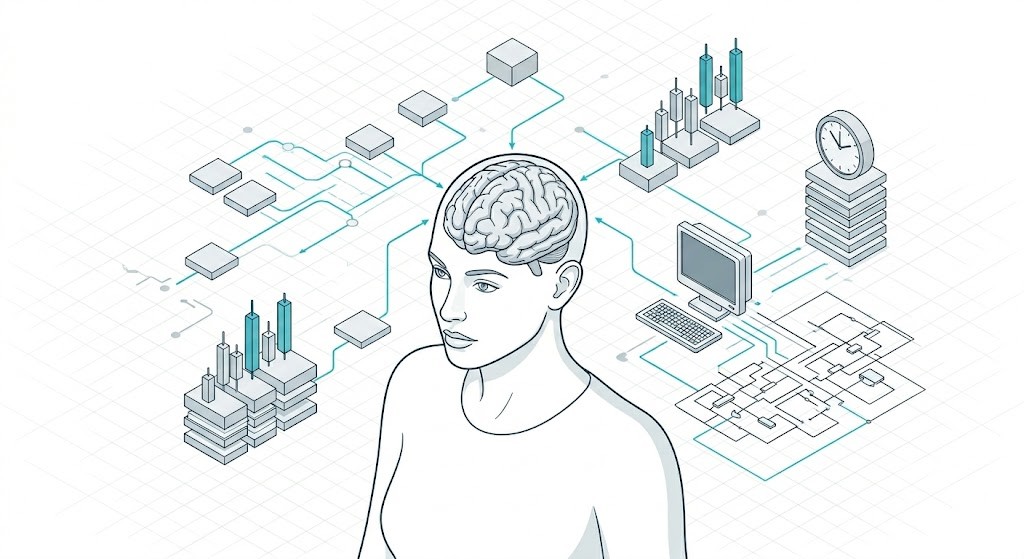
Learning trading takes longer than most people expect. Not because the material is overly complex, but because understanding something and being able to operate inside it are two very different things. Early progress feels real, but it’s mostly recognition. The actual learning begins later, when decisions happen under uncertainty, feedback is inconsistent, and nothing behaves as cleanly as the explanation did.
Updated on May 20, 2026

The trading education industry is worth billions of dollars. Most of it exchanged for information freely available elsewhere. Understanding why paid courses are usually a bad deal for beginners, and where the genuinely good free resources are, saves money and time.
Updated on Jul 10, 2026