
Why Buying Information Won't Make You a Better Trader
The trading education industry is worth billions of dollars. Most of it exchanged for information freely available elsewhere. Understanding why paid courses are usually a bad deal for beginners, and where the genuinely good free resources are, saves money and time.

Learning Path Stage 1: Foundations
Learning Level 2: Understanding
Primary Learning Objective
By the end of this lesson, you will be able to evaluate whether a trading course is likely to improve your skills or simply sell you information you can already access for free. You'll also know where to begin building a high-quality trading education without spending unnecessary money.
Do I Need to Buy a Course?
Before you hand over your credit card, you need to understand how the trading education industry actually works as a business. Spoiler alert: Most trading educators don’t make their primary income from trading. They make it from selling trading education.
This doesn’t mean they’re all mustache-twirling villains; many genuinely believe in what they’re teaching. But it does create a massive, structural conflict of interest. To keep their business running, their marketing has to outshine reality. "The secret strategy that changed my life!" gets millions of views; "A boring, systematic approach to risk management that produced a modest 4% return over three years" is a total snooze-fest, even though the latter is what actually keeps you alive in the markets.
Some trading businesses are built around recurring subscriptions, premium communities, or ongoing mentorship. That doesn't automatically make them bad, but it does mean you should ask whether each purchase is helping you become more independent or simply encouraging you to keep buying the next level.
Information vs. Skill
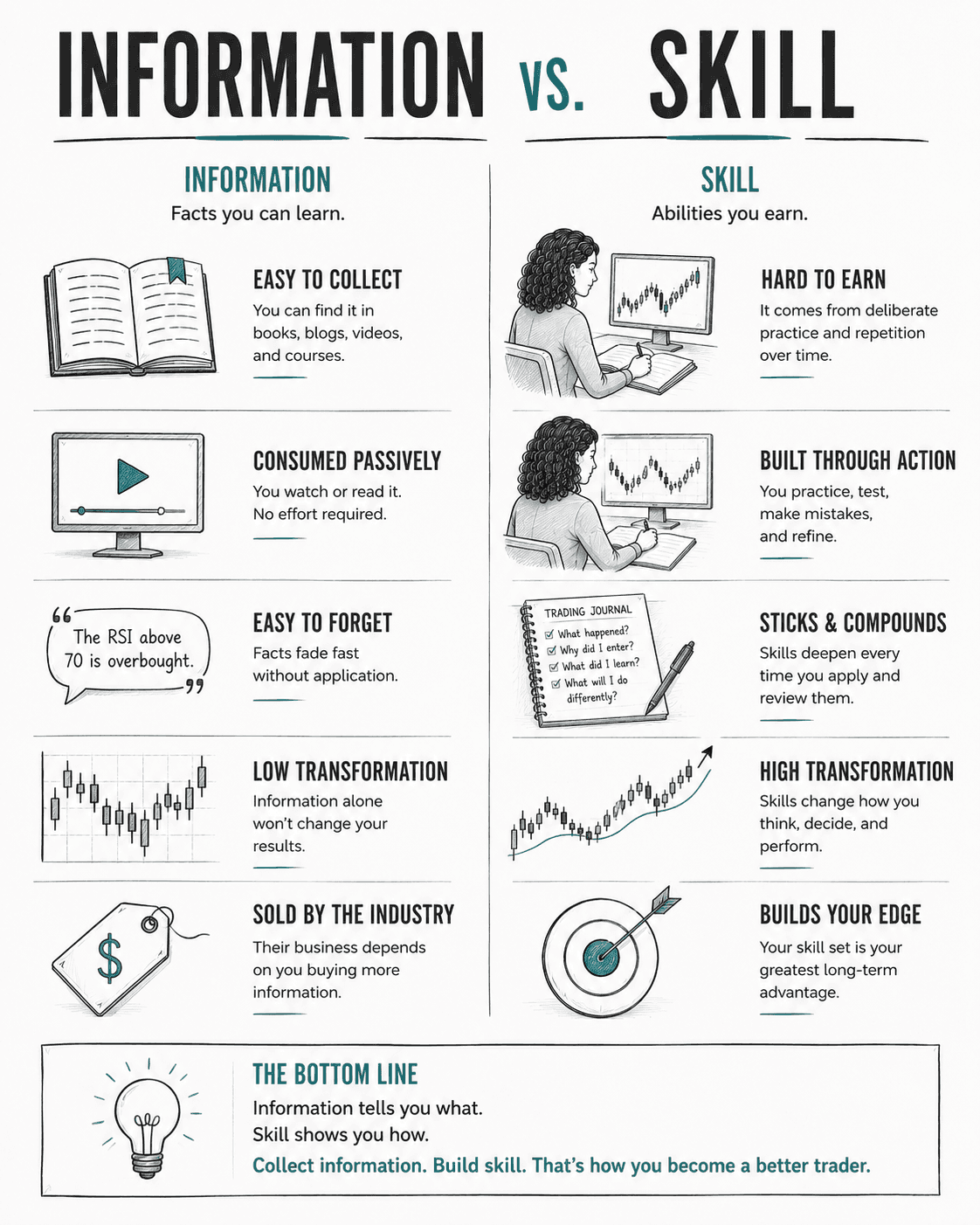
The golden rule of learning to trade is simple: Does the education teach you skills, or is it just selling you facts?
Information is cheap: "The RSI above 70 is overbought," "A head-and-shoulders is a reversal pattern," "The spread is the transaction cost." You can find thousands of blog posts and videos explaining these facts for free. Paying a guru $1,000 to read you a glossary of terms in front of a high-def camera is a bad trade.
Skill is earned: Reading raw price action, managing risk on a losing position, controlling your panic when a trade goes south, and meticulously reviewing your data.
No course can hand you a skill. You can't read a book about doing push-ups and walk away with a six-pack; you have to actually do the push-ups. In trading, the push-ups happen in practice environments (replay mode, demo accounts, simulators). Paid courses sell you the map, but free practice environments are where you actually learn to drive.
Where Should I Learn Instead?
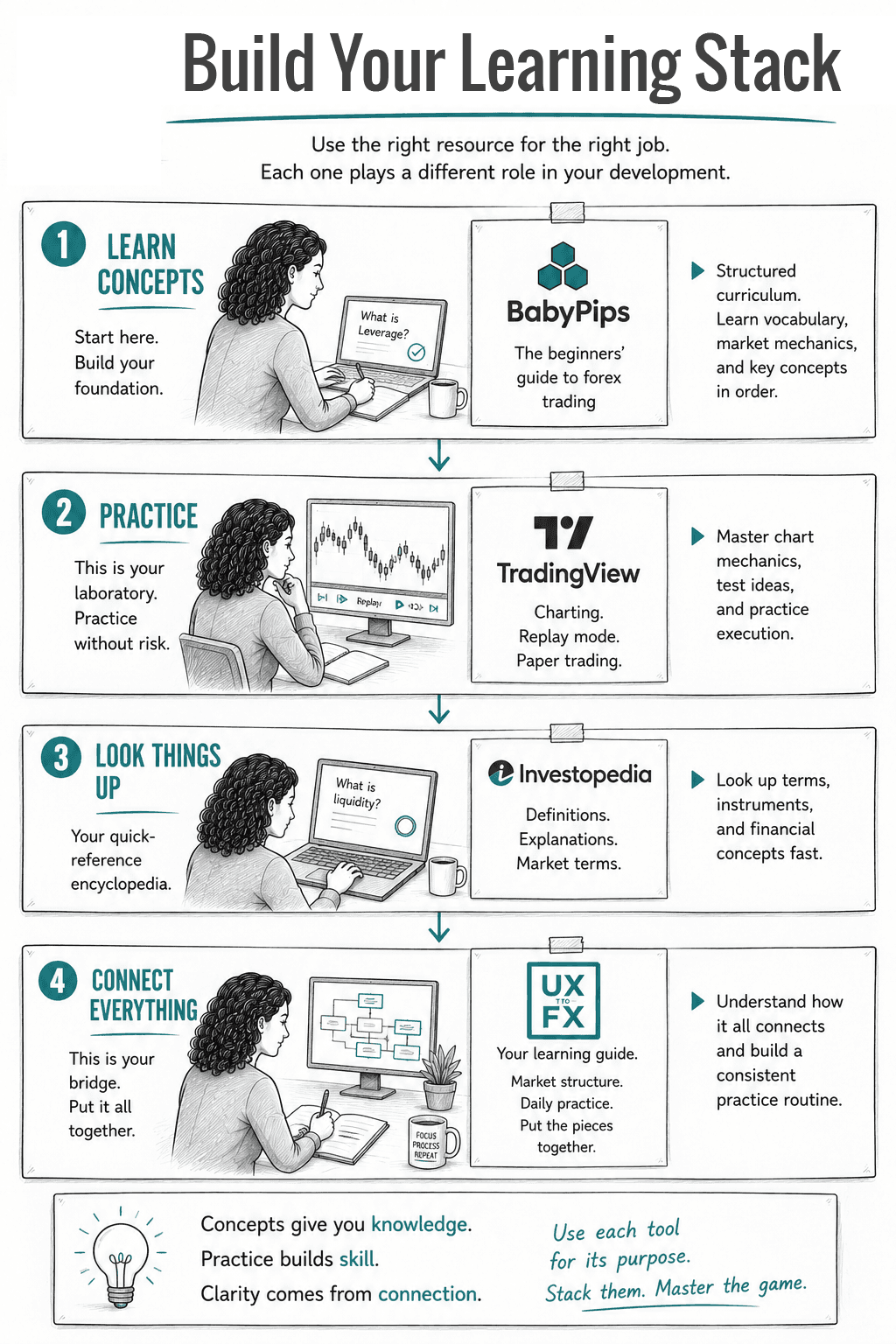
Instead of burning your capital on a shiny course, you can piece together a world-class education using targeted, free resources. Don't just collect links. Understand exactly what role each tool plays in your development:
Resource | Why It Belongs |
BabyPips | Structured beginner curriculum. This is your textbook. Use it to learn vocabulary, market mechanics, and fundamental concepts in a logical, sequential order. |
TradingView | Platform mechanics & practice. This is your laboratory. Use it to master chart mechanics, utilize replay mode, and practice execution via paper trading without financial risk. |
Investopedia | The financial dictionary. This is your quick-reference encyclopedia. Use it to immediately look up unfamiliar financial terms or market instruments without buying a course to explain them. |
UX to FX | Your Learning Guide. This is your bridge. Use it to learn how all the free pieces connect, shift your focus to market structure, and build a concrete, daily practice routine. |
When Paying Actually Makes Sense
Once you’ve spent a substantial period of self-directed learning using free resources, your internal fake guru-radar will be fully developed. At that point, you’re in a position to selectively pay for things that actually add value, rather than buying polished facts.
Paying makes sense when you are funding:
Deep-dive data, backtesting databases, or specialized research tools you genuinely can't access for free.
Actual 1-on-1 mentorship with someone who has a verifiable, audited track record and focuses entirely on your individual execution.
Highly technical books written by actual, credibly credentialed market practitioners.
Even then, the bar should be incredibly high. Your free education should have already given you 90% of what you need. The remaining 10% is just refinement.
The goal isn't to collect more information. It's to become the kind of trader who can turn information into consistent decisions.
Success Criteria
After completing this lesson, you should be able to:
Distinguish between information that can be learned for free and skills that require deliberate practice.
Evaluate whether a paid course is likely to provide genuine value.
Identify trustworthy free resources and explain the role each plays in your learning.
Explain when paying for education or tools actually makes sense.
Common Misconception
If a course is expensive, it must be high quality.
The Truth: High prices usually mean the creator has a massive marketing budget to pay for ads, not that the content is revolutionary. Most expensive courses just wrap basic, free information in shiny packaging.
FAQ's
Q: How do I know when I've outgrown free education?
Q: If I only have time for one free resource, where should I start?
Q: If free resources are so good, why do people buy expensive courses?
Table of Contents
About Me

Krista Weber
After a career as a VP of UX and EdTech executive, I retired early—and quickly realized the traditional world of trading education is fundamentally broken.
As someone with a Master’s in HCI who specialized in the design of e-learning systems, I saw a massive gap: beginners aren't failing because trading is impossible; they’re failing due to massive cognitive overload and terrible instructional design.
This site bridges that gap. I’m applying the principles of learning science, systems thinking, and minimalist UX to strip away the market noise and teach trading the way it actually should be taught.
Stay in Touch
Some of the pages on my travel blog contain affiliate links. Whenever you buy something through one of these links, I get a small commission at no extra cost to you. As an affiliate, I only recommend products and services that I feel are high quality and helpful to my readers. Thanks for your support.
Read More

Open almost any trading platform and you'll see EUR/USD sitting next to XAU/USD, NQ, ES, and a dozen CFDs on stocks you've heard of. They all show up as candlesticks moving left to right, which quietly implies they're all the same kind of thing. They aren't. Before going deeper into any one of them, it's worth drawing the map.
Updated on Sep 6, 2026

Futures are standardized contracts tied to defined specifications and a future settlement date. They can look complex at first, but the mechanics become much clearer once you know what the contract specification controls. Here's what you actually need to know.
Updated on Sep 6, 2026

CFDs appear everywhere in retail trading – but most new traders couldn't explain exactly what they are or why that matters. Here's a plain-language breakdown, including the parts that most introductions skip.
Updated on Sep 6, 2026