
Trading Is a Skill, Not a Side Hustle
Trading gets marketed as passive income or a side hustle. It's neither. It's a skill-intensive discipline with a multi-year learning curve. Understanding this upfront changes how you approach everything that comes next.

Learning Path Stage 1: Foundations
Learning Level 2: Understanding
Primary Learning Objective
By the end of this lesson, you will be able to explain why trading is a multi-year cognitive and behavioral skill rather than a casual, short-term side hustle, and connect this understanding directly to your trading expectations, capital allocation, and practice routines.
The "Side Hustle" Trap
The marketing pitch is beautiful: Work two hours a day from your laptop, pull consistent income from the markets, and tell your boss to kick rocks. It frames trading as a casual weekend hobby, like making sourdough bread or flipping couches.
This pitch works because it preys on real pain points: financial anxiety, corporate burnout, and the desire for freedom. But it conveniently deletes the messy prologue. It skips the years of red months, the abandoned social life, and the thousands of hours staring at candles until your eyes blur.
Framing trading as a casual side hustle isn't just inaccurate. It's financially dangerous.
What a Real Skill Requires
Trading isn’t a checklist; it’s a high-level cognitive sport. These are examples of the kinds of skills professional traders gradually develop:
Pattern Recognition: Spotting a valid setup in a sea of chaotic, blinking charts.
Probabilistic Thinking: Accepting that any single trade can lose, and being completely okay with that.
Risk Calculation: Ruthlessly protecting your capital, even when your ego begs you to double down.
Emotional Regulation: Not throwing your laptop out the window after a losing streak.
Adaptive Reasoning: Admitting you were wrong the second the market changes its mind.
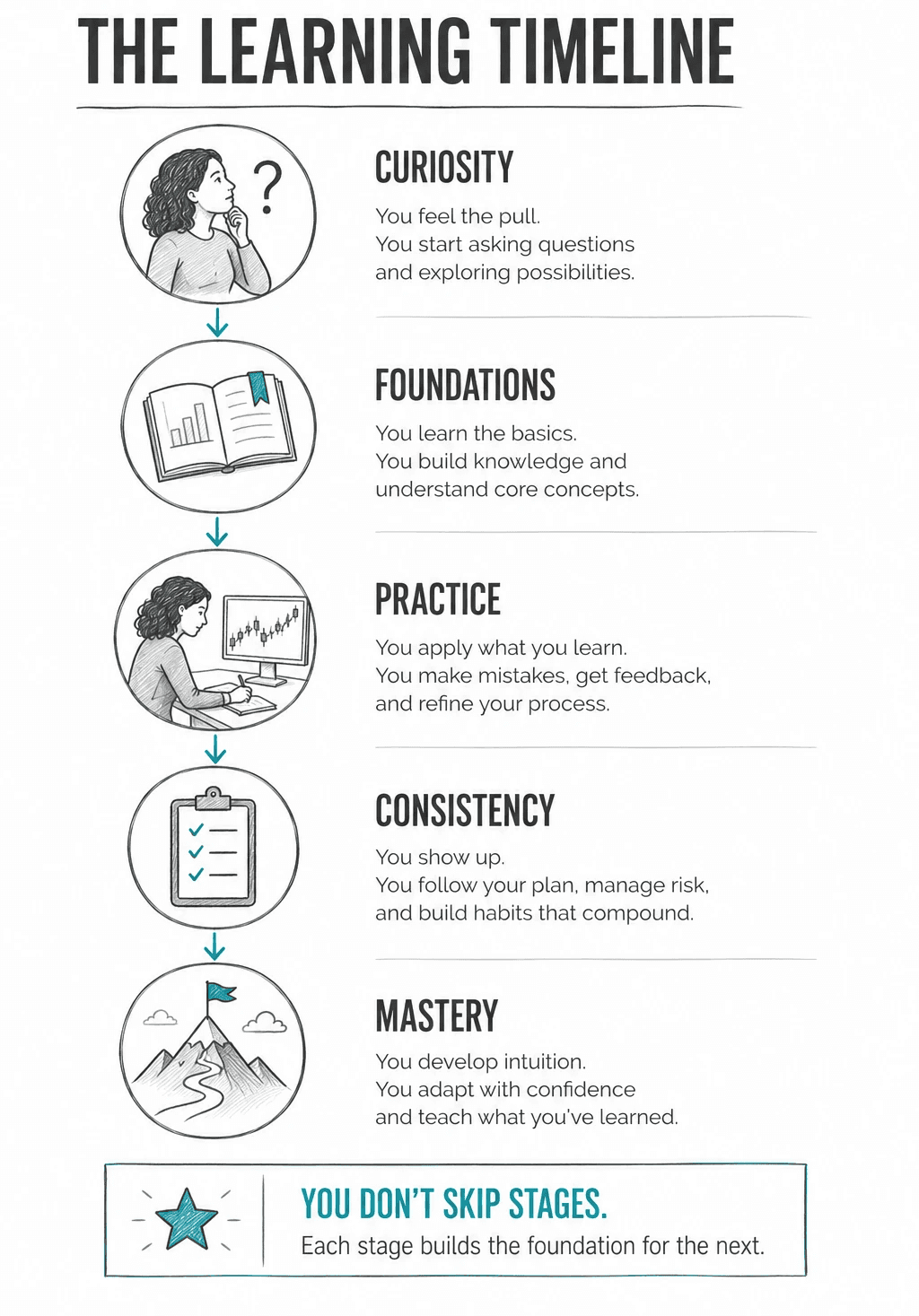
You cannot absorb these skills by osmosis from a TikTok video. You need deliberate, repetitive practice under live-fire conditions. The closest comparison is learning a concert instrument, a new language, or a martial art. Most successful traders think in years, not months. The exact timeline varies, but developing consistent judgment, discipline, and pattern recognition takes much longer than most advertisements suggest.
The Price of Admission (What the Wrong Framing Costs You)
When you treat trading like a casual side hustle, you set yourself up to fail in very predictable ways:
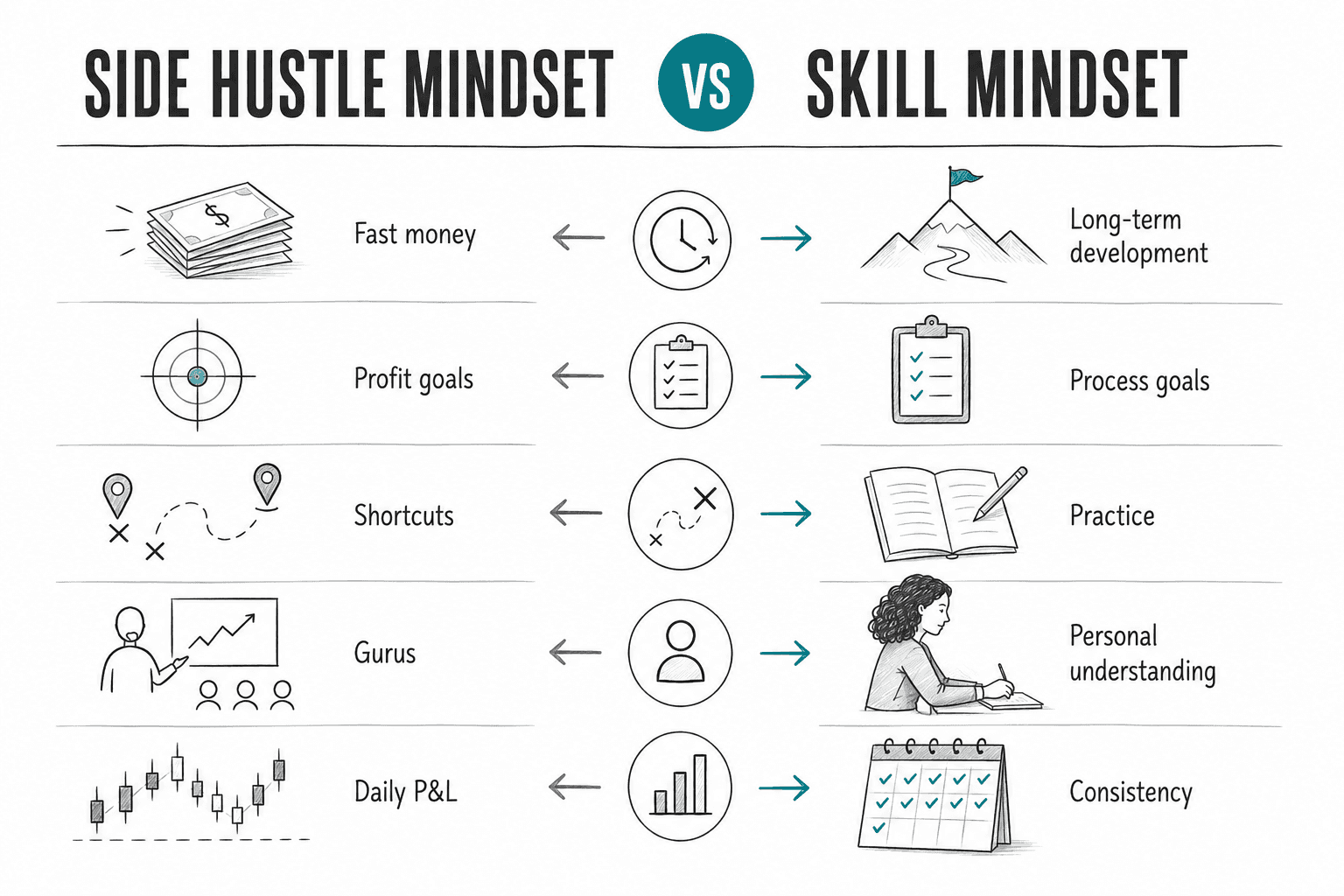
You underinvest in training: Nobody expects to become a part-time dentist in six months, but people expect to master global macroeconomics by Thursday. When the money doesn't roll in immediately, the side-hustle mindset breaks down.
You burn real cash too soon: The classic excuse is, "I need to trade real money to feel the emotion." The reality? Trading live without a proven edge is just giving a mandatory donation to Wall Street.
You quit right before the breakthrough: When you're six months in and still losing money, the "side hustle" mindset says, "This is a scam, I'm out." The "skill" mindset says, "Cool, I'm in the first semester of freshman year."
You chase fake benchmarks: If you expect a smooth, upward profit line in year one, you will constantly feel like a failure. If you expect a multi-year learning curve, your reality and your expectations actually match up.
The Mindset Shift
When you stop treating trading like a gig-economy job and start treating it like practicing medicine or playing the piano, everything changes:
Practice is for learning, not paying rent. A musician doesn't expect a paycheck for practicing scales in their bedroom.
You stop obsessing over daily P&L. In the beginning, your metric for success isn't "How much money did I make?" It's "Did I execute my plan perfectly and manage my risk?"
You scale your capital appropriately. You start with simulator data. Then you move to micro-lots. You only earn the right to trade bigger size once you've proven you can survive.
What Successful Traders Actually Do
The consistently profitable traders aren't the ones posting screenshots of sports cars on social media. They are usually quite boring. The survivors share a few basic traits:
They accepted a multi-year learning curve upfront.
They checked their ego at the door and adapted when they were wrong.
They kept journals that exposed their worst behavioral flaws.
They mastered one boring setup instead of chasing twenty flashy ones.
They accepted that losing streaks are just the cost of doing business.
It’s not glamorous, it’s not a get-rich-quick scheme, and it won't go viral online. But if you treat trading like a serious profession, it has the potential to pay you like one.
Every serious skill has a tuition. In trading, that tuition is paid in time, deliberate practice, and a long list of mistakes you'll eventually be grateful you made in simulation instead of with significant capital.
Success Criteria
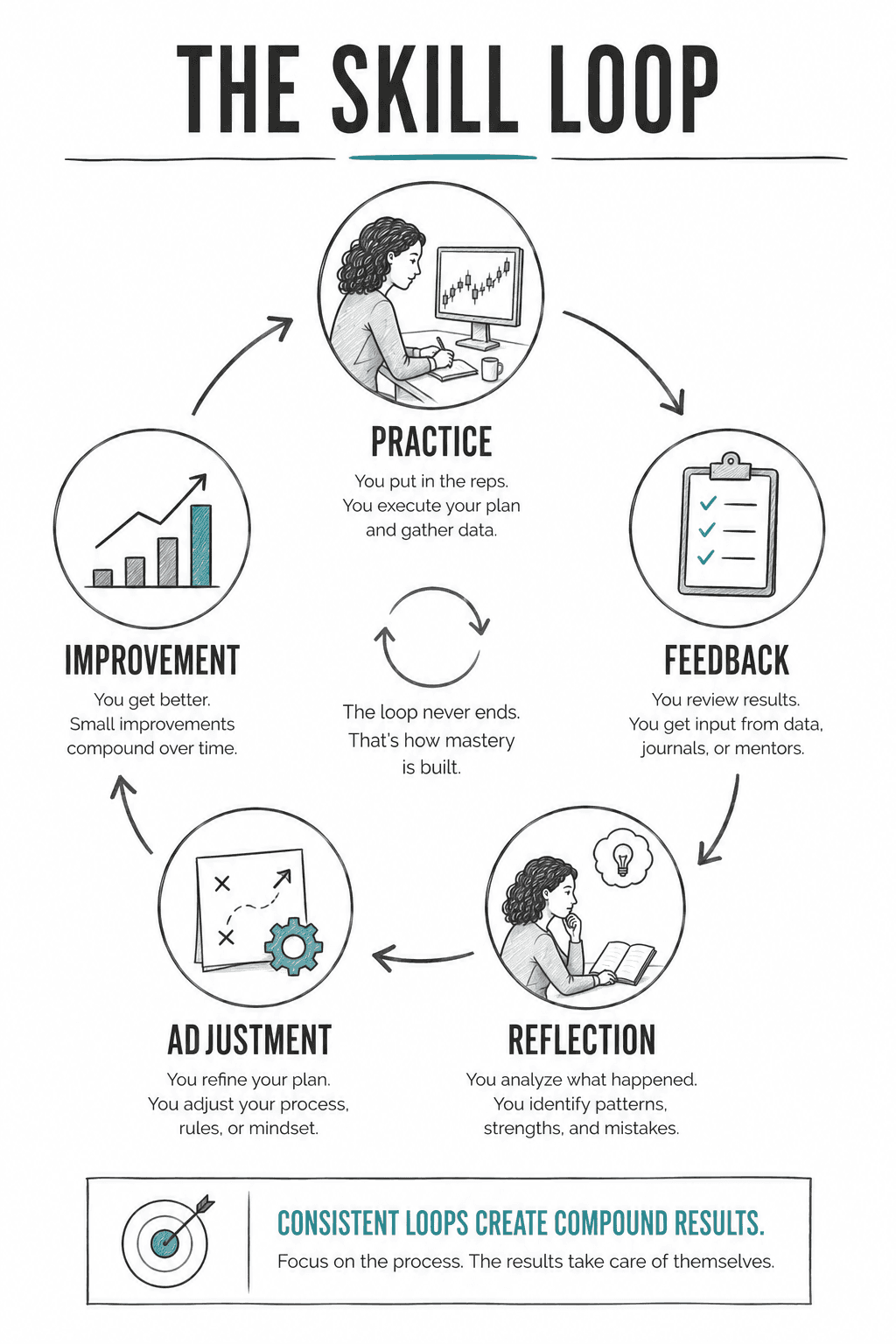
You will know you have mastered this concept when you can:
Explain why trading should be approached as a long-term skill rather than a short-term income strategy.
Recognize how that mindset changes the way you practice, measure progress, and manage expectations.
Evaluate whether your current goals reflect learning or earning.
Common Misconception
The "Plug-and-Play" Fallacy. Believing that trading is just a matter of finding the right "secret" indicator, joining the right Discord chat, or copying the right guru to unlock consistent profits.
The Truth: Success comes from repeated practice, risk management, emotional regulation, and adaptive reasoning. Those skills don’t evolve overnight. Just like anything else that’s hard, it takes practice and continued effort.
FAQ's
Q: Can trading still be a side income someday?
Q: Can I at least shorten the learning curve?
Q: Can’t I just copy-paste trades from some guru and get rich?
Table of Contents
About Me

Krista Weber
After a career as a VP of UX and EdTech executive, I retired early—and quickly realized the traditional world of trading education is fundamentally broken.
As someone with a Master’s in HCI who specialized in the design of e-learning systems, I saw a massive gap: beginners aren't failing because trading is impossible; they’re failing due to massive cognitive overload and terrible instructional design.
This site bridges that gap. I’m applying the principles of learning science, systems thinking, and minimalist UX to strip away the market noise and teach trading the way it actually should be taught.
Stay in Touch
Some of the pages on my travel blog contain affiliate links. Whenever you buy something through one of these links, I get a small commission at no extra cost to you. As an affiliate, I only recommend products and services that I feel are high quality and helpful to my readers. Thanks for your support.
Read More

Open almost any trading platform and you'll see EUR/USD sitting next to XAU/USD, NQ, ES, and a dozen CFDs on stocks you've heard of. They all show up as candlesticks moving left to right, which quietly implies they're all the same kind of thing. They aren't. Before going deeper into any one of them, it's worth drawing the map.
Updated on Sep 6, 2026

Futures are standardized contracts tied to defined specifications and a future settlement date. They can look complex at first, but the mechanics become much clearer once you know what the contract specification controls. Here's what you actually need to know.
Updated on Sep 6, 2026

CFDs appear everywhere in retail trading – but most new traders couldn't explain exactly what they are or why that matters. Here's a plain-language breakdown, including the parts that most introductions skip.
Updated on Sep 6, 2026