
Trend Following Part 3: Why It's Popular
Trend following has been around longer than modern financial markets. Understanding why it persists, despite being psychologically uncomfortable to execute, reveals something important about what actually produces trading edge over time.

Learning Path Stage 6: Find Your Strategy
Learning Level 2: Understanding
Primary Learning Objective
By the end of this lesson, you will be able to explain the institutional and retail history of trend following and critically evaluate the claims made on its behalf.
Why People Love It (And Why They Still Fail at It)
If you spend more than five minutes in the trading world, you’ll notice a distinct lack of verifiable proof. Most strategies are backed by nothing more than a "Trust me, bro" and a screenshot of a 200% return from a cherry-picked Tuesday last August.
Trend following is different. It’s one of the few trading methodologies with a paper trail that dates back decades, heavily documented by actual regulated funds. But while the data is pretty, the human execution is notoriously messy.
Let's dissect the psychological architecture, the clean math, and the brutal reality of why this strategy persists, and why most people drop it at the exact wrong time.
1. Look at the Track Record Before the Strategy
The absolute best reason to take trend following seriously is that its documented history is highly verifiable.
Unlike retail influencers, Commodity Trading Advisors (CTAs) running systematic trend-following programs are required by law to disclose audited performance histories. We aren't relying on theoretical models here; we are looking at real institutional data across multiple market regimes.
Across decades of data, regulated track records consistently show three things:
Long-term positive returns punctuated by massive, soul-crushing drawdown periods.
Explosive outperformance during global crisis events when markets trend hard.
Total underperformance during extended, choppy, range-bound environments.
Regarding Data Integrity: This isn't anecdotal. The edge is real, documented, and completely agnostic to any single practitioner’s ego. You don't have to take anyone's word for it—the data has already done the heavy lifting.
2. The Clean, No-BS Math
A lot of trading strategies rely on elaborate, untestable narratives. They require you to believe stories about "institutional order flow," "smart money manipulation," or "market makers hunting your specific stop loss on a Micro S&P contract."
Trend following completely ditches the folklore in favor of basic arithmetic.
Expectancy = (Win Rate x Average Win Size) - (Loss Rate x Average Loss Size)
If that expectancy equation yields a positive number, and your position sizing doesn't cause you to blow up your account first, the edge compounds over time. That is literally it.
No claims about why the market is moving.
No guessing what the "smart money" is doing.
No assuming a pattern works because of mystical psychological price levels.
This transparent logic is exactly why Richard Dennis’s famous "Turtle Traders" experiment worked. He didn’t screen applicants for market intuition, psychic abilities, or genetic talent. He selected normal people who were simply willing to execute mechanical rules like a software script. The results came from the system, not human genius.
3. "Crisis Alpha" (Profiting While the World Burns)
Trend following has a unique structural property that institutional portfolios love: it thrives on chaos.
During the 1987 equity crash, the 2008 financial crisis, and the 2020 COVID panic, while traditional buy-and-hold portfolios were in an absolute freefall, systematic trend followers were having banner years.
This isn't magic; it's structural design. Crises create massive, sustained, panic-driven momentum. Because trend followers don't try to predict the bottom, they simply ride the downward wave.
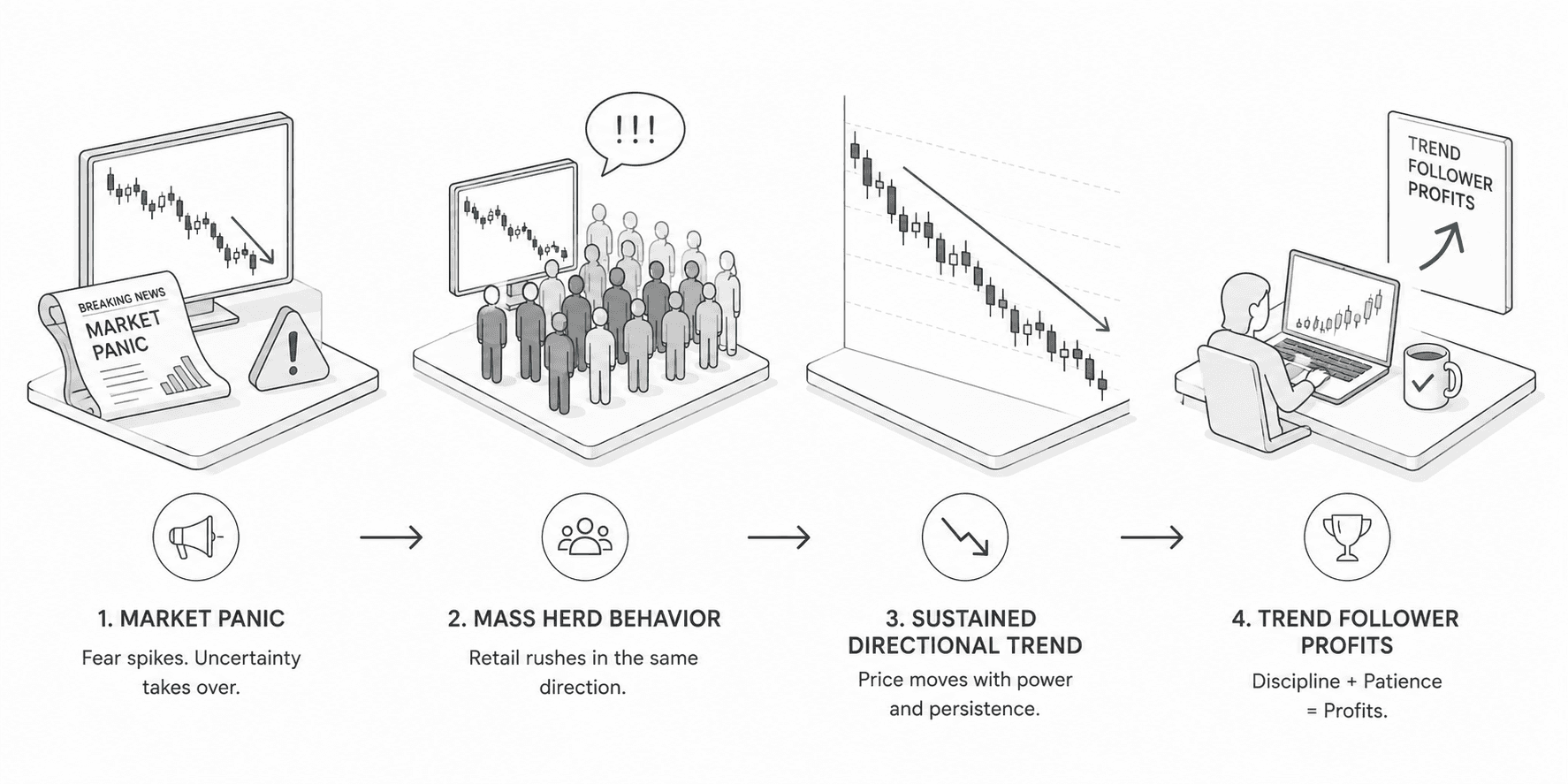
When human beings respond to fear and uncertainty, they move in herds. Trend following is simply a mechanical tool designed to monetize that exact behavioral flaw.
4. The Conceptual Trap of Simplicity
The core framework of trend following can be written down on a single napkin:
If the price is moving up, buy it. Stay in it until it stops moving up. If it turns against you, cut the loss immediately. Repeat.
It sounds incredibly accessible. It doesn’t require ten years of screen time to develop an unarticulated "feel" for chart patterns. You can hand the ruleset to someone on day one.
But do not mistake a simple user interface for an easy user experience.
The difficulty of trend following is 0% comprehension and 100% execution. The massive gap between understanding expectancy and actually clicking the button during a losing streak is where most traders ruin their accounts. Paradoxically, this psychological friction is the only reason the edge still exists. If it were easy to execute, billions of dollars would arbitrage it out of existence by tomorrow morning.
5. Why People Abandon the System
Most traders who attempt trend following quit at the exact moment the strategy is about to pay off. It usually boils down to four distinct psychological barriers:
The Low Win-Rate Grind
Losing 6 or 7 out of every 10 trades is a brutal emotional experience. Your brain wants comfort and constant validation; trend following offers a steady stream of small, paper-cut losses punctuated by occasional massive wins. The math makes sense on paper, but your lizard brain hates it.
The Illusion of Permanence
When the market enters a choppy, range-bound regime, trend followers get chopped to pieces. A drawdown that lasts six consecutive months starts to feel permanent. Without deep conviction in the underlying probability, you will inevitably conclude that "the system is broken" right before a massive trend begins.
The "Accidental" Winners
When you finally catch a massive 5:1 or 6:1 win, it rarely feels like skill. You didn't predict a top or bottom; the market just kept going. Because the wins feel like luck and the losses feel like personal failures, traders struggle to build the positive reinforcement loop needed to stay disciplined.
The Terminal Boredom
If you are addicted to the dopamine hit of over-trading and making fifty micro-decisions a day, higher-timeframe trend following will drive you insane. It involves staring at a chart, realizing your rules say to do absolutely nothing, and closing the laptop. It turns trading into a dull administrative task.
6. Audit Your Psychological Architecture
Trading psychology isn't a moral test. There are no "good" or "bad" personalities, just different behavioral designs. Before trying to trade a trend strategy, you need to run an honest audit on how you operate under stress.
Trend Following Suits You If: | Trend Following Will Destroy You If: |
You naturally think in terms of probabilities, not certainties. | You need a high win rate to keep your motivation alive. |
You can handle a month of small losses without tweaking the rules. | Extended flat or negative equity periods cause you to panic-adjust settings. |
You prefer strict, mechanical rules over your own daily judgment. | You get bored doing nothing and start forcing trades for entertainment. |
The strategy itself rarely fails; the human operator does. Trend following has survived a century of shifting market dynamics because human psychology hasn't changed. If you can handle the math and survive the boredom, the history is entirely on your side.
Success Criteria
After completing this lesson, you should be able to describe who has used trend following successfully, what the academic evidence shows, and where healthy skepticism is still warranted.
Common Misconception
Trend following's strong historical record guarantees future performance.
The Truth: The evidence supports that the edge has been persistent, but every presentation of historical performance understates how psychologically difficult execution is during extended drawdown periods.
FAQ's
Q: Why don't more people trade trend following if it has such a long track record?
Q: Does trend following require being right about market direction?
Q: Is trend following dead in modern markets?
Table of Contents
About Me

Krista Weber
After a career as a VP of UX and EdTech executive, I retired early—and quickly realized the traditional world of trading education is fundamentally broken.
As someone with a Master’s in HCI who specialized in the design of e-learning systems, I saw a massive gap: beginners aren't failing because trading is impossible; they’re failing due to massive cognitive overload and terrible instructional design.
This site bridges that gap. I’m applying the principles of learning science, systems thinking, and minimalist UX to strip away the market noise and teach trading the way it actually should be taught.
Stay in Touch
Some of the pages on my travel blog contain affiliate links. Whenever you buy something through one of these links, I get a small commission at no extra cost to you. As an affiliate, I only recommend products and services that I feel are high quality and helpful to my readers. Thanks for your support.
Read More

Open almost any trading platform and you'll see EUR/USD sitting next to XAU/USD, NQ, ES, and a dozen CFDs on stocks you've heard of. They all show up as candlesticks moving left to right, which quietly implies they're all the same kind of thing. They aren't. Before going deeper into any one of them, it's worth drawing the map.
Updated on Sep 6, 2026

Futures are standardized contracts tied to defined specifications and a future settlement date. They can look complex at first, but the mechanics become much clearer once you know what the contract specification controls. Here's what you actually need to know.
Updated on Sep 6, 2026

CFDs appear everywhere in retail trading – but most new traders couldn't explain exactly what they are or why that matters. Here's a plain-language breakdown, including the parts that most introductions skip.
Updated on Sep 6, 2026