
Trend Following Part 4: What's Actually Worth Reading and Watching
Trend following has the best-documented body of public knowledge of any trading approach. The resources below represent decades of practitioner wisdom. Many of them are freely available and more rigorous than anything in the paid course market.

Learning Path Stage 6: Find Your Strategy
Learning Level 2: Understanding
Primary Learning Objective
By the end of this lesson, you will be able to identify the most substantive resources for learning trend following and prioritize them based on where you are in your understanding.
My No Nonsense Recommendations
The literature surrounding trend following is unusually deep compared to other trading styles. Because the practitioners who have deployed this strategy at scale have done so in highly regulated institutional environments, they’ve actually written about it seriously.
You don’t need to drop $5,000 on a "masterclass" to understand this edge. The best education in the world is available at library cost or completely free online.
Here is an opinionated, highly filtered list of the resources, tools, and communities worth your limited bandwidth—and exactly what you need to skip.
1. If You are a Book Person or Want to Build Your Trading Library
If a trend following book doesn't include audited track records or cold math, it’s just fan fiction. These four texts are the industry standard:
"Trend Following" by Michael Covel
The Verdict: The absolute foundational text. Covel covers the history of the strategy from old-school commodities to modern systematic funds. It provides primary sources, audited performance history, and a brutal look at the low win-rate psychology. If you want to understand the empirical why behind the strategy, start here.
"The Complete Turtle Trader" by Michael Covel
The Verdict: The companion piece to his main text. It documents Richard Dennis’s famous 1983 experiment where he trained normal people with zero market background to trade a mechanical system. It is the ultimate proof that trend following is a teachable skill, not an innate genetic gift. Plus, it contains the actual legacy ruleset.
"Market Wizards" & "New Market Wizards" by Jack Schwager
The Verdict: While these anthologies cover all trading styles, the interviews with legendary trend followers like Ed Seykota and Jerry Parker are pure gold. Hearing a multi-millionaire practitioner talk about surviving a six-month drawdown is worth more than a thousand theoretical blog posts.
"Way of the Turtle" by Curtis Faith
The Verdict: Written by one of the original, most successful Turtles. The most fascinating UX angle here is Faith's breakdown of why traders given the exact same rules achieved wildly different results. Spoiler: The edge isn't in the code; it’s in the human operator's ability to execute it under pressure.
2. High-Signal Free Resources
The institutional and academic communities have open-sourced a shocking amount of high-quality data. Skip the forums and read the source material:
AQR Capital Management (Research Section): They published "A Century of Evidence on Trend-Following Investing," which is one of the most rigorously cited pieces of data in existence. Reading it takes 30 minutes and gives you a better baseline than any paid retail course.
SSRN (Social Science Research Network): Go to SSRN and search terms like "time series momentum" or "CTA performance." You’ll find peer-reviewed, math-heavy papers with raw data open for scrutiny. It’s an instant antidote to retail trading folklore.
Michael Covel’s Trend Following Podcast: Dozens of hours of free interviews with systematic fund managers and veteran retail practitioners. The value here is hearing them describe the mind-numbing boredom and discipline required during a choppy, flat-equity market regime.
BabyPips (School of Pipsology): If you are starting completely from scratch, their sequential modules on basic trend mechanics, swing highs/lows, and basic stop management are clean, structured, and free. It builds the vocabulary you need before tackling academic papers.
3. Deliberate Practice: The Weekend Testing Blueprint
Don’t just read about the math. Go break it in a simulator. You can build a robust mental model of trend following over a single weekend using TradingView's strategy tester. Follow this three-step progression:
Step 1: Establish Your Baseline
Build a primitive Exponential Moving Average (EMA) crossover system (e.g., long when 20 EMA crosses above 50 EMA on the daily chart; short when it crosses below). Run it on an instrument like EUR/USD or the S&P 500 over a five-year window.
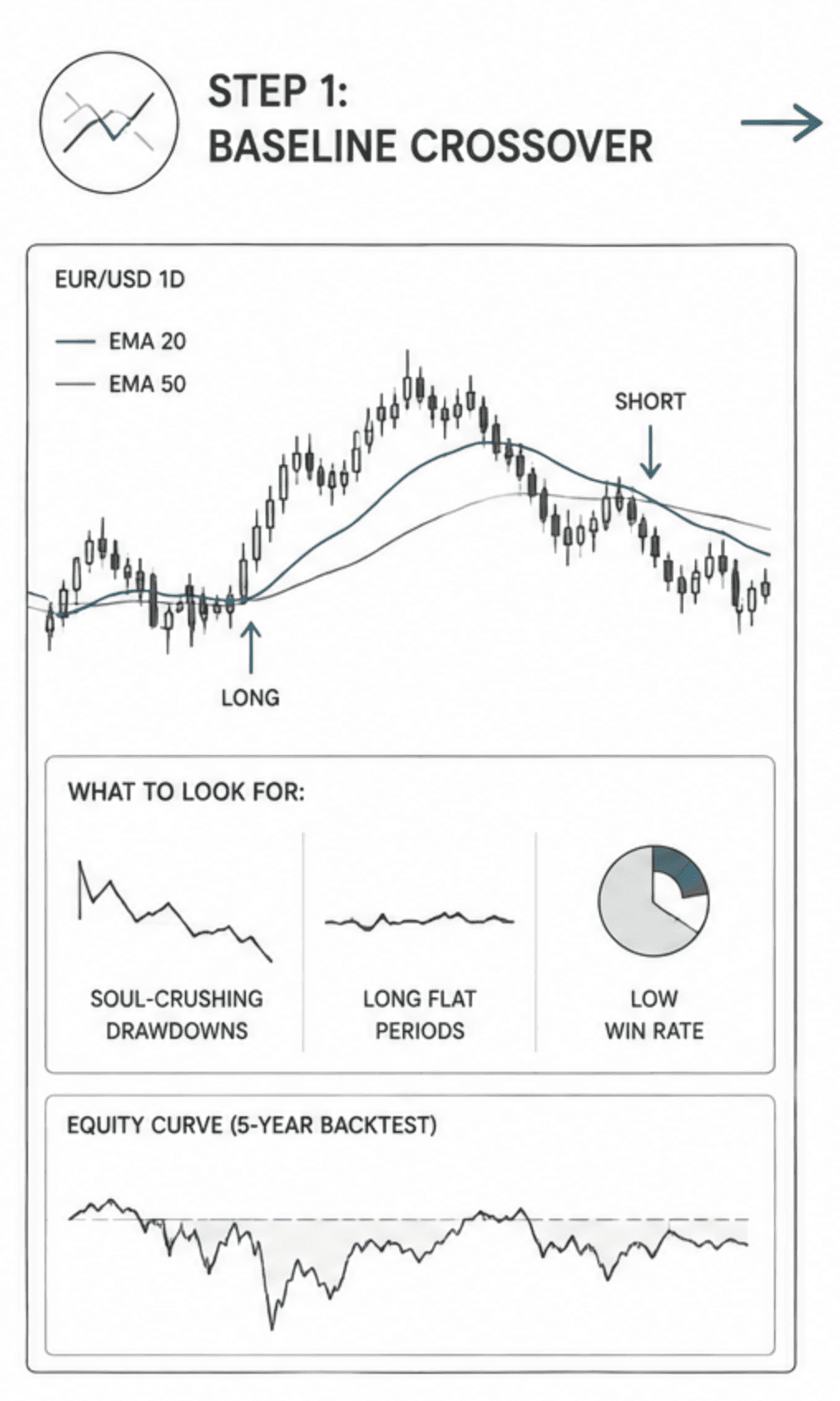
What to look for: Don't look at the total profit. Look at the soul-crushing drawdown periods, the length of time the equity curve stays flat, and the low win rate. This is your psychological baseline.
Step 2: Fix the Math with an ATR Stop
Keep the exact same EMA entry rules, but swap the exit rule for an Average True Range (ATR) trailing stop (e.g., trailing 3x ATR behind the swing highs/lows).
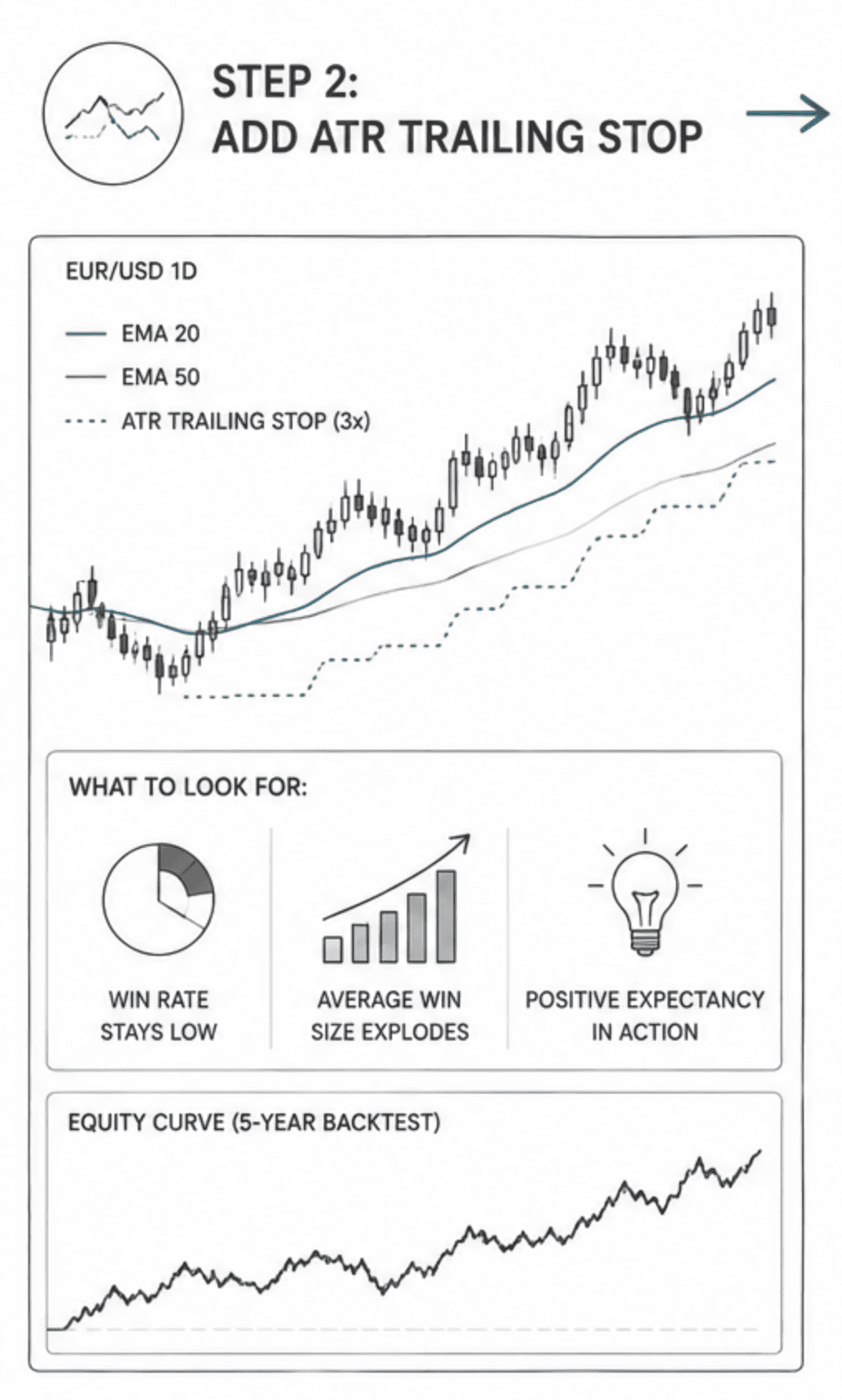
What to look for: Watch how your win rate stays low, but your average winning trade size explodes. Seeing this shift on a chart teaches you more about positive expectancy than a textbook ever could.
Step 3: Run the Multi-Asset Stress Test
Take those exact, unchanged rules from Step 2 and run them across a few completely distinct asset classes like: Gold, Crude Oil, S&P 500, EUR/USD, and Bitcoin (if you feel like being extra brave today).
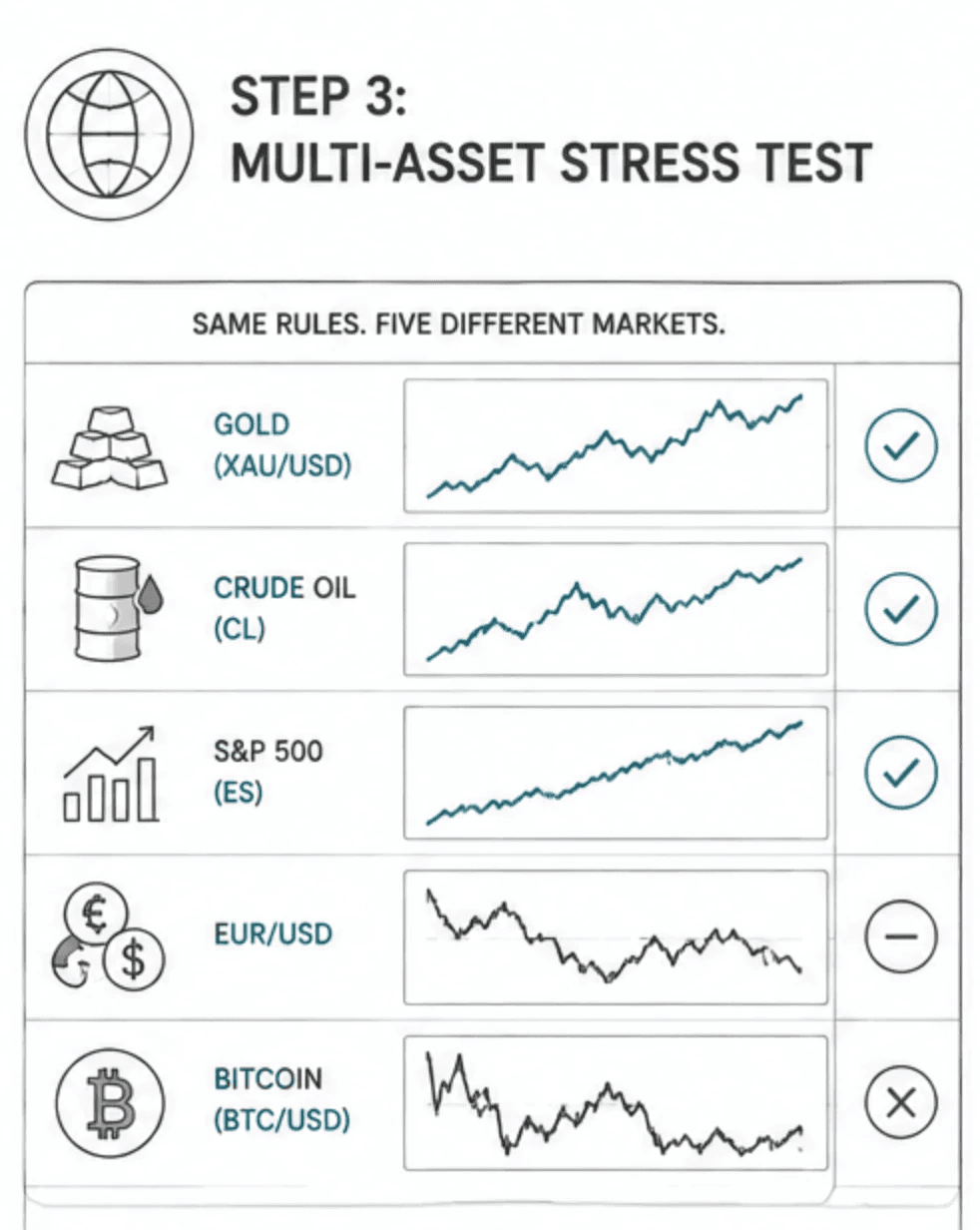
What to look for: Notice how the system thrives on some instruments and gets completely chopped to pieces on others. This is the exact mechanism that forces institutional trend followers to diversify across dozens of uncorrelated markets.
4. Where the Real Conversations Happen
If a community is focused on predicting where the market will go tomorrow morning, leave. You want communities focused on architecture and data:
r/algotrading (Reddit): Because this community approaches trading from a pure quantitative, programming perspective, the "trust me, bro" mentality is somewhat filtered out. You'll need to be aware that Reddit can still be the Wild West, so a healthy level of skepticism is recommended. The discussions on system design, backtesting bias, and code execution can be exceptionally high-quality.
Systematic Trading Podcasts & Archives: Seeking out content that focuses strictly on Systematic CTAs and automated trend execution will keep your mind anchored to probability rather than discretionary emotional guesswork.
5. What to Avoid (The Garbage Filter)
To keep your learning curve clean, you need to aggressively filter out the noise. Put these three things on your personal blocklist:
YouTube "Trend Masterclasses": If someone is selling a trend following course for thousands of dollars, they are charging you for information that Michael Covel or AQR provides for free or cheap.
Black-Box "Foolproof" Signal Services: Trend-following edge requires you to mathematically understand and accept the losing streaks. If you buy a signal service where you don’t know the underlying logic, you will inevitably abandon it during the first normal 6-trade losing streak.
Premature Optimization: Do not spend three weeks tweaking an EMA from a 20-period to a 21.5-period trying to make the past backtest look perfect. Over-optimizing curves creates a fragile system that breaks in live markets. Simpler, robust rules are far easier for a human to execute consistently over time.
The best trend-following education is overwhelmingly free, grounded in math, and identical to the core principles studied by institutional fund managers. Pick up a book, open a code editor, and let the data cure your bad habits.
Success Criteria
After completing this lesson, you should be able to name the key texts and academic papers, explain what each contributes, and describe a reading order that builds understanding progressively.
Common Misconception
Paid trend following courses offer more value than free resources.
The Truth: The best trend following education is largely free (academic papers) or inexpensive (books), and the paid course market for this approach is one of the weakest relative to the quality of free alternatives.
FAQ's
Q: Are there free online resources as good as the books?
Q: Should I backtest trend following on TradingView?
Q: Is there good content on trend following psychology specifically?
Table of Contents
About Me

Krista Weber
After a career as a VP of UX and EdTech executive, I retired early—and quickly realized the traditional world of trading education is fundamentally broken.
As someone with a Master’s in HCI who specialized in the design of e-learning systems, I saw a massive gap: beginners aren't failing because trading is impossible; they’re failing due to massive cognitive overload and terrible instructional design.
This site bridges that gap. I’m applying the principles of learning science, systems thinking, and minimalist UX to strip away the market noise and teach trading the way it actually should be taught.
Stay in Touch
Some of the pages on my travel blog contain affiliate links. Whenever you buy something through one of these links, I get a small commission at no extra cost to you. As an affiliate, I only recommend products and services that I feel are high quality and helpful to my readers. Thanks for your support.
Read More

Open almost any trading platform and you'll see EUR/USD sitting next to XAU/USD, NQ, ES, and a dozen CFDs on stocks you've heard of. They all show up as candlesticks moving left to right, which quietly implies they're all the same kind of thing. They aren't. Before going deeper into any one of them, it's worth drawing the map.
Updated on Sep 6, 2026

Futures are standardized contracts tied to defined specifications and a future settlement date. They can look complex at first, but the mechanics become much clearer once you know what the contract specification controls. Here's what you actually need to know.
Updated on Sep 6, 2026

CFDs appear everywhere in retail trading – but most new traders couldn't explain exactly what they are or why that matters. Here's a plain-language breakdown, including the parts that most introductions skip.
Updated on Sep 6, 2026