
Why Learning Forex Takes Longer Than You Think
Forex looks accessible. Charts, patterns, a few rules, and you're in. What most new traders discover is that knowing what to do and doing it consistently under the psychological pressure of real money are two entirely different things. This article gives you an honest picture of why forex is hard and what that means for how to approach it.

Learning Path Stage 1: Foundations
Learning Level 1: Recognition
Primary Learning Objective
By the end of this lesson, you will be able to identify the primary structural and psychological drivers behind the high retail forex failure rate and contrast a rules-based, market-structure approach with speculative trading behaviors.
The forex market is genuinely accessible. You can open a live account with a few hundred dollars. The chart software is free. There are thousands of courses, YouTube channels, and forums explaining exactly how to trade. Entry barriers are low.
But accessibility isn't the same as ease. Forex has the highest barrier-to-survival of almost any retail activity — most estimates suggest 70-80% of retail forex accounts lose money. This isn't because the concept is complicated. It's because of a specific set of challenges that catch most people off guard.
How to Survive Retail Forex (When 70-80% of Accounts Lose Money)
Opening a retail forex account is staggeringly easy. It takes about four minutes, the charting software is free, and your social media feeds are undoubtedly clogged with "gurus" screaming about their 95% win-rate indicator strategy. The barriers to entry are practically zero.
Forex has one of the lowest barriers to entry, and one of the highest barriers to survival.
Most estimates show that 70% to 80% of retail accounts lose money. Forex has the highest baseline extinction rate of almost any retail activity on Earth. This isn't because market structure is an inscrutable mystery; it’s because the market is a masterclass in psychological warfare, and most traders walk onto the battlefield armed with a butter knife and a dream.
If you want to avoid becoming a statistic, you need to understand the structural realities of the arena you are stepping into.
The Gap Between Knowledge and Execution
Here is the ultimate retail paradox:
You can memorize what a pin bar looks like in 15 minutes.
You can master the textbook concept of support and resistance in an hour.
You can read a book on risk management over a weekend.
And then, bright-eyed and bushy-tailed, you open a live trade and watch it immediately move against you.
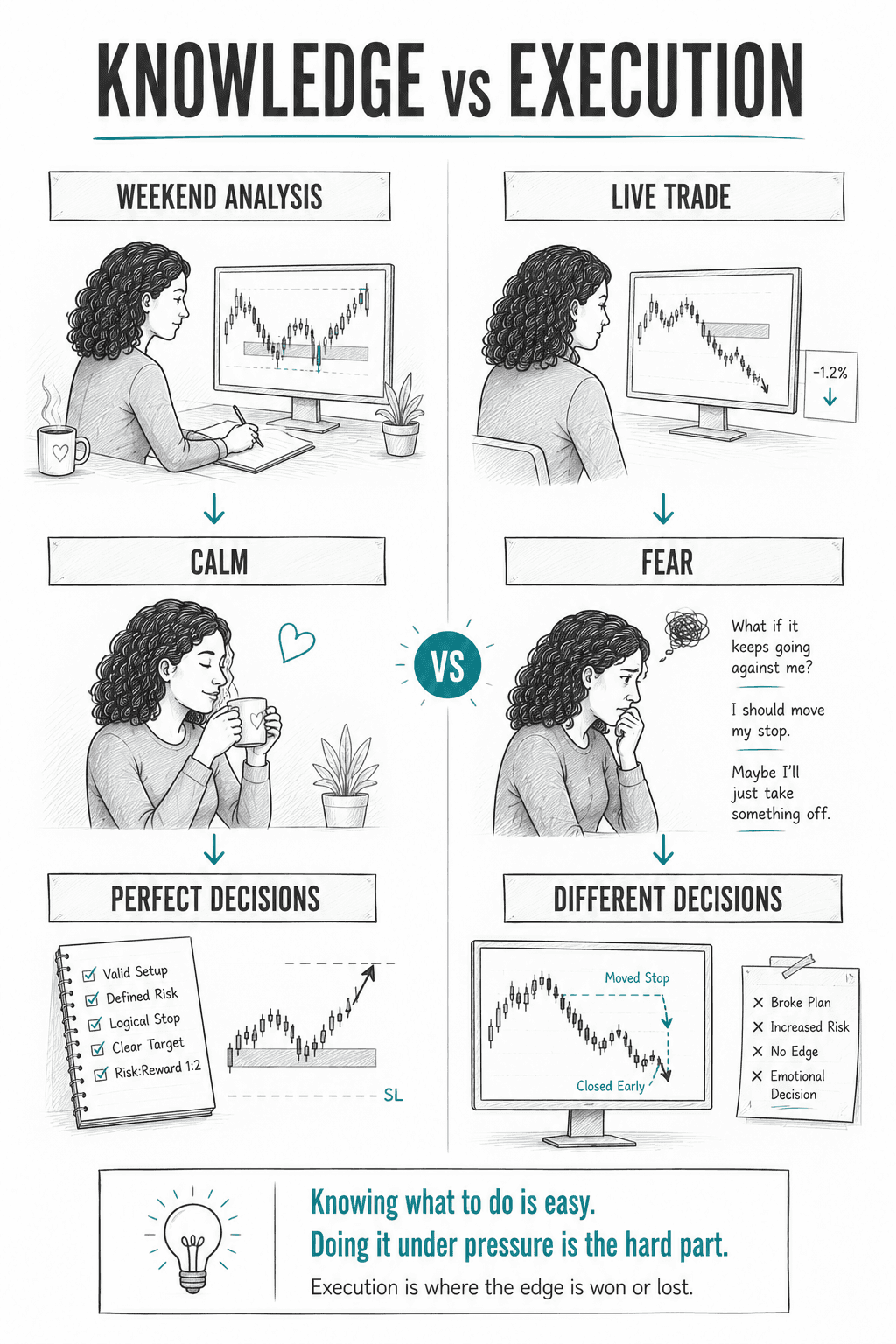
Suddenly, that perfectly logical, structurally sound stop loss you marked during your calm weekend analysis feels incredibly arbitrary. It feels offensive. So, you move it "just a few pips" to give the trade room to breathe. Conversely, when a trade actually goes your way and creeps within micro-pips of your profit target, panic sets in. You smash the close button early to lock in enough gains to buy a premium cup of coffee.
Congratulations: you just systematically dismantled your strategy's expected value.
The application gap between knowing what to do and executing it flawlessly while your actual capital is on the line is massive. It turns out that managing a position under emotional pressure is vastly different from staring at a static chart. Almost nobody closes that gap quickly.
The Honest Learning Timeline
Every serious elite skill has an honest developmental timeline. If you wanted to be a surgeon, you wouldn't expect to perform open-heart surgery after a weekend webinar. Forex is no different. Here is what the actual road looks like:
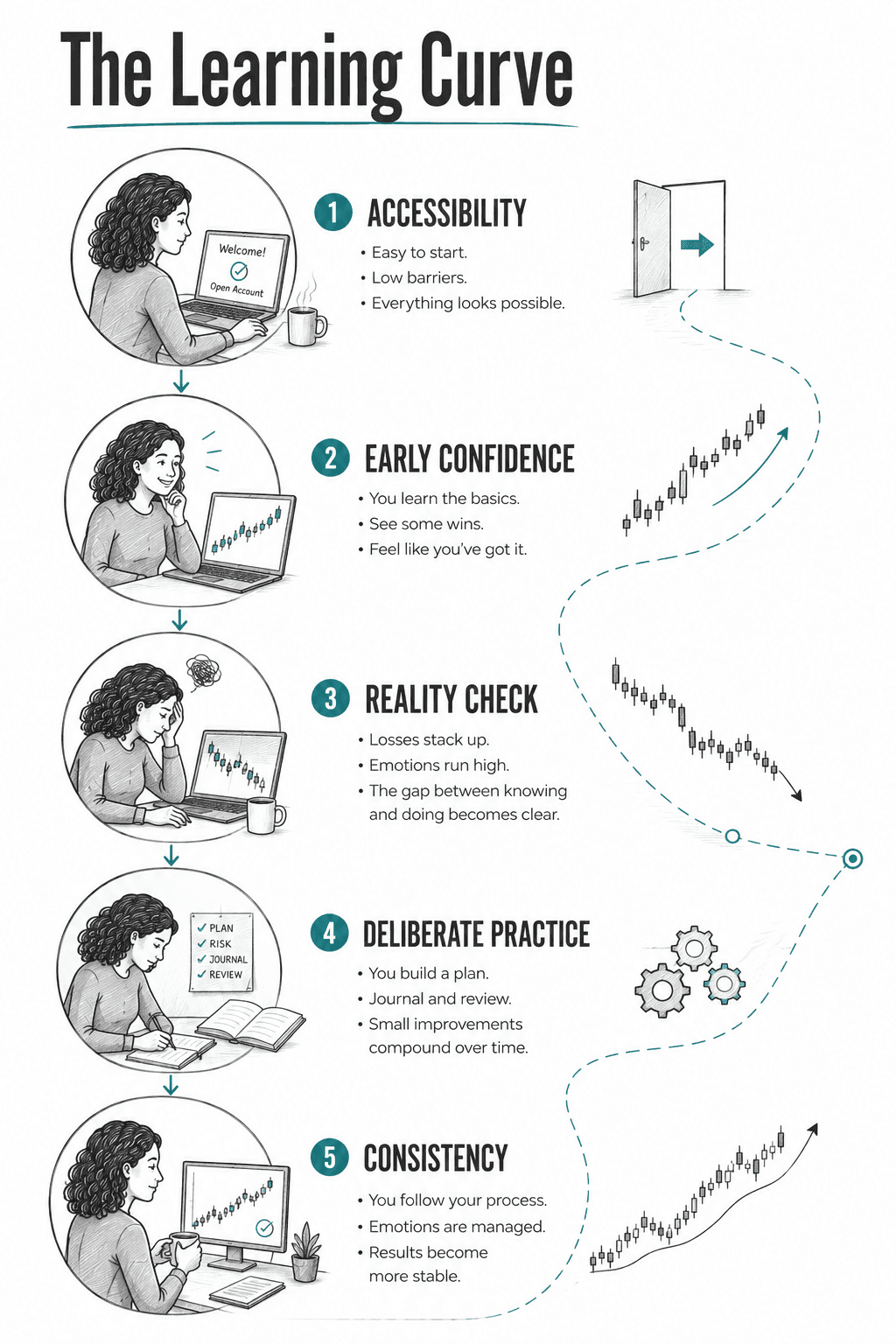
Months 1–3 (The Honeymoon Phase): You learn the basic mechanics—candles, basic market structure, and how to navigate your platform. You feel like a financial genius. Enjoy it, because you are currently at the absolute peak of Mount Dunning-Kruger.
Months 3–12 (The Reality Check): The application gap hits like a freight train. Your demo or evaluation results fluctuate wildly. Trying to trade a live personal account during this phase is essentially an expensive form of entertainment.
Years 1–2 (The Grind for Consistency): You finally stop chasing shiny new indicators and commit to a single, structured approach. You practice strict risk parameters. Progress feels painfully slow, and the psychological weight of taking discipline-testing losses is very real. This is where the majority of retail traders quit.
Years 2+ (The Operator Stage): You operate with a verified edge, a deep respect for market structure, and mechanical execution. You view losses merely as the cost of doing business, akin to an inventory expense.
This timeline strictly assumes deliberate practice—meaning rigorous journaling, backtesting historical session data, and reviewing your mistakes. Mindlessly staring at live charts for hours without a structured process will simply extend this timeline indefinitely.
The goal of your first few months isn't to become profitable. It's to become competent.
Success Criteria
After completing this lesson, you should be able to:
Explain the application gap in your own words, specifically identifying how emotional pressure alters execution parameters (like stop-loss management and profit-taking) compared to static weekend analysis.
Differentiate between trading an "edge" versus "trading looks," defining a real edge using structural elements like higher-timeframe supply/demand zones and session boundaries.
Identify how institutional order flow interacts with retail liquidity, explaining why price frequently sweeps obvious retail support/resistance levels before reversing.
Map your current progress accurately against an honest 2-year+ developmental timeline, identifying the specific milestones required to move past the "reality check" phase.
Common Misconception
The "Market vs. Me" Fallacy. A widespread belief among developing traders is that the market or a specific broker is intentionally targeting their individual stop-loss orders.
The Truth: The market does not care about your single micro-contract. What feels like a targeted attack is actually a structural feature of market mechanics: retail stop orders naturally cluster at highly predictable, textbook levels. Large institutions require massive liquidity to fill their positions, and those clustered retail stops create the exact liquidity pools they need to absorb. You aren't being targeted; you are simply standing in the coordinates where the order flow naturally clears.
FAQ's
Q: Why do so many beginners feel confident at first and overwhelmed a few months later?
Q: How long does it really take to become consistent?
Q: Does everyone go through the "reality check" phase?
Table of Contents
About Me

Krista Weber
After a career as a VP of UX and EdTech executive, I retired early—and quickly realized the traditional world of trading education is fundamentally broken.
As someone with a Master’s in HCI who specialized in the design of e-learning systems, I saw a massive gap: beginners aren't failing because trading is impossible; they’re failing due to massive cognitive overload and terrible instructional design.
This site bridges that gap. I’m applying the principles of learning science, systems thinking, and minimalist UX to strip away the market noise and teach trading the way it actually should be taught.
Stay in Touch
Some of the pages on my travel blog contain affiliate links. Whenever you buy something through one of these links, I get a small commission at no extra cost to you. As an affiliate, I only recommend products and services that I feel are high quality and helpful to my readers. Thanks for your support.
Read More

Open almost any trading platform and you'll see EUR/USD sitting next to XAU/USD, NQ, ES, and a dozen CFDs on stocks you've heard of. They all show up as candlesticks moving left to right, which quietly implies they're all the same kind of thing. They aren't. Before going deeper into any one of them, it's worth drawing the map.
Updated on Sep 6, 2026

Futures are standardized contracts tied to defined specifications and a future settlement date. They can look complex at first, but the mechanics become much clearer once you know what the contract specification controls. Here's what you actually need to know.
Updated on Sep 6, 2026

CFDs appear everywhere in retail trading – but most new traders couldn't explain exactly what they are or why that matters. Here's a plain-language breakdown, including the parts that most introductions skip.
Updated on Sep 6, 2026