

Stage 6: Find Your Strategy
Discover what kind of trader you are and which strategies fit how you think.
Latest Articles from Stage 6: Find Your Strategy

Breakout Trading Part 1: What Is Breakout Trading?
Breakout trading is exactly what it sounds like: trading the moment when price moves through a significant level with momentum. It's one of the most intuitive strategies available and one of the most commonly misapplied. Here's what it is at its clearest.
Date Published:
Read Time:
5
minutes
Breakout Trading Part 3: Why It's Popular
Breakout trading attracts beginners for obvious reasons and retains experienced traders for less obvious ones. Understanding both sides of the appeal helps you evaluate whether the approach is right for where you are in your development.
Date Published:
Read Time:
5
minutes
Breakout Trading Part 4: Legitimate Learning Resources
Breakout trading resources are abundant and generally high quality — partly because the approach is old enough to have accumulated genuine practitioner wisdom, and partly because the mechanical nature of breakouts makes them highly teachable.
Date Published:
Read Time:
8
minutes
Breakout Trading Part 5: Backtesting and Metrics
Date Published:
Read Time:
5
minutes

The Strategy Fit Audit: Which Approach Matches How You Think?
Most traders pick a strategy based on what they've seen on YouTube. This audit helps you choose one based on something more reliable: how your brain actually works.
Date Published:
Read Time:
5
minutes

Support & Resistance Part 1: The Foundation Every Trader Builds On
Before indicators, patterns, or strategies — price needs somewhere to go and somewhere to stop. Here's how to see those places.
Date Published:
Read Time:
6
minutes
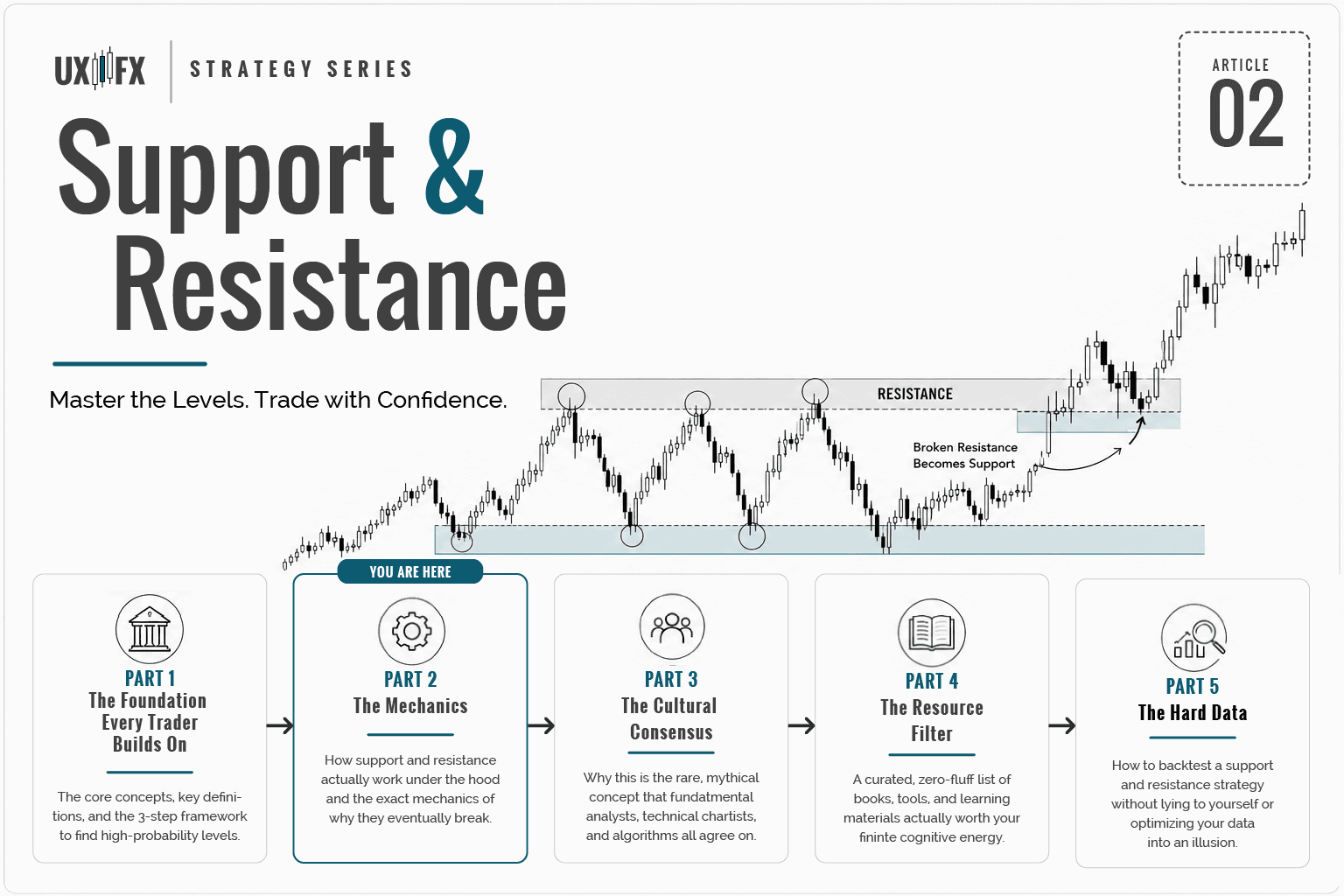
Support & Resistance Part 2: How Support and Resistance Actually Works (And Why It Breaks)
A support level isn't magic — it's the sum of decisions made by real traders at a specific price. Understanding the mechanics makes the levels much easier to trust.
Date Published:
Read Time:
9
minutes

Support & Resistance Part 3: The Most Agreed-Upon Idea in Trading
S&R is the rare concept that technical traders, fundamentalists, and institutions all reference — and understanding why that consensus exists tells you a lot about how markets actually work.
Date Published:
Read Time:
8
minutes

Support & Resistance Part 4: The Books, Tools, and Resources Worth Your Time
A curated list of what's actually useful for learning S&R — filtered for signal, not noise.
Date Published:
Read Time:
7
minutes

Trend Following Part 1: Trading in the Direction of Least Resistance
Trend following is one of the oldest and most academically validated approaches to trading. It's also widely misunderstood by retail traders who apply the name to short-term chart reading. Here's what trend following actually is before we discuss how retail traders use it.
Date Published:
Read Time:
6
minutes
Read My Stories

Trading gets marketed as passive income or a side hustle. It's neither. It's a skill-intensive discipline with a multi-year learning curve. Understanding this upfront changes how you approach everything that comes next.
Updated on Jul 10, 2026

Learning trading takes longer than most people expect. Not because the material is overly complex, but because understanding something and being able to operate inside it are two very different things. Early progress feels real, but it’s mostly recognition. The actual learning begins later, when decisions happen under uncertainty, feedback is inconsistent, and nothing behaves as cleanly as the explanation did.
Updated on May 20, 2026

The trading education industry is worth billions of dollars. Most of it exchanged for information freely available elsewhere. Understanding why paid courses are usually a bad deal for beginners, and where the genuinely good free resources are, saves money and time.
Updated on Jul 10, 2026