
Why Learning Trading Takes Longer Than People Think
Learning trading takes longer than most people expect. Not because the material is overly complex, but because understanding something and being able to operate inside it are two very different things. Early progress feels real, but it’s mostly recognition. The actual learning begins later, when decisions happen under uncertainty, feedback is inconsistent, and nothing behaves as cleanly as the explanation did.
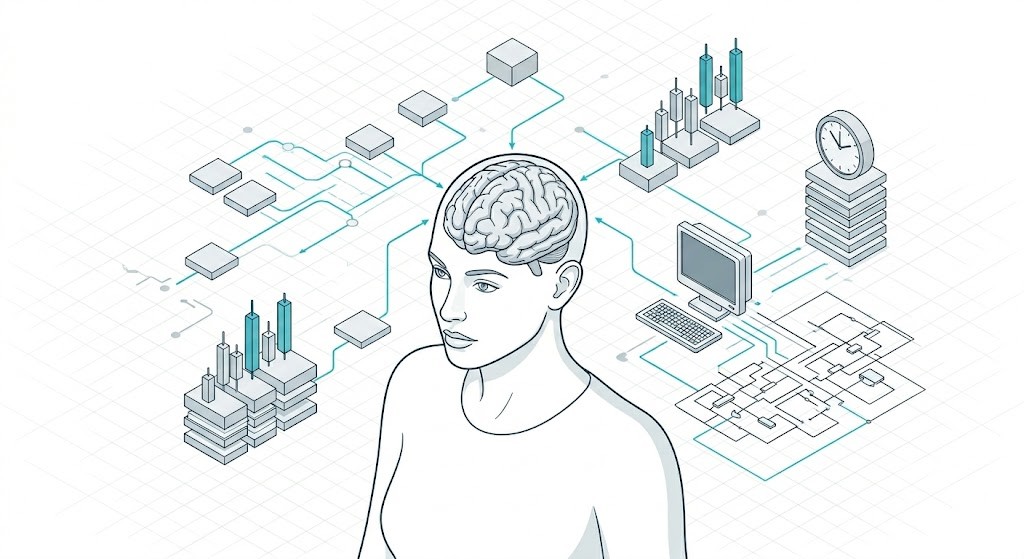
Learning Path Stage 1: Foundations
Learning Level 2: Understanding
Primary Learning Objective
By the end of this lesson, you will be able to explain why trading has a longer-than-expected skill development curve and set realistic expectations for your own learning timeline.
Stop Blaming Yourself for How Long Trading Takes to Learn
Most people assume learning to trade should be quick.
Not simple. Just quick.
That expectation comes from how modern learning gets packaged. Concepts get broken into short videos. Strategies get condensed into frameworks. Outcomes get shown without the messy variation behind them.
It creates the impression that once you "understand it," you're basically there.
Trading doesn't work like that.
The gap between understanding concepts and operating inside uncertainty is where most of the real learning time lives.
At UX to FX, learning progresses from recognizing concepts, to understanding them, to applying them, analyzing them, evaluating your own performance, and finally adapting your strategy. We'll guide you through those stages one at a time.
Early Learning Feels Deceptively Smooth
You learn what candles are. You learn support and resistance. You get introduced to indicators and basic patterns. Spend any time on structured platforms like BabyPips, and the market starts to feel readable almost immediately.
That readability creates a quiet assumption: familiarity equals readiness.
This is where things start to split.
Because recognizing a concept and making decisions under pressure are two very different skills.
Knowing what a pattern is doesn't automatically tell you when it matters, when it fails, or when it's just noise inside a larger structure doing something else entirely.
At this stage, you're still working at the lowest level of learning: recognition and recall. The system feels familiar. It's not yet usable in a reliable way.
Trading Is a Feedback System, Not a Knowledge System
Most traditional learning rewards accumulation. Understand more, perform better. That works inside exams, certifications, and structured environments.
Trading doesn't follow that path cleanly.
You're not evaluated on what you know. You're evaluated on how your decisions interact with a system that changes continuously and stays partially unpredictable.
You're jumping straight to the top rung of the learning ladder: creation. Applying what you've learned to scenarios you've never seen before.
And your feedback is often:
Delayed in meaning
Emotionally noisy
Statistically unclear at small sample sizes
Occasionally designed to make you question your own sanity
So even as understanding grows, performance doesn't necessarily follow in a straight line.
That mismatch is why learning feels slower than expected.
The Real Curve Is Cognitive, Not Technical
At some point, the challenge shifts away from concepts and toward behavior. This is where the timeline stretches.
You can understand risk management in a single sentence: "Don't risk too much on any one trade." Easy.
But applying that consistently means sitting through outcomes that feel wrong, even when your process was right.
-You take a loss that followed your rules, and your brain immediately opens an internal support ticket.
-You take a win that broke your structure, and your brain politely suggests the rules were more like guidelines.
The system routinely rewards bad behavior and punishes good behavior in the short term. Your knowledge can feel completely disconnected from your results.
You can do the right thing and have a bad outcome. Working through that dissonance is precisely what slows the learning curve to a crawl.
You're Building a Different Kind of Pattern Recognition
People assume trading is about learning patterns on charts.
That's only partially true.
The more important skill: learning which patterns hold under changing conditions, and which ones collapse when context shifts.
This doesn't come from explanations. It comes from exposure to variation.
Over time, you start to notice:
When movement is continuation vs. exhaustion
When structure is forming vs. when you're convincing yourself it is
When a setup is meaningful vs. when it just looks like a screenshot you saw three weeks ago
You also realize the brain is extremely good at finding patterns where no meaningful pattern exists. Useful in UX. Less useful when money is involved.
This only develops after enough repetition to separate what looks coherent from what actually behaves coherently. That distinction takes longer than most people expect, because you can't shortcut it through explanation. Or optimism.
You Can't Compress Exposure
One of the quieter frustrations: understanding doesn't speed up experience.
Many analytical professionals assume that studying harder, logging more hours at night, and dissecting more historical data will compress the timeline.
It won't.
Even when your technical setups become clear, you still need to experience how they behave across a wide range of changing market conditions. Low-volume afternoon drift. High-participation morning volatility. Shifting macro narratives.
You can only accumulate that exposure. And occasionally wonder why the chart seems to have a personality. An evil one.
Architect's Tip: In software development, you eventually ship a finalized product. In trading, you're operating inside an open-source system that pushes breaking updates to production every single day, with no release notes. You never actually "finish" learning. You're not earning a static degree; you're building a continuous optimization process. The moment you assume you've fully "learned" the market is usually the exact moment your mental models go stale.
Why Progress Feels Painfully Slow
Modern culture has conditioned us to expect immediate alignment between consuming information and being competent. If a concept is explained clearly on a screen, we assume it should be usable by tomorrow morning.
Trading breaks that expectation. It combines:
Probabilistic outcomes
-ehavioral decision-making
Rapidly changing context
Understanding any one of those alone is manageable. Operating across all three at once is where things get interesting. And "interesting" here is doing a lot of heavy lifting.
When progress feels painfully slow, it's rarely a sign you lack intelligence. More often, it's an accurate reflection of the system you're working inside. The brain needs a vast amount of time to build clean mental models in an environment that offers zero certainty.
The Shift to Slower Thinking
Over time, trading starts to feel less reactive. Not easier. Just less internally noisy.
You gradually stop treating every trade as a final verdict on your intelligence. You stop projecting your need for certainty onto random, low-volume price movements. Instead, you start looking past the immediate outcome and focus entirely on the quality of your execution conditions.
This shift forms incredibly slowly because it doesn't require you to add more information to your dashboard. It requires the opposite: aggressively filter the noise, manage your cognitive load, and remove the frantic urgency from your decisions.
Closing Thought
Learning trading takes longer than people expect because most of what you're learning isn't visible while it's happening.
You're not just learning a set of tools.
You're learning how to operate inside a system that doesn't reward certainty, speed, or emotional confidence the way most learning environments do.
That kind of adaptation doesn't compress cleanly.
It accumulates through repetition, exposure, and time inside the system itself.
Success Criteria
After completing this lesson, you should be able to identify the structural reasons the learning curve is long, distinguish between "still developing" and "this doesn't work," and explain why the timeline discrepancy is so consistent across learners.
Common Misconception
Not being profitable yet means you're doing something wrong.
The Truth: The learning curve in trading is long by design, and the discomfort of the early stages is a feature of the process, not evidence of failure.
FAQ's
Q: Why do people underestimate how long trading takes to learn?
Q: What is the fastest way to accelerate your trading education?
Q: How long does it realistically take to learn trading?
Table of Contents
About Me

Krista Weber
After a career as a VP of UX and EdTech executive, I retired early—and quickly realized the traditional world of trading education is fundamentally broken.
As someone with a Master’s in HCI who specialized in the design of e-learning systems, I saw a massive gap: beginners aren't failing because trading is impossible; they’re failing due to massive cognitive overload and terrible instructional design.
This site bridges that gap. I’m applying the principles of learning science, systems thinking, and minimalist UX to strip away the market noise and teach trading the way it actually should be taught.
Stay in Touch
Some of the pages on my travel blog contain affiliate links. Whenever you buy something through one of these links, I get a small commission at no extra cost to you. As an affiliate, I only recommend products and services that I feel are high quality and helpful to my readers. Thanks for your support.
Read More

Open almost any trading platform and you'll see EUR/USD sitting next to XAU/USD, NQ, ES, and a dozen CFDs on stocks you've heard of. They all show up as candlesticks moving left to right, which quietly implies they're all the same kind of thing. They aren't. Before going deeper into any one of them, it's worth drawing the map.
Updated on Sep 6, 2026

Futures are standardized contracts tied to defined specifications and a future settlement date. They can look complex at first, but the mechanics become much clearer once you know what the contract specification controls. Here's what you actually need to know.
Updated on Sep 6, 2026

CFDs appear everywhere in retail trading – but most new traders couldn't explain exactly what they are or why that matters. Here's a plain-language breakdown, including the parts that most introductions skip.
Updated on Sep 6, 2026