
What Are CFDs? Contracts for Difference Explained
CFDs appear everywhere in retail trading – but most new traders couldn't explain exactly what they are or why that matters. Here's a plain-language breakdown, including the parts that most introductions skip.

Learning Path Stage 1: Foundations
Learning Level 2: Understanding
Primary Learning Objective
By the end of this lesson, you will be able to explain what a CFD is, how it differs from owning the underlying asset, and why broker/jurisdiction structure matters.
The Basic Structure
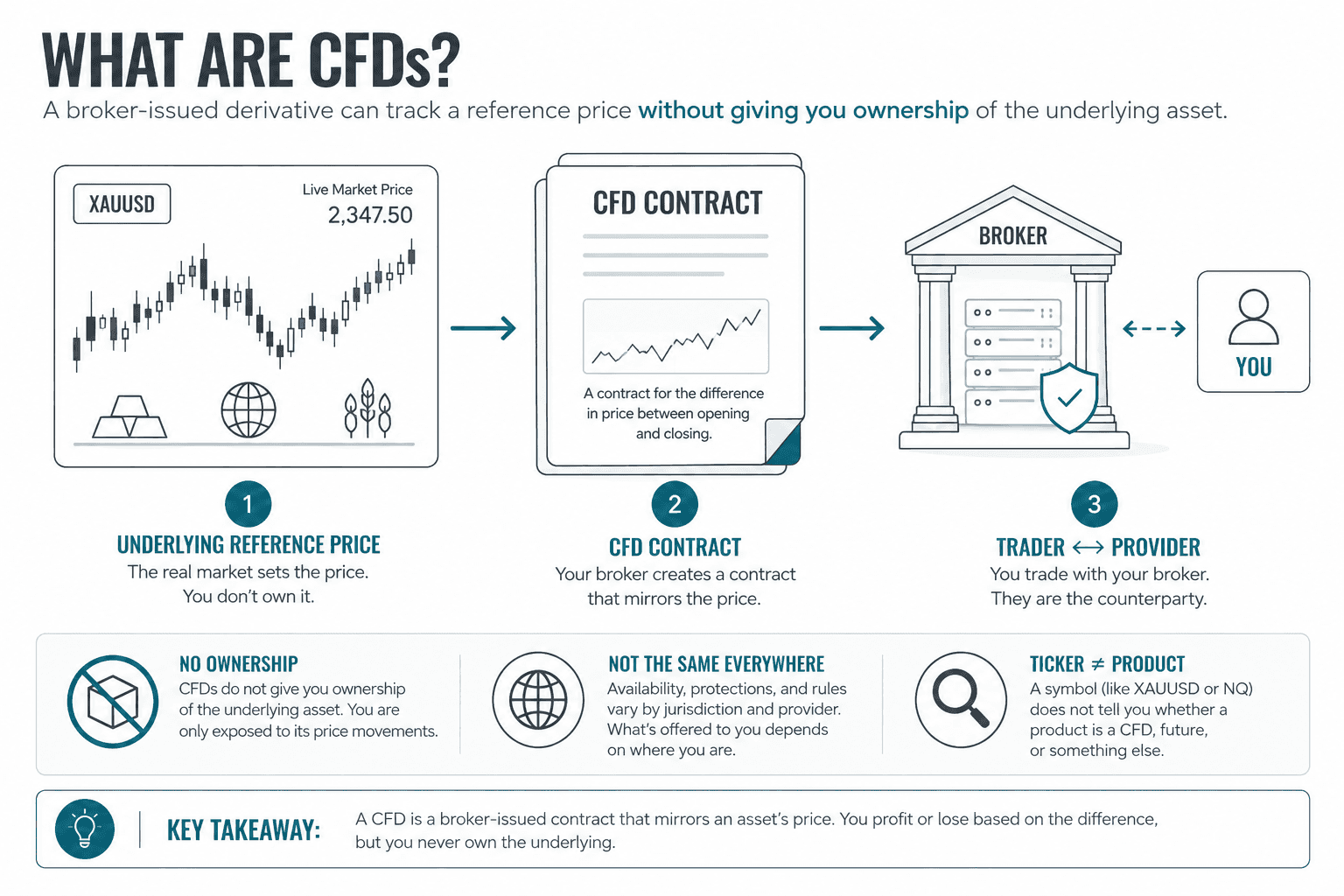
A Contract for Difference (CFD) is an agreement between a trader and a broker to exchange the difference in the price of an asset between when the contract is opened and when it's closed.
If you open a long CFD on gold at $2,000 per ounce and close it at $2,050, the broker pays you the difference – $50 per ounce, multiplied by the contract size. If price moved against you to $1,970, you'd pay the broker $30 per ounce.
Critically: you never own the underlying asset. There's no gold in a vault with your name on it. You own a contract that derives its value from the price of gold. "Contract for Difference" – the difference in price is what you're contracting to exchange.
The name is unusually honest for finance. The difference is literally the thing you are trading.
This structure allows brokers to offer access to a wide range of markets – forex, indices, commodities, individual stocks, crypto – without the trader needing to own or take delivery of anything.
Why CFDs Exist
Whatever their historical origin, the useful question for a learner is what the structure makes possible today. Depending on the provider and jurisdiction, CFDs can:
They allow access to markets that would otherwise require large capital (oil futures, indices)
They allow short-selling without needing to borrow the underlying asset
They offer leverage – controlling a large notional position with a small margin deposit
They enable trading across multiple asset classes through a single broker account
For a retail trader, a CFD account can provide access to forex, gold, oil, major indices, individual stocks, and crypto all in one place, with the ability to go long or short on any of them.
How the Money Works
When you open a CFD position:
Margin deposit: You post margin rather than paying the full notional value. The required amount depends on the instrument, provider, client classification, and jurisdiction. Check the current specification rather than relying on a generic percentage.
Spread: The broker profits from the spread – the difference between the buy price (ask) and sell price (bid). You enter slightly above the market price when buying, and slightly below when selling. This spread is the primary cost on most CFDs.
Overnight financing (swap): If you hold a leveraged CFD position overnight, you typically pay (or receive) a financing charge – the cost of the overnight leverage. This is the swap rate, and it compounds over time on positions held for multiple days. Swap costs are one reason CFDs are generally more suitable for shorter-term trading than long-term holding.
P&L calculation: Profit or loss = (closing price – opening price) × number of units × price per point. The specific calculation varies by instrument and contract specification.
CFDs vs. Futures: The Key Differences
Both CFDs and futures let you speculate on price movements with leverage. The key structural differences:
Feature | CFD | Futures |
|---|---|---|
Exchange traded? | No (OTC, through broker) | Yes (centralized exchange) |
Expiration | None (open-ended) | Fixed expiration dates |
Contract size | Flexible (broker-defined) | Standardized |
Counterparty | Your broker | Exchange clearinghouse |
US retail availability | Not available | Permitted |
Overnight cost | Swap/financing fees | Built into futures pricing |
Futures use standardized exchange-traded contracts and centralized price discovery. CFDs are broker-issued OTC products with provider-defined specifications. Capital requirements, transaction costs, and accessibility vary by product, broker, and jurisdiction, so compare the actual structure rather than assuming one is universally more accessible.
CFDs in the UX to FX Context
When a retail platform offers forex, first identify the legal product being offered. In some jurisdictions that may be a CFD; in others it may be regulated OTC retail forex or another structure. Chart-reading concepts can transfer, but contract mechanics, costs, counterparty structure, and protections may not.
What to be aware of:
Check that your broker is regulated by a recognized authority (FCA, ASIC, CySEC)
Confirm whether they offer negative balance protection
Understand the swap costs on any positions you might hold overnight
Know the exact spread (or commission) on the instruments you trade
The instrument structure doesn't change the analytical skill required. But understanding what you're actually trading helps you ask the right questions when evaluating brokers and managing risk.
Your chart will not volunteer any of this information, of course. Candlesticks are very committed to staying out of the paperwork.
Scenario Practice: What Can You Actually Conclude?
For each scenario, separate what the platform tells you from what you still need to verify. This is a product-structure exercise, not legal advice.
Scenario 1: UK-regulated broker
A broker explicitly labels XAU/USD as a CFD and links to a CFD product specification.
What can you conclude about ownership of the underlying gold?
What contract terms and protections should you still verify?
Scenario 2: U.S.-regulated retail FX dealer
A dealer lists EUR/USD but does not call it a CFD.
Can you conclude that the product is a CFD just because it is leveraged retail FX?
What should you verify about the product and counterparty structure?
Scenario 3: Offshore platform
A platform lists US100 with leverage information but provides no clear legal/product description.
What can the ticker tell you about the likely market exposure?
What can it not tell you about the contract, protections, or regulatory framework?
Reasoning guide
The safe pattern is the same in all three scenarios: identify the reference exposure, identify any explicit product label, then verify the actual contract specification, provider/counterparty terms, costs, and jurisdiction-specific protections. Do not infer the legal structure from chart appearance or ticker format alone.
Retrieval Check
Define a CFD in your own words without using the phrase “it is like trading the asset.”
Who is the contractual counterparty in a broker-issued CFD structure?
Why does jurisdiction matter when evaluating whether a CFD is available and what protections apply?
Two Structures, One Underlying Asset
You now know the two major ways a retail trader gets leveraged exposure to an underlying asset: exchange-traded futures and broker-issued CFDs. Go back to the Market Map for a moment and the pieces click together. The next time you see an instrument like gold sitting on a watchlist, remember that the ticker alone doesn't tell you which of these two structures you'd actually be trading, only the instrument does. The structure is a separate question, and now you know how to ask it.
Where This Topic Goes From Here
This is also a natural pause point. The three lessons so far, the Market Map, Futures, and CFDs, are the foundational half of this topic: orientation you need before you trade anything unfamiliar. The three that follow, Trading Gold, Trading NQ, and Trading Gold vs. Forex vs. Futures, are a different kind of lesson entirely: instrument-specific analysis that assumes you've already built real comfort with charts, risk, and a strategy of your own.
That's not a mistake in the ordering, and it's not a typo if the jump feels abrupt. Come back to those three once you've developed the analytical skills to use them, rather than reading them back-to-back with what you just finished.
The chart can show the same market exposure while the contract underneath it is completely different. Check the product structure before assuming what you actually hold.
Next article: Trading Gold (XAU/USD): What Drives It and How Traders Approach It. This one, and the two after it, are worth bookmarking rather than reading right now, see the note above.
Success Criteria
You will have successfully completed this lesson when you can distinguish underlying ownership from CFD exposure, identify the broker as counterparty, explain the role of leverage/financing, and state that availability and protections depend on jurisdiction and broker regulation.
Common Misconception
A CFD position means you own a small piece of the underlying asset.
The Truth: You never do. A CFD is a contract whose value tracks the price difference of the asset between open and close. There's no gold in a vault, no shares in your name, no currency in an account somewhere. What you own is the contract, not the thing.
FAQ's
Q: Why can't US retail traders access CFDs?
Q: Is there a risk that I owe money beyond my deposit in a CFD?
Q: Are CFDs the same as forex?
Table of Contents
About Me

Krista Weber
After a career as a VP of UX and EdTech executive, I retired early—and quickly realized the traditional world of trading education is fundamentally broken.
As someone with a Master’s in HCI who specialized in the design of e-learning systems, I saw a massive gap: beginners aren't failing because trading is impossible; they’re failing due to massive cognitive overload and terrible instructional design.
This site bridges that gap. I’m applying the principles of learning science, systems thinking, and minimalist UX to strip away the market noise and teach trading the way it actually should be taught.
Stay in Touch
Some of the pages on my travel blog contain affiliate links. Whenever you buy something through one of these links, I get a small commission at no extra cost to you. As an affiliate, I only recommend products and services that I feel are high quality and helpful to my readers. Thanks for your support.
Read More

Open almost any trading platform and you'll see EUR/USD sitting next to XAU/USD, NQ, ES, and a dozen CFDs on stocks you've heard of. They all show up as candlesticks moving left to right, which quietly implies they're all the same kind of thing. They aren't. Before going deeper into any one of them, it's worth drawing the map.
Updated on Sep 6, 2026

Futures are standardized contracts tied to defined specifications and a future settlement date. They can look complex at first, but the mechanics become much clearer once you know what the contract specification controls. Here's what you actually need to know.
Updated on Sep 6, 2026

Gold is one of the most widely traded instruments in the world, but its behavior changes with market regime, liquidity, positioning, policy expectations, and event risk. Understanding what drives gold price movement changes how you interpret its charts.
Updated on Sep 6, 2026