
What Are Futures? A Plain-Language Introduction
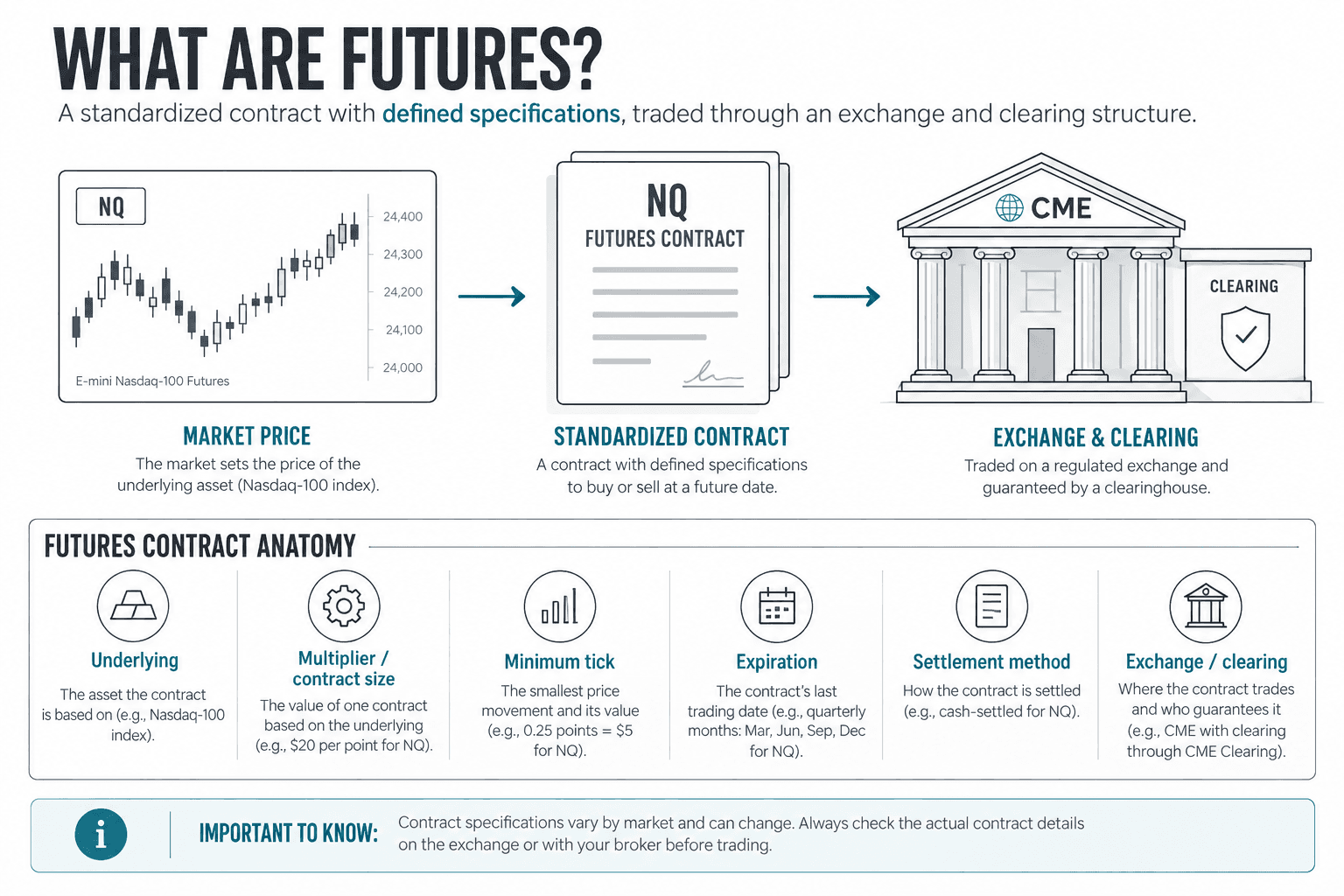
Futures are standardized contracts tied to defined specifications and a future settlement date. They can look complex at first, but the mechanics become much clearer once you know what the contract specification controls. Here's what you actually need to know.

Learning Path Stage 1: Foundations
Learning Level 2: Understanding
Primary Learning Objective
By the end of this lesson, you will be able to explain how a futures contract works and how exchange trading, standardization, margin, and expiration change the trading mechanics compared with spot/OTC forex.
The Basic Idea
A futures contract is an agreement between two parties to buy or sell something at a predetermined price on a specific future date.
The "something" can be:
A commodity (oil, gold, wheat, natural gas)
A financial instrument (stock index, currency, interest rate)
A cryptocurrency (Bitcoin futures, Ethereum futures)
The party agreeing to buy is "long." The party agreeing to sell is "short." The price is agreed upon today; the transaction occurs at the future date (the expiration or delivery date).
This structure was originally developed for commercial purposes. A wheat farmer knows they'll have 10,000 bushels to sell at harvest in six months. A food company knows they'll need 10,000 bushels in six months. Both face price uncertainty. A futures contract lets them agree on a price now – the farmer locks in revenue, the food company locks in cost. Price risk is managed before the transaction occurs.
This is still how commodity futures are used commercially. But the liquid futures markets that developed around this commercial function also became attractive for traders who have no intention of producing or consuming the underlying asset – they're speculating on the price direction.
The good news is that you do not need a grain silo. The less exciting news is that expiration still matters.
How Futures Trading Actually Works
When a retail trader buys a futures contract, they're not agreeing to take delivery of 1,000 barrels of oil in December. They're taking a position on whether the price of oil futures will go up or down. If they're right, they profit. If they're wrong, they lose. At some point before expiration, they close the position by taking the opposite trade (buying to close a short, selling to close a long). The profit or loss is the difference between entry price and exit price, multiplied by the contract size.
Standardization: Unlike spot forex, futures contracts are fully standardized. The contract size, tick size (minimum price movement), tick value, expiration date, and trading hours are defined in the contract specification. This removes ambiguity and makes pricing transparent.
For once, finance gives you a spec sheet before asking you to risk money. Use it.
Exchange traded: Futures trade on regulated exchanges, including CME Group markets for many U.S. futures products. This provides centralized order matching, price discovery, and clearing through the exchange and clearinghouse structure. Retail spot/OTC forex uses a different decentralized dealer and broker structure, so the relevant counterparty protections and obligations depend on the product, broker, and jurisdiction.
Margin and leverage: To trade futures, you don't pay the full contract value upfront. You post margin – a good-faith deposit that's a fraction of the contract's notional value. This creates leverage. Leverage amplifies both gains and losses; a small price move against you can exceed your margin and result in a margin call (a demand to deposit more funds or have your position closed).
Popular Futures Markets for Traders
Some of the most actively traded futures instruments:
Equity index futures:
ES (E-mini S&P 500) – tracks the S&P 500, highly liquid, popular with day traders
NQ (E-mini Nasdaq-100) – tracks the Nasdaq-100; compare its current realized volatility with ES over the same measurement window rather than assuming a permanent ranking
MES / MNQ – micro versions at 1/10th the size, used by smaller accounts
Commodity futures:
Gold (GC) – actively traded, responds to dollar and risk sentiment
Crude Oil (CL) – highly liquid, volatile, major economic indicator
Currency futures:
Euro (6E), British Pound (6B), Japanese Yen (6J) – regulated exchange-based alternatives to spot forex
Bond futures:
Treasury futures (ZN, ZB) – track US government bond prices, important for macro traders
Futures Versus Spot Forex: A Quick Comparison
Feature | Spot Forex | Futures |
|---|---|---|
Market structure | Over-the-counter | Exchange-traded |
Contract size | Variable (set by broker) | Standardized |
Expiration | None (positions roll automatically) | Fixed expiration dates |
Regulation | Varies by broker/jurisdiction | CME regulated (US) |
Capital / margin constraint | Broker- and jurisdiction-specific | Contract- and broker-specific; verify current margin and risk requirements |
Transparency | Pricing varies by broker | Centralized price discovery |
Neither is objectively better for all purposes. Neither structure is objectively better. The practical trade-offs depend on the product, contract size, current margin, transaction costs, jurisdiction, data needs, and the trader’s execution and risk requirements.
Explain It: Futures Mechanics Check
Decide whether each statement is true or false, then explain why. The explanation matters more than the correct true/false answer.
Every futures contract uses the same contract size and tick value.
A futures contract expires because it represents a standardized agreement tied to a specific contract month or settlement date.
All financial futures are cash settled.
Exchange trading and centralized clearing are structural differences between futures and retail spot/OTC forex.
Answer key
False. Standardization happens within each contract specification. Different futures contracts can have different multipliers, tick values, expiration cycles, and settlement methods.
True. Expiration is part of the contract design. Traders who want continued exposure commonly close or roll before the relevant contract reaches expiration.
False. Settlement is contract-specific. Some contracts cash settle and others use physical delivery. The specification for the exact contract is the source of truth.
True. Futures trade on centralized exchanges with centralized clearing, while retail spot/OTC forex does not use one centralized exchange in the same way.
If "check the contract specification" is starting to feel repetitive, that is intentional. Futures are wonderfully standardized, right up until you assume the wrong standard.
Retrieval Check
Why do futures contracts expire?
What does standardized mean in the context of a futures contract?
Name two structural differences between futures and retail spot/OTC forex.
Why This Matters for UX to FX Readers
This lesson is awareness, not a call to action. The UX to FX curriculum primarily uses forex examples, but the analytical frameworks, reading charts, identifying structure, applying risk management, managing psychology, transfer directly to futures. Many traders who start in forex eventually explore futures, particularly NQ or ES, for different volatility profiles or because futures offer a regulated, exchange-based alternative.
Knowing what futures are gives you a map for that eventual exploration and helps you follow the broader conversation in trading communities where futures terms come up constantly. It does not mean you need to trade them, or even fully understand every mechanic, before you've built real comfort with forex. Learning to trade futures is a separate, later step from simply knowing what they are.
A futures contract is just an agreement to trade something at a future date. The price discovery that happens around those agreements is where the opportunity lives.
Next article: What Are CFDs? Contracts for Difference Explained
Success Criteria
You will have successfully completed this lesson when you can explain why a futures contract expires, what standardization means, why most retail speculators close or roll before settlement, and at least two structural differences from spot/OTC forex.
Common Misconception
Trading futures means you'll eventually have to take physical delivery of the underlying asset.
The Truth: Retail traders almost never do. Positions are closed or rolled to the next contract before expiration, and brokers generally require this. Even commodity futures on oil or wheat rarely result in a retail trader actually receiving barrels or bushels.
FAQ's
Q: What does it mean when a futures contract "expires"?
Q: Can beginners trade futures?
Q: What's the difference between futures and forex?
Table of Contents
About Me

Krista Weber
After a career as a VP of UX and EdTech executive, I retired early—and quickly realized the traditional world of trading education is fundamentally broken.
As someone with a Master’s in HCI who specialized in the design of e-learning systems, I saw a massive gap: beginners aren't failing because trading is impossible; they’re failing due to massive cognitive overload and terrible instructional design.
This site bridges that gap. I’m applying the principles of learning science, systems thinking, and minimalist UX to strip away the market noise and teach trading the way it actually should be taught.
Stay in Touch
Some of the pages on my travel blog contain affiliate links. Whenever you buy something through one of these links, I get a small commission at no extra cost to you. As an affiliate, I only recommend products and services that I feel are high quality and helpful to my readers. Thanks for your support.
Read More

Open almost any trading platform and you'll see EUR/USD sitting next to XAU/USD, NQ, ES, and a dozen CFDs on stocks you've heard of. They all show up as candlesticks moving left to right, which quietly implies they're all the same kind of thing. They aren't. Before going deeper into any one of them, it's worth drawing the map.
Updated on Sep 6, 2026

CFDs appear everywhere in retail trading – but most new traders couldn't explain exactly what they are or why that matters. Here's a plain-language breakdown, including the parts that most introductions skip.
Updated on Sep 6, 2026

Gold is one of the most widely traded instruments in the world, but its behavior changes with market regime, liquidity, positioning, policy expectations, and event risk. Understanding what drives gold price movement changes how you interpret its charts.
Updated on Sep 6, 2026