
How to Set Realistic Trading Goals
Most trading goals are set backwards: "I want to make $X per month." That's an outcome goal, and it's largely outside your control. What you can control (and therefore what you should set goals around) is your process. This article explains the difference, and what realistic trading goals actually look like at different stages of learning.

Learning Path Stage 1: Foundations
Learning Level 2: Understanding
Primary Learning Objective
By the end of this lesson, you will be able to distinguish between uncontrollable outcome goals and controllable process goals, and construct a stage-appropriate, process-oriented trading plan designed to manage risk and build long-term consistency.
Set Trading Goals That Actually Build Skill (and Don't Blow Up Your Account)
"I want to turn $5,000 into $50,000 in six months." There's only one problem with that goal: the market gets a vote.
Almost every new trader starts here. It feels motivating. It gives the endless hours staring at charts a shiny, Lambo-flavored purpose.
It also creates the absolute worst possible decision-making environment known to mankind.
When you chase a specific dollar amount on a strict deadline, every single tick against you feels like a personal insult. Pressure builds. Pressure breeds desperation. Desperation leads to over-leveraging a terrible setup at 2:00 AM. Before you know it, the goal that was supposed to fuel your dream ends up draining your account.
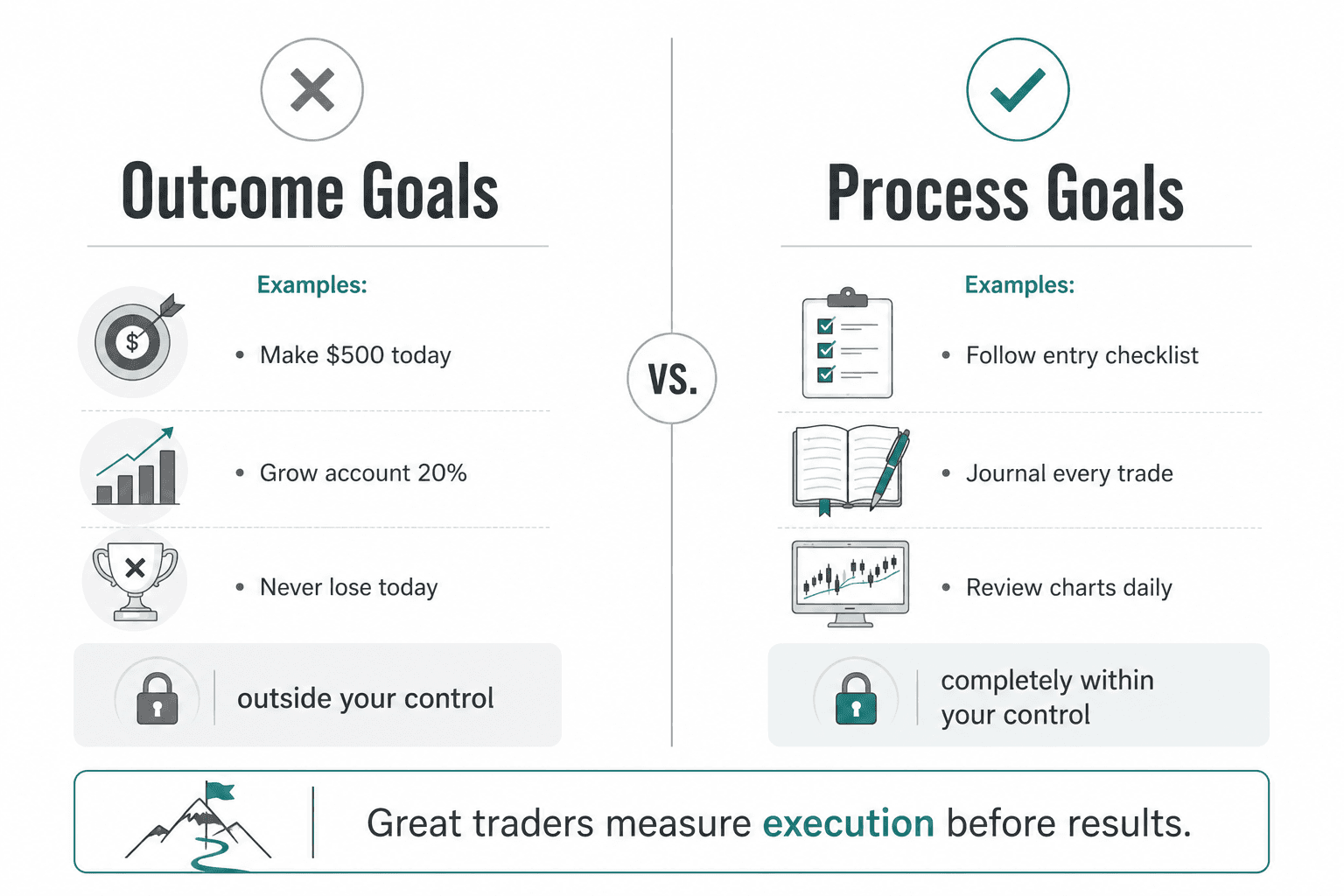
Outcome Goals vs. Process Goals
To survive this game, you have to understand the difference between what you can control and what you think you can control.
Outcome Goals (The Mirage)
These target results where the market has the final say. They sound like:
"I'm going to make $500 this week."
"I need to grow my account by 20% this month."
"I will not have a single losing trade today." (Spoiler: The market doesn't care about your streak).
Process Goals (The Blueprint)
These target behaviors entirely within your control. They sound like:
"I will check the economic calendar for high-impact news before every session."
"I will never enter a trade unless all three of my strategy criteria are met."
"I will complete a detailed trade review within 24 hours of every closed position."
In most professions, outcome goals work because direct effort yields direct results. If you build 10 chairs, you get paid for 10 chairs.
Trading, however, loves to introduce short-term randomness. A seasoned professional with a genuine mathematical edge can still have losing weeks or months. That isn't a skill failure; it’s just normal statistical variance. Process goals keep you sane because you can hit them perfectly even when the market decides to be a chaotic mess. They compound into actual skill, creating the exact conditions needed for long-term profitability.
What Realistic Goals Look Like (Stage by Stage)
Stop trying to run an institutional fund before you even know how to set a stop-loss. Match your goals to your actual experience level.
Stages 1–2
Focus: Learning to read the charts
The Goals:
Review 10 historical setups per week using the TradingView replay tool.
Complete a session review every single day you active-test.
Mark significant support and resistance levels before the session starts, not mid-trade while panicking.
The Reality Check: Your financial expectations here should be exactly zero. You are paying for your education in the currency of time and attention.
Stages 3–4
Focus: Trading a Defined Strategy on Demo
The Goals:
Only take trades where every entry rule is checked off.
Log every single trade—wins, losses, and break-evens—in your journal.
Track your monthly adherence rate (e.g., "What percentage of my trades actually followed the plan?").
The Reality Check: You are grading your execution, not your fake account's P&L. High adherence with negative results means your strategy needs a tweak. Low adherence with positive results just means you got lucky, which is a dangerous habit to form.
Stages 5–6
Focus: Early Live Trading (With Real, Hard Earned Cash)
The Goals:
Risk absolutely no more than 1% of your account per trade.
Do not trade the hyper-volatile first 30 minutes of the London open.
Never add to a losing position unless it was explicitly budgeted into your plan.
The Reality Check: This stage is entirely about building a fortress around your capital. These rules constrain the exact lizard-brain behaviors that destroy beginner accounts.
Later In Your Journey
Only when you've survived the gauntlet do "outcome-adjacent" goals make sense. Even then, speak the language of math, not dollars. "Achieve a positive Expected Value ($EV$) over a sample size of 100+ trades" is infinitely better than saying "I need to make $2,000 this month."
The Trap of Monthly Return Targets
Setting a goal like "I need to make 10% every month" triggers a classic, heartbreaking psychological trap:
Your month starts out fine, but then you hit a few losses in week two. You are behind the pace you need to hit your goal and panic sets it. You overcompensate by taking risks that aren't part of your trading plan, which leads to a revenge trading and taking trades that are oversized. Next thing you know, you've blown up your account.
Professional institutional traders don't start their mornings thinking about how much money they must make. They think about how much they are allowed to lose. They set strict risk limits: maximum drawdown and maximum daily loss.
The limitations are controllable; the returns are just the byproduct of disciplined execution. You cannot bully the market into giving you money just because your rent is due.
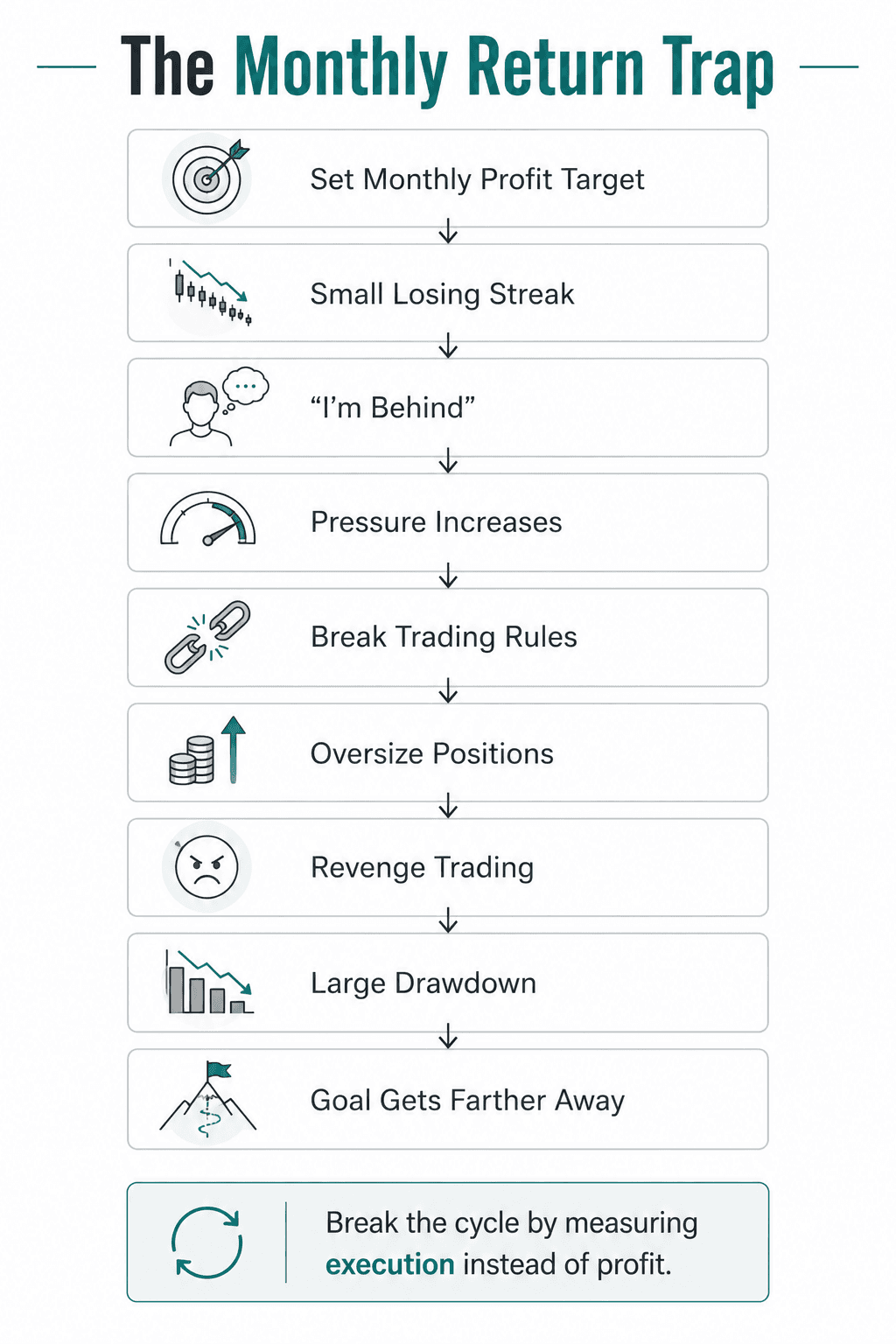
The Fix: If you're a retail trader starting out, delete monthly return targets from your brain. Replace them with drawdown floors. If you lose X% this month, you unplug the mouse and review. If you manage the floor, the ceiling tends to take care of itself.
Look at the trading goals you currently have written down.
How many are based on money?
Rewrite each one into a behavior that is completely under your control.
Success Criteria
After completing this lesson, you will know you have mastered this concept when you can:
Identify and separate outcome goals (e.g., monthly return targets, daily profit quotas) from process goals (e.g., rule adherence, journaling consistency) within your own trading routine.
Audit your current trading stage (Stages 1–6) and accurately align your daily milestones with behavior-based metrics rather than financial P&L.
Formulate a personalized "drawdown floor" and execution adherence tracker to replace arbitrary monthly monetary targets.
Common Misconception
Setting high financial targets (like making 10% a month) gives me the necessary motivation and drive to trade sharper and work harder.
The Truth: In trading, short-term randomness and statistical variance mean that direct effort does not instantly equal direct financial returns. Treating trading like a traditional job where "more hustle = more immediate pay" creates intense psychological pressure. This pressure invariably forces traders to abandon their plans, over-leverage, and chase losses—ultimately blowing up accounts rather than building skill. Motivation must be anchored to process execution, not shifting market outcomes.
FAQ's
Q: How do I know when I’m actually ready to set financial expectations?
Q: Process goals feel incredibly boring compared to making money. How do I stay motivated?
Q: What if I’m trading to replace my income? I need financial targets.
Table of Contents
About Me

Krista Weber
After a career as a VP of UX and EdTech executive, I retired early—and quickly realized the traditional world of trading education is fundamentally broken.
As someone with a Master’s in HCI who specialized in the design of e-learning systems, I saw a massive gap: beginners aren't failing because trading is impossible; they’re failing due to massive cognitive overload and terrible instructional design.
This site bridges that gap. I’m applying the principles of learning science, systems thinking, and minimalist UX to strip away the market noise and teach trading the way it actually should be taught.
Stay in Touch
Some of the pages on my travel blog contain affiliate links. Whenever you buy something through one of these links, I get a small commission at no extra cost to you. As an affiliate, I only recommend products and services that I feel are high quality and helpful to my readers. Thanks for your support.
Read More

Open almost any trading platform and you'll see EUR/USD sitting next to XAU/USD, NQ, ES, and a dozen CFDs on stocks you've heard of. They all show up as candlesticks moving left to right, which quietly implies they're all the same kind of thing. They aren't. Before going deeper into any one of them, it's worth drawing the map.
Updated on Sep 6, 2026

Futures are standardized contracts tied to defined specifications and a future settlement date. They can look complex at first, but the mechanics become much clearer once you know what the contract specification controls. Here's what you actually need to know.
Updated on Sep 6, 2026

CFDs appear everywhere in retail trading – but most new traders couldn't explain exactly what they are or why that matters. Here's a plain-language breakdown, including the parts that most introductions skip.
Updated on Sep 6, 2026