
How to Set Up Your Paper Trading Workspace
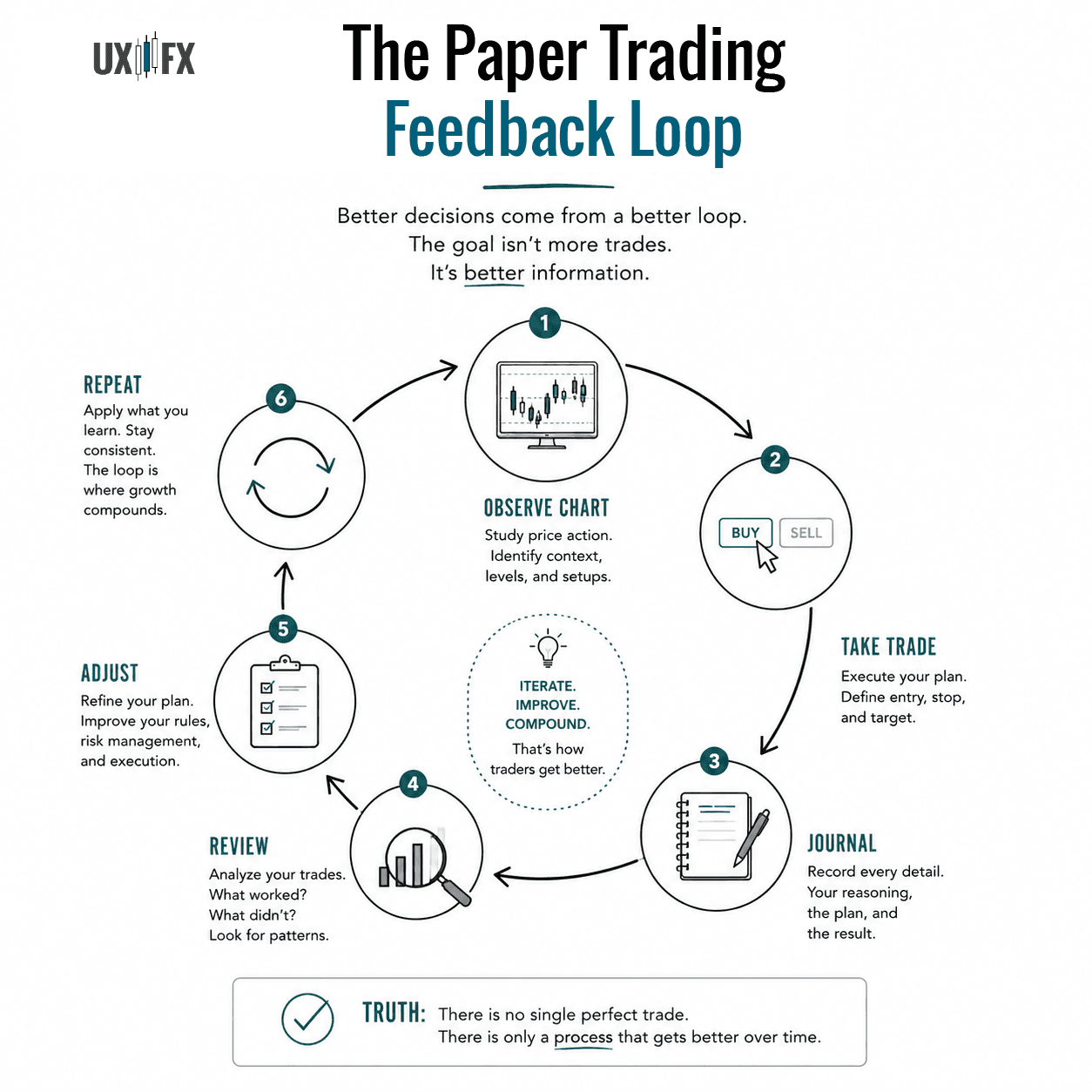
Paper trading is practicing with fake money (making trades as if they were real, recording results, and learning what works without any actual financial risk). It's the training simulator of financial markets.

Learning Path Stage 1: Foundations
Learning Level 1: Recognition
Primary Learning Objective
By the end of this lesson, you will be able to identify the core components of Paper Trading, explain how to establish a virtual tracking system, and recognize how to evaluate a baseline data sample before transitioning to live capital.
Paper Trading: How to Play Stock Market Sandbox Without Going Broke
In the previous lesson, we looked at why paper trading is one of the best ways to begin learning. Now let's set up a practice environment that actually teaches you something.
How to Do It: Choose Your Platform
Option 1: TradingView (The Lazy & Luxury Route)
TradingView has a built-in paper trading mode. You just click "Paper Trading" at the bottom of the chart, and boom! You have a virtual account. You can buy and sell directly on the live chart and track your fictional profit and loss. It’s the easiest entry point and requires zero broker registration.
Option 2: Broker Demo Accounts (The Dress Rehearsal)
Most brokers will happily give you a demo account stuffed with $100,000 of fake monopoly money. These simulate real market conditions better because they use the broker's actual software and data feeds. Just search "forex demo account" or "stock demo account" and pick your poison.
Option 3: Manual Journaling (The Stone Age Method)
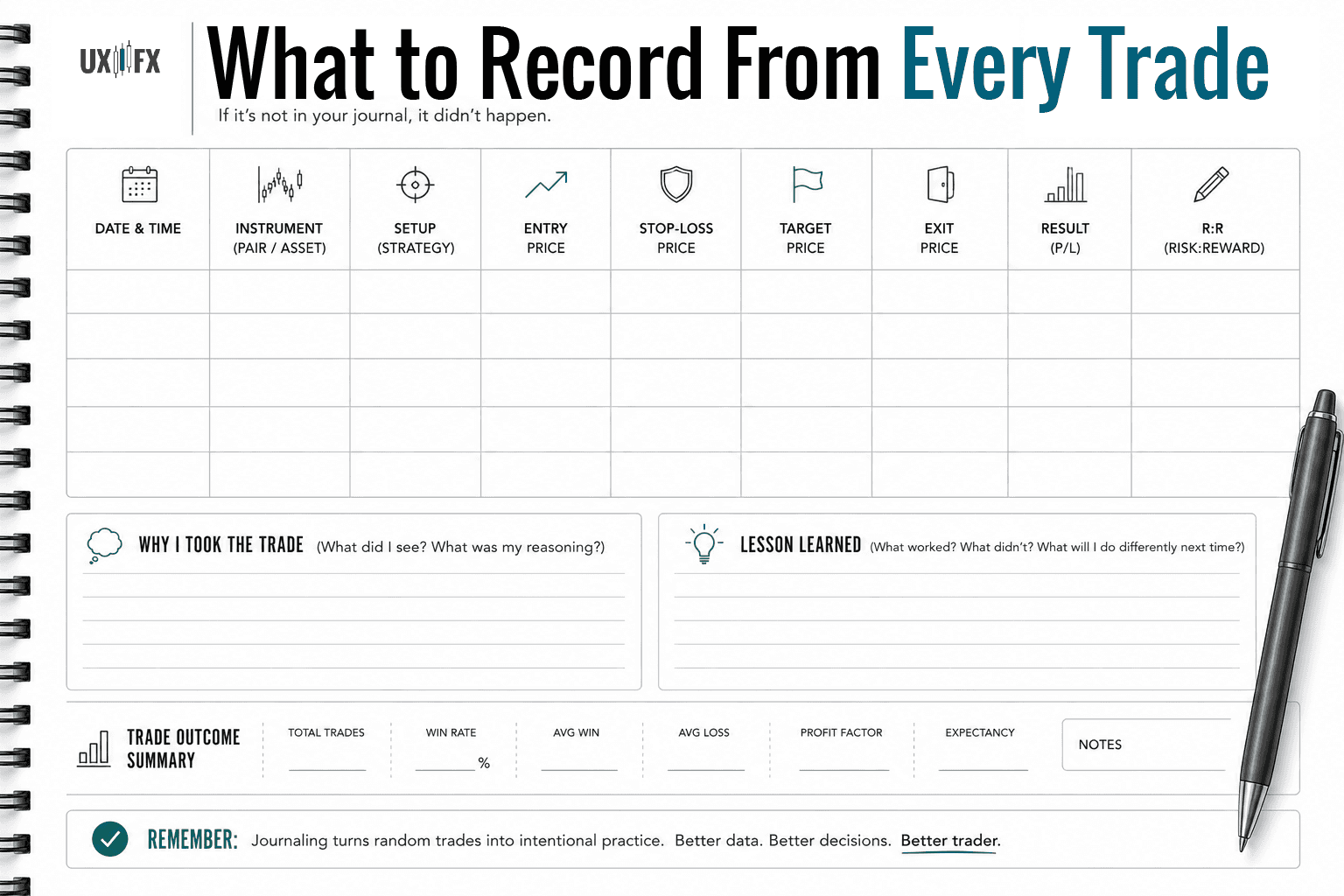
The OG method. You open a physical notebook and manually write down the date, asset, direction, entry, stop-loss, and target price, alongside your why. It’s slower, it requires math, and it forces you to face your own logic. It’s tedious, but forcing yourself to write why you're doing something stops you from trading on pure, unadulterated vibes.
Build Your Journal
If you don't track your data, you aren't paper trading—you're just playing a video game badly. For every single trade, you need to log:
Trade Metric | What It Actually Means |
Date & Time | When did you make this choice? |
Asset / Pair | What exactly are you trading? (e.g., EUR/USD) |
Direction | Are you betting it goes up (Long) or down (Short)? |
Entry Price | The exact price you "bought" it at. |
Stop-Loss Price | The emergency eject button if everything goes wrong. |
Target Price | The "I am a genius, take my profit" line. |
Risk & Reward | The distance in pips/points to your stop vs. your target. |
Risk-to-Reward Ratio | Are you risking $1 to make $3, or risking $10 to make $1? |
Reason for Entering | The most critical column. Why did you do this? |
Exit Price & Result | Where did you actually close it, and what was the damage? |
After about 30 trades, look back at your "Reason for Entering" column. You will quickly realize a pattern: your highly calculated, rule-based entries probably made "money," while the ones labeled "It looked like it wanted to go up" resulted in a paper dumpster fire.
Common Beginner Mistakes
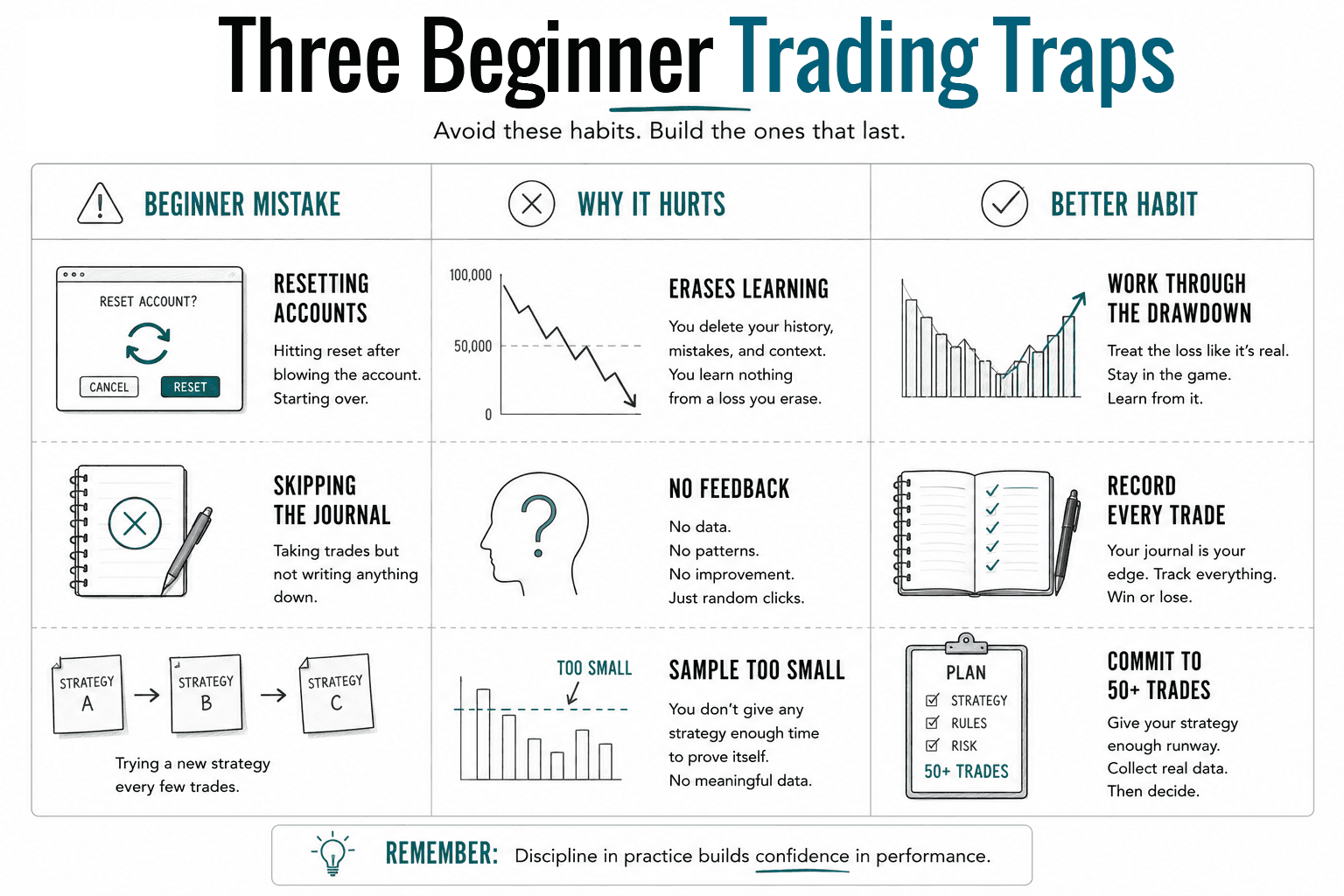
Because paper trading has no financial consequences, beginners tend to treat it like an arcade game rather than a training ground. If you want your simulation time to actually mean something, avoid these three classic pitfalls:
1. The "Infinite Respawn" Trap (Resetting Accounts)
The moment a beginner blows through their virtual $100,000 balance, their first instinct is to click the "Reset Account" button to start fresh with a clean slate.
Mistake: Treating a blown demo account as a minor data glitch that can be wiped away with a single click.
Why it Matters: In the real world, there is no reset button. Clicking reset deletes your history, your mistakes, and the emotional weight of losing. You learn absolutely nothing from a disaster if you erase the evidence.
Better Habit: If you lose fake money, sit with the loss. Treat that blown account as if the money were real. Document the loss. Learn from it. Keep trading the same account.
2. Ghosting Your Data (Ignoring Journals)
Many traders will happily take 50 paper trades but won't journal a single one of them because "it's just practice."
Mistake: Skipping the trade log because no real capital was risked.
Why it Matters: Taking trades without journaling them is just click-therapy. You are building muscle memory for pressing buttons, but you aren't building the analytical framework required to see if your strategy actually has an edge.
Better Habit: If it doesn't go in the journal, the trade never happened. The discipline required to log your data when the money is fake is the exact same discipline you'll need to keep from melting down when the money is real. Record every trade, even the embarrassing ones.
3. Strategy Hopping (The 5-Trade Itch)
This is the habit of trying a strategy, taking five losses in a row, deciding the system is "broken," and immediately switching to a completely new one.
Mistake: Abandoning a trading strategy based on a tiny, statistically insignificant sample size.
Why it Matters: Every trading strategy has a distribution of winners and losers. Even a highly profitable system can easily experience 5, 6, or 7 consecutive losses. By quitting after five trades, you are abandoning a system before you've collected enough data to know whether it actually works.
Better Habit: Commit to a single strategy for a minimum sample size of 50 trades before you even think about tweaking it. You need to see how a system performs across different market conditions, not just judge it based on a bad afternoon. Commit to one strategy until you have a meaningful sample of results.
When Are You Ready to Leave the Simulator?
In the previous lesson, we talked about why most traders switch to live trading far too early. That advice doesn't change just because you've set up a good paper trading routine.
Before risking real money, make sure you can honestly check each of these boxes:
☐ I have completed at least 50 fully documented paper trades.
☐ My results show a positive expectancy over that sample.
☐ I stayed disciplined through a losing streak without abandoning my rules.
☐ I can explain every trade using my written strategy—not intuition or gut feeling.
If you can't check every box yet, that's okay. The goal of paper trading isn't to finish as quickly as possible. The goal is to build enough evidence that you trust your process before real money starts influencing your decisions.
Paper trading won't turn you into a market wizard overnight, but it gives you the chance to make your expensive mistakes before they cost you real money. That's a trade almost every beginner should take.
Success Criteria
After completing this lesson, you should be able to:
Define Paper Trading and explain how it simulates market mechanics without financial exposure.
Compare the entry-level tools for simulation (TradingView vs. Broker Demo Accounts vs. Manual Journaling).
Identify the exact data metrics required for a valid trade log, with an emphasis on documenting your trade rationale.
List the minimum criteria needed to validate consistency (such as a 50-trade sample size and positive expectancy) before introducing real capital.
Common Misconception
If I can make a consistent profit on a paper trading account, I will immediately make the exact same consistent profit when I switch to a live account.
The Truth: Managing a simulated account only proves your mechanical and analytical understanding of a strategy. It cannot test your psychology. When real money is on the line, emotional factors like hesitation, greed, and the urge to micro-manage setups alter your decision-making. Success on paper is a required prerequisite, but you must still treat the transition to live capital as a completely separate psychological phase.
FAQ's
Q: How long should I paper trade before going live?
Q: Does paper trading actually prepare you for real trading?
Q: What's the difference between paper trading and a demo account?
Table of Contents
About Me

Krista Weber
After a career as a VP of UX and EdTech executive, I retired early—and quickly realized the traditional world of trading education is fundamentally broken.
As someone with a Master’s in HCI who specialized in the design of e-learning systems, I saw a massive gap: beginners aren't failing because trading is impossible; they’re failing due to massive cognitive overload and terrible instructional design.
This site bridges that gap. I’m applying the principles of learning science, systems thinking, and minimalist UX to strip away the market noise and teach trading the way it actually should be taught.
Stay in Touch
Some of the pages on my travel blog contain affiliate links. Whenever you buy something through one of these links, I get a small commission at no extra cost to you. As an affiliate, I only recommend products and services that I feel are high quality and helpful to my readers. Thanks for your support.
Read More

Open almost any trading platform and you'll see EUR/USD sitting next to XAU/USD, NQ, ES, and a dozen CFDs on stocks you've heard of. They all show up as candlesticks moving left to right, which quietly implies they're all the same kind of thing. They aren't. Before going deeper into any one of them, it's worth drawing the map.
Updated on Sep 6, 2026

Futures are standardized contracts tied to defined specifications and a future settlement date. They can look complex at first, but the mechanics become much clearer once you know what the contract specification controls. Here's what you actually need to know.
Updated on Sep 6, 2026

CFDs appear everywhere in retail trading – but most new traders couldn't explain exactly what they are or why that matters. Here's a plain-language breakdown, including the parts that most introductions skip.
Updated on Sep 6, 2026