
What Paper Trading Actually Is
Paper trading means practicing trades with simulated money before risking real capital. It's one of the most consistently recommended starting points for new traders, but it has real limitations that nobody mentions. Here's the full picture.
Learning Path Stage 1: Foundations
Learning Level 1: Recognition
Primary Learning Objective
After reading this lesson, you'll be able to explain what paper trading is, what it can teach, and what it cannot teach before you begin trading with real money.
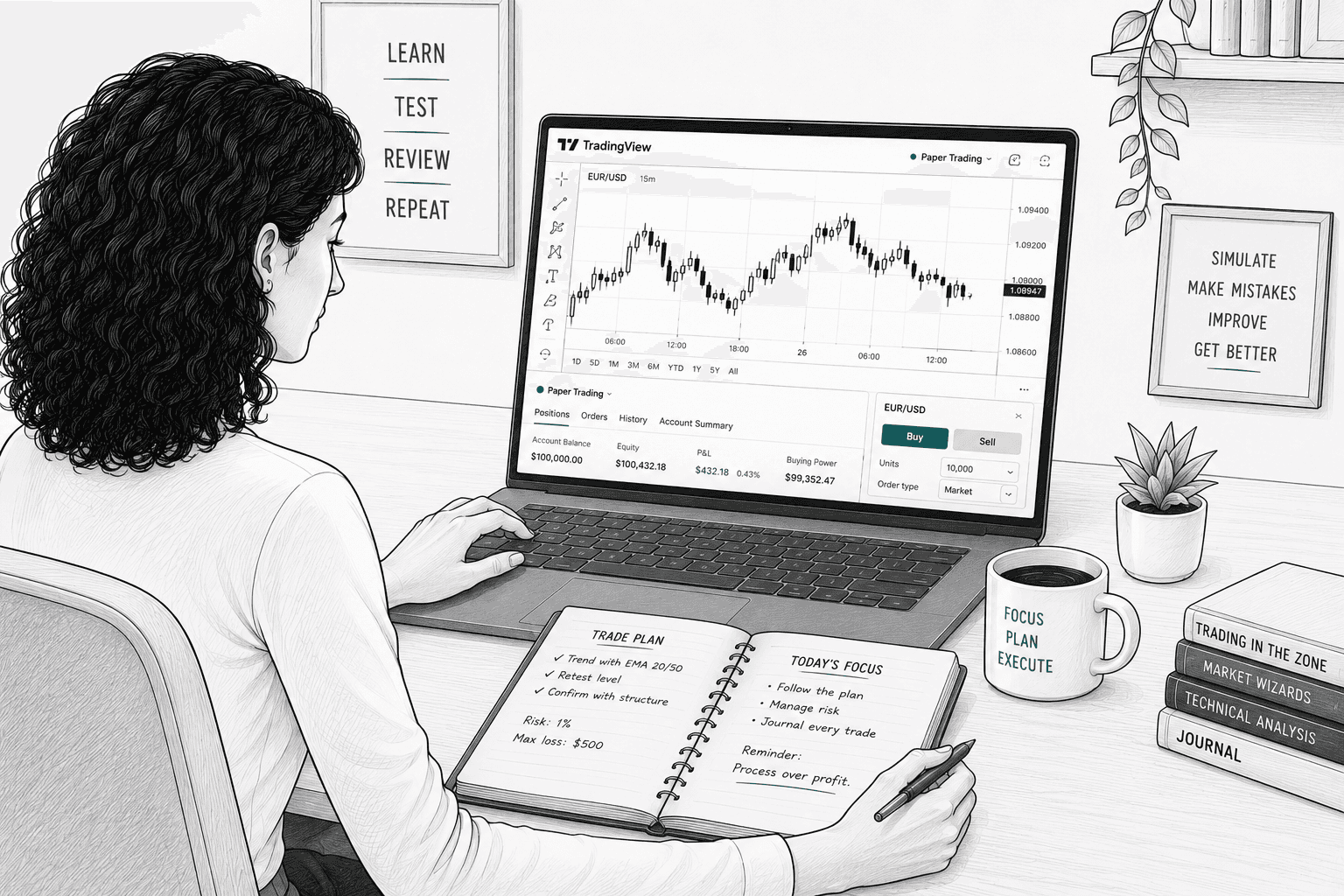
Paper trading (also known as demo or simulated trading) is the financial equivalent of playing The Sims with the stock market. You enter real buy and sell orders at real market prices, but the resulting profits and losses are entirely fictional.
Before trading platforms existed, traders literally tracked hypothetical trades on paper. "I totally would have bought here and sold there." Thankfully, we've upgraded from notebooks.Today’s platforms make it far more realistic, offering live charts, real price data, and actual execution feedback like slippage and spread costs.
For a rookie, paper trading is a flight simulator. You get to figure out how the instrument panel works before you crash a very real, very expensive aircraft into the side of a mountain.
Why Paper Trading Is Recommended
1. You learn mechanics without financial self-destruction
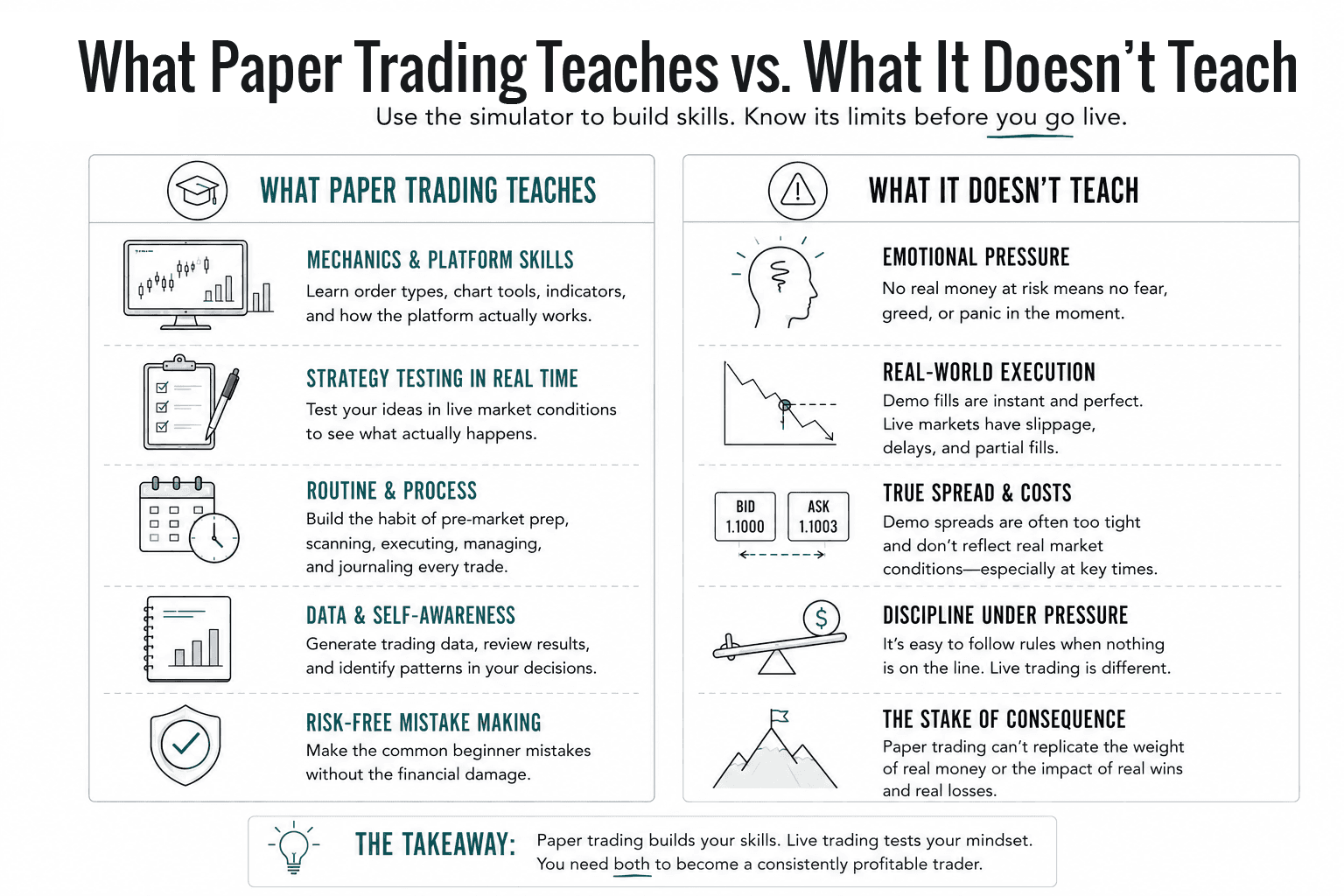
This is where you figure out order types, stop placements, position sizing, and what a margin call looks like. Paper trading is the designated safe space for the "dumb but predictable" mistakes every single beginner makes, like misclicking the wrong direction, putting your stop loss on the wrong side of the trade, or accidentally risking your entire net worth on a single lot. Better to make these blunders on Monopoly money.
2. You test your strategy in the wild
If you have a brilliant trading idea, paper trading lets you throw it into live conditions. You get to see what actually happens, rather than what a flawless, historical backtest promised would happen. It forces you to identify setups in real time and manage them through the chaotic noise of the morning bell.
3. It builds muscle memory
Trading requires a strict routine: pre-session prep, scanning for setups, evaluating criteria, entering, managing, exiting, and journaling. Paper trading builds this habit before real money arrives to completely hijack your nervous system.
The Limitations Nobody Mentions
While highly recommended, paper trading has a few massive blind spots that can give you a dangerous, false sense of security.
1. It completely lacks emotional stakes
This is the elephant in the room. Some traders argue paper trading is actively misleading because it can't replicate the absolute panic of losing real money. When nothing is at stake, you hold through a massive drawdown without an existential crisis. You follow your rules perfectly because fear isn't whispering in your ear. In the live market, fear isn't whispering, it's screaming.
2. The execution is "too perfect"
In a demo environment, your orders usually fill instantly at the exact quoted price. In the real world, the market doesn't care about your feelings. During fast-moving news events or session opens, you will experience slippage, meaning you'll get filled at a worse price. A strategy that looks like a money-printing machine on paper can quickly become a dumpster fire in live trading due to poor fills.
3. Demo spreads are a lie
Many platforms underestimate spread costs, especially during low-liquidity hours. If your strategy relies on trading when spreads are wide, a paper account will aggressively overstate your profitability.
4. It breeds bad habits
Because the losses aren't real, it’s easy to develop a toxic tolerance for risk. You might let a losing trade run forever because "eh, it's just paper." When you inevitably finish the month in the green, you become overconfident, entirely unprepared for the psychological buzzsaw of live market execution.
How to Paper Trade Productively
If you want your simulation time to actually mean something, you have to follow a few rules:
Treat it like real money: Act as if every single dollar lost is coming out of your actual bank account. If you wouldn't 10x your position size on a live account, don't do it on a demo just to see the big numbers move.
Journal every single trade: Paper trading without a journal is just a video game. Write down the setup, the entry logic, your planned stop and target, the actual result, and a brutal assessment of how well you followed the plan.
Stop hitting the reset button: The ultimate cheat code of paper trading is resetting the account balance after a terrible week. Resist this. A realistic experience requires you to sit in the misery of a drawdown and a losing streak. Resetting teaches you how to quit; it doesn't teach you how to trade.
Run a real sample size: Do not judge a strategy based on 5 trades. You need at least 50+ completed trades before drawing any conclusions. Anything shorter is just statistical noise.
When to Go Live
You are officially ready to graduate from the simulator when your paper trading shows:
A defined strategy with strictly documented rules.
50 to 100 completed, logged trades.
A win rate and expectancy that actually match your strategy’s theory.
Absolute rule compliance (no "gut-feeling" trades or cherry-picking).
A consistent journaling habit.
When you finally cross the rubicon into live trading, start with the smallest position size your broker allows, not the massive size you used on paper. The entire goal of your first live trading stint isn't to get rich; it's to see if you can execute your plan while your pulse is racing. Keep the size microscopic until your live behavior perfectly matches your paper behavior.
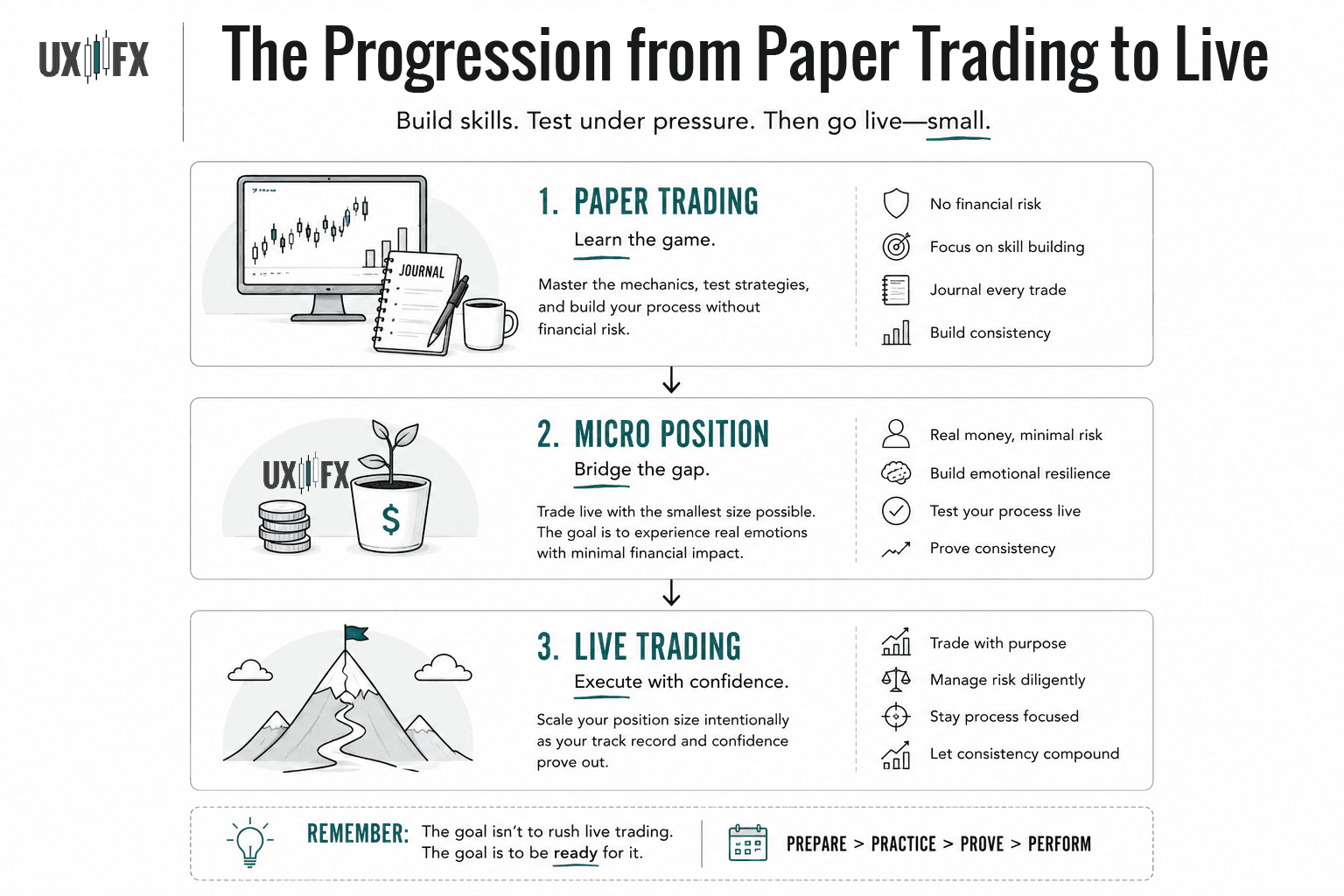
Your first live trades are not a profit test. They're an execution test.
The Bottom Line: Paper trading teaches you how to trade. Live trading teaches you how to trade while your own brain is actively trying to sabotage you. You cannot bypass either education.
Success Criteria
After reading this lesson, you should be able to:
Explain what a simulator gets right (execution, spreads, fills) and where it falls short (zero emotional pressure)
Run a strict sim routine: 50+ trades minimum, a journal for every session, and zero account resets after a losing streak
Build a clear, data-backed plan to go live, starting at the smallest position size allowed and scaling up from there
Common Misconception
If I'm profitable on paper, I'll be profitable with real money.
The Truth: Paper trading removes fear. There's no sting when you lose fake money. Your heart rate stays flat. Your decision-making stays clean. On top of that, simulators often give you better fills than the real market. Slippage shrinks. Spreads tighten. Everything runs smoother than it will on a live account, especially during fast-moving sessions. Profit on a simulator proves your strategy works under perfect conditions. It does not prove you can execute that same strategy when real dollars, real fear, and real market friction show up at the same time.
FAQ's
Q: How long should I paper trade before going live?
Q: I was profitable on paper. Why am I losing money now?
Q: Is paper trading on TradingView the same as using a demo account from a broker?
Table of Contents
About Me

Krista Weber
After a career as a VP of UX and EdTech executive, I retired early—and quickly realized the traditional world of trading education is fundamentally broken.
As someone with a Master’s in HCI who specialized in the design of e-learning systems, I saw a massive gap: beginners aren't failing because trading is impossible; they’re failing due to massive cognitive overload and terrible instructional design.
This site bridges that gap. I’m applying the principles of learning science, systems thinking, and minimalist UX to strip away the market noise and teach trading the way it actually should be taught.
Stay in Touch
Some of the pages on my travel blog contain affiliate links. Whenever you buy something through one of these links, I get a small commission at no extra cost to you. As an affiliate, I only recommend products and services that I feel are high quality and helpful to my readers. Thanks for your support.
Read More

Open almost any trading platform and you'll see EUR/USD sitting next to XAU/USD, NQ, ES, and a dozen CFDs on stocks you've heard of. They all show up as candlesticks moving left to right, which quietly implies they're all the same kind of thing. They aren't. Before going deeper into any one of them, it's worth drawing the map.
Updated on Sep 6, 2026

Futures are standardized contracts tied to defined specifications and a future settlement date. They can look complex at first, but the mechanics become much clearer once you know what the contract specification controls. Here's what you actually need to know.
Updated on Sep 6, 2026

CFDs appear everywhere in retail trading – but most new traders couldn't explain exactly what they are or why that matters. Here's a plain-language breakdown, including the parts that most introductions skip.
Updated on Sep 6, 2026