
Why Good Traders Think in Probabilities
Certainty is a comfort you can't afford in trading. The fastest upgrade in trading mindset is learning to think probabilistically, and understanding what that actually changes about how you operate.

Learning Path Stage 4: Risk & Mindset
Learning Level 4: Analysis
Primary Learning Objective
By the end of this lesson, you will be able to analyze trading setups and outcomes through a probabilistic framework, shifting your evaluation metrics from individual trade profitability to systemic process consistency.
You Cannot Know Whether Any Specific Trade Will Win or Lose
Accept this fact. Let it sink in. Tattoo it on your monitor if you have to.
You can have an undeniable edge—a strategy that wins 60% of the time or yields massive payouts when it does. But on any single trade? The outcome is outside your control. Your absolute best setup, perfect historical location, beautiful candle confirmation, and pristine market context can still result in a maximum-loss stop-out.
This isn't a failure of your intelligence. This is just how math works.
Think about a coin weighted to land on heads 60% of the time. If it lands on tails 4 times out of 10, the coin isn't broken. It’s performing exactly as expected. Heck, sometimes tails will show up 7 times in a row. Nothing is malfunctioning. That is simply what random sequences do. If a 7-tail streak makes you flip the table and question reality, you shouldn't be playing the game.
What Probabilistic Thinking Changes
1. How You Evaluate Trades
The Amateur: “This trade made money, so my analysis was pure genius. This trade lost, so I am a failure who should rewrite my entire strategy.”
The Probability Thinker: “This trade won; neat, consistent with my edge. This trade lost; also neat, completely consistent with my edge, which is mathematically expected to lose 40% of the time. Was my execution correct? If yes, it was a great trade.”
The evaluation shifts entirely from outcome to process. If you followed your rules and met your criteria, the trade was a massive success—even if it lost money.
2. How You Size Positions
The Amateur: “I’m feeling incredibly confident about this breakout, so I’m going to double my risk.” Or: “My last two trades hit my stop, so I’m going to trade micro-lots until my vibes improve.”
The Probability Thinker: “My edge produces a specific expected value per trade. Because I am not a psychic, I have no idea which specific trades will be the winners. Therefore, I size every qualifying setup identically.”
Varying your position size based on "confidence" injects a massive, chaotic variable into what is supposed to be a systematic machine. The market does not care about your confidence, and it doesn't give extra credit.
3. How You Respond to Losses
The Amateur: A loss means a crisis. They immediately analyze, over-adjust their indicators, feel miserable, and spend the night questioning their life choices.
The Probability Thinker: A loss is just a line item. It’s one data point in a massive spreadsheet. The only question that matters is whether a series of 50 to 100 trades is performing consistently with historical data. A single loss—or five in a row—tells you absolutely nothing new.
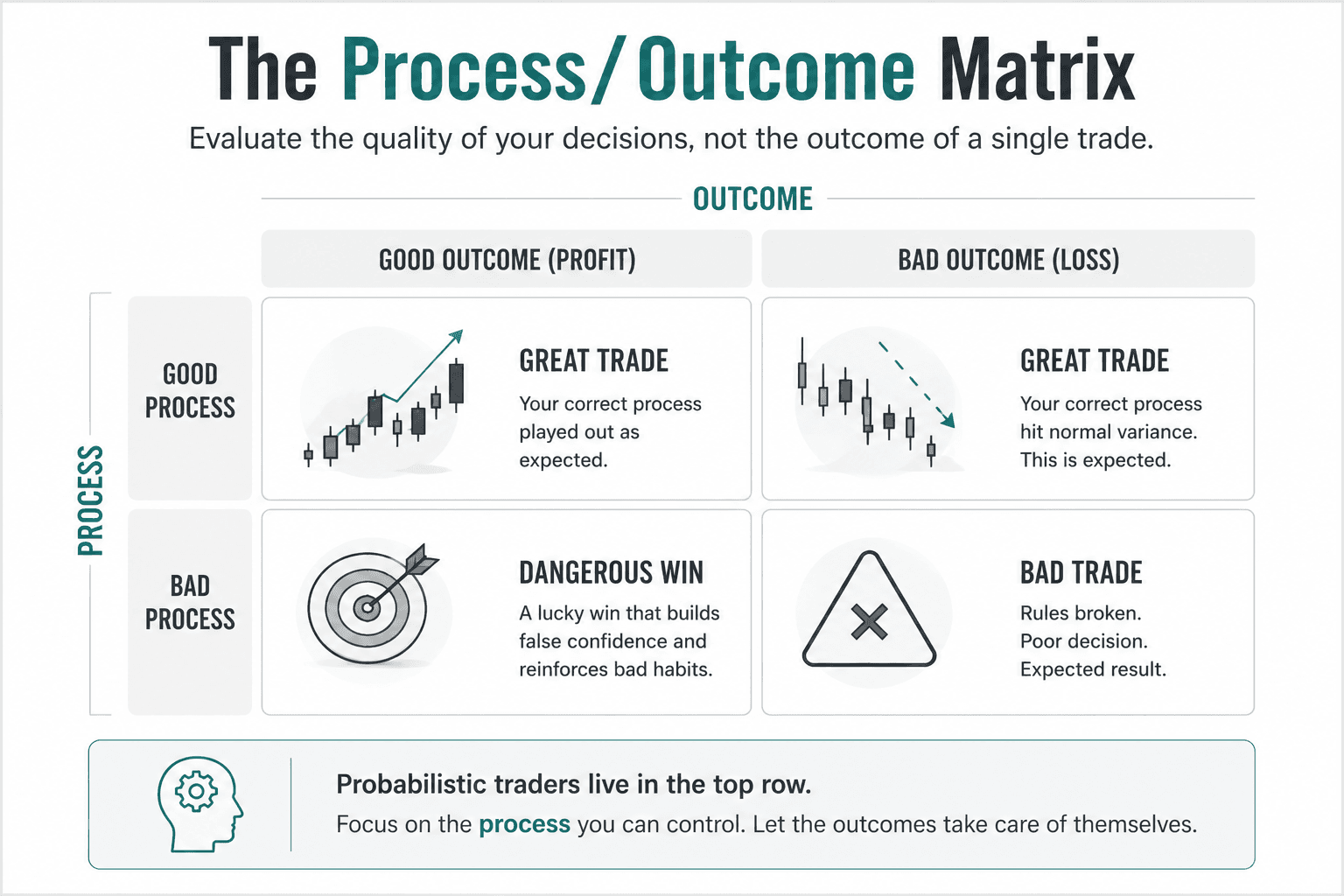
The Process/Outcome Matrix
If you want to survive the markets, you need to understand this matrix deeply:
Good Outcome (Profit) | Bad Outcome (Loss) | |
Good Process | Good Trade (Expected system behavior) | Good Trade (A correct decision that hit normal variance) |
Bad Process | The Danger Zone (Lucky win; false reinforcement that creates terrible habits) | Bad Trade (Play stupid games, win stupid prizes) |
Probabilistic traders live exclusively in the top row. They don’t care about the outcome as long as the process was pristine.
In fact, professional traders specifically dread the bottom-left cell: winning a trade you had no business taking. Sizzling into a revenge trade, breaking your rules, risking way too much, and somehow walking away with a profit is the financial equivalent of finding a twenty-dollar bill in a public restroom toilet. It feels good for a second, but it rewards a disgusting habit. It builds false reinforcement, ensuring you will use that exact same terrible process to blow up your account next week.
How to Build the Mindset in Practice
Rewrite Your Internal Monologue
Stop talking to yourself like a victim and start talking like a casino owner.
Old Thought
"I was wrong."
↓
Better Question
"Did I follow my process?"
Old Thought
"I need to change my strategy."
↓
Better Question
"Is this statistically meaningful yet?"
Old Thought
"I'm on a hot streak."
↓
Better Question
"Has anything actually changed?"
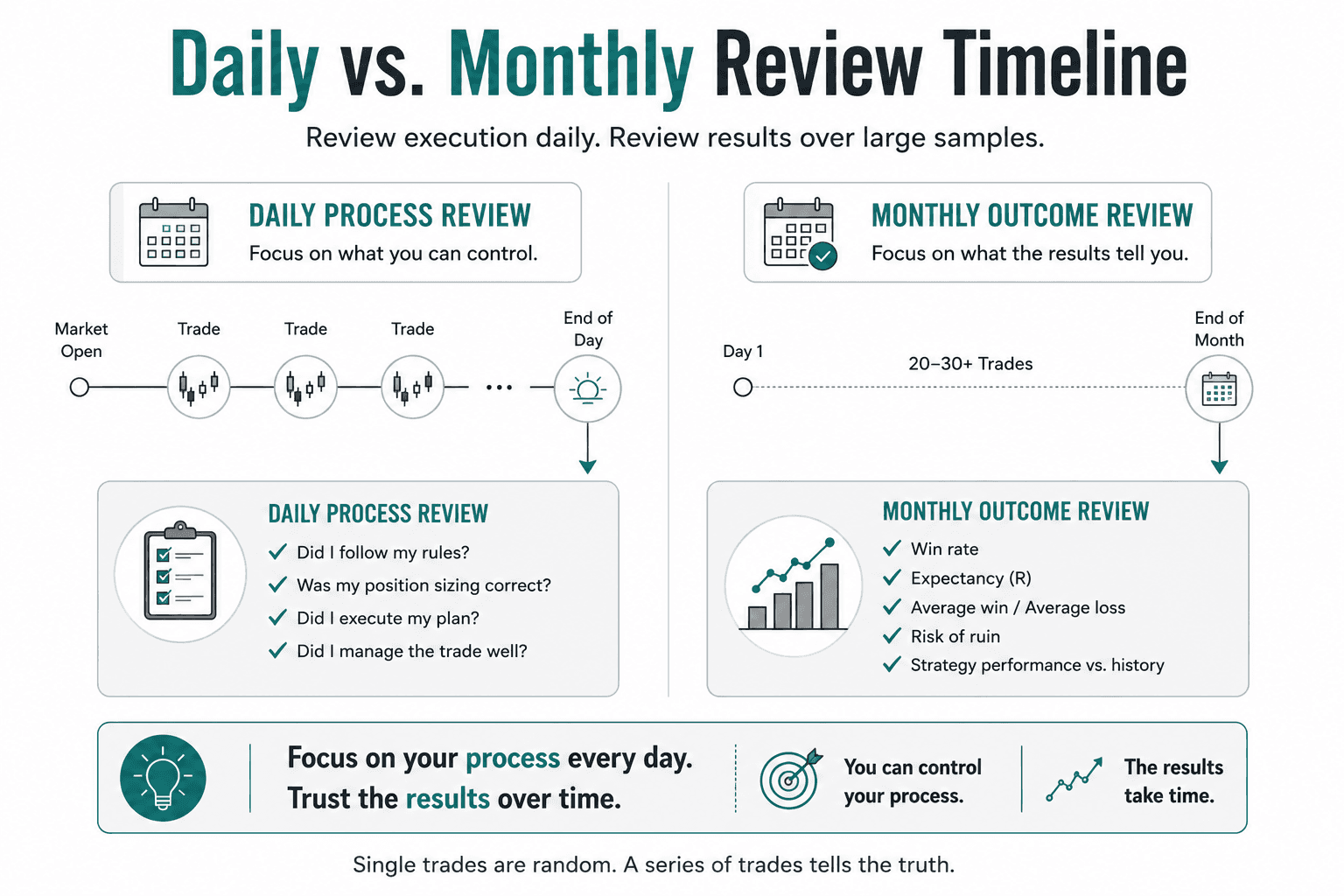
Review the Album, Not the Song
Track your performance in rolling windows of 20 to 30 trades. Do not look at your daily PnL with emotional attachment. Ask yourself: “Is my win rate and average risk-to-reward (R) over the last 30 trades operating within historical norms?” If yes, the individual losses are just the cost of doing business. If no, then you can investigate if the market environment has shifted or if you’ve let your discipline slip.
Separate the Interrogation from the Verdict
Keep your reviews separate in time and focus:
Process Review (Daily): Did I follow my rules? Was my sizing right? Did I manage it correctly? (Do this right after the session).
Outcome Review (Monthly): Is the aggregate math working? (Do this at the end of the month when the emotions of individual trades are dead and buried).
The Freedom of the Math
When you truly internalize probabilistic thinking, a beautiful thing happens: the crushing emotional weight of trading completely vanishes.
If you genuinely believe that any single trade’s outcome is random, and that your 60% strategy must lose 4 out of 10 trades to be working correctly, then a loss stops being a personal crisis. It transforms into a standard, boring line item of a functional business.
Amateurs often look at veteran traders and mistake their calm for cold emotional detachment. It’s not that veterans don’t care about money; they care deeply about overall performance. They’ve just realized that an individual trade is entirely meaningless.
Every trade you take is just a single sentence in a massive book. Stop rewriting the whole plot just because one sentence ended in a period you didn't like. Focus on making sure the book is good.
Success Criteria
After completing this lesson, you should be able to:
Define the difference between outcome quality and process quality using the Process/Outcome Matrix.
Execute identical position sizing across a series of 20–30 trades without altering risk parameters based on personal confidence or recent win/loss streaks.
Conduct separate daily process reviews and monthly outcome reviews to isolate normal market variance from actual strategy deficiencies.
Log a multi-trade losing streak without experiencing the emotional urge to alter your underlying trading rules or execute a revenge trade.
Common Misconception
Discipline and emotional control are psychological traits you either have or you don't.
The Truth: Trading psychology problems are almost always structural system problems in disguise. Traders don't bleed money because they lack willpower; they bleed money because they treat a single random data point (one trade) as a referendum on their skill. Discipline becomes infinitely easier to maintain the moment you stop trying to predict the next trade and start managing the math of the next hundred trades.
FAQ's
Q: If each trade is probabilistic, why does it feel so personal when a trade loses?
Q: What separates a trader who thinks in probabilities from one who is essentially gambling?
Q: How is probabilistic thinking different from normal thinking?
Table of Contents
About Me

Krista Weber
After a career as a VP of UX and EdTech executive, I retired early—and quickly realized the traditional world of trading education is fundamentally broken.
As someone with a Master’s in HCI who specialized in the design of e-learning systems, I saw a massive gap: beginners aren't failing because trading is impossible; they’re failing due to massive cognitive overload and terrible instructional design.
This site bridges that gap. I’m applying the principles of learning science, systems thinking, and minimalist UX to strip away the market noise and teach trading the way it actually should be taught.
Stay in Touch
Some of the pages on my travel blog contain affiliate links. Whenever you buy something through one of these links, I get a small commission at no extra cost to you. As an affiliate, I only recommend products and services that I feel are high quality and helpful to my readers. Thanks for your support.
Read More

Open almost any trading platform and you'll see EUR/USD sitting next to XAU/USD, NQ, ES, and a dozen CFDs on stocks you've heard of. They all show up as candlesticks moving left to right, which quietly implies they're all the same kind of thing. They aren't. Before going deeper into any one of them, it's worth drawing the map.
Updated on Sep 6, 2026

Futures are standardized contracts tied to defined specifications and a future settlement date. They can look complex at first, but the mechanics become much clearer once you know what the contract specification controls. Here's what you actually need to know.
Updated on Sep 6, 2026

CFDs appear everywhere in retail trading – but most new traders couldn't explain exactly what they are or why that matters. Here's a plain-language breakdown, including the parts that most introductions skip.
Updated on Sep 6, 2026