
How to Evaluate Trading Resources Before You Trust Them
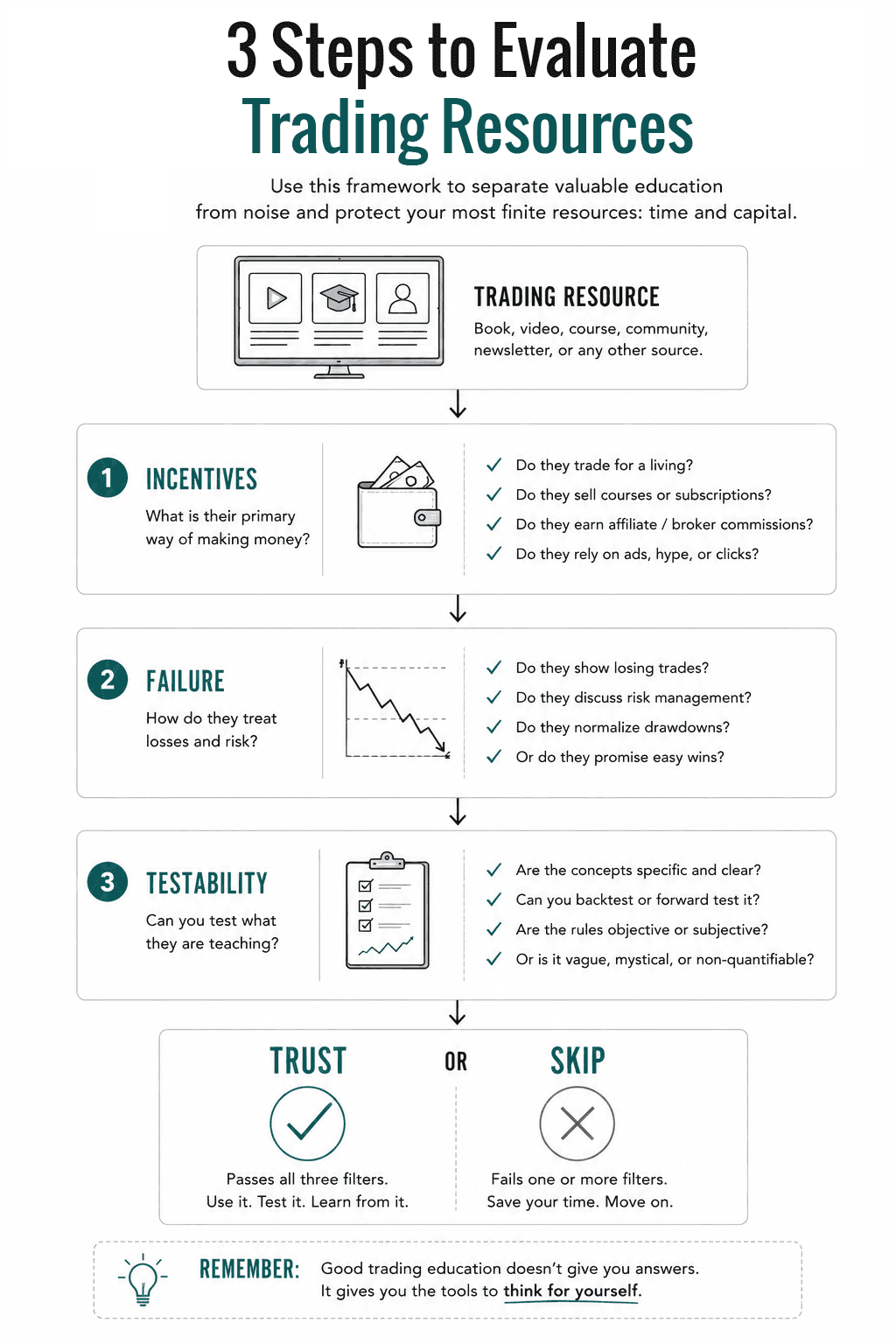
The internet contains an almost infinite amount of trading content, and a significant proportion of it ranges from mediocre to actively harmful. This lesson introduces a simple three-filter framework for evaluating trading educators, courses, videos, and communities before you invest your time or money.

Learning Path Stage 1: Foundations
Learning Level 4: Analysis
Primary Learning Objective
Readers will be able to critically audit any trading resource (videos, books, or communities) by analyzing its underlying incentive structure, its transparency regarding risk and failure, and the objective testability of its core claims.
How I Filter Trading Resources So I Only Study What Actually Works
The modern retail trading space is roughly 90% performance art, 9% recycled basic chart patterns, and maybe 1% actual utility. If you aren't careful, you’ll spend more time inhaling content from "gurus" filming from rented Lamborghinis than actually learning how to read a tape.
Thanks to the internet, we now have access to infinite trading advice, strategies, and "secret formulas." The modern problem isn't a scarcity of data; it's a massive overabundance of noise. The hard part isn't finding information, it's knowing what actually deserves your attention.
Your time is a finite resource, and your trading capital is even more finite. To protect both, you need a rigorous process to immediately eliminate the junk. Here is the exact three-filter evaluation framework I use to separate the actual market practitioners from the content poets.
The Three-Filter Evaluation Framework
Before wasting a single hour on a book, video, or course, run it through this mental checklist:
1. What is this person's primary incentive?
Understanding how someone earns money doesn't tell you whether they're trustworthy—but it does help you understand the incentives shaping their content.
2. How does this content treat failure?
Legitimate trading education treats risk and loss with proportionate gravity. The reality of retail trading is stark: roughly 70% to 80%+ of participants lose money. If a resource makes success sound like an inevitability for anyone who "just believes in the system," they are either blissfully ignorant or trying to sell you something.
3. Does the content produce testable claims?
"Support levels are zones where buyers historically step in." Verdict: Good. You can open a chart right now and manually verify if this holds true.
"Markets move in cycles of accumulation driven by shadowy composite operators." Verdict: Fine as a conceptual model, though a bit harder to explicitly disprove.
"My proprietary, cloud-based indicator unlocks the hidden geometric rhythms of the market." Verdict: Skip it. If you can't independently test a claim, it's not a strategy—it's mythology.
Try It Yourself
The best way to build your filtering muscle is to apply this framework to your current media diet.
Level 4 Practice Exercise
Pick a trading YouTube channel, Discord community, or book you are currently consuming and run it through the audit table below.
Evaluation Question | Your Notes & Observations |
1. How do they actually make money? (Trading profits, ad revenue, course sales, or broker sign-up links?) | |
2. How do they discuss losses? (Are losses analyzed transparently, or are they buried under a mountain of winning screenshots?) | |
3. Can you test what they're teaching? (Are they giving clear rules you can backtest, or vague, subjective descriptions?) |
The Final Verdict
Once you've filled out your notes, look at the data objectively and ask yourself one final question:
Knowing what you know now about their incentives, risk transparency, and testability—would you still recommend this resource to a friend who is risking real money?
If the answer is no, hit unsubscribe and reclaim your time. The ultimate goal of good trading education isn't to hand you pre-packaged conclusions to follow blindly. It’s to give you the mental framework and tools required to think for yourself.
Success Criteria
After completing this lesson, you should be able to:
Identify the primary revenue driver behind a content creator and evaluate how that alignment affects the objectivity of their advice.
Flag marketing tactics that hide or downplay the baseline $70\%\text{--}80\%+$ retail failure rate.
Classify a trading assertion as either an independently verifiable "testable claim" or an unfalsifiable "mythological claim."
Complete a rigorous self-audit of their current media consumption using the provided evaluation framework.
Common Misconception
The belief that filtering trading advice requires deep technical expertise or specialized market knowledge.
The Truth: The most effective defense against predatory or useless content relies on basic logic, evaluating the provider's financial incentives and demanding that any strategy they teach can be independently tested and verified on a clean chart.
FAQ's
Q: Is paid trading education ever worth it?
Q: Can trading content be actively harmful?
Q: How do I know if a trading educator is legitimate?
Table of Contents
About Me

Krista Weber
After a career as a VP of UX and EdTech executive, I retired early—and quickly realized the traditional world of trading education is fundamentally broken.
As someone with a Master’s in HCI who specialized in the design of e-learning systems, I saw a massive gap: beginners aren't failing because trading is impossible; they’re failing due to massive cognitive overload and terrible instructional design.
This site bridges that gap. I’m applying the principles of learning science, systems thinking, and minimalist UX to strip away the market noise and teach trading the way it actually should be taught.
Stay in Touch
Some of the pages on my travel blog contain affiliate links. Whenever you buy something through one of these links, I get a small commission at no extra cost to you. As an affiliate, I only recommend products and services that I feel are high quality and helpful to my readers. Thanks for your support.
Read More

Open almost any trading platform and you'll see EUR/USD sitting next to XAU/USD, NQ, ES, and a dozen CFDs on stocks you've heard of. They all show up as candlesticks moving left to right, which quietly implies they're all the same kind of thing. They aren't. Before going deeper into any one of them, it's worth drawing the map.
Updated on Sep 6, 2026

Futures are standardized contracts tied to defined specifications and a future settlement date. They can look complex at first, but the mechanics become much clearer once you know what the contract specification controls. Here's what you actually need to know.
Updated on Sep 6, 2026

CFDs appear everywhere in retail trading – but most new traders couldn't explain exactly what they are or why that matters. Here's a plain-language breakdown, including the parts that most introductions skip.
Updated on Sep 6, 2026