
Stop Studying. Start Charting. (That’s How You Actually Learn to Trade)
Consuming trading content feels like progress. It often isn't. Here's how to distinguish between the two, and what to do when you realize you've been in consumption mode for months.

Learning Path Stage 1: Foundations
Learning Level 4: Analysis
Primary Learning Objective
By the end of this lesson, you will be able to diagnose whether your trading routine is stuck in passive "consumption mode" and implement a structured, hands-on charting practice to build actual market competence.
Why Autoplay is Not Your Friend
The trading education ecosystem is brilliantly optimized for consumption, not skill-building. Videos autoplay. Podcasts drop weekly. YouTube algorithmically shoves the next "100% Win Rate Strategy" down your throat before you’ve even finished digesting the last one.
Let's be honest: consumption feels phenomenal. It has some beautifully deceptive features:
It’s comfortable: Zero risk of being wrong or losing fake money.
It feels intellectual: Look at you, accumulating all that "knowledge."
It kills time productively: Surely watching 14 hours of market analysis counts as a shift, right?
It makes you feel deeply informed: You are a scholar of the charts.
But knowledge without application is completely useless. The trader who has watched 200 hours of YouTube content but has never manually marked a single level on a live chart is exactly as prepared as they were on day one. Spoiler alert: they aren't.
The Trader’s Knowledge Building Journey
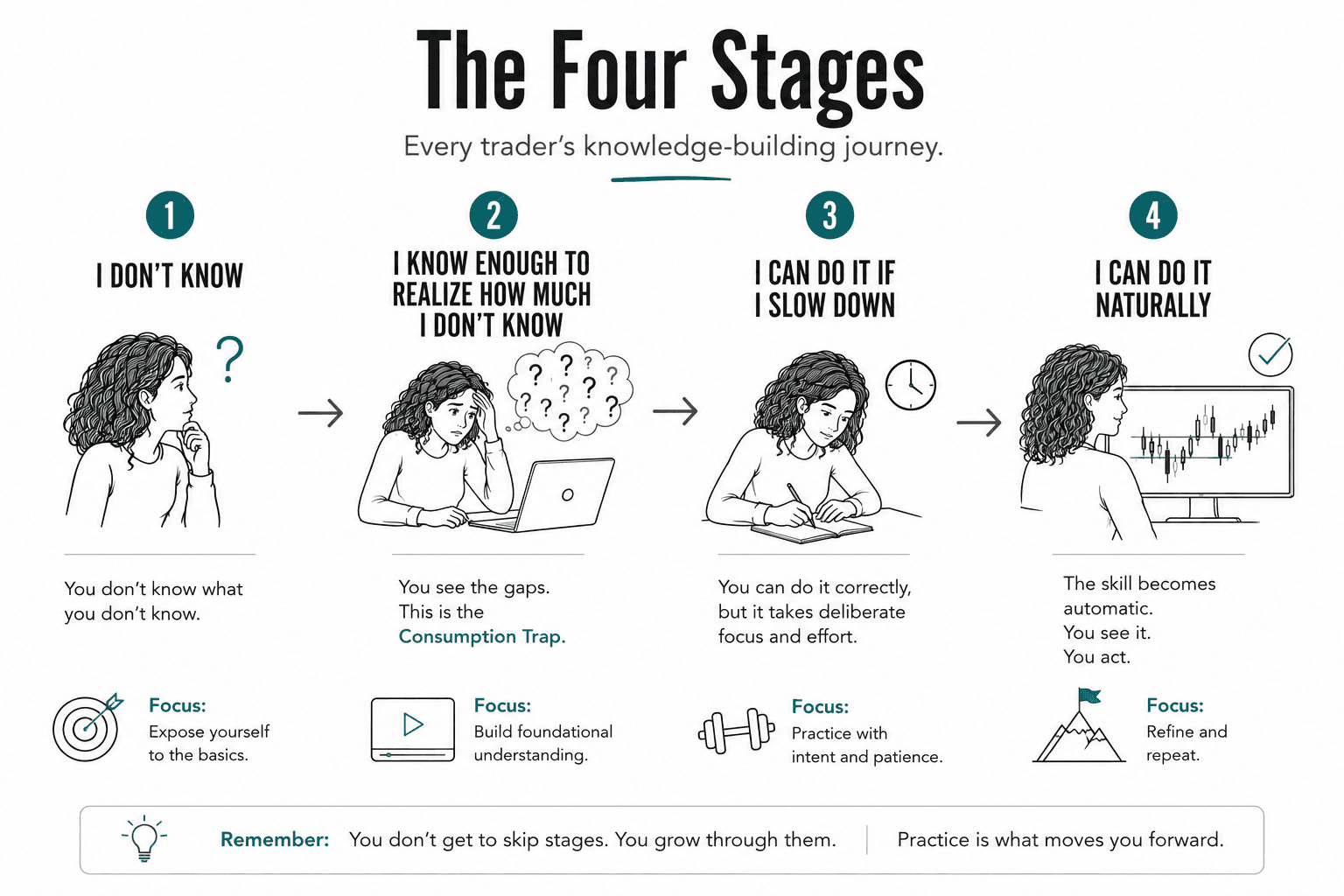
Stage 1: I Don’t Know
You don't know what you don't know. You probably think trading is just clicking a green button when a line goes up. Ah, sweet innocence.
Stage 2: I Know Enough to Realize How Much I Don’t Know
You finally know what you don't know. You’ve studied enough to see the massive, terrifying gaps in your knowledge. This is the Consumption Trap. Because you see so many gaps, you binge-watch tutorials to try and bridge them. If you've been studying for six months and still can't confidently tell if a chart is trending or ranging without looking at a paid indicator, you are officially stuck in Stage 2.
Stage 3: I Can Do It if I Slow Down
You can do the thing correctly, but it requires heavy mental lifting. You can spot a double top, but you have to squint and double-check your notes. You can calculate position sizing, but it takes you a solid three minutes of intense math.
Stage 4: I Can Do It Naturally
The Holy Grail. The skill becomes muscle memory. You glance at a chart for three seconds, and structural levels practically jump off the screen.
The Reality Check: Progressing to stages 3 and 4 requires repetition with brutal feedback. Consuming more Stage 2 content won't unstick you. Practice will.
The Diagnostics: Three Tests to Prove You're Actually Learning
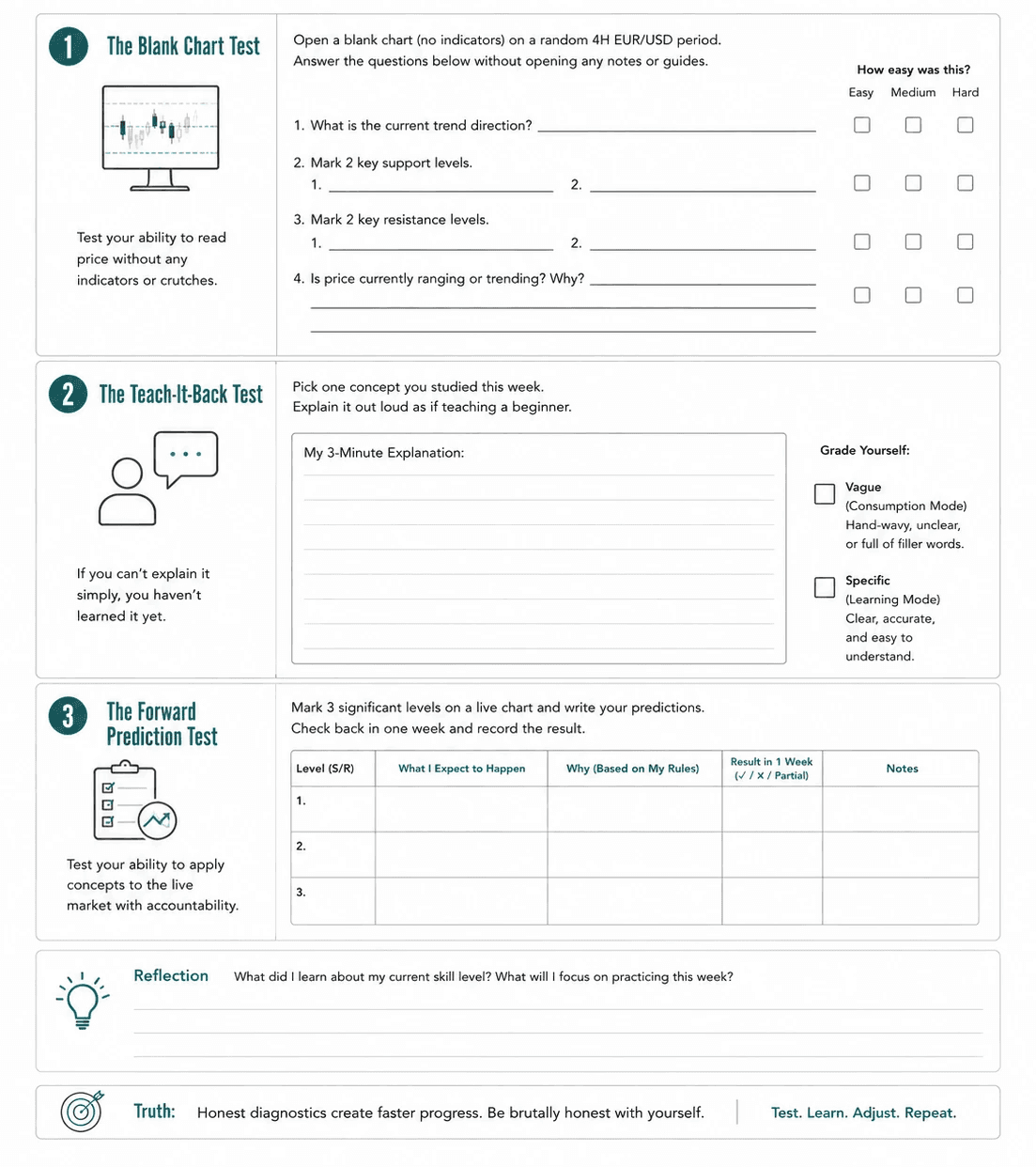
If you think you're genuinely learning, it's time to prove it to yourself. Run these three diagnostics:
Test 1: The Blank Chart Test
Open TradingView, pull up EUR/USD on the 4-hour chart, and turn off every single indicator. Scroll back to a random recent period. Can you, without opening a single notes tab:
Identify the current trend direction?
Mark the two most significant support levels?
Mark the two most significant resistance levels?
Identify whether price is currently ranging or trending?
If you struggle or hesitate, congratulations: you now know exactly what you need to practice.
Test 2: The Teach-It-Back Test
Pick a concept you studied this week. Set a timer for 3 minutes. Explain it out loud as if you are teaching someone who thinks "liquidity" is just a fancy word for water.
Now, grade yourself:
Vague (Consumption Mode): "Uh, it's kind of like when price goes up really fast, but then it sort of bounces off that one invisible ceiling thing..."
Specific (Learning Mode): "A hammer candle forms when sellers aggressively push the price down during the session, but buyers completely reject it, forcing the price back up near the open. This creates a long lower wick, which is highly significant at key support levels."
If your explanation is hand-wavy, you haven't learned it; you've just rented it.
Test 3: The Forward Prediction Test
Mark three significant levels on a live, current chart. Write down exactly what you expect to happen when price gets there (e.g., holds, breaks, forms a specific reversal candle).
Walk away. Wait a week. Go back and check. Were your predictions correct? More importantly, were they based on explicit, repeatable rules, or did you just rely on "vibes" and vague intuition? This test separates useful pattern recognition from sophisticated-sounding randomness.
Signs You're Addicted to Consumption
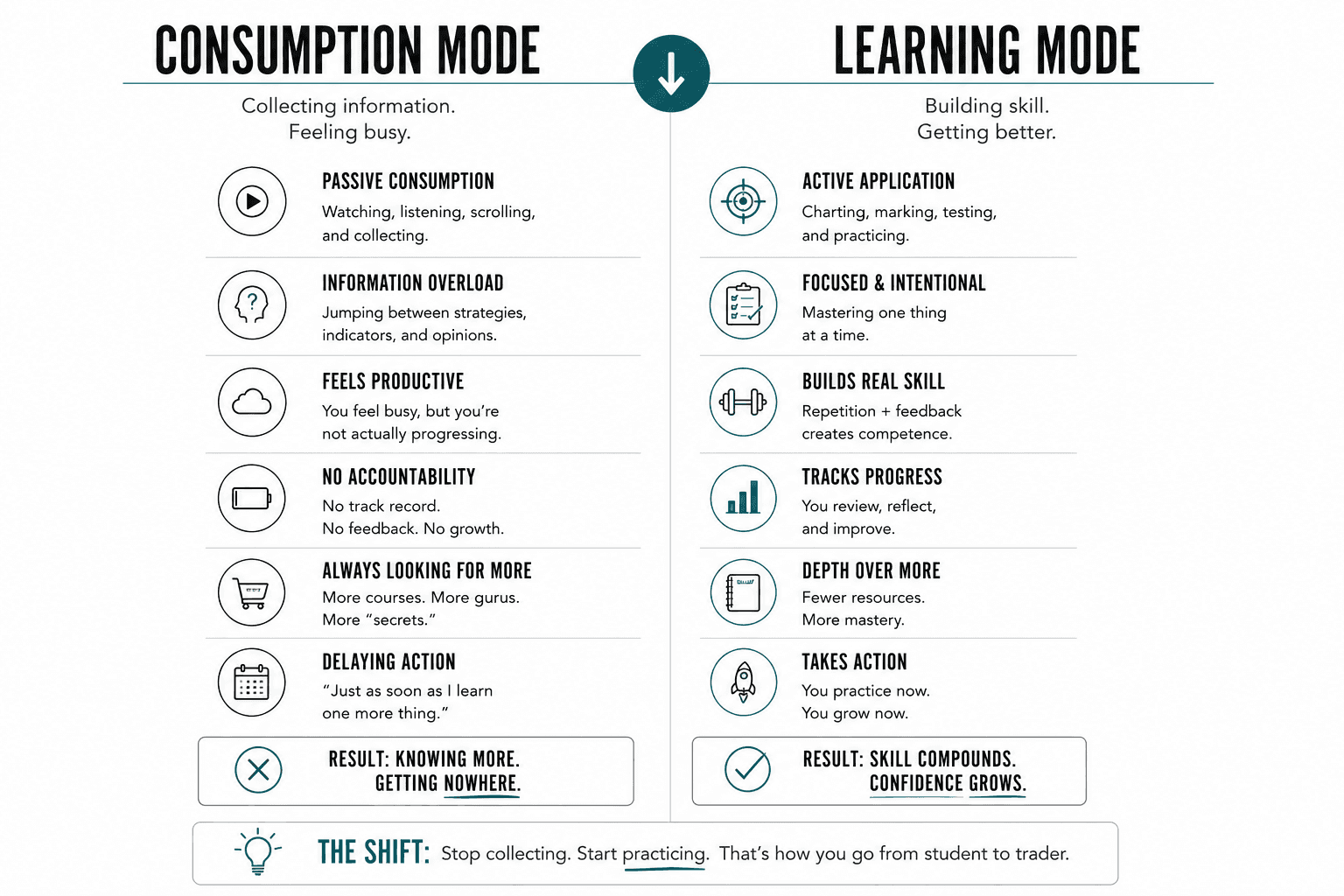
You might be stuck in Consumption Mode if:
You’ve "studied" 5+ different trading strategies but haven't paper-traded a single one for more than two consecutive weeks.
You can describe 10 different indicators in technical detail but can't identify a basic market trend without them.
You constantly tell yourself you'll start trading for real "just as soon as I learn this one last concept."
Your trading journal has fewer than 20 entries despite months of "studying."
Your strategy entry rules are entirely "contextual" (read: unwritten, improvised, and made up on the spot).
You’ve bought an expensive premium course before even bothering to exhaustively paper-trade the free content available online.
How to Break the Addiction and Start Learning
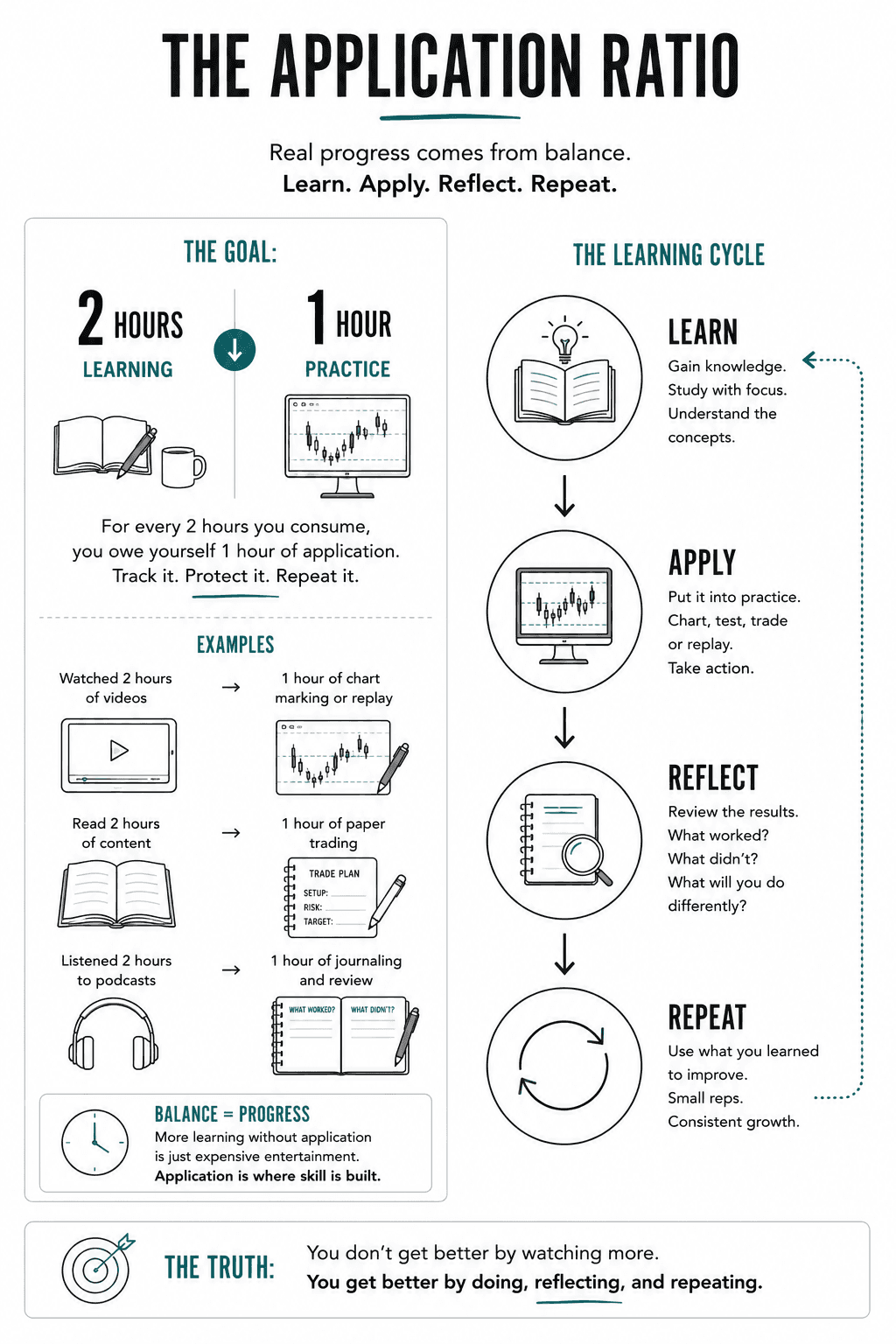
Enforce an Application Quota: For every 2 hours of trading content you consume, you owe the universe 1 hour of manual chart marking, paper trading, or replay sessions. Track this ratio for two weeks.
Put Your Inputs on a Strict Diet: Choose exactly two educational resources to follow this month. Ruthlessly block, mute, and ignore everything else. More sources do not equal more profit; it just equals context-switching and analysis paralysis.
Start the Journal Today. Not Tomorrow: Day one of demo trading is day one of journaling. If your only entry for the session is "Watched 2 hours of chart replay, noticed that the 15m structure breaks often fail during lunch," that is infinitely better than an empty page.
Give Yourself a Hard Execution Deadline: If you haven’t placed a demo trade within the next two weeks, you're a spectator, not a trader. Pick any strategy, write down your current best understanding of the rules, and start executing.
Learning doesn't happen when you read the map. It happens when you walk the terrain, trip over a rock, adjust your boots, and keep walking. Content is just the map. The chart is the territory.
Success Criteria
After completing this lesson, you should be able to:
Execute the Blank Chart Test: Correctly identify trend direction and map key support/resistance levels on a raw 4-hour chart without the aid of indicators or external notes.
Pass the Teach-It-Back Test: Explain any recently studied trading concept using concrete, mechanic-based language rather than vague, intuitive descriptions.
Enforce a 2:1 Application Ratio: Intentionally match every two hours of educational content with at least one hour of data collection, journaling, or manual chart analysis.
Maintain a Day-One Demo Journal: Record a minimum of 20 consecutive session entries documenting specific chart observations and rule-based practice setups.
Common Misconception
Watching expert analysis is a form of practice that makes me a better trader.
The Truth: It isn’t. Binging tutorials and watching others mark up historical data creates a psychological illusion of competence. It feels like productive work because it fills time and builds a library of theoretical knowledge, but it carries zero execution risk. True skill development only occurs when your brain is forced to navigate an unmapped chart, make definitive predictions, and absorb the feedback of being wrong. Content is just the map; the live chart is the territory.
FAQ's
Q: Is there a quick test to check if I've actually retained something?
Q: What if I've spent the last 6 months just watching videos without doing any charting?
Q: How much trading content is too much?
Table of Contents
About Me

Krista Weber
After a career as a VP of UX and EdTech executive, I retired early—and quickly realized the traditional world of trading education is fundamentally broken.
As someone with a Master’s in HCI who specialized in the design of e-learning systems, I saw a massive gap: beginners aren't failing because trading is impossible; they’re failing due to massive cognitive overload and terrible instructional design.
This site bridges that gap. I’m applying the principles of learning science, systems thinking, and minimalist UX to strip away the market noise and teach trading the way it actually should be taught.
Stay in Touch
Some of the pages on my travel blog contain affiliate links. Whenever you buy something through one of these links, I get a small commission at no extra cost to you. As an affiliate, I only recommend products and services that I feel are high quality and helpful to my readers. Thanks for your support.
Read More

Open almost any trading platform and you'll see EUR/USD sitting next to XAU/USD, NQ, ES, and a dozen CFDs on stocks you've heard of. They all show up as candlesticks moving left to right, which quietly implies they're all the same kind of thing. They aren't. Before going deeper into any one of them, it's worth drawing the map.
Updated on Sep 6, 2026

Futures are standardized contracts tied to defined specifications and a future settlement date. They can look complex at first, but the mechanics become much clearer once you know what the contract specification controls. Here's what you actually need to know.
Updated on Sep 6, 2026

CFDs appear everywhere in retail trading – but most new traders couldn't explain exactly what they are or why that matters. Here's a plain-language breakdown, including the parts that most introductions skip.
Updated on Sep 6, 2026