
The Difference Between Gambling and Trading
People ask whether trading is gambling more than they ask whether surgery is gambling, even though both involve uncertainty and high stakes. The honest answer is that trading can be gambling, and frequently is. Here's how to tell the difference, and why it matters.

Learning Path Stage 1: Foundations
Learning Level 2: Understanding
Primary Learning Objective
By the end of this lesson, you will be able to Distinguish between trading behaviors that build a long-term edge and gambling behaviors driven by emotion or chance.
The Real Difference
Build a genuine edge, and trading stops being a bet.
An edge isn't magic, and it certainly isn't certainty. It is a positive-expectancy strategy: a consistent decision-making process that, over a large enough sample size, ensures your total wins outweigh your total losses.
Without an edge, trading is just high-stakes gambling in a business casual format. The fact that you are staring at a brokerage platform instead of a casino floor is purely cosmetic.
With a real edge that is consistently applied and properly risk-managed, trading transforms into a game of probabilities. It might feel identical in the heat of the moment, but the math underneath tells a completely different story. The real work of becoming a trader isn't clicking the buy and sell buttons; it’s finding and developing that edge. Skipping that step and diving straight into live capital isn't trading. It's just a very expensive hobby.
What Makes Something Gambling
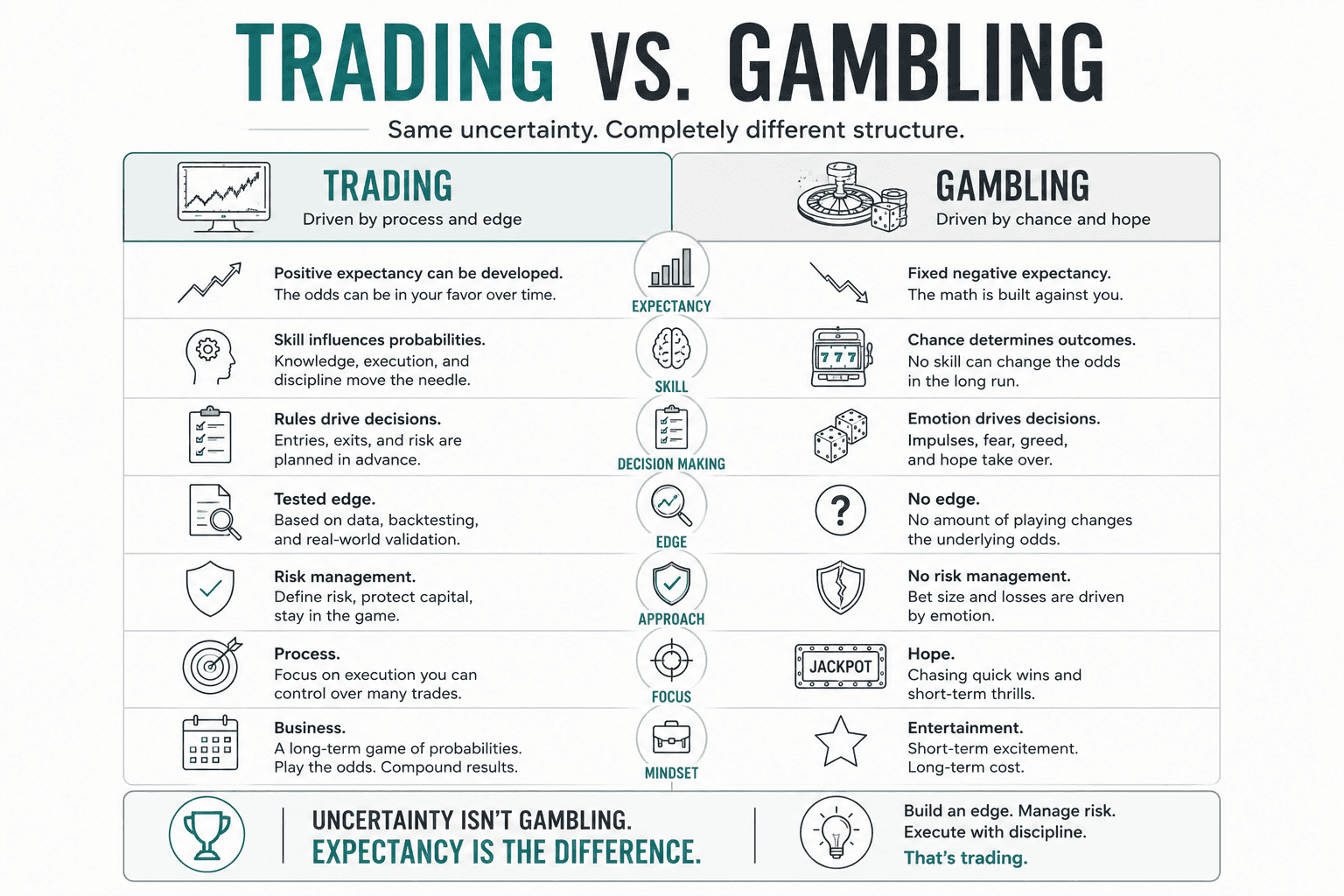
In a structural sense, gambling is defined by three distinct traits:
Fixed Negative Expectancy: The math is rigged against you from day one. The casino’s house edge ensures that consistent play inevitably leads to a zero balance. No amount of personal talent can rewrite the rules of the game.
Zero Skill Component to Shift the Odds: While skilled poker players can find positive expectancy against other humans, pure chance games like slots, roulette, or the lottery couldn't care less about your intelligence. "Systems" like the Martingale don't change the odds; they just change the speed and theatricality of your eventual loss.
An Emotional Structure Built for Compulsion: Gambling environments are intentionally designed to hijack your rational brain. Variable rewards, the illusion of a "near-miss," social validation, and complete time distortion ensure that you stop making expected-value calculations and start acting on raw emotion.
If you approach the markets incorrectly, trading will gladly check all three of these boxes for you.
What Makes Trading Different (When Done Right)
Non-Fixed Expectancy: Unlike a casino, the market isn't a closed loop designed to systematically harvest your capital. It’s a dynamic marketplace populated by participants with wildly different skill levels, information pipelines, and time horizons. Developing a strategy that extracts a positive expectancy over time is entirely possible. It's not guaranteed, but it's why professional firms exist.
Skill Actually Moves the Needle: Reading price structure, managing risk parameters, executing flawlessly under pressure, and maintaining ruthless psychological discipline are genuine, measurable skills. They take significantly longer to develop than a flashy YouTube ad implies, but they produce a stark, undeniable difference in long-term results.
Asymmetrical Risk Management: A casino will never let you dynamically size your bet mid-hand based on how confident you feel about the dealer's cards. In trading, you have the ultimate weapon: you can risk next to nothing when structural conditions are muddy, and scale up appropriately when a high-probability zone aligns perfectly. This ability to adjust your risk dynamically is a luxury gamblers will never have.
When Trading Slides into Gambling
Even if you possess a brilliant strategy, you cross the line into gambling the moment:
You Abandon the Playbook: You have an edge, but you discard the rules the second a trade becomes uncomfortable. Taking impulsive setups the strategy didn't call for, skipping valid entries out of fear, or dragging your stop loss back to avoid taking a hit … these actions have completely unknown expectancy. You've left the reservation.
You Size Up Emotionally: Doubling your position size because you're on a "hot streak," or cranking up the risk to aggressively claw back a loss ("I just need to break even for the day") is classic casino logic. Position sizing should be a boring, mathematical rule, not a reflection of your emotional state.
You Trade Without an Edge: If you are operating live in the markets without a thoroughly documented, verified strategy, you are gambling by default. It's the classic beginner trap. It's also exactly why surviving professionals obsess over simulation time and disciplined journaling before risking real capital.
The Practical Test
To diagnose exactly what you are doing on the charts today, ask yourself these five questions:
Do I have a clearly defined strategy with rigid, objective rules for entries and exits?
Has this exact strategy been backtested or forward-tested on simulation for a meaningful sample of at least 50–100 trades?
Have I tested this strategy over enough trades to know it has a positive expectancy?
Am I consistently executing this strategy, or am I making constant "discretionary exceptions" based on gut feel?
Is my position sizing determined by a strict, fixed risk percentage, or by how good the setup looks?
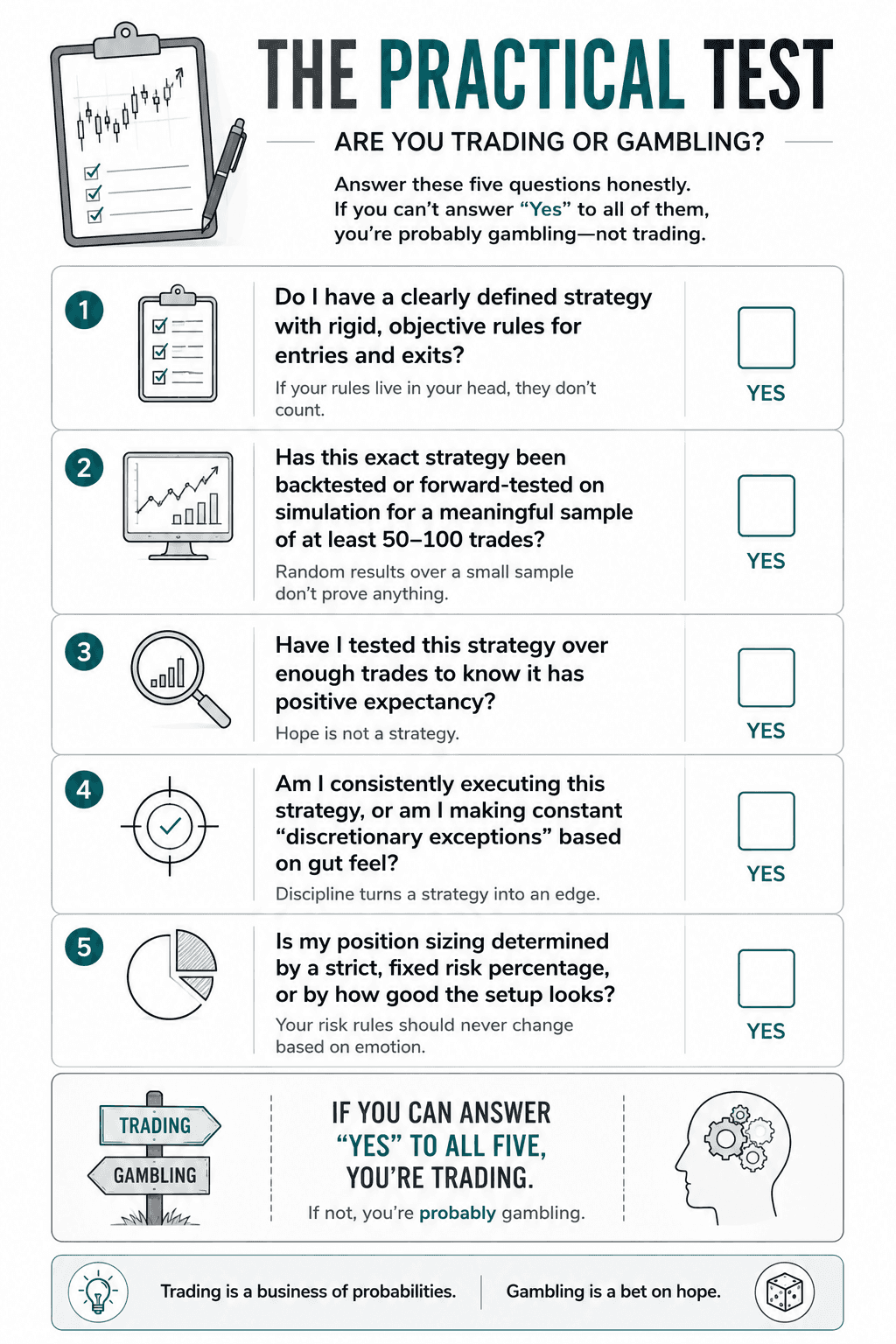
The difference between trading and gambling isn't certainty. It's whether your decisions, repeated over many outcomes, produce positive expectancy. That's a question you can actually answer.
If this distinction resonates with you, the next step isn't finding a better strategy. It's building behaviors that support disciplined execution. That's exactly what we'll explore in the next lesson on setting realistic trading goals.
Success Criteria
After completing this lesson, you should be able to:
Explain why uncertainty does not automatically make something gambling.
Describe the role of an edge and risk management in trading.
Recognize common behaviors that turn trading into gambling.
Common Misconception
Putting money at risk in an uncertain market is a gamble no matter how you dress it up.
The Truth: It’s easy to look at the cosmetics (charts, execution platforms, risk of loss) and assume the activities are identical. The misconception stems from conflating uncertainty with gambling. In pure chance games, no amount of skill can ever alter the fixed math against you. In trading, skill, structural context, and asymmetrical risk management dynamically tilt the probabilities in your favor. The difference isn't the presence of certainty; it's the math underneath. Without a tested edge, you are absolutely gambling, but with one, you are running a business of probabilities.
FAQ's
Q: If trading involves uncertainty, how is it actually different from roulette?
Q: Why does trading feel so much like gambling even when you have a plan?
Q: Is day trading gambling?
Table of Contents
About Me

Krista Weber
After a career as a VP of UX and EdTech executive, I retired early—and quickly realized the traditional world of trading education is fundamentally broken.
As someone with a Master’s in HCI who specialized in the design of e-learning systems, I saw a massive gap: beginners aren't failing because trading is impossible; they’re failing due to massive cognitive overload and terrible instructional design.
This site bridges that gap. I’m applying the principles of learning science, systems thinking, and minimalist UX to strip away the market noise and teach trading the way it actually should be taught.
Stay in Touch
Some of the pages on my travel blog contain affiliate links. Whenever you buy something through one of these links, I get a small commission at no extra cost to you. As an affiliate, I only recommend products and services that I feel are high quality and helpful to my readers. Thanks for your support.
Read More

Open almost any trading platform and you'll see EUR/USD sitting next to XAU/USD, NQ, ES, and a dozen CFDs on stocks you've heard of. They all show up as candlesticks moving left to right, which quietly implies they're all the same kind of thing. They aren't. Before going deeper into any one of them, it's worth drawing the map.
Updated on Sep 6, 2026

Futures are standardized contracts tied to defined specifications and a future settlement date. They can look complex at first, but the mechanics become much clearer once you know what the contract specification controls. Here's what you actually need to know.
Updated on Sep 6, 2026

CFDs appear everywhere in retail trading – but most new traders couldn't explain exactly what they are or why that matters. Here's a plain-language breakdown, including the parts that most introductions skip.
Updated on Sep 6, 2026