
Building Your FX Watchlist
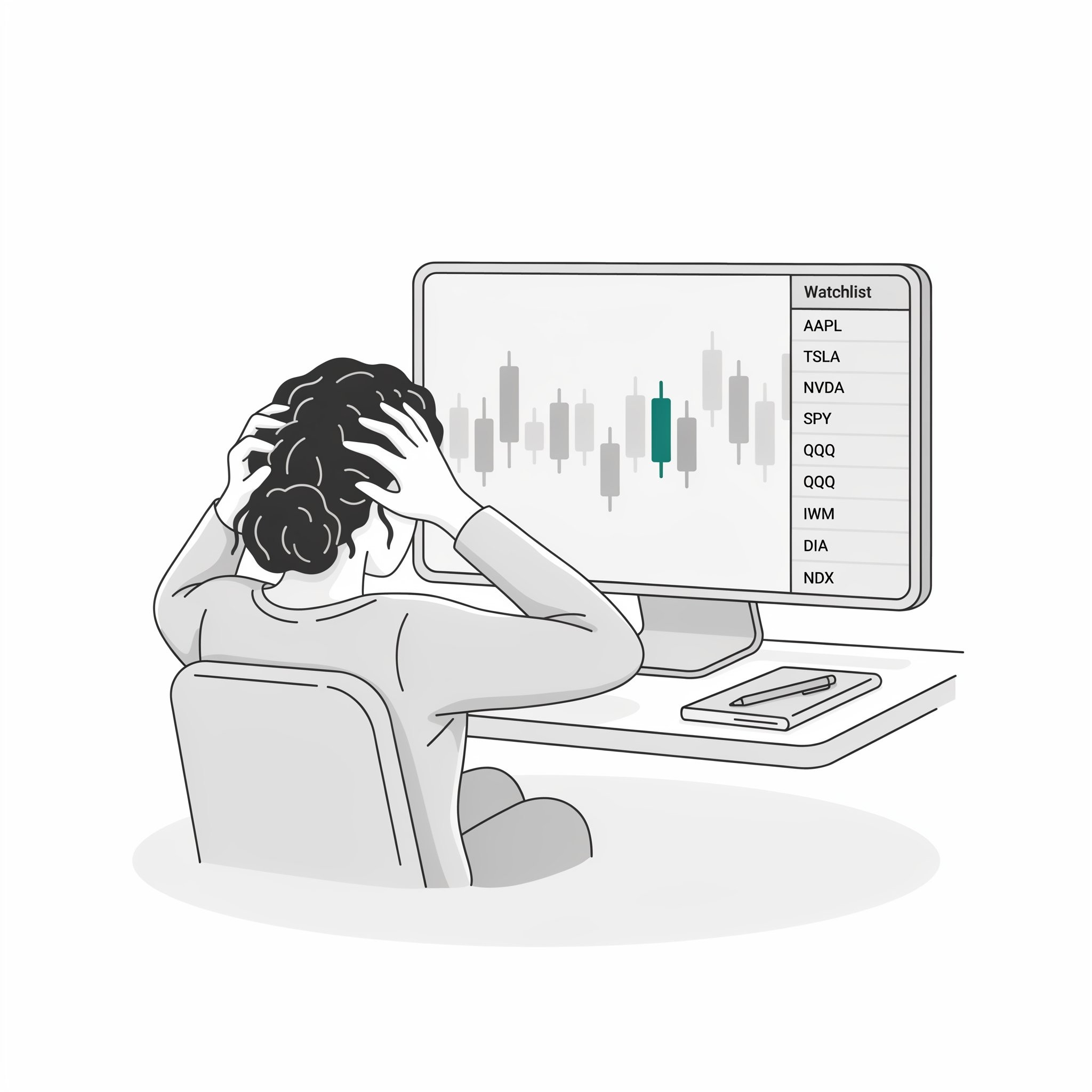
A watchlist is not just a list of markets to watch. It's a decision about where to concentrate your attention and build expertise. Watching too many instruments spreads attention thin; watching too few limits opportunity. The process of building a focused, deliberate watchlist is part of building a trading approach that's actually sustainable.
Learning Path Stage 6: Find Your Strategy
Learning Level 2: Understanding
Primary Learning Objective
By the end of this lesson, you will be able to build a focused forex watchlist and explain the criteria used to select instruments worth monitoring.
Cut your watchlist down to four instruments and you'll read price action better within weeks.
Most new traders watch everything. Every major forex pair, a handful of indices, some commodities, whatever showed a setup yesterday. Experienced traders watch far fewer instruments, with far greater depth.
The fewer instruments you track, the more you learn about how each one moves: its typical session behavior, its response to specific news catalysts, the structural levels that matter across timeframes. Deep knowledge of a small number of instruments beats shallow familiarity with many.
Why Watchlist Size Matters
Each instrument you track requires genuine attention:
-The current structure on the daily chart
-The relevant trading session (each pair has sessions where it's most active and liquid)
-The economic calendar events that move this instrument most
-A mental model of how this pair behaves under different conditions
Tracking 20 pairs means tracking all of these things for 20 pairs. For most traders still learning, that's cognitive overload. Attention spreads too thin to build the familiarity that produces good reads.
Five pairs tracked with genuine depth produces better results than 20 pairs tracked on the surface.
How to Choose Your Instruments
Start with what you can observe during your trading time. Each forex pair has a primary session where it's most active:
-EUR/USD, GBP/USD, EUR/GBP - most active during the London session and London/New York overlap
-AUD/USD, NZD/USD - most active during the Asian session and London open
-USD/JPY - active across multiple sessions
If you can only trade from 7am-9am EST, London-active pairs are your natural starting point. Picking pairs that are active when you aren't is a structural disadvantage.
Choose pairs with lower spreads. Wider spreads mean higher trading costs and more price action that's noise from the spread, not genuine directional movement.
-Major pairs (EUR/USD, GBP/USD, USD/JPY, USD/CHF, AUD/USD, USD/CAD, NZD/USD) have the tightest spreads at most brokers
-Minor pairs (pairs without USD) have wider spreads
-Exotics (pairs involving emerging market currencies) have the widest spreads and highest costs
Watch correlated pairs together, or not at all. EUR/USD and GBP/USD move in the same direction most of the time. Watching both without understanding this correlation creates the illusion of two independent setups when they're often the same trade. Either understand the correlation and use it deliberately, or remove one of the correlated pairs to reduce redundancy.
Use indices and commodities as context, not necessarily as trading instruments. Knowing what the S&P 500 is doing during the New York session gives useful context for USD pairs. Gold (XAU/USD) behavior tells you something about risk sentiment. You can track these for context without actively trading them.
A Starter Watchlist for New Traders
A focused starting point:
-2-3 major pairs in your primary session. If you trade London: EUR/USD, GBP/USD, and one more. If you trade the Asian session: USD/JPY and AUD/USD. Understand these pairs in depth rather than trading a wide variety.
-One contextual instrument. Gold or the DXY (Dollar Index) as a USD strength and risk sentiment indicator. Not to trade, just to understand the broader environment.
That's four things to watch. That's enough. Many successful traders watch fewer.
Success Criteria
After completing this lesson, you should be able to identify 5-8 instruments suited to your trading approach and session timing, and explain why a shorter watchlist typically produces better results than monitoring everything.
Common Misconception
A bigger watchlist gives you more opportunities.
The Truth: Monitoring more instruments creates attention dilution, and experienced traders typically watch fewer instruments more deeply rather than more instruments more shallowly.
FAQ's
Q: Should I trade the same pairs forever?
Q: Are there pairs beginners should avoid?
Q: I'm missing good setups on pairs I'm not watching. Should I expand my watchlist?
Table of Contents
About Me

Krista Weber
After a career as a VP of UX and EdTech executive, I retired early—and quickly realized the traditional world of trading education is fundamentally broken.
As someone with a Master’s in HCI who specialized in the design of e-learning systems, I saw a massive gap: beginners aren't failing because trading is impossible; they’re failing due to massive cognitive overload and terrible instructional design.
This site bridges that gap. I’m applying the principles of learning science, systems thinking, and minimalist UX to strip away the market noise and teach trading the way it actually should be taught.
Stay in Touch
Some of the pages on my travel blog contain affiliate links. Whenever you buy something through one of these links, I get a small commission at no extra cost to you. As an affiliate, I only recommend products and services that I feel are high quality and helpful to my readers. Thanks for your support.
Read More

Open almost any trading platform and you'll see EUR/USD sitting next to XAU/USD, NQ, ES, and a dozen CFDs on stocks you've heard of. They all show up as candlesticks moving left to right, which quietly implies they're all the same kind of thing. They aren't. Before going deeper into any one of them, it's worth drawing the map.
Updated on Sep 6, 2026

Futures are standardized contracts tied to defined specifications and a future settlement date. They can look complex at first, but the mechanics become much clearer once you know what the contract specification controls. Here's what you actually need to know.
Updated on Sep 6, 2026

CFDs appear everywhere in retail trading – but most new traders couldn't explain exactly what they are or why that matters. Here's a plain-language breakdown, including the parts that most introductions skip.
Updated on Sep 6, 2026