
Why Paper Trading Is More Than "Fake Trading"
Paper trading has an image problem. Used honestly, it's a sandbox for making your expensive beginner mistakes while they're still free.
Learning Path Stage 1: Foundations
Learning Level 2: Understanding
Primary Learning Objective
By the end of this lesson, you will be able to design a useful paper trading practice that develops genuine skills rather than false confidence.
Paper trading has an image problem. The name works against it. Paper trading, demo trading, practice mode: every label makes it sound like the trading equivalent of a coloring book. Not the real thing. A waiting room you sit in until the actual experience begins.
That framing does beginners a real disservice, because paper trading is one of the most sensible tools available to someone learning the craft. It just has to be understood for what it genuinely is, including its limits.
By now you know what paper trading is and how to set up a practice environment. The more interesting question is whether it actually prepares you for live trading.
The Honest Limitation
Here is where a lot of trading advice gets quietly dishonest, so it's worth being direct. Paper trading does not simulate emotion.
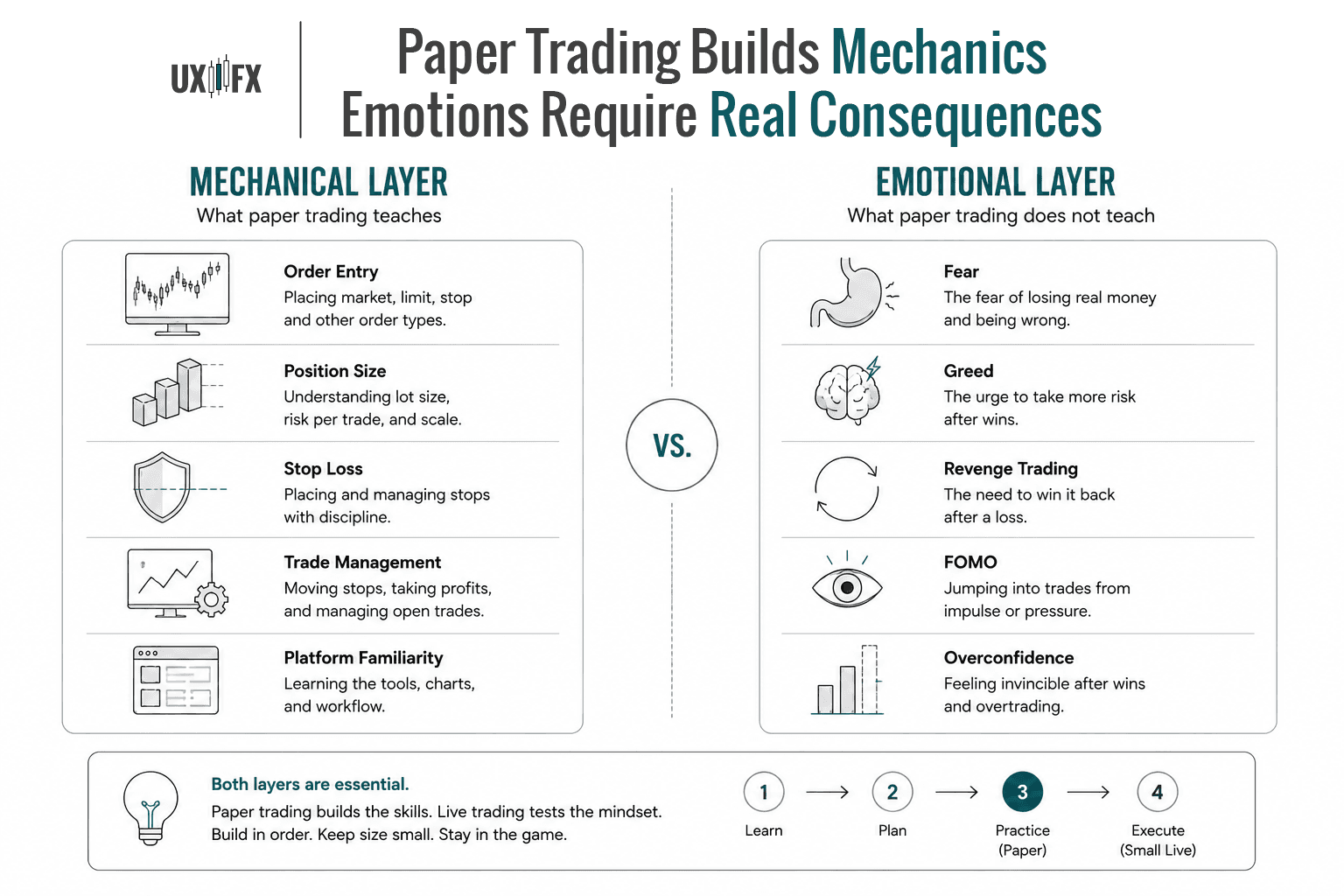
When you lose fake money, nothing happens inside you. There is no drop in your stomach, no urge to immediately win it back, no temptation to abandon your plan. When you win fake money, there is no rush of overconfidence pushing you to size up recklessly on the next trade. The mechanical layer of trading is fully present in a demo account. The emotional layer is almost entirely absent.
That matters because emotion is where most trading difficulty actually lives. Plenty of people can follow a plan calmly when nothing is at stake and then watch that same plan dissolve the moment real money introduces real feeling. Paper trading cannot prepare you for that part, and any source that promises it can is overselling.
So it's best to be precise about what paper trading teaches. It teaches mechanics, process, and familiarity. It does not teach emotional discipline. Knowing that distinction is what lets you use the tool well instead of being surprised by it later.
How to Use It Well
Because paper trading carries no consequences, it is extremely easy to use it badly. This is the most common failure, and it's worth describing plainly.
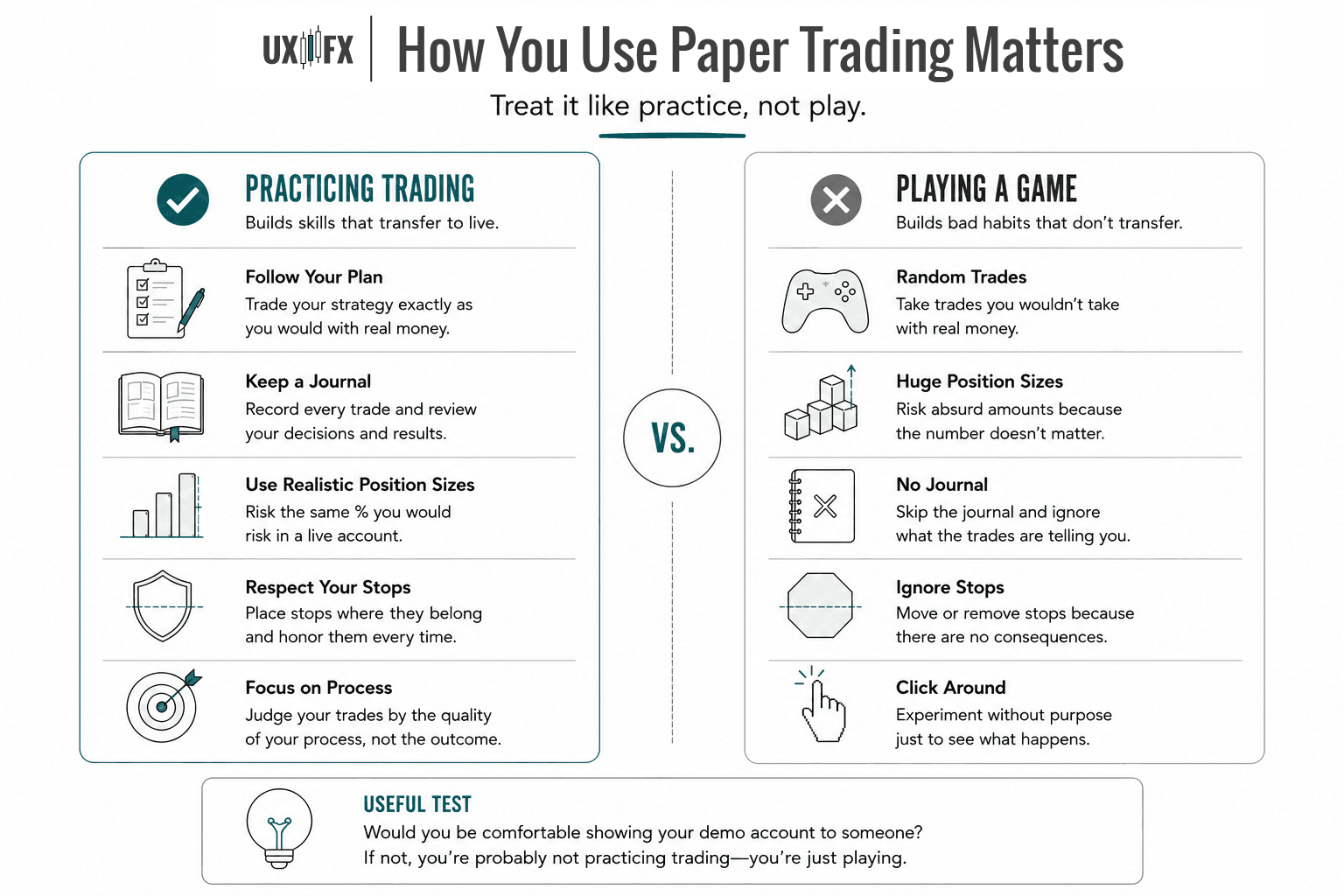
When nothing is at stake, the temptation is to treat the demo account like a video game. You take trades you would never take with real money. You risk absurd amounts because the number means nothing. You skip the journal, ignore your own rules, and click around to see what happens. Then, months later, you fund a live account and feel genuinely betrayed when live trading bears no resemblance to your demo success.
Of course it doesn't. You weren't practicing trading. You were practicing not caring.
The value of paper trading is entirely determined by how honestly you use it. If you treat the simulated money as if it were real, sizing positions sensibly, respecting your stop losses, following your plan, and recording every trade, then the practice transfers. You are building genuine procedural habits. If you treat it as a consequence-free playground, you are building habits too. They are just the wrong ones.
A useful test is to trade the demo account in a way you would not be embarrassed to show someone. If a trade only makes sense because the money is fake, it isn't practice. It's noise.
Paper Trading Isn't the First Step
There's a sequencing point worth making, because it's easy to get this backwards. Paper trading is genuinely valuable, but only once you have something to practice.
If you open a demo account before you understand what you are doing, you aren't practicing trading. You're practicing clicking. The screen will happily let you buy and sell with no idea why, and because nothing is at stake, nothing will stop you. You can spend weeks that way and come out knowing the buttons but not the craft.
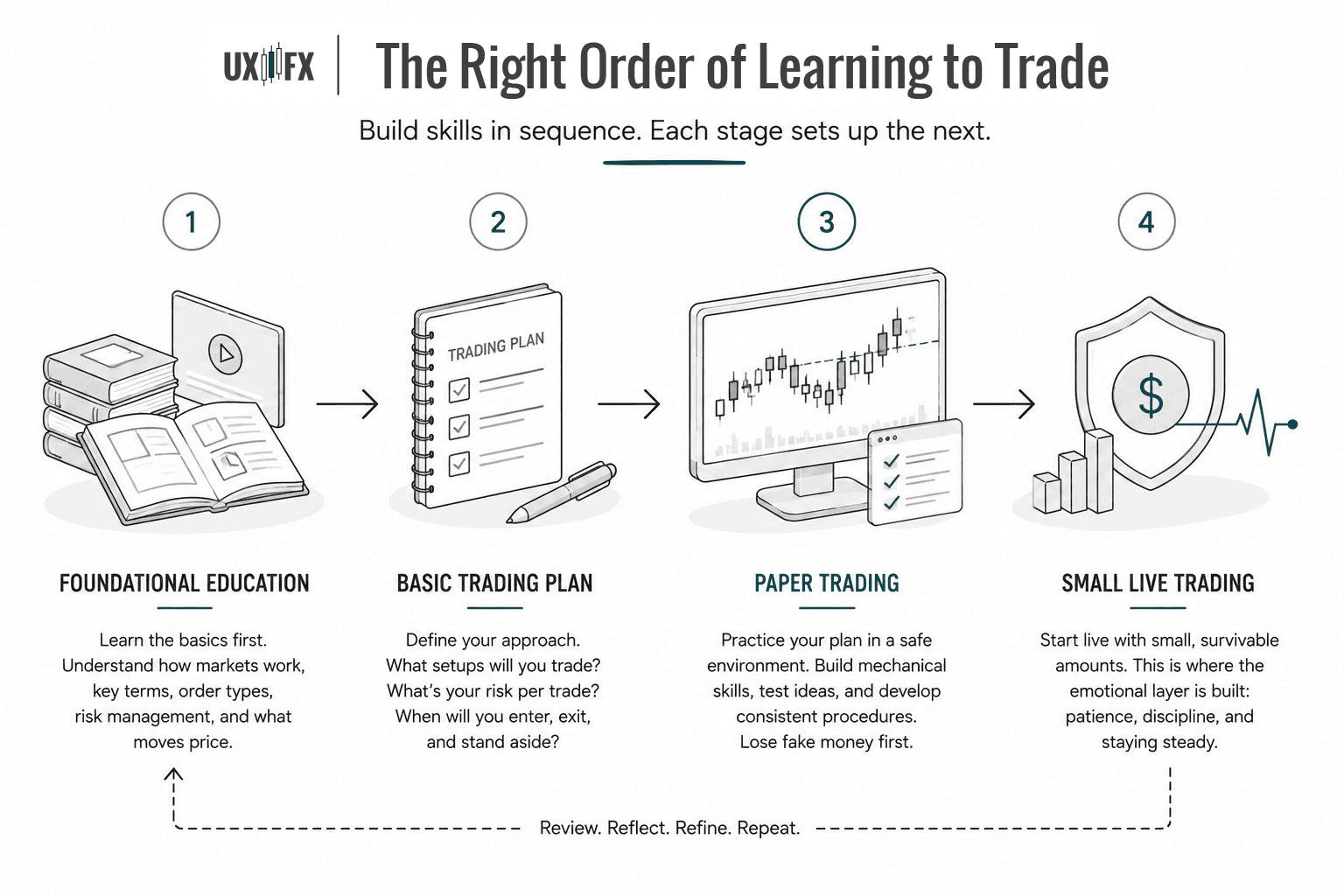
So paper trading sits a little later in the order than people assume. First comes the foundational knowledge, the structured free education that explains what a pip is, how a stop loss works, and what actually moves a market. Then comes a basic plan, some idea of what you are looking for and why. Paper trading is the stage where you take that plan and test it. It's the rehearsal, not the syllabus.
This matters because a demo account is convincing. It looks exactly like the real thing, which can create a false sense that using it is the same as learning. It isn't. The platform can only show you what happens. It can't tell you what you should have been looking for. That part has to come from somewhere else first.
Where it Fits in the Bigger Picture
It helps to think of learning to trade as having two layers. There is the procedural layer, which is knowing how to operate, how to place and manage trades, and how to read what is in front of you. And there is the emotional layer, which is staying steady when real money makes everything feel louder.
Paper trading builds the first layer cleanly and cheaply. It cannot build the second. The emotional layer only really develops later, when you move to live trading with amounts small enough that a loss is genuinely survivable. Both layers are necessary, and they are best built in order. Trying to develop emotional discipline before you have even mastered the mechanics is just adding difficulty for no reason.
So paper trading isn't the waiting room before real trading begins. It's the first proper stage of the practical work. You lose fake money first because those particular losses, the clumsy mechanical beginner losses, are far better learned in a sandbox than on a live account. Save your real money for the lessons that genuinely require it.
Success Criteria
After completing this lesson, you should be able to describe what makes paper trading genuinely useful (treating it as real, tracking results rigorously) and what makes it incomplete (emotional absence), and structure a practice that accounts for both.
Common Misconception
Paper trading is useless because you don't feel the emotional pressure of real money.
The Truth: It's more accurate to say paper trading is incomplete without acknowledging that limitation; it's genuinely useful for developing mechanical execution, rule-following, and pattern recognition before adding the emotional variable.
FAQ's
Q: Does paper trading actually prepare you for real trading?
Q: How long should you paper trade before going live?
Q: What is paper trading?
Table of Contents
About Me

Krista Weber
After a career as a VP of UX and EdTech executive, I retired early—and quickly realized the traditional world of trading education is fundamentally broken.
As someone with a Master’s in HCI who specialized in the design of e-learning systems, I saw a massive gap: beginners aren't failing because trading is impossible; they’re failing due to massive cognitive overload and terrible instructional design.
This site bridges that gap. I’m applying the principles of learning science, systems thinking, and minimalist UX to strip away the market noise and teach trading the way it actually should be taught.
Stay in Touch
Some of the pages on my travel blog contain affiliate links. Whenever you buy something through one of these links, I get a small commission at no extra cost to you. As an affiliate, I only recommend products and services that I feel are high quality and helpful to my readers. Thanks for your support.
Read More

Open almost any trading platform and you'll see EUR/USD sitting next to XAU/USD, NQ, ES, and a dozen CFDs on stocks you've heard of. They all show up as candlesticks moving left to right, which quietly implies they're all the same kind of thing. They aren't. Before going deeper into any one of them, it's worth drawing the map.
Updated on Sep 6, 2026

Futures are standardized contracts tied to defined specifications and a future settlement date. They can look complex at first, but the mechanics become much clearer once you know what the contract specification controls. Here's what you actually need to know.
Updated on Sep 6, 2026

CFDs appear everywhere in retail trading – but most new traders couldn't explain exactly what they are or why that matters. Here's a plain-language breakdown, including the parts that most introductions skip.
Updated on Sep 6, 2026