
Why Most Chart Pattern Content Is Misleading
The problem was never chart patterns. It's that the usual way of teaching them strips out every honest qualifier, because honesty is quiet and qualifiers don't trend.

Learning Path Stage 1: Foundations
Learning Level 1: Recognition
Primary Learning Objective
By the end of this lesson, you will be able to critically evaluate chart pattern educational content and identify the specific ways it misrepresents how patterns actually perform.
There is an enormous amount of free chart pattern content available, which sounds like good news for a beginner. A lot of it, unfortunately, is misleading. Not because the people making it are all dishonest, though some are, but because the format itself rewards a particular kind of distortion.
It is worth understanding the distortion, because once you can see it, you can keep using the content without being fooled by it.
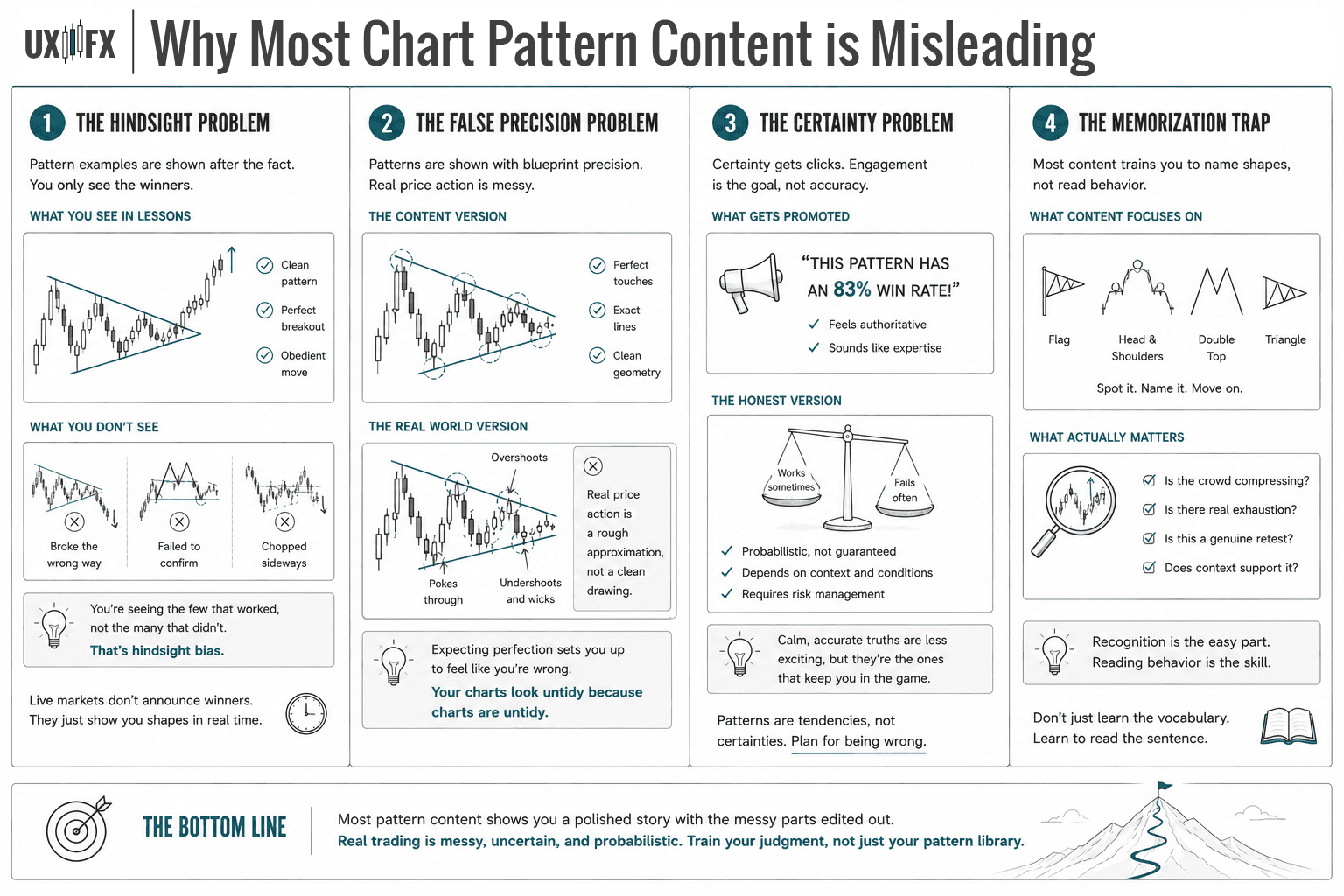
1.The Hindsight Problem
The single biggest issue is that pattern examples are almost always shown after the fact.
An instructor pulls up a chart, draws a tidy head and shoulders on it, and the pattern is followed by a clean, obedient move in exactly the predicted direction. It looks compelling. It also could not have looked any other way, because the chart was chosen for that reason.
You are seeing a pattern that already worked, selected from the much larger pile of patterns that did not. The textbook triangle that broke the wrong way is not in the lesson. The double top that quietly failed is not in the highlight reel. This is hindsight bias delivered as instruction, and it gives you a wildly inflated sense of how often patterns behave.
A real chart, watched live, does not announce which patterns will work. It just shows you shapes, and you have to decide in the moment. That experience is almost nothing like scrolling through a gallery of patterns that have already succeeded.
2.The False Precision Problem
The second issue is precision. Pattern content tends to show shapes drawn with the crispness of a technical blueprint, lines passing exactly through three candle wicks, the geometry suspiciously perfect.
Real price action is messier than that. Price overshoots, undershoots, pokes through a level and comes back, reacts slightly early. A pattern in the wild is a rough approximation, not a clean drawing. When content presents patterns as exact, it sets you up to expect a precision the market never offered, and to feel like you are doing something wrong when your charts look untidy. Your charts look untidy because charts are untidy.
3.The Certainty Problem
The third issue is that certainty gets engagement, and engagement is what most content is optimized for.
"This pattern has an 83 percent win rate" performs better than "this pattern is a rough behavioral tendency that works sometimes." Numbers feel authoritative. A confident claim feels like expertise. Pattern content drifts toward false certainty, because the calm, accurate version is less shareable.
The honest version is of chart patterns is less exciting. Patterns are probabilistic. They reflect crowd behavior, they work when conditions line up, and they fail often enough that you must plan for it. That is the accurate description, and it will rarely be the most popular video on the topic. A calm and accurate explanation has never quite gone viral, and probably never will.
4.The Memorization Trap
There is also a subtler problem in how patterns are usually taught. Most content trains you to identify and name shapes, as though recognition were the skill.
Recognition is the easy part. Anyone can learn to spot a flag in a week. The actual skill is reading the behavior underneath the shape, understanding whether the crowd is genuinely compressing, exhausting, or repeating a test. Content that drills you on naming shapes can leave you feeling educated while skipping the part that matters. You become fluent in the vocabulary and still cannot read the sentence.
What Good Pattern Content Looks Like
It is worth knowing the opposite, so you can recognize the better sources.
Good pattern content tends to show failures alongside successes, because it is trying to teach behavior rather than sell confidence. It draws patterns loosely, as zones rather than razor lines, and says so. It explains why a pattern reflects a particular crowd situation, instead of just asserting that the shape is powerful. And it talks about context, about what was happening around the pattern, rather than presenting the shape as a self-contained spell.
If a source consistently does those things, it is probably worth your time. If it only ever shows tidy winners and quotes suspiciously specific win rates, it is optimized for engagement, and you should grade everything it says accordingly.
How To Use Pattern Content Anyway
None of this means you should avoid pattern content. It means you should adjust how you receive it.
When you see a clean retrospective example, remind yourself you are looking at a survivor. When you see a perfectly drawn pattern, mentally rough it up, because the live version will be messier. When you see a confident win rate, treat it as a sign the source is selling certainty rather than teaching behavior. And when content only teaches you to name shapes, treat that as the beginning of the topic, not the end of it.
The problem was never chart patterns themselves. Patterns are a reasonable, useful idea. The problem is that the most common way of teaching them strips out every honest qualifier, because honesty is quiet and qualifiers do not trend. Keep the qualifiers. They are the part that keeps the patterns useful.
Success Criteria
After completing this lesson, you should be able to identify the presentation biases (cherry-picking, hindsight selection, survivorship bias ) that make chart pattern content look more reliable than it is in real-time trading.
Common Misconception
Textbook chart patterns perform reliably when properly identified.
The Truth: Published pattern content is overwhelmingly selected from the clearest historical examples, not representative ones, which systematically overstates how often clean setups appear and how reliably they resolve.
FAQ's
Q: What is survivorship bias in chart pattern examples?
Q: How should you actually learn chart patterns?
Q: Why is most chart pattern education misleading?
Table of Contents
About Me

Krista Weber
After a career as a VP of UX and EdTech executive, I retired early—and quickly realized the traditional world of trading education is fundamentally broken.
As someone with a Master’s in HCI who specialized in the design of e-learning systems, I saw a massive gap: beginners aren't failing because trading is impossible; they’re failing due to massive cognitive overload and terrible instructional design.
This site bridges that gap. I’m applying the principles of learning science, systems thinking, and minimalist UX to strip away the market noise and teach trading the way it actually should be taught.
Stay in Touch
Some of the pages on my travel blog contain affiliate links. Whenever you buy something through one of these links, I get a small commission at no extra cost to you. As an affiliate, I only recommend products and services that I feel are high quality and helpful to my readers. Thanks for your support.
Read More

Open almost any trading platform and you'll see EUR/USD sitting next to XAU/USD, NQ, ES, and a dozen CFDs on stocks you've heard of. They all show up as candlesticks moving left to right, which quietly implies they're all the same kind of thing. They aren't. Before going deeper into any one of them, it's worth drawing the map.
Updated on Sep 6, 2026

Futures are standardized contracts tied to defined specifications and a future settlement date. They can look complex at first, but the mechanics become much clearer once you know what the contract specification controls. Here's what you actually need to know.
Updated on Sep 6, 2026

CFDs appear everywhere in retail trading – but most new traders couldn't explain exactly what they are or why that matters. Here's a plain-language breakdown, including the parts that most introductions skip.
Updated on Sep 6, 2026