
The UX to FX Learning Journey
The content is organized in two ways: by topic and by learning level. Topics are things like chart patterns, risk management, and trading psychology. Learning levels describe how deeply you're engaging with those topics, and they follow a specific sequence, because that sequence helps you reach higher levels of learning.
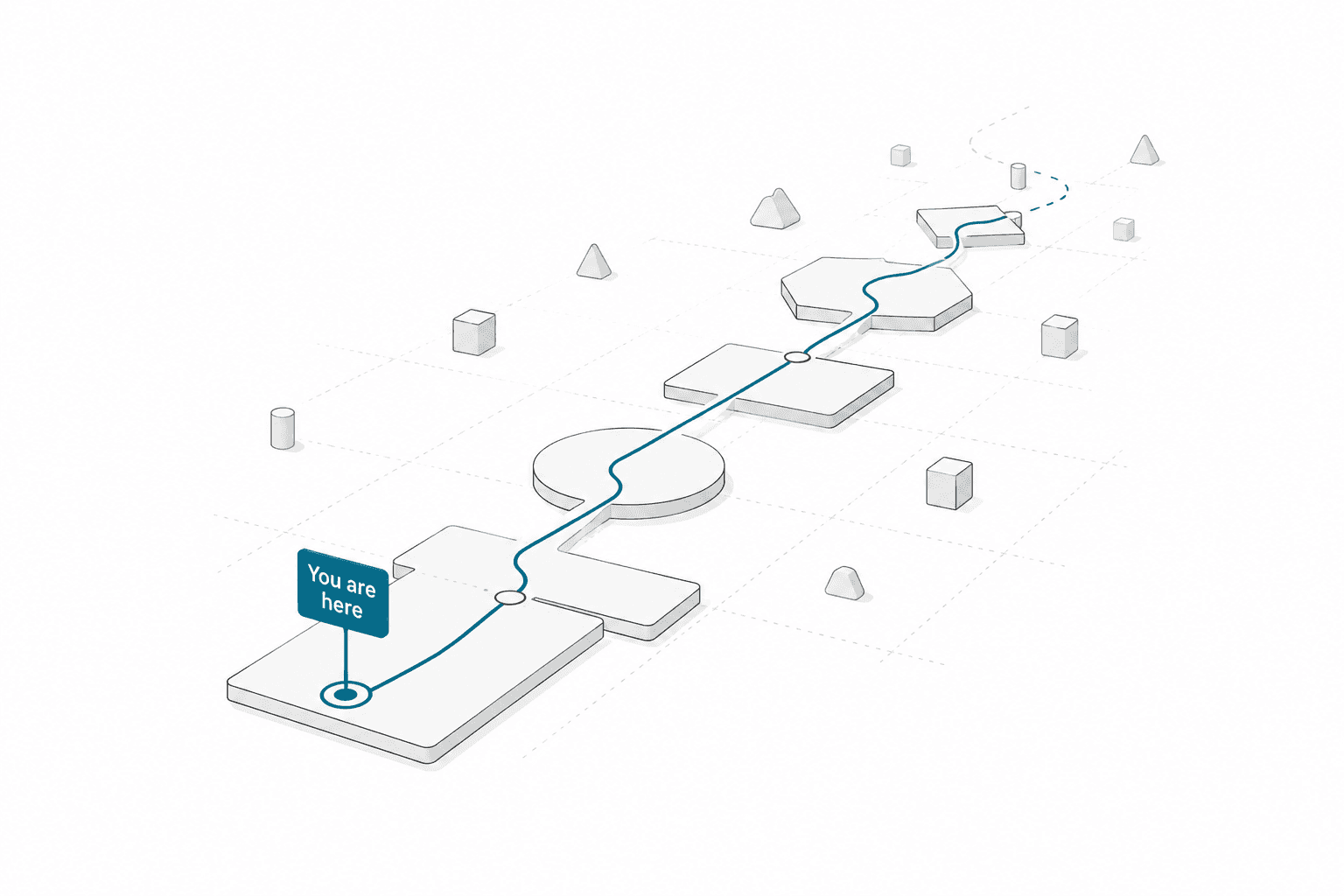
Learning Path Stage 1: Foundations
Learning Level 1: Recognition
Primary Learning Objective
By the end of this lesson, you will be able to navigate the UX to FX learning path and understand how each stage builds on the previous one.
Most trading education teaches you how to recognize patterns. UX to FX teaches you how to think through them.
Most trading education dumps information on you: definitions, patterns, indicators, strategies. Then it assumes you've learned something.
You haven't.
You can read a hundred articles about support and resistance and still freeze when you need to mark a level on a live chart. You can memorize every candlestick pattern and still have no idea which one matters right now, on this timeframe.
Information is not understanding. Understanding is not application. And application is very far from good judgment.
This site is built around that gap. Content is organized two ways: by topic and by learning level. Topics cover things like chart patterns, risk management, and trading psychology. Learning levels describe how deeply you're engaging with those topics, and they follow a specific sequence - because that sequence matters.
The Learning Ladder
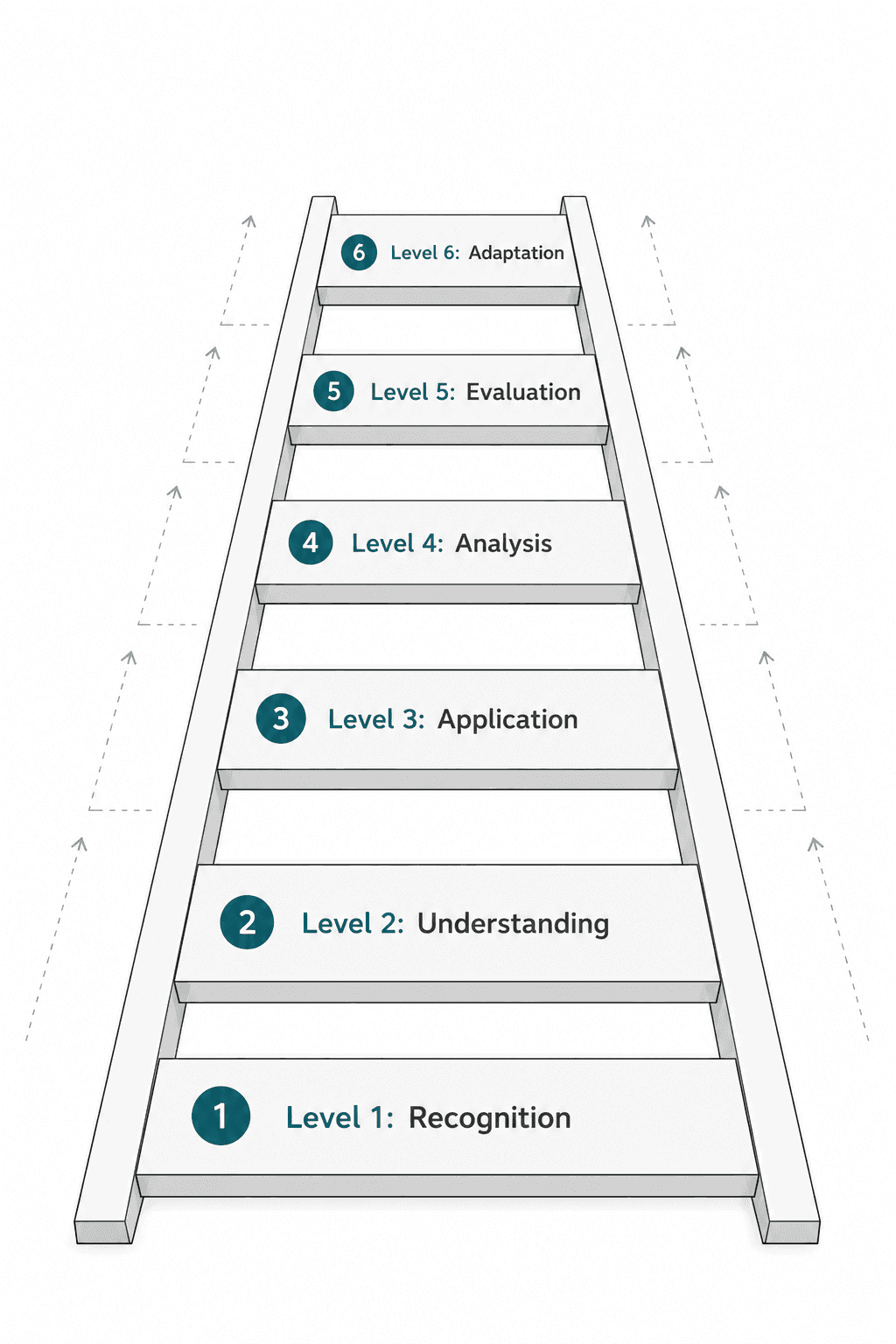
Every article is tagged with one of six learning levels. They move from simpler to more demanding. Read them roughly in order within any topic.
Level 1: Recognition
You can identify the thing. You know what a double top looks like. You can point to support on a chart. You know what a bullish candle is. A lot of traders think they've finished this stage when they haven't; they've seen the names but can't reliably spot the real thing in live conditions. This level builds your visual vocabulary.
Level 2: Understanding
You know what it is and why it forms. The difference between "that's a double top" and "that's a double top because buyers tried twice to push through a level, failed both times, and sellers are gaining control." You're thinking about behavior, not shapes. Most pattern psychology articles live here.
Level 3: Application
You can find it yourself on a live chart, without someone pointing at it first. There's a real gap between recognizing a labeled textbook screenshot and spotting a pattern in progress with no hints and twenty other things happening. This level is practice: chart markup exercises, replay training, real-time identification.
Level 4: Analysis
You can decide what matters. This is where most traders quietly struggle. They've loaded up on knowledge without developing filters. They know what support is, what VWAP is, what the ORB range is, what the trend is, and they have no clear sense of which should drive the decision right now. Analysis is sorting signal from noise under real conditions.
Level 5: Evaluation
You can assess whether a setup is worth the risk. This is a different question than "is this a pattern?" It requires judgment: is this setup clean or messy? Does it have confluence? Where does the idea break? How confident am I, honestly, on a scale of 1 to 10? This is where risk thinking becomes real, not theoretical.
Level 6: Adaptation
You can respond to conditions you didn't predict. A trend day behaves differently than a range day. A news event changes the context. Price does something unexpected and you need to revise your hypothesis rather than abandon your brain. Most trading education skips this level entirely because it can't be scripted. This is where independent thinking begins.
How to Use the Site
Content is also organized by stage: Foundations, Reading Charts, Chart Patterns, Risk and Mindset, Sim and Journaling, and Finding Your Strategy. Stages describe what you're learning. Levels describe how deeply.
If you're new to trading
Start with Stage 1. Work through the Recognition and Understanding articles before moving on. The Foundations stage exists because many concepts don't make sense until you have basic vocabulary: leverage, pips, sessions, what a broker actually does. That groundwork matters more than it sounds.
If you have some experience
The learning level tags help you find where the gaps are. Most people have uneven knowledge - solid on Recognition, shakier on Application, almost nothing on Analysis and Evaluation. The tags let you self-assess and fill in what's missing rather than re-read things you already know.
If you're looking for something specific
Sort and filter by learning level across any stage. This works well if you're trying to move from knowing things to doing things. Filtering for Level 3 and above surfaces the practice-oriented content.
Why Sequence Matters
Trading education tends to front-load everything. Here, the sequence is intentional. Recognition comes before Understanding. Understanding comes before Application.
The reason is cognitive load. If you're trying to evaluate whether a setup deserves risk before you can reliably identify the setup itself, you're asking your brain to do too many things at once. That's a design problem, not a motivation problem.
You don't need to reach Level 6 in every topic before moving forward. But you probably shouldn't read Evaluation content about a pattern you can't yet spot reliably in Application conditions. The sequence exists so you can check your own progress honestly.
What This Site Is
This is a trading education site. Not a signals service, not a strategy shop, not a course with a certificate at the end. It's built by someone from UX and EdTech who understands how people learn, and who got into trading out of intellectual curiosity, not financial desperation.
The goal: help you think better about trading. The six learning levels map out the distance between "I've heard of this" and "I understand this well enough to act on it under real conditions."
That distance is longer than most people expect. But it's more walkable than it looks from the start.
Success Criteria
After completing this lesson, you should be able to identify where you are in the learning path, understand what each stage covers, and know which articles to read next based on your current level.
Common Misconception
You can skip stages and go straight to the highest learning level.
The learning path is sequenced deliberately, and gaps created by skipping tend to surface later as confusion rather than as obvious missing knowledge.
FAQ's
Q: I already have some trading experience. Where should I start?
Q: How do I know when I'm ready to move to the next level?
Q: Do I have to complete every learning level before moving to the next content stage?
Table of Contents
About Me

Krista Weber
After a career as a VP of UX and EdTech executive, I retired early—and quickly realized the traditional world of trading education is fundamentally broken.
As someone with a Master’s in HCI who specialized in the design of e-learning systems, I saw a massive gap: beginners aren't failing because trading is impossible; they’re failing due to massive cognitive overload and terrible instructional design.
This site bridges that gap. I’m applying the principles of learning science, systems thinking, and minimalist UX to strip away the market noise and teach trading the way it actually should be taught.
Stay in Touch
Some of the pages on my travel blog contain affiliate links. Whenever you buy something through one of these links, I get a small commission at no extra cost to you. As an affiliate, I only recommend products and services that I feel are high quality and helpful to my readers. Thanks for your support.
Read More

Open almost any trading platform and you'll see EUR/USD sitting next to XAU/USD, NQ, ES, and a dozen CFDs on stocks you've heard of. They all show up as candlesticks moving left to right, which quietly implies they're all the same kind of thing. They aren't. Before going deeper into any one of them, it's worth drawing the map.
Updated on Sep 6, 2026

Futures are standardized contracts tied to defined specifications and a future settlement date. They can look complex at first, but the mechanics become much clearer once you know what the contract specification controls. Here's what you actually need to know.
Updated on Sep 6, 2026

CFDs appear everywhere in retail trading – but most new traders couldn't explain exactly what they are or why that matters. Here's a plain-language breakdown, including the parts that most introductions skip.
Updated on Sep 6, 2026