
Oil Futures Short — London High/London Low Range, Active Risk Management
Active risk management saved this trend trade.
Learning Path Stage 5: Sim Trading & Journaling
Learning Level 4: Analysis
Primary Learning Objective
By the end of this entry, you will be able to identify the specific technical and contextual factors that informed this setup and recognize how active risk management applies in a live, volatile environment.
The Setup
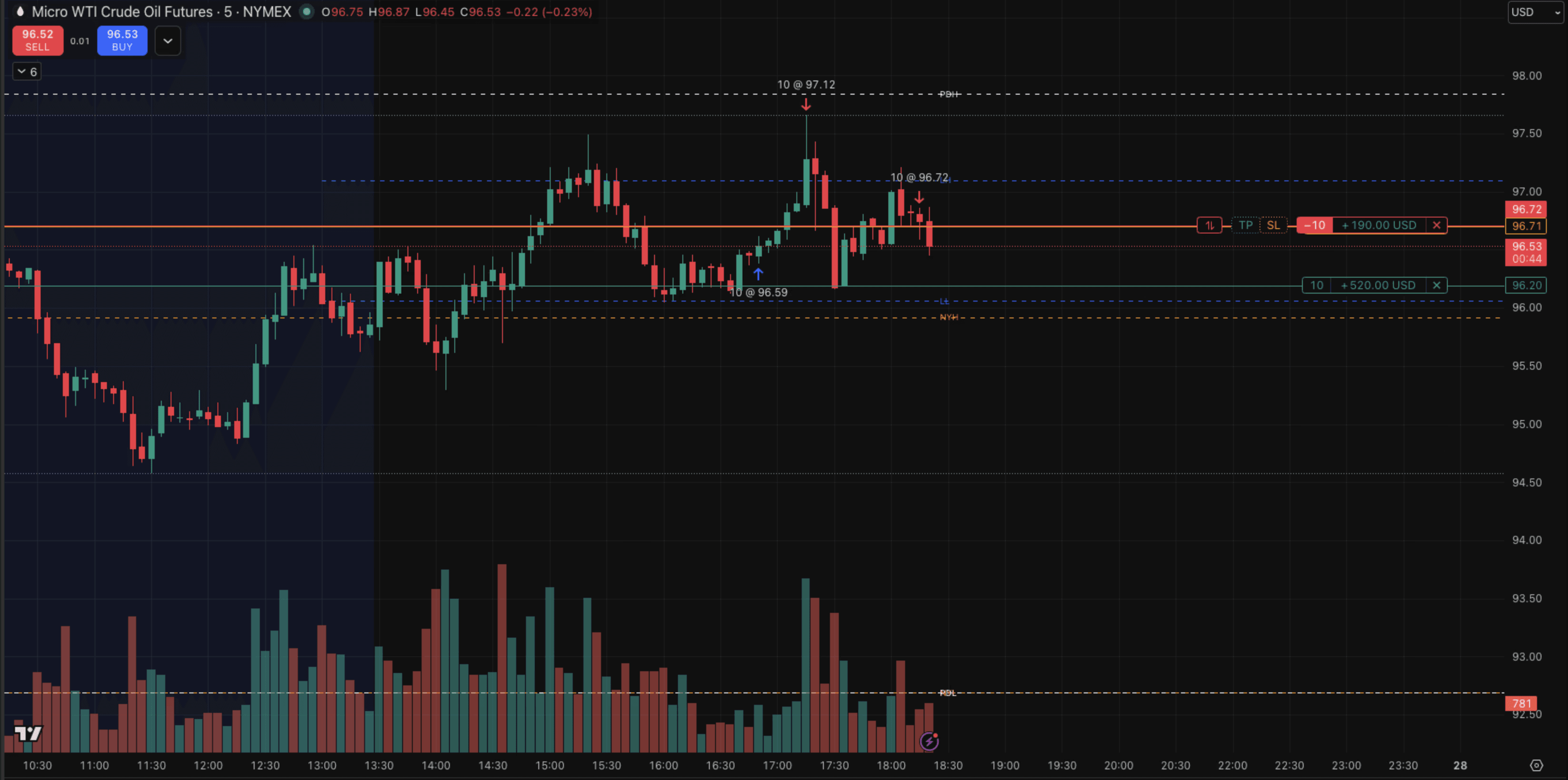
Still in the same London High/London Low range from the morning trade, but this time price was moving to the downside. After the long trade hit TP earlier, I identified that we were still trading within the established range. Price had moved back up toward the LH area, giving a short opportunity back toward the lower end of the range.
Entry: short at 96.72 (10 contracts). TP target at 96.20 (+$520). SL set above the London High level.
What Happened
Price initially moved in my favor. At around +$200 profit, news came across that Trump was reviewing an offer from Iran but that it did not include an agreement to give up their nuclear program. I noticed volatility beginning to increase — wicks were getting longer and price action was becoming choppier.
Rather than hold through the uncertainty, I moved my SL to break even ($0 risk). Once price continued in my favor and I was up around +$300, I observed that momentum appeared to be dying and an indecision candle formed. I tightened the SL to lock in $250 profit, accepting that I was unlikely to reach full TP but guaranteeing a win regardless of the outcome.
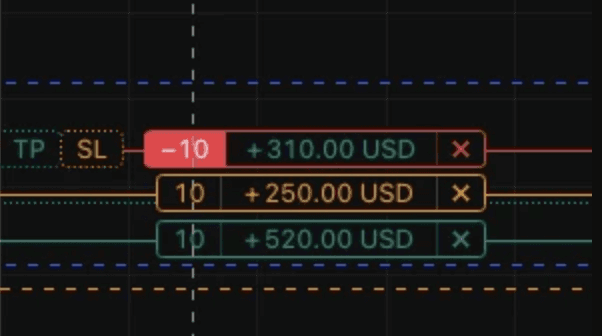
Got stopped out at +$250.
What I Learned
This trade is a good example of reading the environment in real time and adjusting accordingly. The original thesis was valid — price was in a range and moving toward the lower end. But external factors (geopolitical news, rising volatility, wicky price action) changed the probability of reaching full TP.
Key takeaways:
Moving to break even when volatility spikes removes risk without giving up the trade — this is correct behavior.
Tightening the SL to lock in partial profit when momentum dies is a disciplined exit. $250 guaranteed is better than a coin flip on the remaining $270 to full TP.
Reading indecision candles as a signal to protect profit (not just as a setup trigger) is a skill worth developing.
News events don't have to mean exiting immediately — they mean re-evaluating your risk tolerance and adjusting accordingly.
Success Criteria
After reading this journal entry, you should be able to describe the entry rationale, the risk management decisions made during the trade, and the outcome assessment — and distinguish between what worked structurally and what was a function of that specific market environment.
Common Misconception
A single trade outcome tells you whether a setup type works.
The Truth: Individual trade results are noisy data; the pattern across many similar setups over time is the signal.
FAQ's
Q: What does active risk management mean in a trade?
Q: Why would you exit a trade before hitting your take profit target?
Q: What is a London High/London Low range trade?
Table of Contents
About Me

Krista Weber
After a career as a VP of UX and EdTech executive, I retired early—and quickly realized the traditional world of trading education is fundamentally broken.
As someone with a Master’s in HCI who specialized in the design of e-learning systems, I saw a massive gap: beginners aren't failing because trading is impossible; they’re failing due to massive cognitive overload and terrible instructional design.
This site bridges that gap. I’m applying the principles of learning science, systems thinking, and minimalist UX to strip away the market noise and teach trading the way it actually should be taught.
Stay in Touch
Some of the pages on my travel blog contain affiliate links. Whenever you buy something through one of these links, I get a small commission at no extra cost to you. As an affiliate, I only recommend products and services that I feel are high quality and helpful to my readers. Thanks for your support.
Read More

Open almost any trading platform and you'll see EUR/USD sitting next to XAU/USD, NQ, ES, and a dozen CFDs on stocks you've heard of. They all show up as candlesticks moving left to right, which quietly implies they're all the same kind of thing. They aren't. Before going deeper into any one of them, it's worth drawing the map.
Updated on Sep 6, 2026

Futures are standardized contracts tied to defined specifications and a future settlement date. They can look complex at first, but the mechanics become much clearer once you know what the contract specification controls. Here's what you actually need to know.
Updated on Sep 6, 2026

CFDs appear everywhere in retail trading – but most new traders couldn't explain exactly what they are or why that matters. Here's a plain-language breakdown, including the parts that most introductions skip.
Updated on Sep 6, 2026