
Trading the Oil Trend in a High-Volatility Environment
Ongoing geopolitical tension around the Strait of Hormuz, creating sustained bullish pressure on oil.

Learning Path Stage 5: Sim Trading & Journaling
Learning Level 4: Analysis
Primary Learning Objective
By the end of this entry, you will be able to identify how trend-following principles apply to a high-volatility instrument and how position management in that context differs from a textbook example.
The Setup
Context: Ongoing geopolitical tension around the Strait of Hormuz, creating sustained bullish pressure on oil.
Market Condition:
High volatility
Strong upward momentum
Clean continuation structure with pullbacks
Thesis:
Buyers are in control. Pullbacks are likely to be continuation opportunities, not reversals.
Before entering, I defined two things:
Invalidation (hard stop): Based on structure
Manual exit level: A line on the chart where I would exit if price moved down with intent, not just a wick
This gave me both:
a system-based stop
a discretionary “line in the sand” for trade management
What Happened
1. Early Entry (Invalidation)
I entered long on a pullback, but too early.
Price had not finished retracing
My stop was too tight relative to volatility
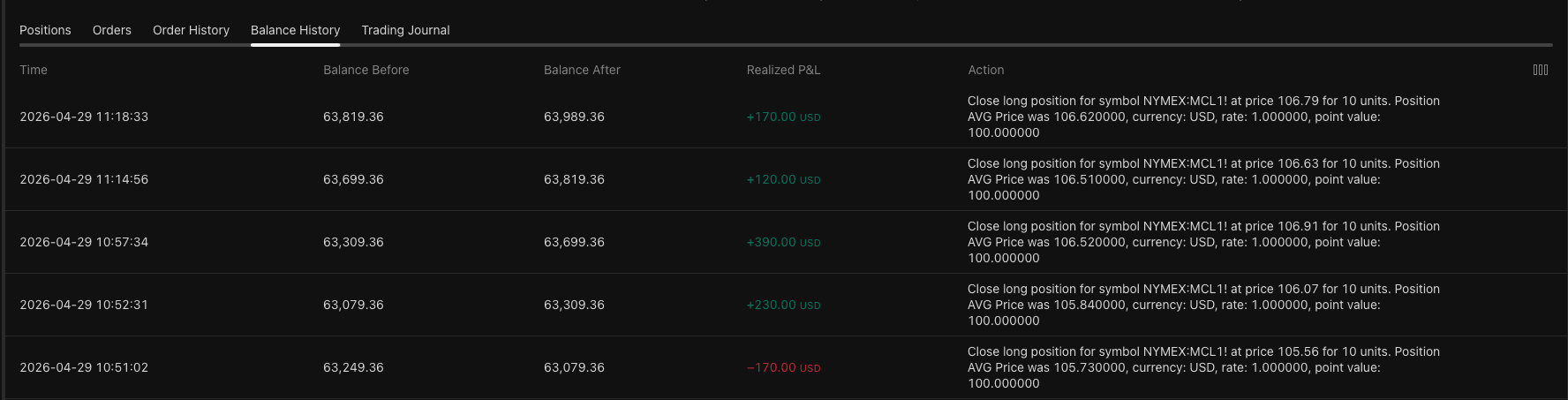
I was stopped out…with considerable slippage past my SL for a $170 loss
This was not a failure of the idea.
It was a mismatch between:
entry timing
and volatility-adjusted risk
2. Re-Entry (Aligned With Conditions)
I still believed in the thesis, so I re-entered long.
This time:
I widened my stop to account for volatility
Positioned based on structure, not comfort
As price moved in my favor:
I moved stop to breakeven
Then locked in profit
This allowed the trade to:
breathe
while removing downside risk
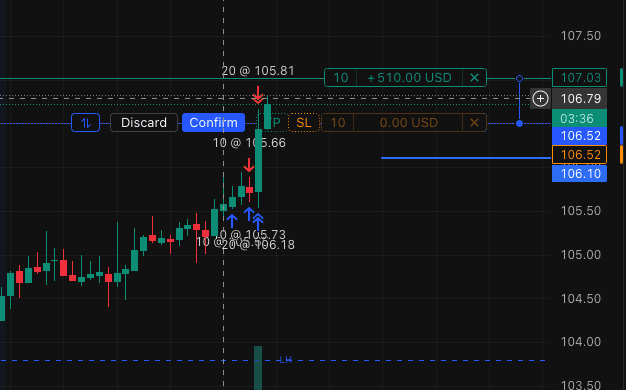
3. Trend Extension (Restraint Over Reaction)
Price continued pushing higher and moved well above previous session highs.
Then:
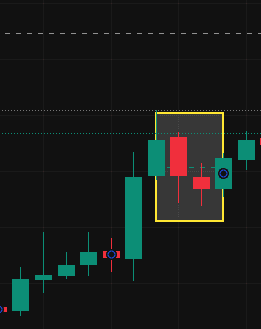
Two large green candles printed
At that point, I made a decision:
Step away and wait for a retracement instead of chasing
This turned out to be the right call.
Price pulled back significantly shortly after.
4. Re-Engagement (Controlled Execution)
I re-entered on the way back up.
Because price was extended and the “top” was unclear:
I used wider TP and SL levels (around $500)
These were not intended as primary exits
Instead, I relied on:
my pre-drawn manual exit line
momentum and price behavior
If price moved down with intent toward that level, I would exit.
If momentum slowed, I took quick profits.
This led to:
multiple small wins
no additional losses
What I Learned
1. Volatility Must Shape Risk
Tight stops in high-volatility markets don’t reduce risk.
They increase the likelihood of being wrong for the wrong reason.
My first stop-out was a volatility issue, not an idea issue.
2. A Good Thesis Can Survive a Bad Entry
Getting stopped out doesn’t mean the idea is invalid.
It means:
timing
or execution
needs adjustment.
Re-entry is part of the process, not a failure of it.
3. Pre-Defined Manual Exit = Lower Cognitive Load
Having a clearly defined line for manual exit before entering made a significant difference.
Instead of asking:
“Should I get out now?”
I had already decided:
“If price reaches this level with intent, I’m out.”
That removed hesitation and second-guessing.
4. Extension Creates Uncertainty
When price moves far beyond structure:
risk becomes harder to define
reversals become more likely
In those conditions:
position size should decrease
expectations should tighten
5. Momentum Is a Usable Signal, But Needs Structure
Using momentum shifts for exits worked well in this session.
However:
it requires full attention
it is easy to rationalize staying in
Going forward, I want to better define:
what qualifies as “loss of momentum”
so this becomes more systematic
Iteration Note
This was one trade idea executed multiple times:
Trade 1: Invalidated due to early entry and tight stop
Trade 2+: Better aligned with volatility and structure
The outcome wasn’t defined by the first result.
It was defined by:
adapting the execution while staying consistent with the thesis
Final Outcome
Overall: Win
Not because every entry worked.
But because:
the idea was sound
execution improved
risk was managed
Closing Thought
You don’t need to be right the first time.
You need to:
recognize when you’re early
adjust to conditions
and stay aligned with your thesis
That’s where consistency comes from.
Success Criteria
After reading this journal entry, you should be able to describe the trend identification process, the stop management approach, and what the outcome reveals about the trade management decisions made during the position.
Common Misconception
Volatility is the enemy of trend following.
The Truth: Volatility is a characteristic of trending markets, and trend following systems that can't handle volatile conditions are weaker implementations of the approach.
FAQ's
Q: How do you trade a trend in a high-volatility environment?
Q: What is the difference between trending and ranging market conditions?
Q: What makes oil futures particularly volatile?
Table of Contents
About Me

Krista Weber
After a career as a VP of UX and EdTech executive, I retired early—and quickly realized the traditional world of trading education is fundamentally broken.
As someone with a Master’s in HCI who specialized in the design of e-learning systems, I saw a massive gap: beginners aren't failing because trading is impossible; they’re failing due to massive cognitive overload and terrible instructional design.
This site bridges that gap. I’m applying the principles of learning science, systems thinking, and minimalist UX to strip away the market noise and teach trading the way it actually should be taught.
Stay in Touch
Some of the pages on my travel blog contain affiliate links. Whenever you buy something through one of these links, I get a small commission at no extra cost to you. As an affiliate, I only recommend products and services that I feel are high quality and helpful to my readers. Thanks for your support.
Read More

Open almost any trading platform and you'll see EUR/USD sitting next to XAU/USD, NQ, ES, and a dozen CFDs on stocks you've heard of. They all show up as candlesticks moving left to right, which quietly implies they're all the same kind of thing. They aren't. Before going deeper into any one of them, it's worth drawing the map.
Updated on Sep 6, 2026

Futures are standardized contracts tied to defined specifications and a future settlement date. They can look complex at first, but the mechanics become much clearer once you know what the contract specification controls. Here's what you actually need to know.
Updated on Sep 6, 2026

CFDs appear everywhere in retail trading – but most new traders couldn't explain exactly what they are or why that matters. Here's a plain-language breakdown, including the parts that most introductions skip.
Updated on Sep 6, 2026