
Position Sizing Explained Simply
Position size should be the last decision, not the first. Fix your risk, let the chart set your stop, and the correct size simply falls out.

Learning Path Stage 4: Risk & Mindset
Learning Level 2: Understanding
Primary Learning Objective
By the end of this lesson, you will be able to calculate position size based on account risk percentage and stop distance, rather than trading a fixed lot size regardless of setup.
Position Sizing: Why You’re Doing It Backwards
Most beginners approach trading like they’re picking a horse at the track. They obsess over direction: Will price go up or down? It’s the glamorous, exciting question, so it gets all the attention. But there is a second question, far less exciting and yet infinitely more important to your survival: How much? How much should you actually put on this trade?
That is position sizing. And the reason it goes sideways for most beginners is that they treat it as the first decision, when it should be the very last.
Size as an input vs. size as an output
A beginner usually picks a position size out of thin air, or based on the "vibe" of the day. Feeling like a genius? Buy a lot. Feeling a little nervous? Buy a little. In this world, size is an input chosen by mood.
A trader who has actually survived a few cycles does the opposite. They rarely choose a size directly at all. The size is an output. It is the final result of two other, far more critical decisions made beforehand. Get those two foundations right, and the math for your size simply appears. Get them wrong, or skip them entirely, and no size on earth is going to save you.
Decision one: how much are you willing to lose?
The first decision is simple: How much money are you willing to burn if this trade turns out to be a disaster?
Not how much you hope to make. How much can you lose without it actually mattering? The standard advice is to risk a small percentage of your account (usually one percent or less). The exact number matters less than the principle: the loss from any single trade should be so small it’s basically forgettable.
This is the only math that keeps you in the game. If you risk one percent per trade, you can be wrong ten times in a row (and trust me, you will be while you are learning) and you’ll still have ninety percent of your account left to fight another day.
Decision one gives you a hard dollar figure. On a $5,000 account risking one percent, that figure is $50. This trade is allowed to cost you $50 if you’re wrong. Not a cent more.
Decision two: where is the trade officially wrong?
We’ve covered this before, but it bears repeating: Your stop loss is your invalidation point. It is the price where your trade thesis is officially dead.
The distance between your entry and this invalidation point is the only other number you need. If you enter at 100 and your invalidation sits at 98, your distance is 2. That distance, whether it’s pips, points, or dollars, is the gap the market has to cross to prove you wrong.
Here is the kicker: You do not get to pick that distance. The chart decides where the structure breaks. If you try to negotiate your stop to a "comfortable" distance, you’re just playing pretend.
Putting them together
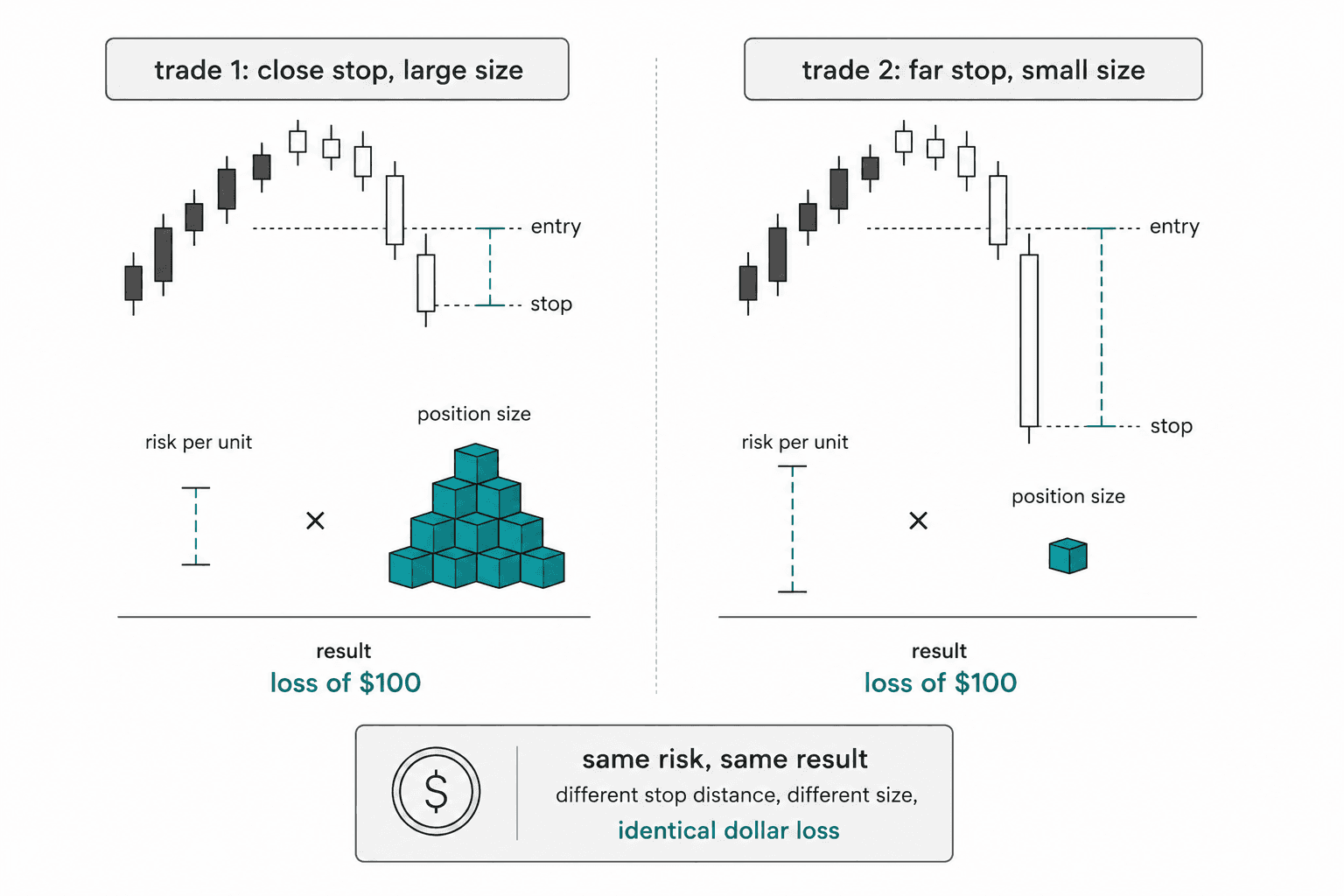
Now, position size simply reveals itself. You have two numbers: the dollars you are allowed to lose, and the distance from entry to invalidation. Your position size is whatever makes those two numbers agree.
Think of it as a balance scale. . If your risk is fixed at $50 and your stop distance is massive, you trade a tiny position. If your stop is close, you can trade a larger position. The size flexes to keep the dollar loss constant.
Why this feels backward (and why it’s not)
This feels unnatural because it strips away your ability to "bet big" when you feel certain. Confidence, it turns out, is a terrible asset manager. By making size the mathematical output of a rigid process, you are effectively protecting yourself from your own ego—which is usually the most expensive thing a beginner owns.
The takeaway
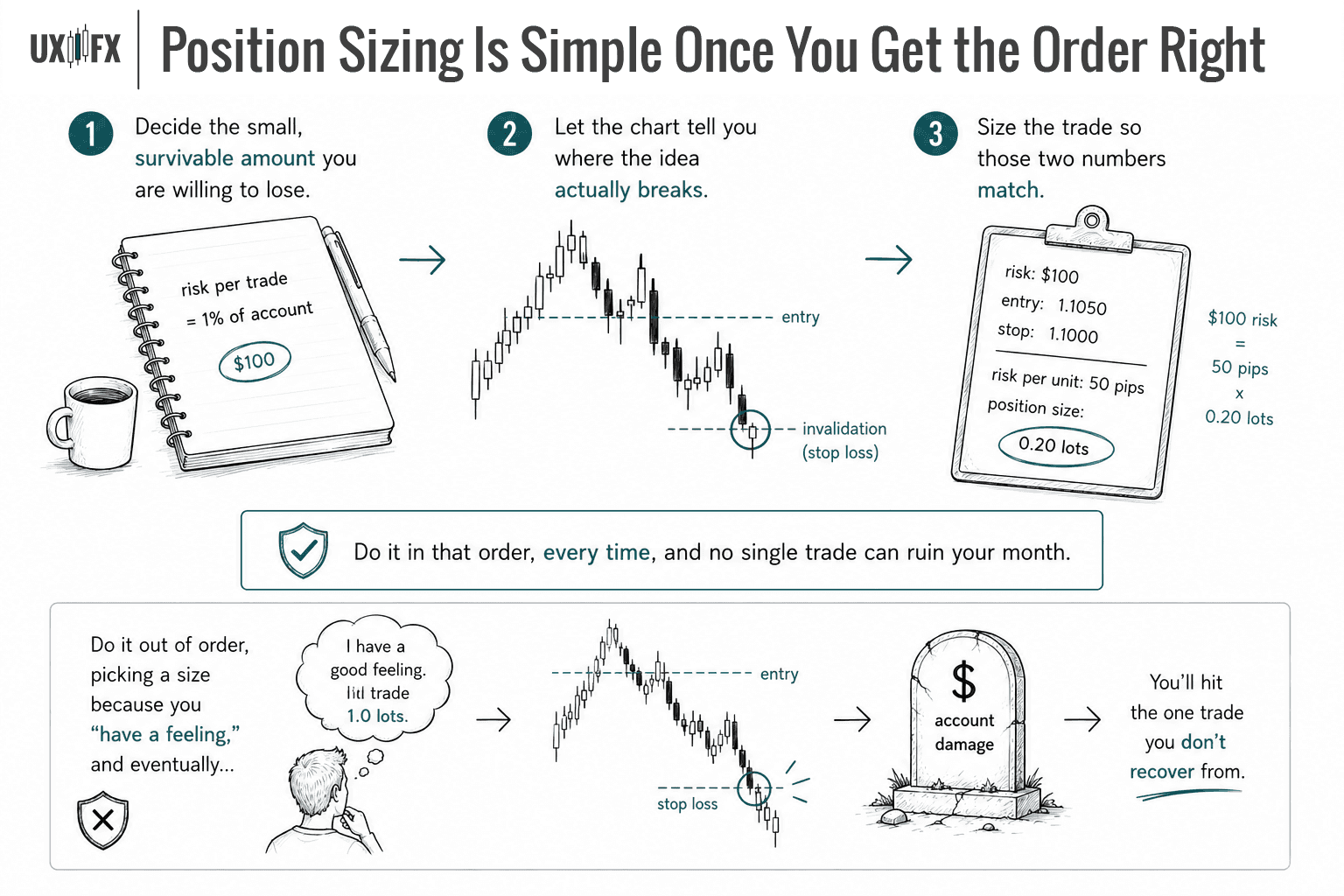
Position sizing is dead simple once you get the order right:
Decide the small, survivable amount you are willing to lose.
Let the chart tell you where the idea actually breaks.
Size the trade so those two numbers match.
Do it in that order, every time, and no single trade can ruin your month. Do it out of order, picking a size because you "have a feeling," and eventually, you’ll hit the one trade you don't recover from.
The order isn't just a suggestion. It's the whole skill.
Success Criteria
After completing this lesson, you should be able to calculate the correct position size for a trade given your account balance, risk percentage, stop distance, and instrument pip value.
Common Misconception
Position sizing is about how much you can afford to lose in simple dollar terms
The Truth: Proper position sizing derives from a fixed percentage of account equity applied consistently across all trades, regardless of how confident you feel about any individual setup.
FAQ's
Q: How do you calculate position size?
Q: What is the biggest mistake traders make with position sizing?
Q: What is position sizing and why does it matter?
Table of Contents
About Me

Krista Weber
After a career as a VP of UX and EdTech executive, I retired early—and quickly realized the traditional world of trading education is fundamentally broken.
As someone with a Master’s in HCI who specialized in the design of e-learning systems, I saw a massive gap: beginners aren't failing because trading is impossible; they’re failing due to massive cognitive overload and terrible instructional design.
This site bridges that gap. I’m applying the principles of learning science, systems thinking, and minimalist UX to strip away the market noise and teach trading the way it actually should be taught.
Stay in Touch
Some of the pages on my travel blog contain affiliate links. Whenever you buy something through one of these links, I get a small commission at no extra cost to you. As an affiliate, I only recommend products and services that I feel are high quality and helpful to my readers. Thanks for your support.
Read More

Open almost any trading platform and you'll see EUR/USD sitting next to XAU/USD, NQ, ES, and a dozen CFDs on stocks you've heard of. They all show up as candlesticks moving left to right, which quietly implies they're all the same kind of thing. They aren't. Before going deeper into any one of them, it's worth drawing the map.
Updated on Sep 6, 2026

Futures are standardized contracts tied to defined specifications and a future settlement date. They can look complex at first, but the mechanics become much clearer once you know what the contract specification controls. Here's what you actually need to know.
Updated on Sep 6, 2026

CFDs appear everywhere in retail trading – but most new traders couldn't explain exactly what they are or why that matters. Here's a plain-language breakdown, including the parts that most introductions skip.
Updated on Sep 6, 2026