
Why Wide Stops Are Not Automatically Bad
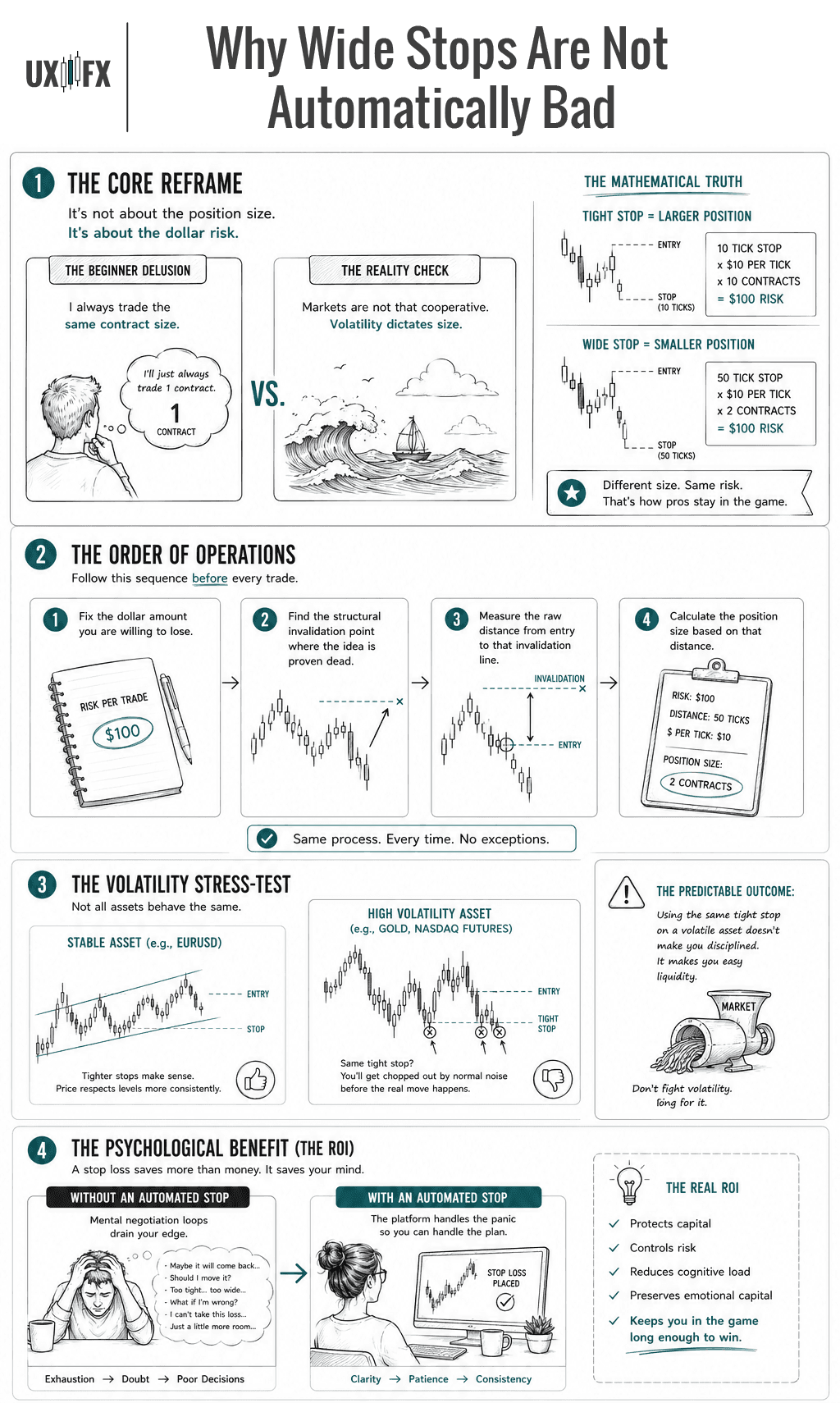
A stop belongs where your idea is proven wrong, not at a distance you find comfortable. A wide stop is not a bigger loss. It is a smaller position.

Learning Path Stage 4: Risk & Mindset
Learning Level 4: Analysis
Primary Learning Objective
By the end of this lesson, you will be able to explain why a wider stop placed at a structurally significant level is often preferable to a tighter stop placed arbitrarily.
Why Your "Tight Stop" is Actually a Bad Idea
Somewhere early in their journey, almost every trader picks up a dangerous little urban legend: A tight stop loss is good, and a wide stop loss is bad. It sounds reasonable. A tight stop means a smaller loss. Smaller losses are better. Therefore, tighter must be better. It’s one of those ideas that is simple, intuitive, and about as reliable as a "get rich quick" course sold in a social media comment section.
A wide stop is not automatically bad. A tight stop is not automatically good. What matters is whether the stop is in the right place, and the right place has absolutely nothing to do with how far away it is from your entry.
What a Stop Is Actually For
Recall what a stop loss is. It is your invalidation point (the price at which your trade idea has been officially proven wrong). The stop belongs at that price. Not near it, not at a "comfortable" distance, and certainly not at a distance that makes your soul feel better. It belongs at the point of invalidation.
The correct distance for your stop is not a matter of preference. It is something you discover by reading the chart. Sometimes the price that genuinely breaks your thesis is sitting right next to your entry. Sometimes it’s in the next zip code. The market decides where the structure breaks; your only job is to read it honestly, rather than negotiating it down to a number that makes your P&L look less scary.
The first problem with "tight stops are good" is that it forces you to put the stop where you want it, rather than where the idea actually breaks.
The Tight Stop Trap
Here is how it plays out in the real world.
A trader wants a tight stop. They tell themselves it’s for "risk management," but they secretly love that it allows for a bigger position size. So, they place the stop close to their entry—closer than the chart structure actually justifies.
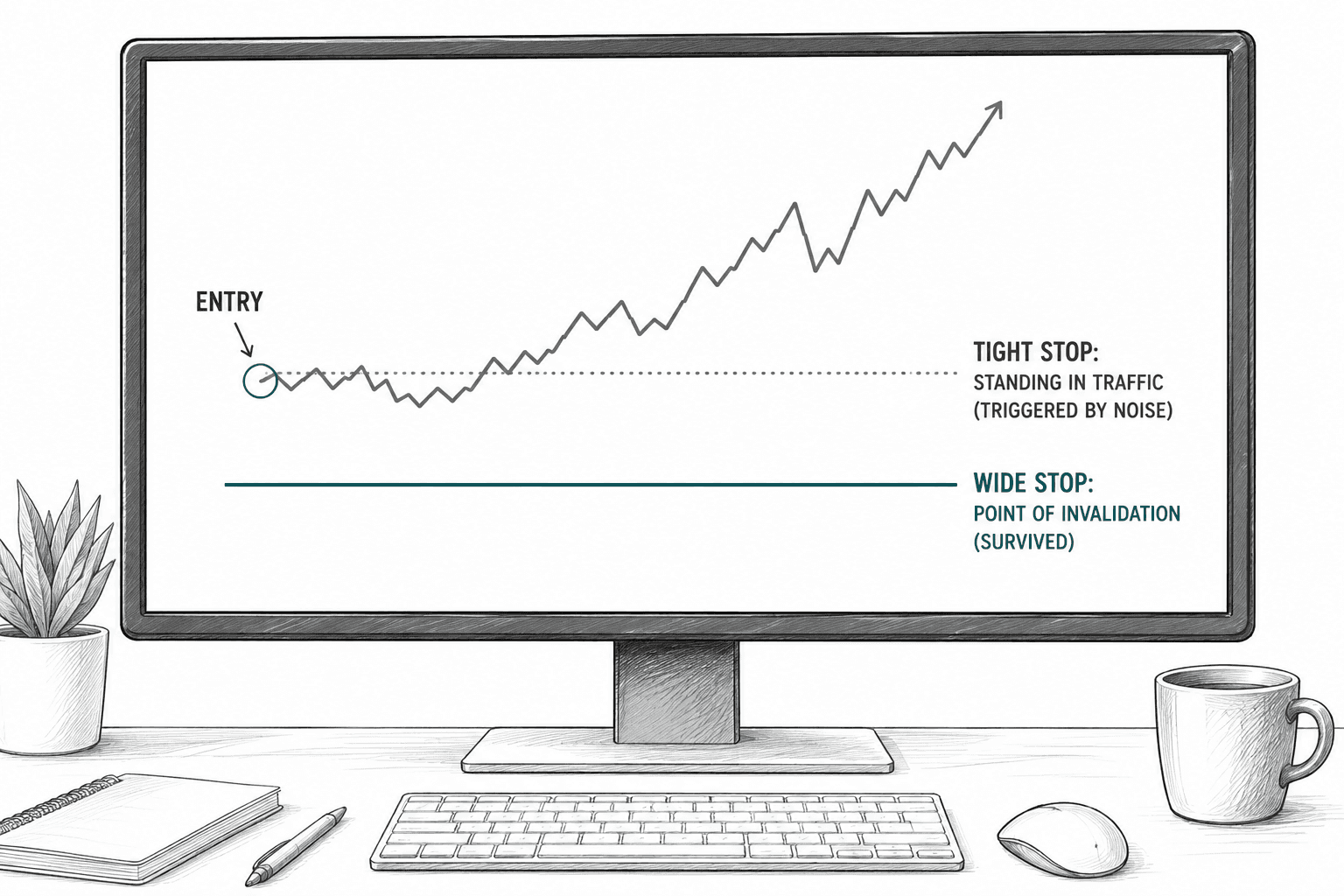
The trouble is, the market is a noisy, caffeinated toddler. It wiggles. It pokes above and below levels constantly, without those tiny moves meaning a single thing. A stop placed too close sits right inside that noise.
The result is as predictable as gravity: Price does its normal, meaningless wiggle, clips the too-tight stop, closes the trade for a loss, and then immediately goes on to do exactly what the trader originally expected. The idea was perfect. The stop was just standing in the middle of traffic. The trader wasn’t wrong about the market; they were just wrong about their choice of parking spot.
A wider stop, placed beyond the noise at the point where the idea is genuinely invalidated, would have survived the wiggle and let the correct idea play out.
Respect the Asset’s Personality
One of the biggest mistakes beginners make is treating all markets as if they move at the same speed. They treat a stock that barely ripples like it’s the same beast as Gold, Oil, or Silver.
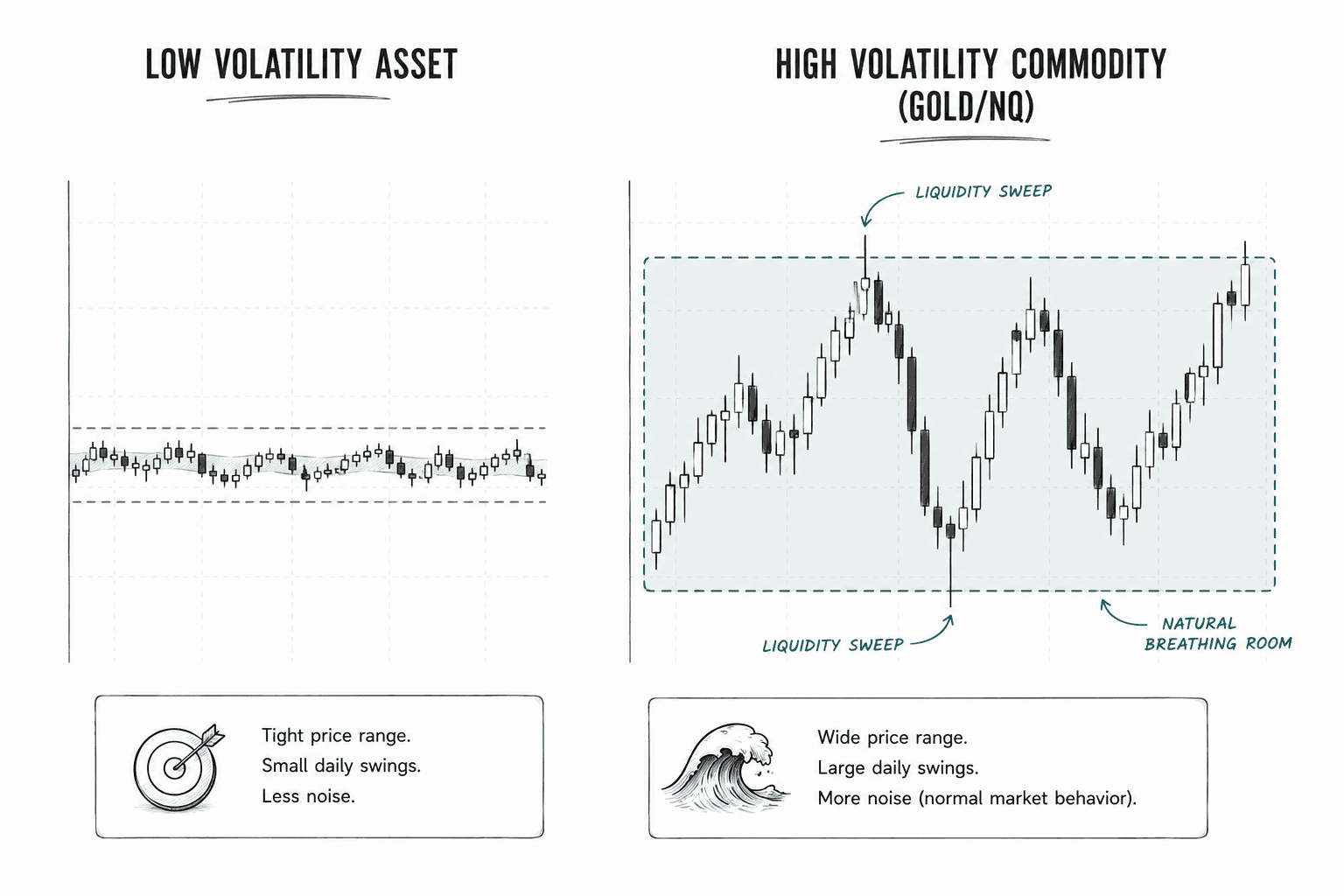
Markets like Gold, Silver, and Oil aren't just lines on a chart. They are massive, global engines of commerce, and they move with significantly more volatility than a slow-moving utility stock. They have "breath." They expand, they contract, and they regularly sweep through levels to gather liquidity before moving in the intended direction.
If you are trading these commodities, you are effectively entering a high-speed lane. If you bring a "tight stop" mentality to Oil or Silver, you are going to get run over. The natural, daily noise of these assets is often large enough to hit a tight stop without even trying. In these markets, a "small" stop isn't a badge of honor; it’s a mathematical error. You are not going to win a trade on a high-volatility commodity with a stop that hasn't given the price room to breathe.
When you trade assets that naturally move in big, sweeping ranges, you have to accept that your stop distance—and consequently your position size—must be scaled accordingly. If the asset requires a wider stop to stay outside the noise, you don't "tighten" the stop to fit your greed; you shrink your position to fit the reality of the chart.
Wide Stops and Position Size
"But wait," I hear you saying. "A wider stop means a bigger loss!"
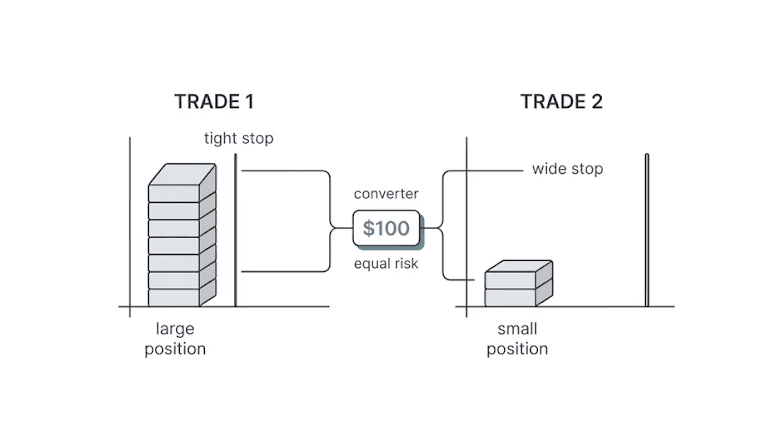
Actually, no. That is where position sizing saves the day. A wide stop does not have to mean a bigger loss. It just means a smaller position.
Remember the math: You fix the dollar amount you are willing to risk. The stop distance is set by the chart. Your position size is the variable that flexes to keep the risk constant. If your invalidation point is far away, you simply trade a smaller position. Your actual loss if you are wrong is exactly the same as it would be with a tight stop and a large position.
You can risk an identical fifty dollars with either setup. The only difference is that the wide-stop version placed its invalidation beyond the noise, meaning it won’t get knocked out by a random, meaningless fluctuation.
Why the Tight Stop Feels Better Anyway
If the dollar risk is the same, why do beginners still chase the tight stop?
Let’s be honest: Because a tight stop lets them trade a bigger position, and a bigger position is exciting. That same fifty dollars of risk, spread over a tiny stop distance, buys a much larger trade. A larger trade makes more money on the days it works.
That is the real attraction. The pull toward tight stops is rarely about safety; it’s about greed. The tight stop is the doorway to a bigger position, and the bigger position is the actual goal. The cost of walking through that doorway is that your invalidation point is now sitting directly in the noise, where it will be hit repeatedly for reasons that have nothing to do with your analysis being right or wrong.
The Professional Way to Think About It
Drop the binary idea that "tight is good" and "wide is bad." Replace it with something more accurate: "Sensible is good, and guessing is bad."
A stop should go exactly where your idea is proven wrong. Measure that distance honestly. If it turns out small, great! You can trade a larger position. If it turns out wide, also great! You trade a smaller one. Either way, your risk per trade stays the same small, survivable amount.
A wide stop on a small position is not timid, and it is not a problem. It is the professional answer. It keeps your invalidation point in a sensible place and accepts a smaller position size as the price of admission. The trader who insists on tight stops isn’t managing risk better; they’re just buying size and hoping the noise stays away.
Don't buy the "tight stop" lie. It's a luxury you can't afford.
Success Criteria
After completing this lesson, you should be able to distinguish between a wide stop that is structurally justified and one that is simply risk-avoidant, and explain how stop width affects required position size and the risk-to-reward ratio.
Common Misconception
A tight stop is always better because it limits loss.
The Truth: A tight stop placed without regard to market structure gets hit more frequently by normal volatility, often resulting in more losses in the trend direction rather than smaller ones.
FAQ's
Q: When is a wide stop appropriate?
Q: What is the relationship between stop width and position size?
Q: Why do many traders think wide stops are bad?
Table of Contents
About Me

Krista Weber
After a career as a VP of UX and EdTech executive, I retired early—and quickly realized the traditional world of trading education is fundamentally broken.
As someone with a Master’s in HCI who specialized in the design of e-learning systems, I saw a massive gap: beginners aren't failing because trading is impossible; they’re failing due to massive cognitive overload and terrible instructional design.
This site bridges that gap. I’m applying the principles of learning science, systems thinking, and minimalist UX to strip away the market noise and teach trading the way it actually should be taught.
Stay in Touch
Some of the pages on my travel blog contain affiliate links. Whenever you buy something through one of these links, I get a small commission at no extra cost to you. As an affiliate, I only recommend products and services that I feel are high quality and helpful to my readers. Thanks for your support.
Read More

Open almost any trading platform and you'll see EUR/USD sitting next to XAU/USD, NQ, ES, and a dozen CFDs on stocks you've heard of. They all show up as candlesticks moving left to right, which quietly implies they're all the same kind of thing. They aren't. Before going deeper into any one of them, it's worth drawing the map.
Updated on Sep 6, 2026

Futures are standardized contracts tied to defined specifications and a future settlement date. They can look complex at first, but the mechanics become much clearer once you know what the contract specification controls. Here's what you actually need to know.
Updated on Sep 6, 2026

CFDs appear everywhere in retail trading – but most new traders couldn't explain exactly what they are or why that matters. Here's a plain-language breakdown, including the parts that most introductions skip.
Updated on Sep 6, 2026