
The Invalidation Point
A stop loss is not a tax on trading. It is your invalidation point, the price at which your idea has been proven wrong, decided while you are still calm.
Learning Path Stage 4: Risk & Mindset
Learning Level 5: Evaluation
Primary Learning Objective
By the end of this lesson, you will be able to identify the specific price level that would invalidate your trade thesis and use it as the structural basis for stop placement.
Invalidation: The Only "Secret" to Staying Alive
There is one idea in trading that quietly separates the survivors from the "deposit-blowers." It isn't a proprietary pattern, a magic moving average, or some secret setting on a dashboard. It’s the invalidation point: the specific price where your reason for being in a trade has been officially proven wrong.
Most beginners know the term stop loss. Far fewer understand what a stop loss actually is. That gap, the one between the terminology and the actual mechanics, is where most accounts go to die.
A Trade Is Just a Hypothesis
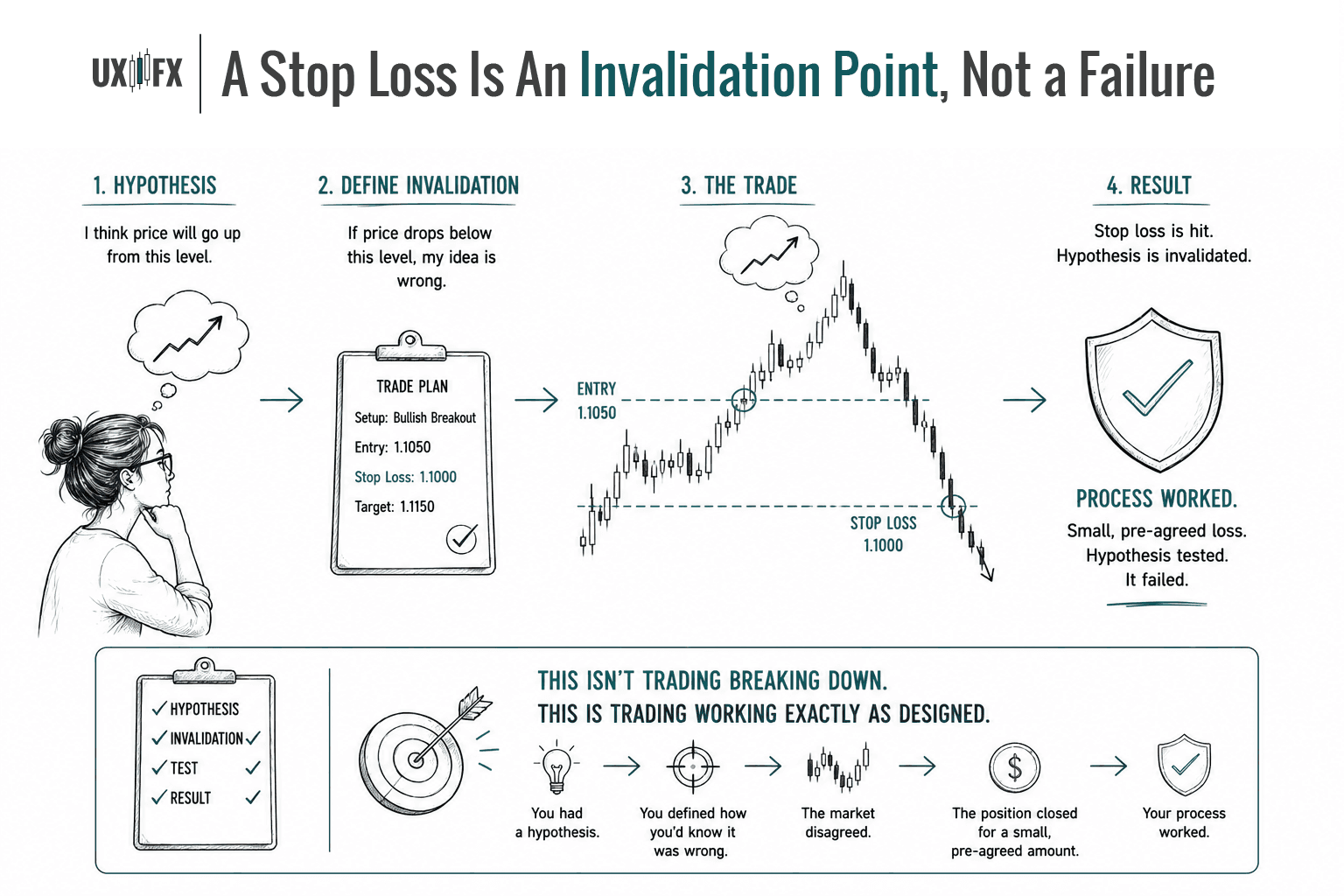
Underneath all the blinking lights and fancy software, every trade is just a claim. You looked at a chart, read the situation, and formed a belief: Price will go up because this trendline is holding. Or: Price will drop because this supply zone is loaded with sellers.
That belief is a hypothesis. It could be right, it could be wrong, and any trader who isn’t delusional knows both are on the table from the first second. Once you accept that a trade is a hypothesis, a natural question follows: If this hypothesis is wrong, how would I know?
The answer to that question is your invalidation point.
Invalidation is a Price, Not a Feeling
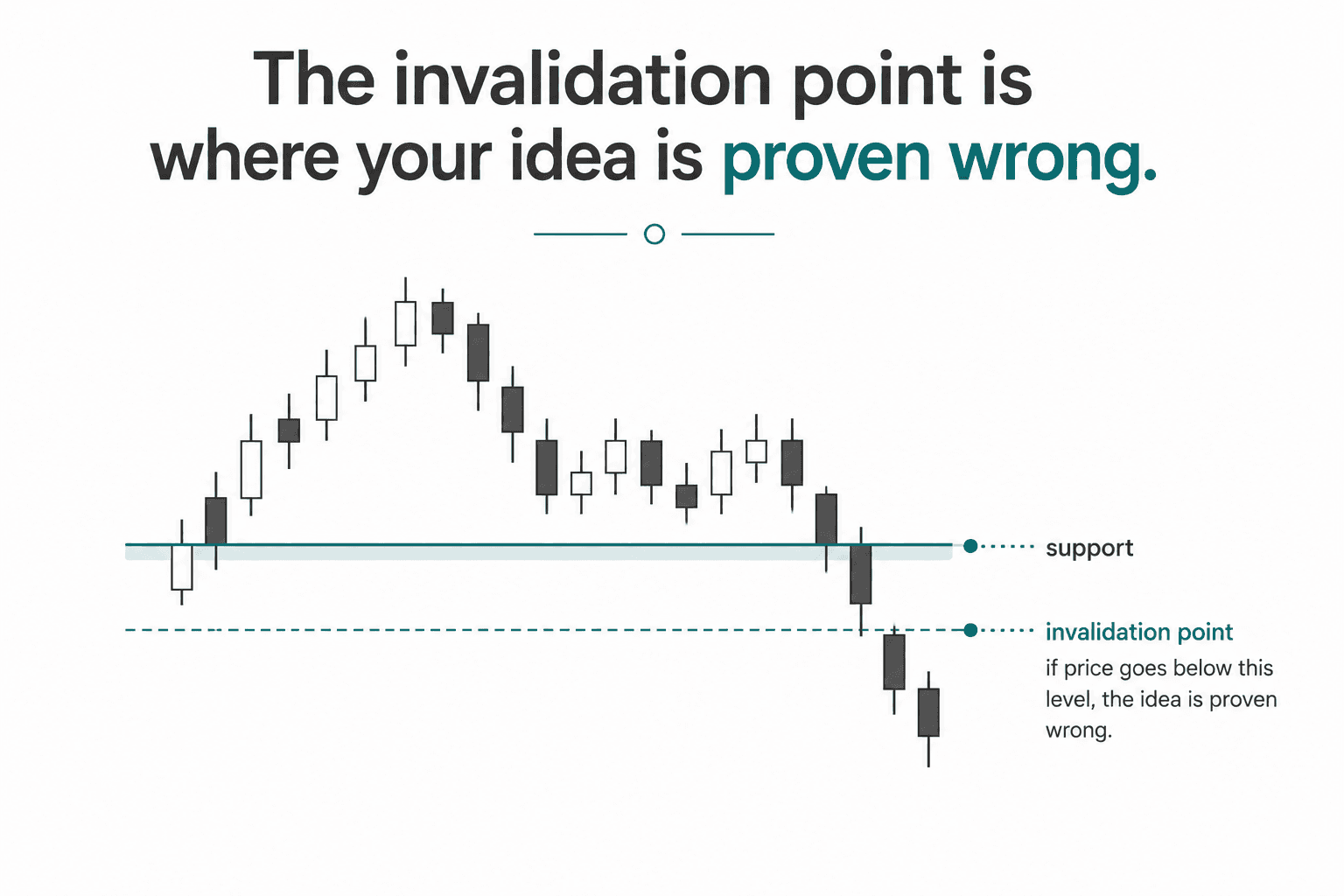
Here is the part where beginners usually trip and fall: Your invalidation point is a specific price identified by chart structure, not a measurement of your emotional tolerance.
Suppose your reason for buying was that a specific support level kept holding. Your hypothesis is: This support holds. If price falls clearly below that support, the thing you believed is no longer true. The level failed. Your reason for being in the trade has evaporated. That price (the one just below the level) is your invalidation point.
Notice what this is not. It is not "the point where I have lost as much as I can stand." It is not "the point where I start to feel sick." Those are emotional thresholds, and emotional thresholds are about as stable as a toddler in a sugar-rush. Your invalidation point is fixed by the chart, because it’s defined by the logic of the trade, not by your current mood.
Why You Must Decide Before You Enter
The invalidation point has to be chosen before you have skin in the game. This isn't a small administrative detail; it’s the most important part of the process.
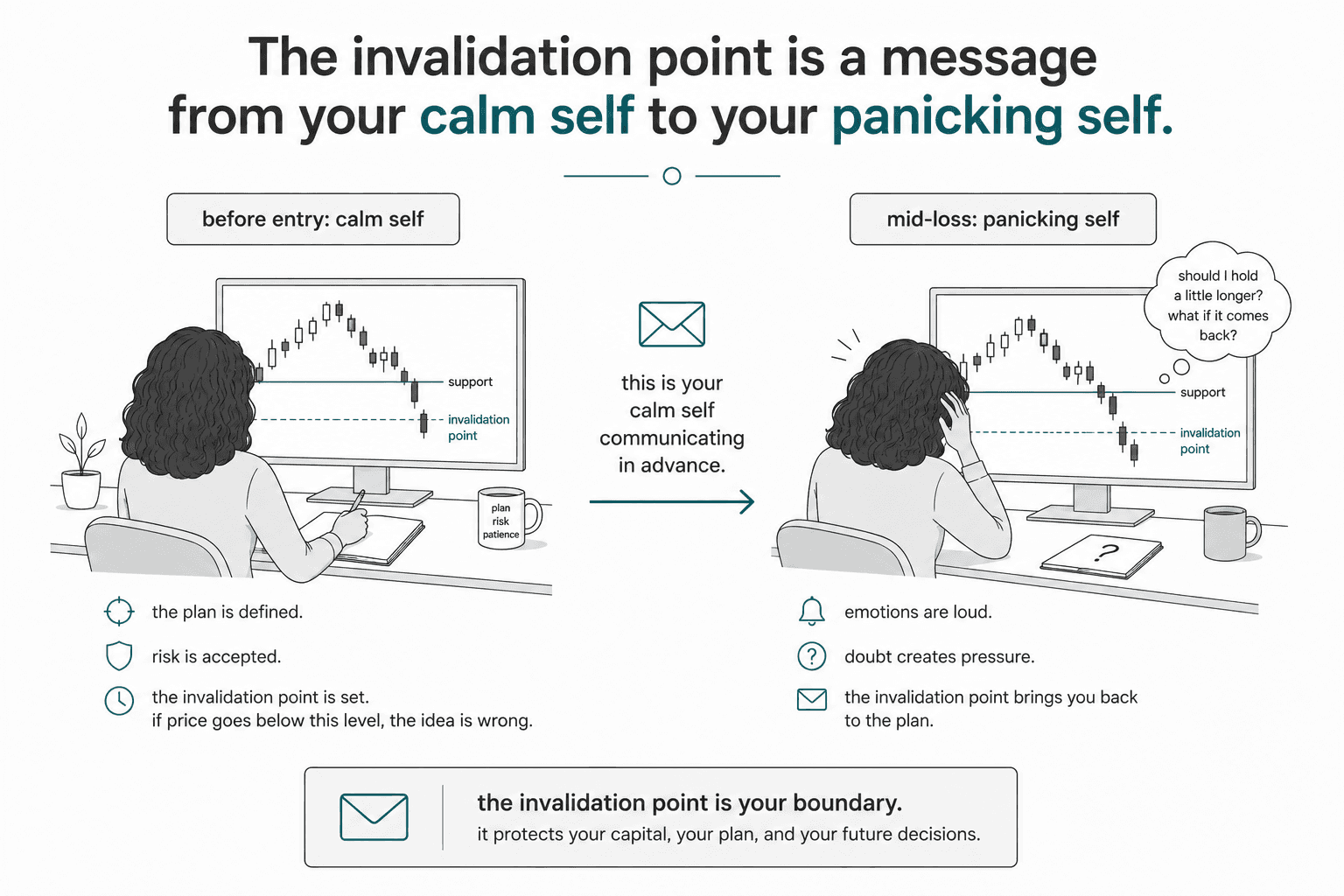
Before you enter, you are a rational human being. You have no money at stake, no position turning red, and no part of your brain screaming, "It'll come back, just give it a minute!" In that calm state, you can look at the chart and honestly identify where your idea breaks.
After you enter? That calm disappears. A losing position triggers a remarkable amount of creative writing in the brain, all pointed at one goal: not taking the loss. You will find "reasons." You will redraw your levels. You will decide the "real" support is a little lower. A decision made in that state isn’t a decision; it’s a hostage negotiation with your own fear.
So, make the call while you can still think clearly. Your invalidation point is a message from your "calm self" to your "panicking self," and the stop loss order is the only way to ensure the panicking self actually obeys.
The Stop Loss is Just the Invalidation Point, Enforced
Stop reframing the stop loss as an "admission of weakness" or a "tax" on your trading. It is simply your invalidation point, written down and handed to your broker so the computer can do the dirty work without asking your ego for permission again.
When a stop loss is hit, nothing has gone wrong with your process. The opposite is true: Your process worked. You had a hypothesis, you defined how you’d know it was wrong, the market disagreed, and the position closed for a small, pre-agreed amount. The hypothesis was tested and it failed. That isn't trading breaking down; that is trading working exactly as designed.
The trader who refuses to use an invalidation point has no way for a trade to be "wrong." And a trade that cannot be wrong cannot be closed. It just stays open, getting worse and worse, until it evolves into a "learning experience" you didn't need.
How to Actually Do This
Concretely, the habit is this: Before you place any trade, finish this sentence: "I am wrong if price reaches ____."
If you cannot fill in that blank, you do not have a trade. You have a hope. Go back to the chart and find the price that would genuinely break your reasoning. It’s usually just beyond the pattern boundary that gave you the idea in the first place.
Then place the stop there, and walk away. Don't nudge it down because the trade is "getting close." Don't move it because you "feel a bounce coming." The whole point was to decide while you were calm, and moving the stop now is just the panic-brain overriding the decision.
The Quiet Skill
None of this is exciting. The invalidation point will never be the part of trading that makes for a flashy YouTube video. But it is the only part of trading that keeps you in the game long enough to actually get good.
A trade without an invalidation point isn't "brave." It’s just gambling. Decide where you’re wrong, decide it before you click "buy," and respect the math. That single habit does more for a beginner than any indicator ever will.
Success Criteria
After completing this lesson, you should be able to describe the difference between a stop placed at an invalidation point and a stop placed based on pain tolerance, and demonstrate how to identify the former for a given setup.
Common Misconception
There's a "best" stop loss distance that works across all trades.
The Truth: Stop distance should vary based on market structure and volatility, and using a fixed-pip or fixed-dollar stop regardless of context systematically places stops in structurally wrong locations.
FAQ's
Q: Why is defining your invalidation point before entering a trade important?
Q: How do you find the invalidation point for a trade?
Q: What is an invalidation point in trading?
Table of Contents
About Me

Krista Weber
After a career as a VP of UX and EdTech executive, I retired early—and quickly realized the traditional world of trading education is fundamentally broken.
As someone with a Master’s in HCI who specialized in the design of e-learning systems, I saw a massive gap: beginners aren't failing because trading is impossible; they’re failing due to massive cognitive overload and terrible instructional design.
This site bridges that gap. I’m applying the principles of learning science, systems thinking, and minimalist UX to strip away the market noise and teach trading the way it actually should be taught.
Stay in Touch
Some of the pages on my travel blog contain affiliate links. Whenever you buy something through one of these links, I get a small commission at no extra cost to you. As an affiliate, I only recommend products and services that I feel are high quality and helpful to my readers. Thanks for your support.
Read More

Open almost any trading platform and you'll see EUR/USD sitting next to XAU/USD, NQ, ES, and a dozen CFDs on stocks you've heard of. They all show up as candlesticks moving left to right, which quietly implies they're all the same kind of thing. They aren't. Before going deeper into any one of them, it's worth drawing the map.
Updated on Sep 6, 2026

Futures are standardized contracts tied to defined specifications and a future settlement date. They can look complex at first, but the mechanics become much clearer once you know what the contract specification controls. Here's what you actually need to know.
Updated on Sep 6, 2026

CFDs appear everywhere in retail trading – but most new traders couldn't explain exactly what they are or why that matters. Here's a plain-language breakdown, including the parts that most introductions skip.
Updated on Sep 6, 2026