
Start Trading Education for Free (Here's Your Exact Setup)
You don’t need to spend thousands on courses, prop firm fees, or fancy setups to learn trading well. A breakdown of what free actually looks like.

Learning Path Stage 1: Foundations
Learning Level 2: Understanding
Primary Learning Objective
Start Trading Education for Free (Here's Your Exact Setup)
Learn to Trade with Free Tools: Pay with Time, Not Money
The retail trading industry is a masterclass in aggressive monetization. Paid courses, exclusive signal groups, custom "secret" indicators, and "AI-powered" alert systems will flood your feeds before you even know what a pip actually represents. This relentless marketing creates a highly distorted impression: learning this skill requires thousands of dollars of upfront capital. The truth is, the introductory phase of your trading journey requires almost zero financial investment. What you actually need early on is basic, unpolluted structure—just enough architectural context to understand what you are looking at when you open a live data feed.
What You Need (Early On)
If your immediate goal is to learn how to trade, your initial milestone is remarkably straightforward. You are building spatial familiarity with how liquid markets behave; you are absolutely not optimizing for peak performance or extracting maximum yield yet. Most of your essential starter kit falls into three distinct, free categories:
Charting Tools: The free version of TradingView is more than enough for your first year. It allows you to analyze multiple timeframes, apply structural drawing tools, replay historical price action for backtesting, and execute paper trades. The goal here is raw repetition—observing organic price movement without the psychological friction of live capital. That is exactly where true, unforced pattern recognition begins to take root.
Structured Education: BabyPips’ School of Pipsology remains one of the finest, most logically sequenced entry points available on the internet. It introduces market concepts in a sequence that deeply respects cognitive load theory: explaining how the plumbing of the exchange works, what currency pairs or futures contracts actually represent, and how risk is mechanically calculated through position sizing.
Selective Observation: YouTube can be a phenomenal asset, but it is an incredibly noisy ecosystem. You must aggressively filter your inputs. Selectively watch how experienced, systematic educators think through live market structures in real time. Prioritize cold analytical clarity over high-energy excitement, and focus entirely on their execution process rather than their directional predictions.
These specific tools are highly effective because they naturally minimize your cognitive load. By keeping your environment clean, you can focus on processing market data rather than fighting a cluttered user interface.
The Hoarding Phase (The Asset Accumulation Trap)
A universal trap for analytical professionals entering the markets is treating trading education like an information-hoarding game. Beginners collect endless video playlists, stack conflicting technical indicators, screenshot hundreds of random charts, and fill desktop folders with dense strategy PDFs. They operate under the false assumption that profitable market intuition will spontaneously emerge from sheer data volume.
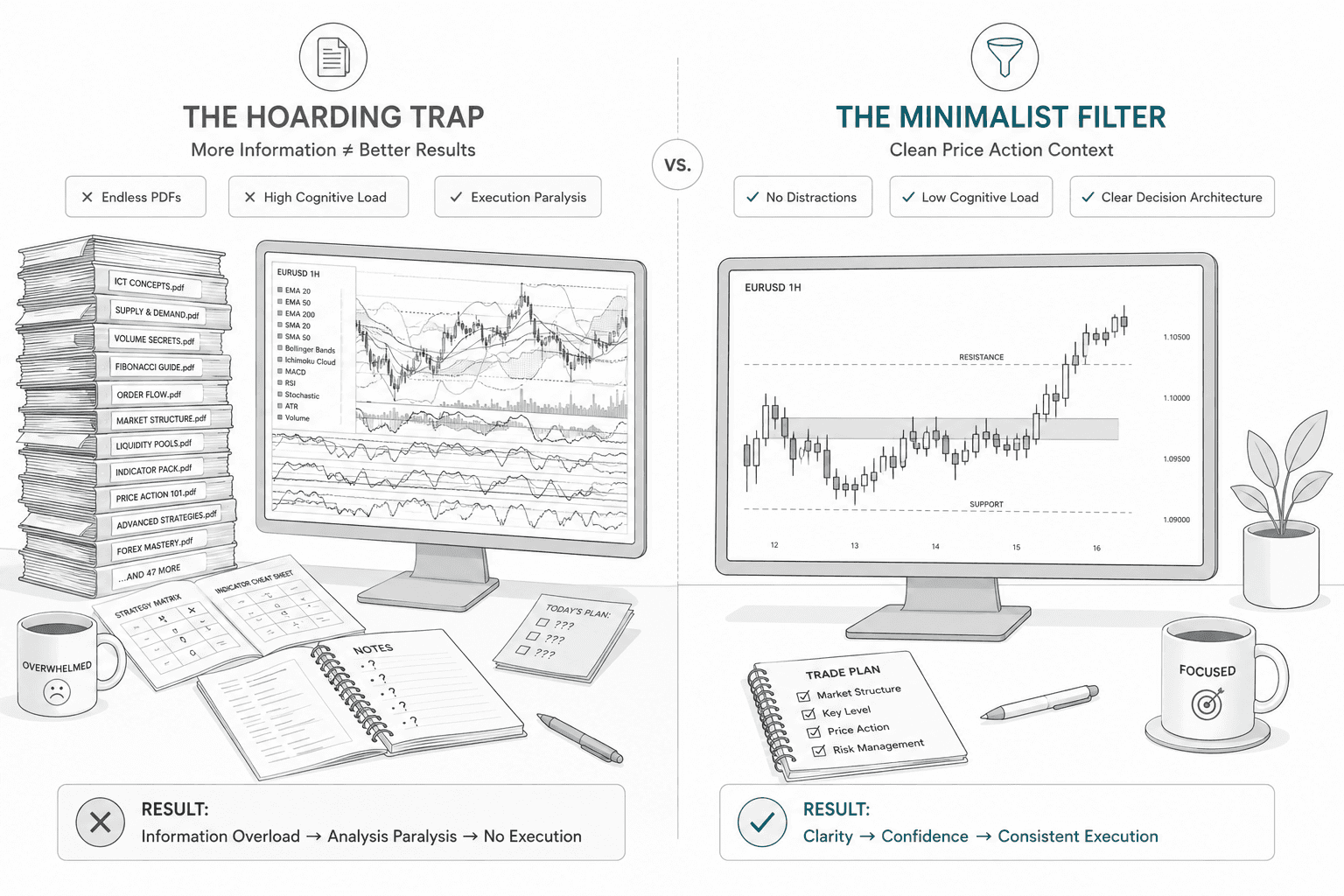
To break out of this cycle, apply a strict filter to every piece of content you consume by asking: “Does this teach me why the market is moving, or does it simply tell me what action to take?” The former builds independent, analytical systems-thinking; the latter builds blind, fragile dependency on an external source. Over time, your goal is to reduce visual and mental confusion. You need to build a stable, minimalist mental model of how price behaves under uncertainty, and how your own decision-making shifts when real assets are on the line.
The Role of Macro Context and Economic Calendars
Charts do not move in a vacuum. Sudden, violent waves of intraday volatility almost always have a fundamental driver, and those drivers are mapped out in advance on the global economic calendar. Tools like Forex Factory exist specifically to provide this structural layer of context. You do not need to go back to school for a degree in macroeconomics; you simply need a basic, daily awareness of when the immediate trading environment is scheduled to become highly unstable.
High-impact macro events (frequently designated as "red-folder news" like CPI releases or central bank interest rate decisions) introduce an immense amount of institutional order flow that can override technical chart setups entirely. A brilliant, low-friction habit for a beginner is to simply stand aside and avoid trading during these specific volatility windows until you fully understand how your edge behaves under extreme duress. The ultimate objective of an elite risk manager is to never occupy an environment they didn’t actively choose to be in.
The Monetization of Your Impatience
As you progress past the basics, the internet will accurately diagnose your growing pains and offer you endless, expensive shortcuts. You will be targeted with high-ticket courses promising compressed timelines, signal groups offering to completely remove the burden of independent decision-making, prop firm challenges framed as a fast track to institutional capital, and proprietary indicators wrapped in sleek branding like "AI-powered 90% win-rate algorithms."
These offers sound incredibly alluring when your internal uncertainty is high. However, they all share a fatal structural flaw: they attempt to replace core structural understanding with superficial access.
Premium Courses frequently arrive way too early in a trader's lifecycle, before they possess enough baseline context to evaluate whether the framework being sold is mathematically valid or pure marketing fluff.
Signal Groups create total psychological dependency, crippling your development and leaving you completely incapable of navigating a live chart when the group chat goes silent.
Prop Firm Challenges require pristine execution consistency and flawless emotional regulation—advanced operational skills that beginners are still actively trying to develop.
Custom Indicators add massive visual complexity to your monitor without doing a single thing to improve the quality of your underlying data processing.
None of these products are inherently useless, but their timing is destructive. Introduced too early, they drastically increase your cognitive load instead of streamlining it.
📐 Architect's Tip: In product design, slapping new features onto a fundamentally broken user interface never resolves the underlying usability defect; it simply masks the flaw with expensive clutter. Trading operates on the exact same logic. Many intermediate traders eventually upgrade to premium charting tiers, purchase private data feeds, or join high-ticket masterminds. That decision only becomes functionally meaningful once you can identify the exact technical or operational limitation you are trying to solve. Without that precise clarity, upgrades are just a form of expensive procrastination.
A Grounded Starter Setup
A high-utility, professional starter setup is significantly simpler than the industry wants you to believe. You need TradingView for your charting canvas, BabyPips for your mechanical foundation, and an economic calendar for situational awareness. That is your entire production stack.
At this developmental stage, keeping a daily journal of your raw market observations is infinitely more valuable than purchasing any piece of premium software. Forcing yourself to write down what you see on a clean chart pushes your brain out of impulsive, fast-twitch reactions and into deliberate, slow-thinking mode. Slower thinking is precisely where authentic pattern recognition is forged.
The real cost of learning to trade is paid exclusively in time, hyper-focused attention, and immense psychological patience. These constraints shape your long-term consistency, and no premium subscription on earth can bypass them. Rushing this engineering process is always far more expensive than any course fee—it directly leads to blown accounts, emotional overtrading, and frantic strategy-switching before a foundation is ever built.
Your Starting Checklist
[ ] Strip the Canvas: Open a free TradingView account. Spend your first week looking at pristine, naked charts without drawing a single line or loading an indicator. Just watch how price moves.
[ ] Build the Schema: Work systematically through BabyPips' beginner curriculum to wire the basic mechanical definitions into your mental model.
[ ] Audit the Environment: Check an economic calendar every single morning before the market opens. Build the operational habit of tracking major volatility windows.
[ ] Log the Data: Journal your daily market observations in writing, even if your notes feel incredibly simple or incomplete.
Closing Thought
You can spend a tremendous amount of money trying to speed up your learning curve before you even comprehend what it is you are trying to learn. Or, you can slow down just enough to build a stable, unshakeable foundation first. One approach feels faster. The other tends to last. This platform is built entirely around the second.
Success Criteria
After completing this lesson, you should be able to distinguish between necessary learning costs and avoidable ones, and identify which expenses actually accelerate skill development versus which are marketing.
Common Misconception
The biggest cost of learning to trade is losing money in the market.
The Truth: The more significant costs are usually time, opportunity cost, and paid courses that deliver less than promised.
FAQ's
Q: What are the actual costs of learning to trade?
Q: What should I avoid spending money on as a new trader?
Q: Do I need to spend money on trading courses to learn?
Table of Contents
About Me

Krista Weber
After a career as a VP of UX and EdTech executive, I retired early—and quickly realized the traditional world of trading education is fundamentally broken.
As someone with a Master’s in HCI who specialized in the design of e-learning systems, I saw a massive gap: beginners aren't failing because trading is impossible; they’re failing due to massive cognitive overload and terrible instructional design.
This site bridges that gap. I’m applying the principles of learning science, systems thinking, and minimalist UX to strip away the market noise and teach trading the way it actually should be taught.
Stay in Touch
Some of the pages on my travel blog contain affiliate links. Whenever you buy something through one of these links, I get a small commission at no extra cost to you. As an affiliate, I only recommend products and services that I feel are high quality and helpful to my readers. Thanks for your support.
Read More

Open almost any trading platform and you'll see EUR/USD sitting next to XAU/USD, NQ, ES, and a dozen CFDs on stocks you've heard of. They all show up as candlesticks moving left to right, which quietly implies they're all the same kind of thing. They aren't. Before going deeper into any one of them, it's worth drawing the map.
Updated on Sep 6, 2026

Futures are standardized contracts tied to defined specifications and a future settlement date. They can look complex at first, but the mechanics become much clearer once you know what the contract specification controls. Here's what you actually need to know.
Updated on Sep 6, 2026

CFDs appear everywhere in retail trading – but most new traders couldn't explain exactly what they are or why that matters. Here's a plain-language breakdown, including the parts that most introductions skip.
Updated on Sep 6, 2026