
What You Actually Need to Start Trading
Trading culture sells an image of six glowing monitors. The honest list of what you need to begin is uncomfortably short, and that's good news.

Learning Path Stage 1: Foundations
Learning Level 1: Recognition
Primary Learning Objective
By the end of this lesson, you will be able to identify the minimum viable setup for beginning to learn to trade without over-investing in tools before you know what you need.
Start Trading With What You Already Own (The Real Gear List Is Embarrassingly Short)
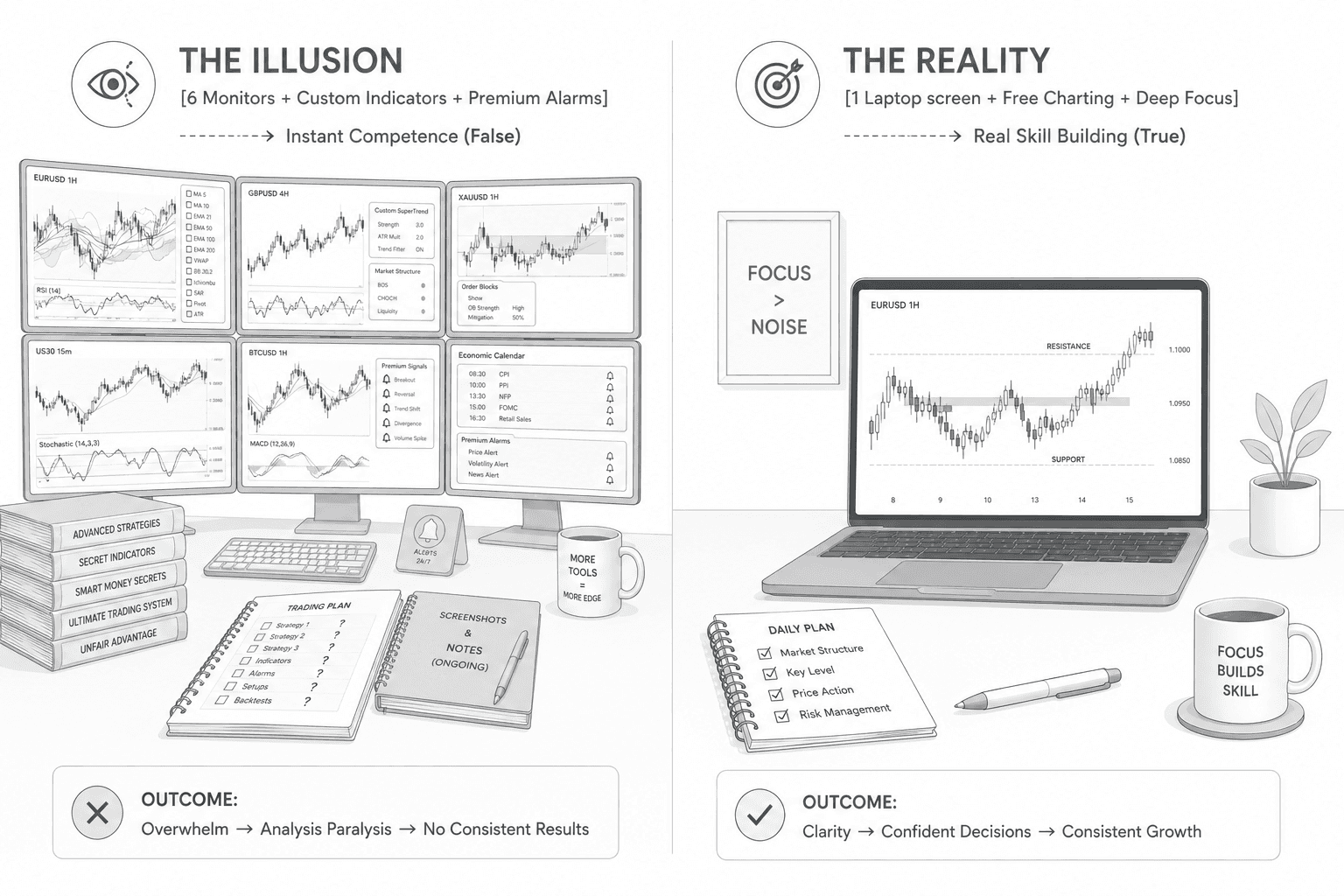
Mainstream trading culture aggressively sells a highly specific visual fantasy: a dimly lit room, six glowing vertical monitors, an ergonomic high-back chair, and a intense professional watching flashing numbers scroll by like an F-18 fighter pilot. It is cinematic, highly shareable on social media, and looks fantastic in a marketing brochure. But its relevance to actually learning how to successfully navigate the financial markets? Virtually zero.
When you strip away the aesthetics and ask the honest, unvarnished question, "What do you actually need to begin learning?", the answer is so remarkably small that it utterly destroys the most popular beginner defense mechanism: "I'll start as soon as my workspace is properly optimized."
The Genuinely Short Production List
If you are treating trading as an engineered skill rather than an expensive hobby, your required hardware and software stack fits into a single, minimalist bucket. Everything else is pure visual noise.
A Basic Computer: A standard desktop or consumer laptop is perfectly adequate. It does not need to be liquid-cooled, it does not need a top-tier gaming graphics card, and it certainly doesn't need to be brand new. Modern charting software is incredibly lightweight. The machine you currently use to read this article is already over-spec’d for the job.
Charting Software: The free tier of TradingView is the industry benchmark. It provides live data feeds, clean charting capabilities, historical data replay, and built-in simulation tools. You will not legitimately outgrow the limitations of the free tier for a very long time.
A Simulation Environment: A demo account allows you to practice order execution, observe market mechanics, and test your structural hypotheses using simulated capital. Most reputable brokers provide this data stream entirely for free.
A Standard Internet Connection: If you have enough bandwidth to stream a video or load this webpage, your latency is perfectly acceptable for learning how to read price action.
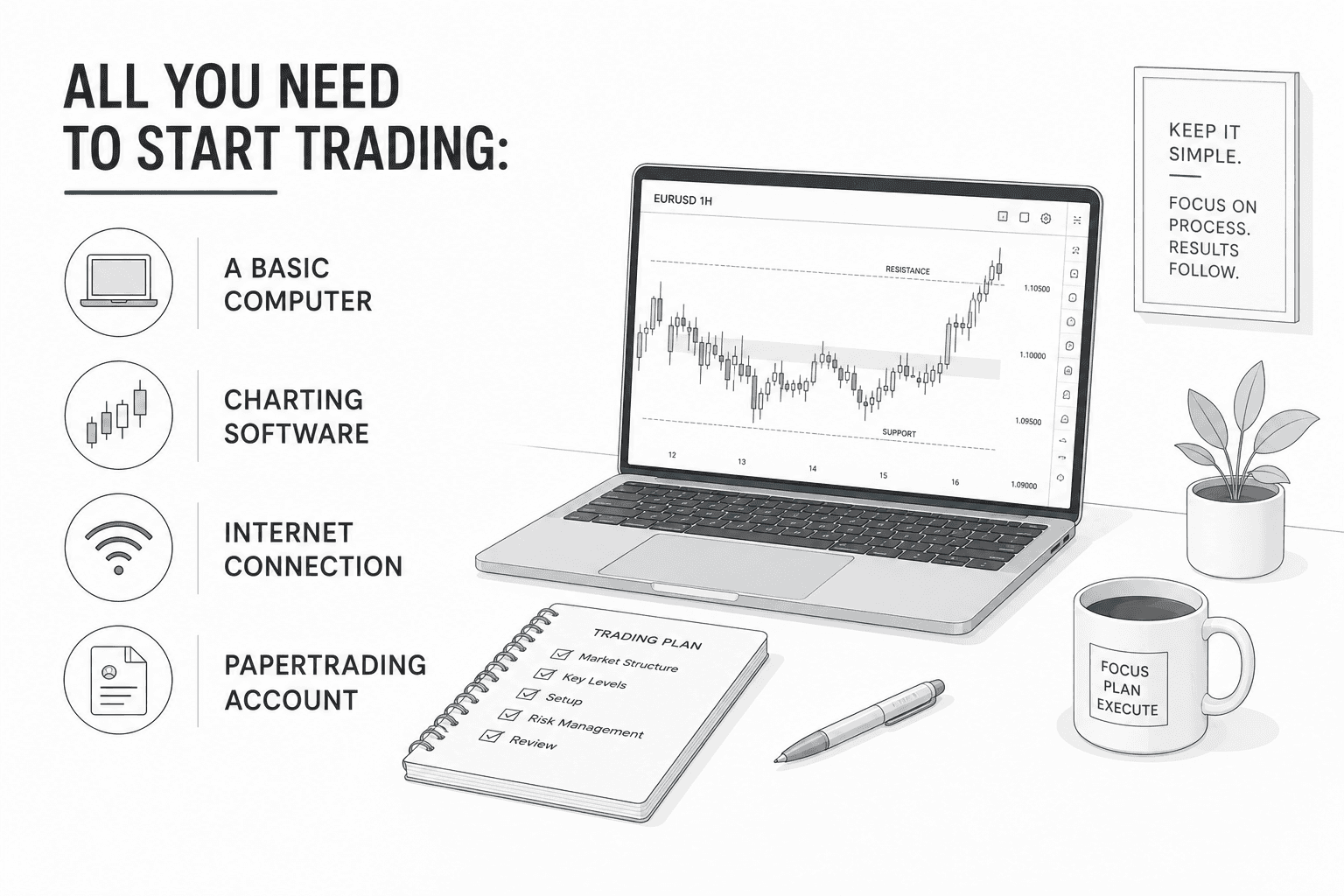
That is the entire enterprise setup: a device you already own, free institutional-grade software, a practice simulator, and your undivided attention. Everything else is strictly optional, and it remains optional far longer than the retail industry wants you to believe.
What You Can Safely Ignore at the Starting Line
Retail trading marketing is uniquely sophisticated at convincing you that spending money is a functional substitute for building an operational skill. Here is the bloated feature list you can completely purge from your roadmap right now:
Real Capital
Learning order types, watching how a stop-loss reacts under sudden volatility, and observing how position sizing directly impacts your mathematical risk are all operational skills that cost zero dollars on a simulator. Funding a live account before you can consistently execute these basics is simply paying mandatory tuition to the market for no justifiable reason.
Extra Monitors
A multi-screen layout adds nice operational convenience much later in a professional career. At the starting line, however, adding more pixels simply means creating more visual surface area for your brain to scan. More screens equal more frantic eye movement, more distractions, and more cognitive clutter—the exact opposite of what a beginner needs.
Premium Fluff
You can completely ignore proprietary indicators, expensive custom data feeds, Discord chat rooms packed with hyperactive strangers yelling "BUY NOW" in all caps, and courses utilizing fake countdown tickers on their checkout pages. None of these products touch the part of trading that is actually difficult: managing your own behavior under conditions of absolute uncertainty.
More Tools Does Not Mean More Capability
Coming from a background in product design, this reality is painfully clear. In software engineering and user experience, adding features to a broken, confusing interface never resolves the underlying usability defect; it simply masks the flaw with expensive clutter. A cluttered, hyper-complex workspace doesn't make an operator more capable; it makes them fundamentally overwhelmed.
Every extra line on your chart, every flashing alert, and every secondary monitor competes directly for your strictly limited cognitive bandwidth. An experienced professional with years of deeply grooved mental models can filter out that static effortlessly. For a beginner, it is just high cognitive load dressed up as professional sophistication.
🛠️ The Equipment Substitute: Let’s be completely honest: building an elaborate workspace is almost always a subconscious substitute for doing the heavy lifting. Buying equipment feels like tangible progress. It arrives in a pristine box. You can research specs, optimize your cable management, and watch YouTube reviews of articulating monitor arms with the solemn seriousness of an aerospace engineer.
Actually learning to interpret raw price structure, manage mathematical risk, and tolerate psychological discomfort? That process is slow, tedious, and entirely invisible. No satisfying digital receipt arrives in your inbox to confirm you made progress today. So, people buy the extra monitors instead. It is a deeply human coping mechanism, but it is entirely disconnected from actual competence.
The Three Benchmarks of Execution Readiness
The real high-performance setup for a trader isn’t physical; it is entirely cognitive. It is your structural ability to maintain deep focus, process abstract technical data, tolerate immense ambiguity, and audit your own mistakes with brutal, systematic honesty.
A simple trading journal (even a plain Excel spreadsheet or a physical notebook) will do infinitely more to stabilize your equity curve than a third monitor ever could. Before you click your very first button on a live trade simulator, you must successfully pass three baseline architectural prerequisites:
1. Foundational Systems Knowledge
You need a clear, mechanical understanding of auction theory and market microstructure. You must know what forces actually move price, what a tick or a pip represents, how leverage directly impacts your margins, and how broker spreads interact with your stop-loss placement.
None of this is advanced macroeconomics, and the absolute best environment to learn it is completely free. Spending focused time working through highly structured, beginner-friendly curriculums like BabyPips' School of Pipsology is often the precise moment a chart stops looking like a chaotic random walk and begins looking like clean, actionable information.
2. Authentic Comprehension (The Teaching Test)
Passively consuming trading content online while retaining almost none of the underlying mechanics is dangerously easy. Binge-watching YouTube playlists feels like studying, but it is not the same as active neural retention.
📋 The Test: Could you explain your core technical setup plainly to a complete outsider without opening your notes or looking at a reference guide? If you cannot look at a clean chart and immediately articulate exactly why a setup makes structural sense, where your thesis is mathematically invalidated, and how your risk is calculated, you aren't failing—you are simply still in the development phase. That is the system working exactly as designed.
3. A Strict Operational Hypothesis
Before interacting with a trade simulator, you must have concrete, pre-defined answers to four non-negotiable questions:
What specific instrument am I trading right now? (e.g., MNQ, MES, Crude Oil)
What is the exact structural context justifying this entry? (e.g., session high sweep, demand zone tap)
Where is the precise level where my market thesis is proven completely wrong?
What exact percentage of my capital am I risking if the market immediately moves against me?
An execution without these pre-planned parameters is not a trade. It is a reckless button click attached to a hopeful emotional feeling. In product design, you would never ship a major feature to production without a defined hypothesis and a clear metric for success. A professional trade is no different: it is a small, controlled, repeatable experiment. That rigorous planning process is the exact boundary line that separates engineering from gambling, and it costs absolutely nothing except the discipline to slow down.
Closing Thought
Hearing that you barely need any physical equipment to start trading can feel strangely anti-climactic. In reality, it is the best possible news. No financial gatekeeper stands between you and the global markets; you cannot be priced out of learning this skill. The obstacle preventing you from starting isn't a purchase order. It is a behavioral decision.
The six-monitor battle station photographs beautifully for social media, but it tells you absolutely nothing about the operator's actual edge, risk management, or long-term consistency. The real, professional work almost always happens on a single, ordinary laptop screen using free software, a practice account, and an operator who is willing to pay very close attention. The only asset you actually need to install is the willingness to learn slowly and build your foundation properly before risking a single real dollar.
Success Criteria
After completing this lesson, you should be able to distinguish essential tools from nice-to-haves, and know what to acquire first versus what can wait until your learning is further along.
Common Misconception
You need a multi-monitor setup and expensive software to get started
The Truth: The actual minimum is a single screen, a free charting platform, and a demo account.
FAQ's
Q: How much money do you need to start trading?
Q: Do you need to quit your job to trade?
Q: What is the minimum equipment needed to start trading?
Table of Contents
About Me

Krista Weber
After a career as a VP of UX and EdTech executive, I retired early—and quickly realized the traditional world of trading education is fundamentally broken.
As someone with a Master’s in HCI who specialized in the design of e-learning systems, I saw a massive gap: beginners aren't failing because trading is impossible; they’re failing due to massive cognitive overload and terrible instructional design.
This site bridges that gap. I’m applying the principles of learning science, systems thinking, and minimalist UX to strip away the market noise and teach trading the way it actually should be taught.
Stay in Touch
Some of the pages on my travel blog contain affiliate links. Whenever you buy something through one of these links, I get a small commission at no extra cost to you. As an affiliate, I only recommend products and services that I feel are high quality and helpful to my readers. Thanks for your support.
Read More

Open almost any trading platform and you'll see EUR/USD sitting next to XAU/USD, NQ, ES, and a dozen CFDs on stocks you've heard of. They all show up as candlesticks moving left to right, which quietly implies they're all the same kind of thing. They aren't. Before going deeper into any one of them, it's worth drawing the map.
Updated on Sep 6, 2026

Futures are standardized contracts tied to defined specifications and a future settlement date. They can look complex at first, but the mechanics become much clearer once you know what the contract specification controls. Here's what you actually need to know.
Updated on Sep 6, 2026

CFDs appear everywhere in retail trading – but most new traders couldn't explain exactly what they are or why that matters. Here's a plain-language breakdown, including the parts that most introductions skip.
Updated on Sep 6, 2026