
What Brokers Actually Do
Think of your forex broker as a service provider, not your trading mentor. Behind the smooth interface and slick educational videos is a business designed to generate revenue off your trades. Understanding how brokers make money—from spreads and overnight swaps to market making—gives you the clarity you need to navigate pricing models, avoid major conflicts of interest, and protect your capital before ever depositing a dollar.

Learning Path Stage 1: Foundations
Learning Level 1: Recognition
Primary Learning Objective
By the end of this article, you should be able to: Explain the foundational role of a forex broker, identify their primary revenue mechanisms (spreads, commissions, swaps, and market making), and differentiate between dealing desk (MM) and no-dealing-desk (NDD) execution models to evaluate broker transparency.
What a Broker Is
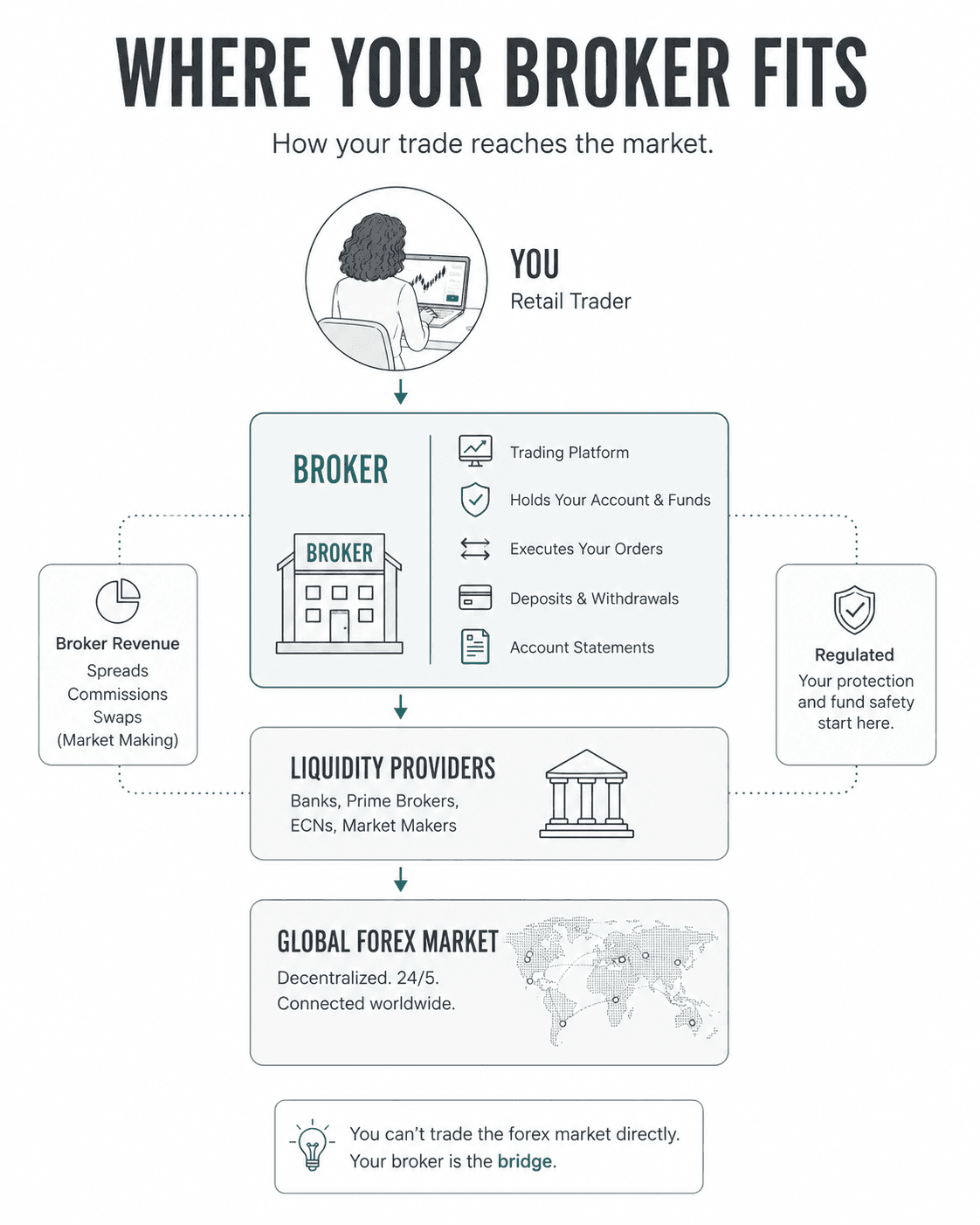
A broker is simply the intermediary sitting between you and the financial market.
In forex, the market is completely decentralized. There is no central, iconic exchange building like the NYSE for stocks. Instead, prices are set by massive networks of banks, institutions, and market makers.
As an individual retail trader, you can't just call up a major global bank and ask to buy $50 worth of Euros. Brokers bridge that gap: they aggregate pricing from multiple sources, display it on their platform, and handle order execution, leverage, account management, and deposits or withdrawals.
Put simply, the broker is the company whose app or website you log into to trade. They hold your money, show you price quotes, process your trades, and send you your account statements.
How Brokers Make Money
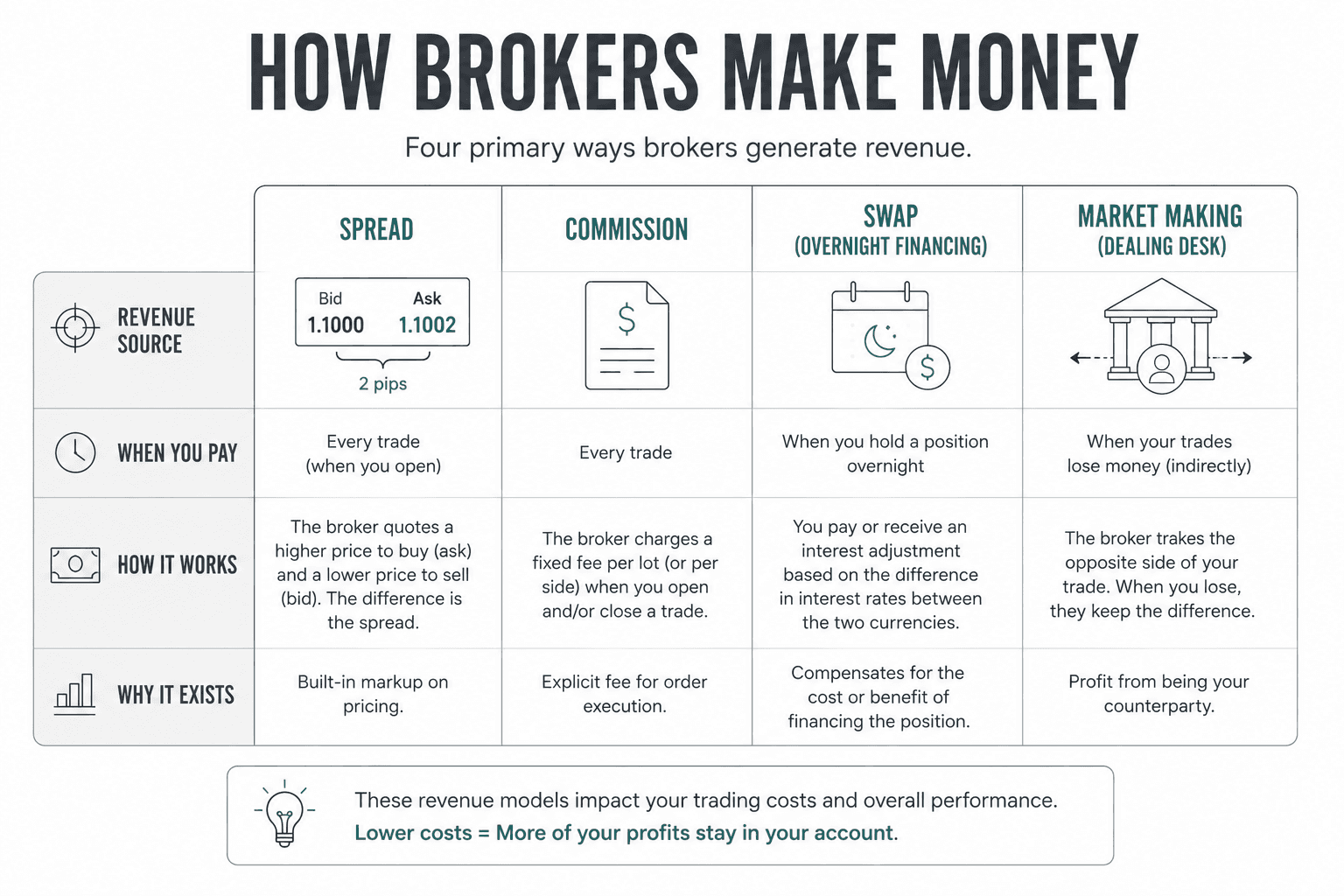
Understanding how brokers generate revenue helps you spot their incentives and recognize potential conflicts of interest. Nobody hands out free access to the global currency markets out of sheer kindness.
Spread
This is the most common revenue source. The spread is the difference between the buy price (ask) and the sell price (bid) of a currency pair.
If EUR/USD is quoted at 1.1000/1.1002, the spread is 2 pips. The second you buy at 1.1002, your position is immediately 2 pips in the red. That 2-pip difference goes straight to the broker's bottom line.
Spread-based brokers don't charge explicit commissions, but every single trade has this built-in cover charge. Tighter spreads (close to 0 pips) mean lower costs for you, while wider spreads (5 to 10 pips or more) quickly eat into your profits.
Commission
Some brokers offer paper-thin, near-zero spreads, but charge a direct commission instead. This is usually a fixed fee per lot traded. Active traders often prefer this model because it is far more transparent: total costs equal a small fee plus a minimal spread, rather than a hidden markup.
Swap (Overnight Financing)
If you hold a position overnight past the daily rollover time (typically 5 PM New York time), you will pay a swap fee or receive a credit, depending on interest rate differences between the two currencies. If you close your trades before the end of the day, swap fees are non-existent. If you hold positions for weeks, those daily interest fees add up.
Dealing Desk (Market Making)
Some brokers act as the direct counterparty to your trade instead of passing it along to external liquidity providers. When you click buy, they sell to you. When your trade loses money, they keep the difference. While strict regulations and long-term business goals generally keep brokers from blatantly rigging the game, the inherent conflict of interest remains.
Types of Brokers, Briefly
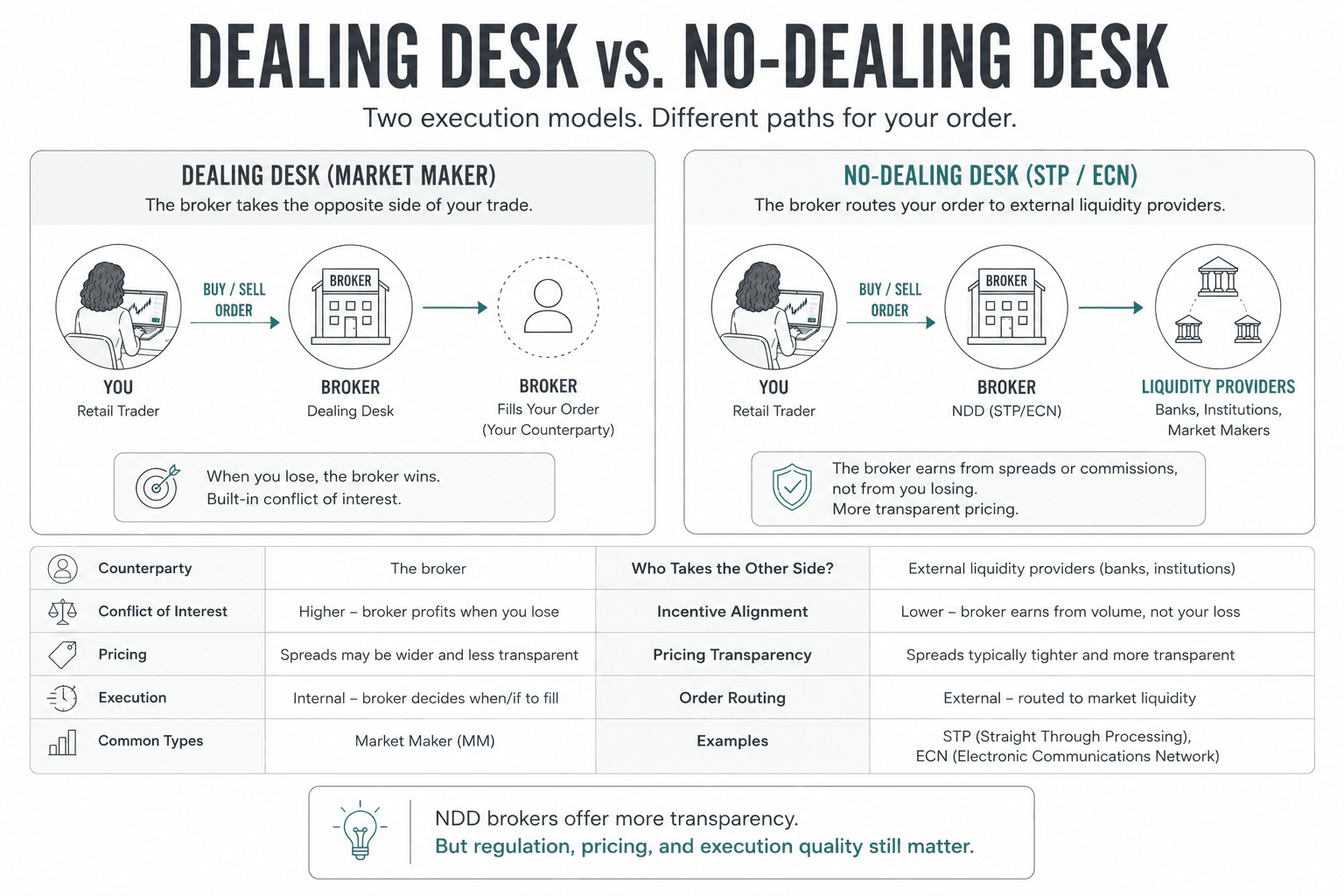
Brokers fit into two main camps:
Dealing-Desk Brokers (Market Makers): They take the opposite side of your trade directly.
No-Dealing-Desk Brokers (STP and ECN): They route your orders to outside liquidity providers and earn revenue through commissions or spread markups.
This distinction affects everything from pricing transparency to conflict of interest. The specific mechanics of each model, along with a side-by-side comparison table, are covered in full in Types of Forex Brokers Explained.
What to Look for in a Broker (When You're Ready)
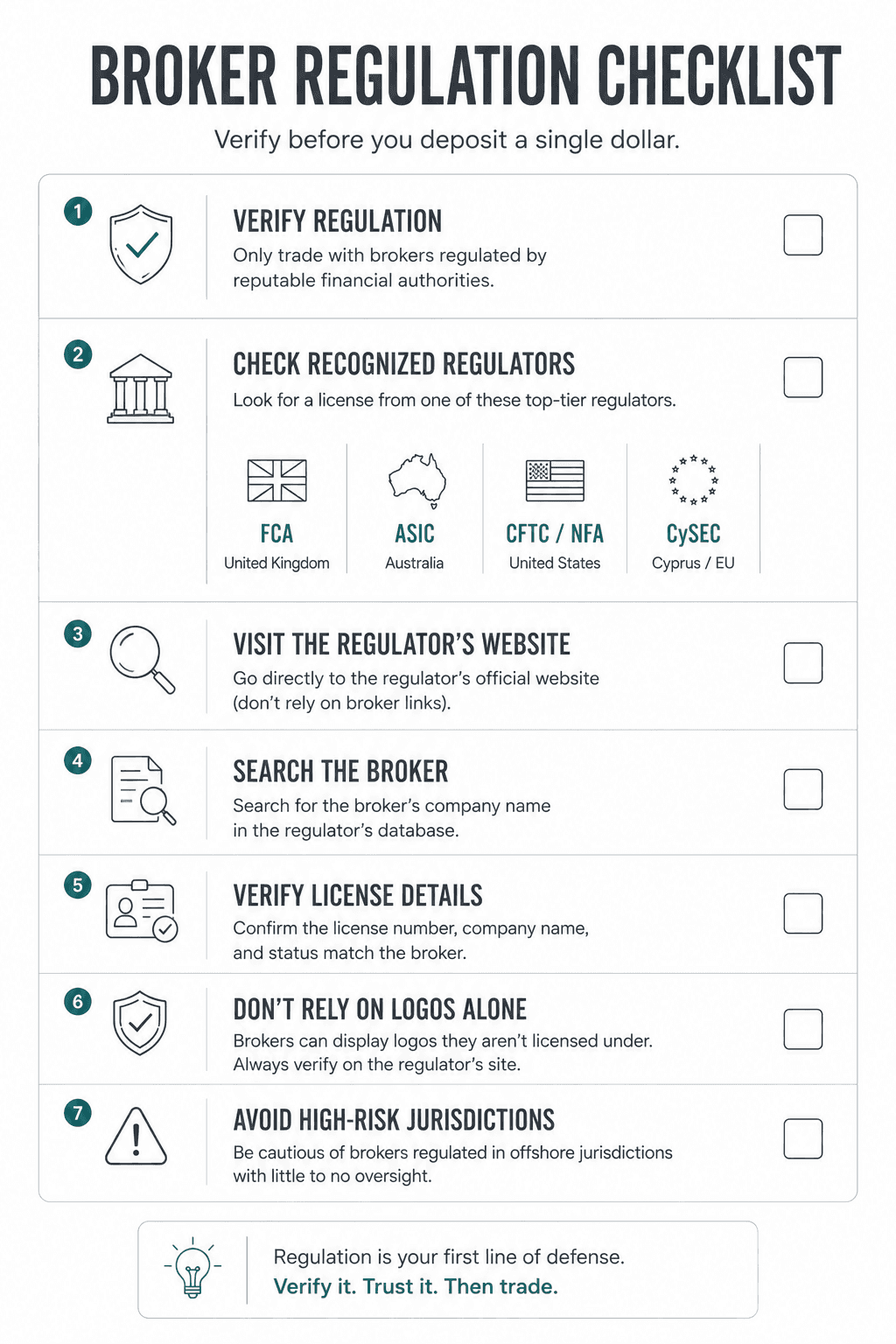
You don't need to open a live account today. When you are ready, the full checklist (regulation, fund safety, pricing, platform speed, available assets, and withdrawal reliability) is laid out in How to Choose a Forex Broker.
The short version? Regulation comes first. Everything else is secondary.
The Broker Is Not Your Teacher
Broker marketing is not trading education.
Broker websites are packed with glossy articles, webinars, and beginner courses. While these can offer decent introductory background, their primary goal is simple: keep you active and trading so you keep generating spreads and commissions.
It isn't inherently evil, it's just business. A casino will gladly hand you a free guide on how to play blackjack, but they aren't hoping you beat the house.
Treat broker educational materials as potentially helpful references, not as your core mentor. Think of your broker as a utility provider, like your bank or internet provider, rather than a trusted guide.
Your broker provides access, not advice. Keeping that distinction clear will save you from a world of unnecessary confusion.
Success Criteria
You are ready to move on the the next lesson if you can:
Identify the role: Explain why retail traders require a broker to participate in the decentralized forex market.
Compare execution models: Differentiate between a Dealing Desk broker (acting as the direct counterparty) and a No Dealing Desk broker (routing orders to external liquidity providers).
Calculate/Evaluate trading costs: Recognize how broker revenue models (spread markups, explicit commissions, and overnight financing swaps) directly impact overall trading performance.
Assess legitimacy: List the top regulatory bodies (FCA, ASIC, CFTC/NFA, CySEC) and explain how to verify a broker’s licensing before opening a live account.
Common Misconception
A broker is a neutral platform with no stake in what you do.
The Truth: It's an easy thing to assume, since the platform just shows you prices and lets you click buttons. In reality a broker is a business with a revenue model, and that model shapes what it shows you, what it encourages, and how it presents "education." Understanding the incentive isn't cynicism. It's basic literacy about who you're dealing with.
FAQ's
Q: How do I know if a broker is legitimate?
Q: What's the difference between a "dealing desk" and "no dealing desk" broker?
Q: Do I need a broker to start learning to trade?
Table of Contents
About Me

Krista Weber
After a career as a VP of UX and EdTech executive, I retired early—and quickly realized the traditional world of trading education is fundamentally broken.
As someone with a Master’s in HCI who specialized in the design of e-learning systems, I saw a massive gap: beginners aren't failing because trading is impossible; they’re failing due to massive cognitive overload and terrible instructional design.
This site bridges that gap. I’m applying the principles of learning science, systems thinking, and minimalist UX to strip away the market noise and teach trading the way it actually should be taught.
Stay in Touch
Some of the pages on my travel blog contain affiliate links. Whenever you buy something through one of these links, I get a small commission at no extra cost to you. As an affiliate, I only recommend products and services that I feel are high quality and helpful to my readers. Thanks for your support.
Read More

Open almost any trading platform and you'll see EUR/USD sitting next to XAU/USD, NQ, ES, and a dozen CFDs on stocks you've heard of. They all show up as candlesticks moving left to right, which quietly implies they're all the same kind of thing. They aren't. Before going deeper into any one of them, it's worth drawing the map.
Updated on Sep 6, 2026

Futures are standardized contracts tied to defined specifications and a future settlement date. They can look complex at first, but the mechanics become much clearer once you know what the contract specification controls. Here's what you actually need to know.
Updated on Sep 6, 2026

CFDs appear everywhere in retail trading – but most new traders couldn't explain exactly what they are or why that matters. Here's a plain-language breakdown, including the parts that most introductions skip.
Updated on Sep 6, 2026