
Types of Forex Brokers Explained
Not all forex brokers play by the same rules. The difference between a market maker and an ECN broker isn’t just technical jargon. It directly impacts how your trades are executed, what you pay per transaction, and whether your broker's financial incentives actually align with your success.

Learning Path Stage 1: Foundations
Learning Level 1: Recognition
Primary Learning Objective
By the end of this lesson, you will be able to distinguish between major forex broker execution models (Market Maker, STP, ECN, DMA) and evaluate which structure (and regulatory tier) best aligns with your trading style and risk management needs.
Why Broker Type Matters
When you click "buy" in your trading platform, a lot happens behind the curtain that you never see. Your order goes somewhere, and who takes the other side depends entirely on your broker’s business model.
Think of it like buying produce:
ECN: Buying straight from the local farmer. No middleman and real market prices, but you do a bit more legwork (and pay a small handling fee).
STP: Buying from a wholesaler who gets produce from multiple farms and adds a small, transparent markup.
Market Maker: Buying from the corner convenience store. They set their own prices for convenience, don't tell you what they paid wholesale, and sometimes try to sell you slightly bruised apples because it's what they have on the shelf.
None of these business models are inherently scams. They’re just different arrangements, and knowing which one you’re using sets proper expectations.
It comes down to three main factors:
Cost: How much you pay per trade.
Execution: How accurately your orders fill at your intended price.
Conflict of Interest: Whether your broker makes money when you lose.
Market Makers
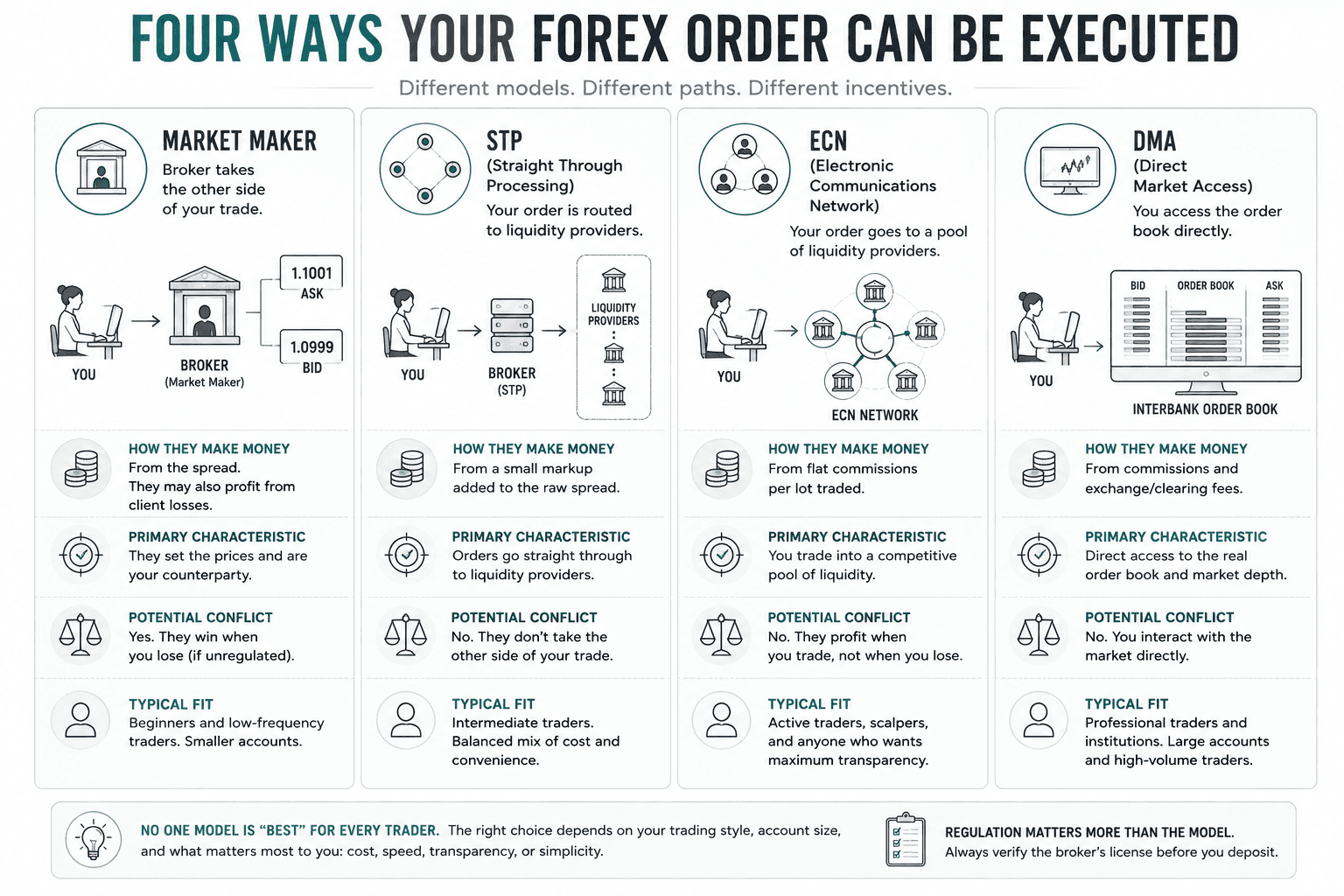
A market maker literally "makes the market" for its clients. They quote both the bid and ask price and act as the direct buyer or seller for every trade you place.
How it works: You want to buy EUR/USD. The market maker sells it to you from their own inventory. You want to sell? They buy it back.
How they make money: Primarily off the spread. When you buy at the ask and sell at the bid, they pocket the difference. They may also hold net opposing positions if they suspect their clients are mostly wrong (and let’s be honest, retail traders often are).
Pros:
No commission charges
Low minimum deposits (great for starting out)
Smooth execution in normal, low-volatility conditions
Fixed spreads are sometimes available
Cons:
Direct conflict of interest (they win when you lose)
Risk of re-quotes during fast markets
Spreads can be wider than ECN raw spreads during normal hours
Verdict: Regulated market makers at reputable firms execute fairly and work great for beginners. Unregulated offshore market makers are where "mysterious price spikes" and missing stop-losses tend to happen.
STP Brokers (Straight Through Processing)
STP brokers skip the middleman desk and route your orders straight to liquidity providers—like big banks and financial institutions.
How it works: Your order passes through automatically to whoever is offering the best price in the broker’s liquidity pool. No human dealer sits around approving or rejecting your trade.
How they make money: By adding a tiny markup (a fraction of a pip) to the raw spread from liquidity providers.
Pros:
No conflict of interest—they don't take the other side of your trade
No re-quotes (orders execute at live market prices)
Faster execution times
Cons:
Spreads still include a markup
During low liquidity (like holiday trading), spreads can blow out wide
Verdict: A great middle ground. You get clean execution alignment without needing to calculate per-lot commission fees on every trade.
ECN Brokers (Electronic Communications Network)
ECN brokers hook you straight into an electronic hub filled with banks, hedge funds, and other traders matching orders against each other.
How it works: Your order enters an open electronic pool. It matches instantly against an opposing order or a liquidity provider. The broker acts purely as the host of the party and couldn't care less whether your trade wins or loses.
How they make money: Purely through flat commissions (usually $2–$7 per standard lot traded).
Pros:
Interbank-level raw spreads (frequently 0.0 pips on EUR/USD during peak hours)
Zero conflict of interest
Fast, high-quality execution for active traders
Anonymous order flow (liquidity providers can't see who you are or hunt your stops)
Cons:
Commissions add up quickly if you overtrade
Raw spreads can spike during off-peak hours
Generally require higher initial deposits
Verdict: The gold standard for active traders, scalpers, and anyone who wants complete transparency.
DMA Brokers (Direct Market Access)
DMA is ECN on steroids. Traders look directly into the interbank order book and place limit/market orders right into the order queue.
For 99% of retail traders, the difference between ECN and DMA is mostly academic. Unless you are managing serious capital or running high-frequency institutional algos, you don't need to pay the premium required for DMA access.
The Regulation Question (More Important Than Broker Type)
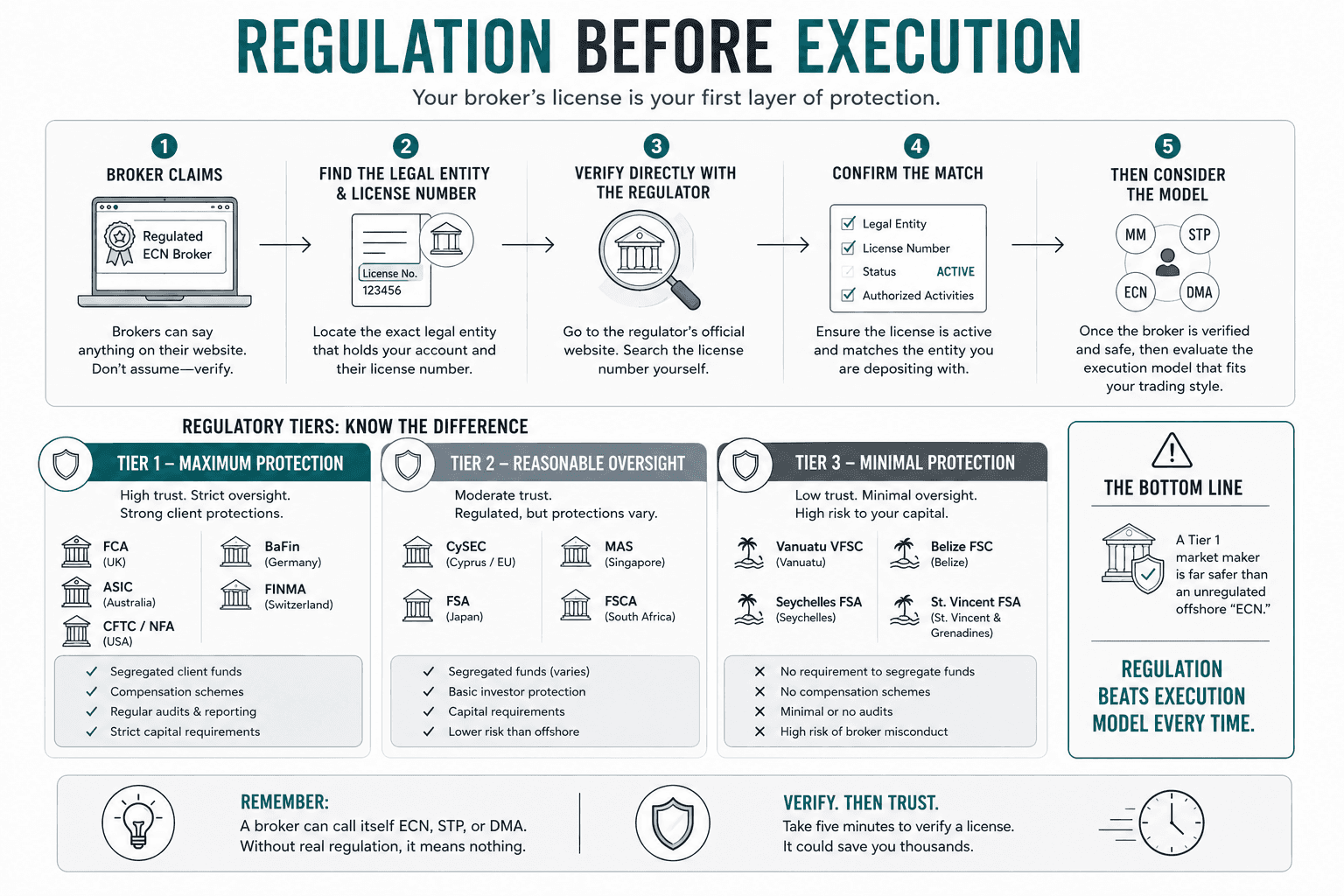
You can pick the fanciest ECN setup on the planet, but if the broker operates out of an unregulated mailbox in a beach town, your money isn't safe. Regulation beats execution model every single time.
Regulatory Tier Cheat Sheet:
Tier 1 (Maximum Protection): FCA (UK), ASIC (Australia), BaFin (Germany), CFTC/NFA (USA)
Tier 2 (Reasonable Oversight): CySEC (Cyprus/EU), FSA (Japan), MAS (Singapore)
Tier 3 (Wild West / Minimal Protection): Offshore registrations like Vanuatu, Seychelles, Belize, or St. Vincent
A Tier 1 market maker must segregate client funds, submit to strict audits, and adhere to best-execution rules. An offshore "ECN" with zero oversight can shut down its website tomorrow and buy a yacht with your deposit.
Choosing the Right Broker
Factor | Market Maker | STP | ECN |
Cost Structure | Spread only | Spread + small markup | Commission + raw tight spread |
Conflict of Interest | Potential (if unregulated) | None | None |
Execution Speed | Moderate | Fast | Fastest |
Best For | Beginners, low frequency | Intermediate traders | Active traders & scalpers |
Min. Deposit | $50 – $500 | $200 – $1,000 | $500 – $5,000+ |
The Bottom Line
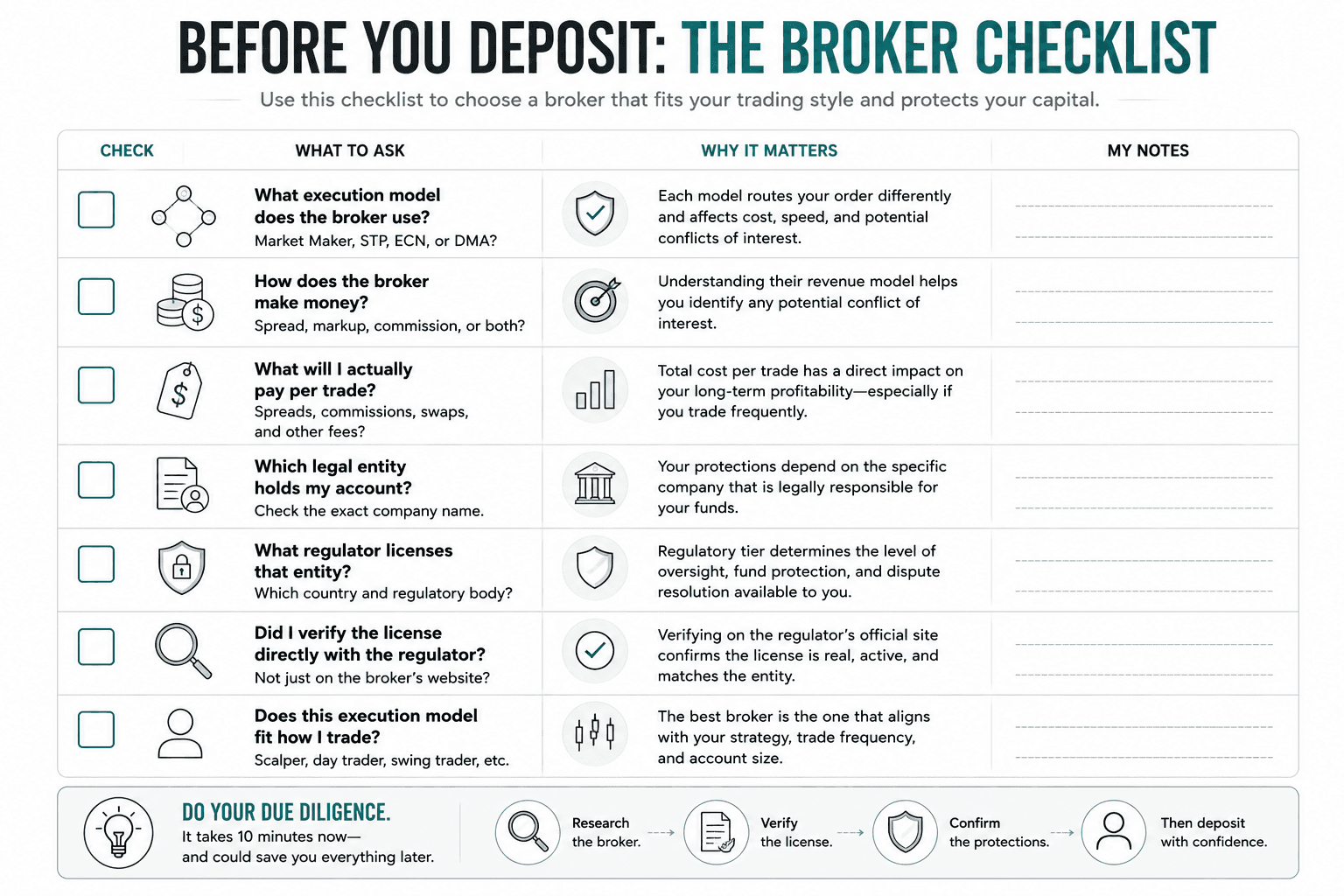
There is no single "best" broker type—only the broker type that fits your style, account size, and trading frequency.
Whatever you do, verify their regulatory license number directly on the regulator's official website before sending over a single dollar. Don't just trust a pretty badge pasted onto their homepage footer.
Success Criteria
You will have been successful in learning this lesson if you can:
Identify key execution models: Clearly explain the core mechanics, fee structures, and potential conflicts of interest for Market Maker, STP, ECN, and DMA brokers.
Evaluate trade impact: Assess how execution speed, spreads, and commissions directly affect different trading strategies (e.g., scalping vs. long-term holding).
Verify broker safety: Distinguish between regulatory tiers (Tier 1 vs. Tier 3 offshore) and perform a manual verification of a broker's licensing credentials on official regulatory databases.
Common Misconception
ECN or DMA execution is automatically the "better" choice.
The Truth: It's an understandable assumption: those models sound more professional, more transparent, closer to how "real" institutions trade. But the Verdicts below make the actual point. A regulated market maker can be perfectly appropriate for a beginner's account size and trade frequency, and execution model matters less than regulation and fit to your trading style.
FAQ's
Q: Does broker type affect execution quality?
Q: How do I know what type of broker I'm actually using?
Q: What is the difference between a market maker and an ECN broker?
Table of Contents
About Me

Krista Weber
After a career as a VP of UX and EdTech executive, I retired early—and quickly realized the traditional world of trading education is fundamentally broken.
As someone with a Master’s in HCI who specialized in the design of e-learning systems, I saw a massive gap: beginners aren't failing because trading is impossible; they’re failing due to massive cognitive overload and terrible instructional design.
This site bridges that gap. I’m applying the principles of learning science, systems thinking, and minimalist UX to strip away the market noise and teach trading the way it actually should be taught.
Stay in Touch
Some of the pages on my travel blog contain affiliate links. Whenever you buy something through one of these links, I get a small commission at no extra cost to you. As an affiliate, I only recommend products and services that I feel are high quality and helpful to my readers. Thanks for your support.
Read More

Open almost any trading platform and you'll see EUR/USD sitting next to XAU/USD, NQ, ES, and a dozen CFDs on stocks you've heard of. They all show up as candlesticks moving left to right, which quietly implies they're all the same kind of thing. They aren't. Before going deeper into any one of them, it's worth drawing the map.
Updated on Sep 6, 2026

Futures are standardized contracts tied to defined specifications and a future settlement date. They can look complex at first, but the mechanics become much clearer once you know what the contract specification controls. Here's what you actually need to know.
Updated on Sep 6, 2026

CFDs appear everywhere in retail trading – but most new traders couldn't explain exactly what they are or why that matters. Here's a plain-language breakdown, including the parts that most introductions skip.
Updated on Sep 6, 2026