
Why Chart Patterns Work (When They Do)
Chart patterns work when the behavior they describe is genuinely present and enough traders act on it. Treating them as probabilities, not promises, is the whole skill.
Learning Path Stage 3: Chart Patterns
Learning Level 2: Understanding
Primary Learning Objective
By the end of this lesson, you will be able to explain the behavioral mechanism behind chart patterns (why they produce predictable outcomes at all, rather than simply memorizing which patterns "work.")
The honest version of this topic is right there in the title. Chart patterns work, when they do. Not always. Not reliably enough to remove thinking from the process. But often enough, and for understandable reasons, that they remain worth learning.
That qualifier matters. Most pattern content quietly drops it, because "this pattern works" is a more exciting sentence than "this pattern works sometimes, under certain conditions, for reasons you should understand." The exciting version is also the one that loses people money. So it is worth walking through both halves: why patterns work at all, and why they regularly do not.
Patterns reflect a real situation
The first reason patterns work is that the good ones describe something genuinely happening in the market.
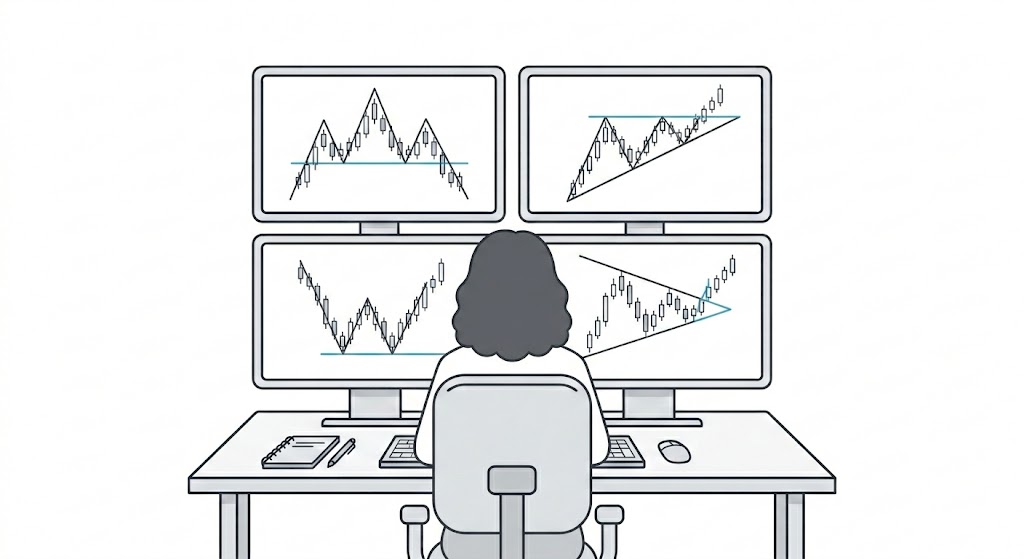
Take a triangle, where price swings up and down in a steadily narrowing range. That shape is not arbitrary. It is what a market looks like when participants are becoming less and less certain, when the gap between what buyers will pay and what sellers will accept is compressing. The triangle is the visible signature of a real behavioral state: a market coiling toward a decision.
A double top works the same way. Price reaches a high, fails, returns to the same high, and fails again. That shape reflects a crowd genuinely testing a level twice and being turned away both times. The pattern is informative because the repeated rejection actually happened.
When a pattern works, part of the reason is simply that the situation it describes was real. The compression really was happening. The exhaustion really was setting in. The shape was an accurate read of behavior, and behavior tends to carry forward.
Patterns also work because people watch them
The second reason is more circular, and worth being honest about. Patterns work partly because enough people believe in them.
A widely known pattern is watched by a large number of traders at once. They see the same shape, expect the same outcome, and place orders in similar places. When that happens, the expectation becomes partly self-fulfilling. Price breaks the triangle, the traders who were all watching that triangle act, and their combined action helps produce the very move they expected.
This is not a trick or a flaw. It is just how shared attention behaves in a market. A pattern is, among other things, a coordination point. It gives a scattered crowd a common reference, and common references create clustered behavior.
It does mean, though, that a pattern's reliability is tied to how many people are paying attention to it, and to whether they act.
Why patterns fail
Patterns fail constantly, and a beginner needs to expect that rather than be wounded by it.
The simplest reason is that the market is under no obligation. A pattern is a tendency, not a contract. The behavioral situation it describes can be real and then change. Compression can resolve in the unexpected direction. Exhaustion can be followed by a second wind. New information can arrive and override whatever the crowd was doing.
There is also the matter of who is trapped. When a pattern is obvious, a lot of traders pile in expecting the textbook outcome. If price goes the other way, all of those traders are now offside and have to exit, which can accelerate the move against them. The very visibility that makes a pattern work can also make its failure violent. A failed pattern is not nothing. It is often its own kind of signal.
When patterns are most worth trusting
If patterns are conditional, it helps to know roughly when the conditions tend to hold.
Patterns tend to be more reliable when the shape is clean and obvious rather than something you had to talk yourself into. A clear pattern is one many traders can see, which means the shared-attention effect is stronger. They also tend to be more reliable when they appear in a sensible context, in agreement with the larger trend and structure around them, rather than in isolation. A continuation pattern pointing the same way the market was already moving is leaning with behavior that already exists. One pointing against everything around it is asking the crowd to reverse, which is a heavier lift.
You will go deeper into context later. For now, the short version is that a pattern is most trustworthy when it is obvious and when it agrees with its surroundings.
A pattern is a hypothesis
The most useful way to hold all of this is to treat a chart pattern as a hypothesis rather than a prediction.
A hypothesis says: if this shape reflects what I think it reflects, price will probably do this. It is a statement with a built-in chance of being wrong, and that is a feature, not a weakness. It means you can plan for the wrong case in advance.
This is exactly what a stop loss is for. A stop loss is not just protection. It is the point at which your hypothesis has been proven wrong, decided ahead of time, while you are calm. If the pattern was a genuine read of behavior, good. If it was not, the position closes and you have lost a small, known amount. Either way you were never relying on certainty.
Working with patterns honestly
So patterns work when two things line up. The behavioral situation the shape describes is genuinely present, and enough participants see it and act on it. When both are true, patterns can be quite useful. When either is missing, the shape is just a shape.
That is not a disappointing conclusion. It is the realistic one, and the realistic one is what keeps you solvent. A trader who expects patterns to work every time is constantly betrayed. A trader who treats each pattern as a reasonable hypothesis with a known failure point is simply doing the job. The patterns did not change. The expectations did.
Success Criteria
After completing this lesson, you should be able to describe the crowd psychology that creates and resolves common patterns, and use this understanding to evaluate whether a pattern is setting up properly versus superficially similar.
Common Misconception
Chart patterns work because everyone watches them and they become self-fulfilling.
The Truth: They work primarily because of underlying order flow and behavioral dynamics at key price levels; the self-fulfilling aspect is secondary.
FAQ's
Q: What market conditions are best for trading chart patterns?
Q: Should you trade every chart pattern you see?
Q: Why do chart patterns sometimes work and sometimes fail?
Table of Contents
About Me

Krista Weber
After a career as a VP of UX and EdTech executive, I retired early—and quickly realized the traditional world of trading education is fundamentally broken.
As someone with a Master’s in HCI who specialized in the design of e-learning systems, I saw a massive gap: beginners aren't failing because trading is impossible; they’re failing due to massive cognitive overload and terrible instructional design.
This site bridges that gap. I’m applying the principles of learning science, systems thinking, and minimalist UX to strip away the market noise and teach trading the way it actually should be taught.
Stay in Touch
Some of the pages on my travel blog contain affiliate links. Whenever you buy something through one of these links, I get a small commission at no extra cost to you. As an affiliate, I only recommend products and services that I feel are high quality and helpful to my readers. Thanks for your support.
Read More

Open almost any trading platform and you'll see EUR/USD sitting next to XAU/USD, NQ, ES, and a dozen CFDs on stocks you've heard of. They all show up as candlesticks moving left to right, which quietly implies they're all the same kind of thing. They aren't. Before going deeper into any one of them, it's worth drawing the map.
Updated on Sep 6, 2026

Futures are standardized contracts tied to defined specifications and a future settlement date. They can look complex at first, but the mechanics become much clearer once you know what the contract specification controls. Here's what you actually need to know.
Updated on Sep 6, 2026

CFDs appear everywhere in retail trading – but most new traders couldn't explain exactly what they are or why that matters. Here's a plain-language breakdown, including the parts that most introductions skip.
Updated on Sep 6, 2026