
How Major Currency Pairs Behave Differently
EUR/USD, GBP/USD, and USD/JPY are all major forex pairs, but the conditions around them can differ. Instead of memorizing a permanent "personality," learn to compare what you can observe now: volatility, session activity, spread and liquidity, event sensitivity, and directional persistence.

Learning Path Stage 1: Foundations
Learning Level 4: Analysis
Primary Learning Objective
By the end of this lesson, you will be able to compare major currency pairs using observable current conditions, including realized volatility, session activity, spread/liquidity, event sensitivity, and directional persistence.
EUR/USD: A High-Liquidity Benchmark
EUR/USD is one of the world's most actively traded currency pairs. That depth of participation makes it a useful benchmark for learning how to compare pair conditions, but high liquidity doesn't guarantee clean price action or razor-thin spreads. Thinking EUR/USD won't chop you to pieces during a quiet afternoon is a rite of passage every trader pays for at least once.
What to observe now: recent realized volatility or ATR, current spread, activity during European and US trading hours, and sensitivity to ECB and US macroeconomic events.
Why conditions change: EUR/USD reflects more than a single rate differential. Monetary-policy expectations, US and Eurozone macro data, global risk shocks, capital flows, and hedging demand can all matter.
Practical takeaway: use EUR/USD as a reference point, then compare today's conditions with the assumptions your strategy needs. Do not treat historical behavior as a permanent technical personality.
GBP/USD: Compare Current Volatility and Event Sensitivity
GBP/USD often attracts traders because it can show substantial movement around UK and US trading hours and scheduled economic events. GBP/USD (sometimes referred to as Cable) didn't earn its reputation by sitting politely on its hands. But rather than treating it like an unpredictable wild card, measure its current realized volatility against EUR/USD before you size your position.
What to observe now: recent ATR or daily range, current spread, activity around UK and US market hours, and sensitivity to Bank of England and UK economic releases.
Risk implication: if recent volatility is higher than the pair you usually trade, the same fixed stop distance may represent a different amount of normal market noise. Position sizing and stop placement should come from your strategy and current volatility, not from a memorized pair label.
Practical takeaway: compare the pair's present volatility and event exposure with your strategy requirements before trading it.
USD/JPY: Watch Rates, Risk Sentiment, and Intervention
USD/JPY is strongly influenced by monetary-policy expectations and the relationship between US and Japanese interest rates, but those are not the only drivers. Risk sentiment, capital flows, and policy surprises can also matter.
What to observe now: recent realized volatility, directional persistence, activity during Asian and US trading hours, and the current macro backdrop.
Intervention risk: this isn't a footnote in a textbook, it’s Japan’s Ministry of Finance deciding to remind the market who actually runs the order book. When policy intervention hits, you better be sure you set up reasonable stop-losses.
Practical takeaway: USD/JPY should not be treated as inherently "calm," "smooth," or permanently trend-following. Evaluate current conditions and keep policy-event risk in the analysis.
EUR/JPY and GBP/JPY: Crosses With Different Current Conditions
Crosses remove USD from the pair, but they do not remove macroeconomic drivers. EUR/JPY reflects euro- and yen-related forces; GBP/JPY reflects pound- and yen-related forces. Their volatility and directional behavior can change materially as monetary policy, risk sentiment, and market conditions change.
What to observe now: recent realized volatility, current spread and liquidity, active-session behavior, event exposure, and whether directional movement is persistent or choppy.
Practical takeaway: GBP/JPY isn't named 'The Dragon' because it offers gentle, friendly trends. Don't assume EUR/JPY is just a tame compromise either. Compare current data before drawing conclusions.
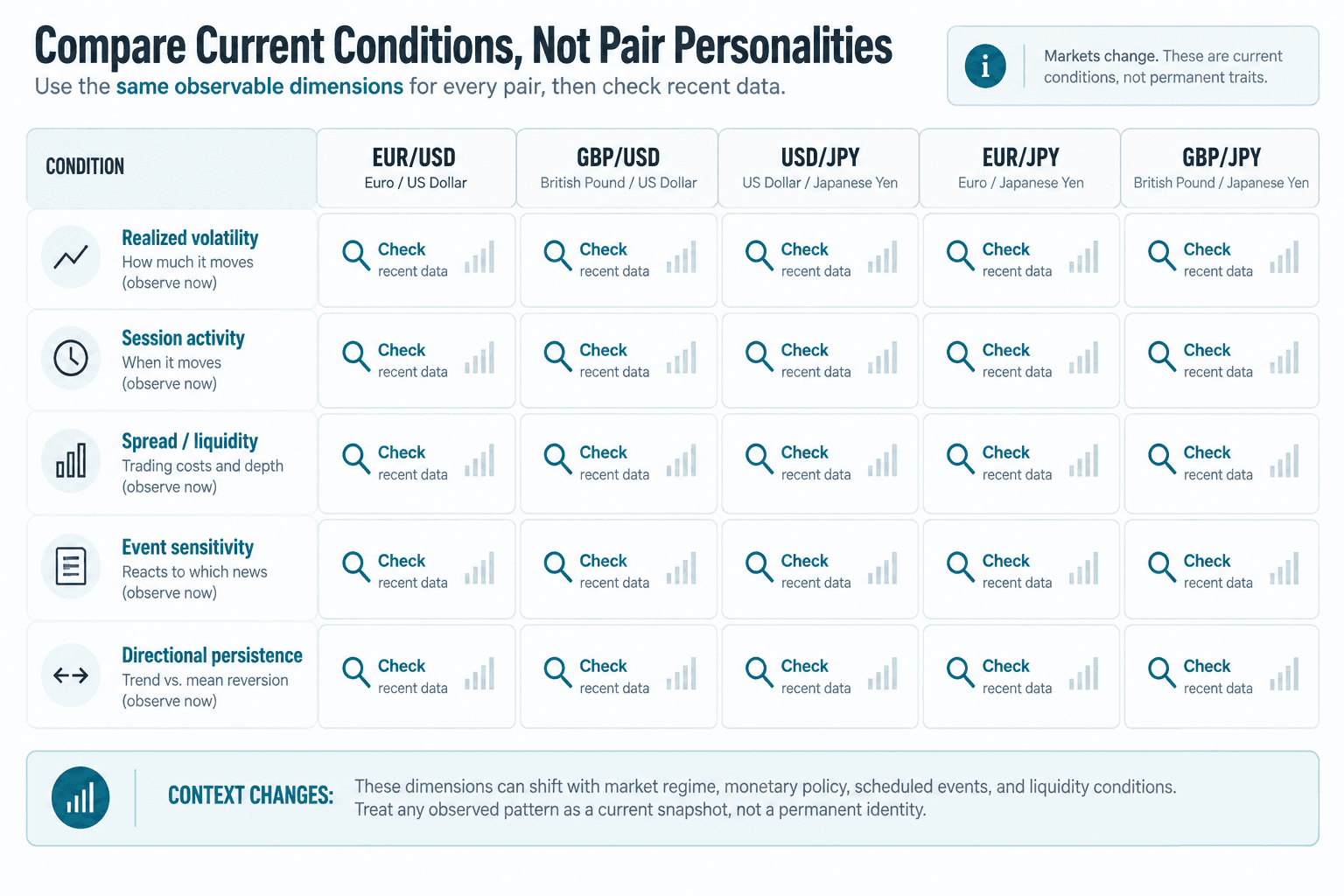
Compare the Pairs Side by Side
Pair behavior is context-dependent and can shift with monetary policy and market conditions. Treat these as working tendencies, not permanent identities.
Pair | What to compare now | Broad activity window | Important drivers to monitor | Avoid assuming |
|---|---|---|---|---|
EUR/USD | Recent ATR or daily range, current spread, liquidity | European and US trading hours | ECB and Fed expectations, Eurozone and US data, global risk and capital flows | That it is always the "cleanest" pair or always has the lowest spread |
GBP/USD | Recent volatility, spread, event sensitivity | UK/European and US trading hours | Bank of England expectations, UK data, US data, broader risk conditions | That it is permanently "the volatile one" or always needs a fixed wider stop |
USD/JPY | Realized volatility, directional persistence, event risk | Asian and US trading hours | Fed and BoJ expectations, rate differentials, risk sentiment, intervention risk | That it is inherently calm, smooth, or always trend-following |
EUR/JPY | Recent volatility, spread, persistence, event exposure | Compare Asian and European activity in current data | Eurozone and Japanese policy expectations, risk conditions | A fixed personality inherited from EUR/USD or USD/JPY |
GBP/JPY | Recent volatility, spread, liquidity, event sensitivity | Compare Asian and UK/European activity in current data | UK and Japanese policy expectations, risk conditions | That it is always the highest-volatility choice |
Turning Personality Into a Decision
Knowing each pair's character is the input. Turning that into an actual choice, which pair to start with, when to add a second, how to match a pair to your schedule and strategy, is its own decision framework: see How to Choose a Currency Pair to Trade.
Scenario Practice
For each scenario, identify which observable dimension matters most and explain what current evidence you would check. The objective is comparison and reasoning, not memorizing a pair personality.
A trader uses very tight stops and is comparing EUR/USD with GBP/USD. What characteristic matters most?
A trader is only available during Asian market hours and is comparing EUR/USD with USD/JPY. What characteristic matters most?
A trader plans to observe markets around a major UK economic release. What characteristic matters most when comparing GBP/USD with EUR/USD?
A trader is choosing between a smoother instrument and a more volatile instrument. What should they compare before assuming the more volatile pair is better?
Suggested reasoning Current realized volatility and normal price noise matter most. Compare recent ATR or observed range before deciding whether one pair needs more room than another.
Session activity matters most. Compare recent activity during the learner's available hours rather than assuming a fixed ranking.
Event sensitivity and currency-specific drivers matter most. GBP/USD is directly exposed to UK data, so the learner should check the calendar and recent reactions around comparable releases.
Larger daily ranges look incredible on a historical chart, but trading them with tight stops is just donating capital to market noise. Larger movement is not automatically better because it can also require wider stops and create more noise.
Pair behavior is context-dependent and can change with monetary policy and market conditions.
Practical Consequences for Your Setup
Different pairs require different ATR-based stop distances. Before trading any new pair, spend time studying its recent daily ranges and how it behaves around key levels. Questions worth researching: how far does this pair typically spike through a support or resistance level before reversing, which affects stop placement; how long does it typically trend before a significant reversal, which affects how much you trail profits; and what news events move it most, and when do those tend to land.
These aren't one-time questions. Each pair's character can shift over months and years as monetary policy changes and global conditions evolve. The USD/JPY of 2021 (low rates, yen carry trade) behaved differently from the USD/JPY of 2023 (sharp rate differential, strong trend). Knowing a pair's current character is as important as knowing its historical tendencies.
One more consequence of knowing each pair's personality: pairs that share drivers tend to move together. If you're holding more than one pair at a time, that overlap matters for how much risk you're actually carrying.
Retrieval Check
Answer without looking back at the lesson.
Why can the same technical setup behave differently on two currency pairs?
Which pair characteristics are most affected by session timing?
Why should historical pair personality never be treated as permanent?
What additional risk can appear when several pairs share the same driver?
Check your answers Pairs can be trading under different volatility, liquidity, session, and event conditions, so the same setup can encounter different noise or follow-through.
Activity level, volatility, liquidity, and the timing of meaningful price movement are especially affected by session timing.
Interest-rate differentials, monetary policy, liquidity, and broader market conditions change. Historical tendencies are context, not permanent rules.
Several positions can create concentrated exposure to the same underlying currency or macro driver, so apparent diversification may actually increase correlated risk.
Compare the conditions you can observe, not a personality you memorized.
Next article: How to Choose a Currency Pair to Trade
Success Criteria
Given two or more candidate pairs and a trading context, you can identify which observable conditions matter most, compare the pairs using current evidence, and explain the trade-offs without relying on a fixed pair personality.
Common Misconception
Technical analysis works identically on every pair.
The Truth: The same setup can appear under different volatility, liquidity, session, and event conditions. That does not mean one pair has a permanent technical personality. It means the trader should evaluate current conditions before assuming the same stop, target, or execution expectations will transfer unchanged.
FAQ's
Q: Why do some pairs move more than others in the same session?
Q: Is it safe to assume a pair's personality will stay consistent during major economic releases or central bank policy shifts?
Q: Does pair selection matter if I'm using a pure price action strategy?
Table of Contents
About Me

Krista Weber
After a career as a VP of UX and EdTech executive, I retired early—and quickly realized the traditional world of trading education is fundamentally broken.
As someone with a Master’s in HCI who specialized in the design of e-learning systems, I saw a massive gap: beginners aren't failing because trading is impossible; they’re failing due to massive cognitive overload and terrible instructional design.
This site bridges that gap. I’m applying the principles of learning science, systems thinking, and minimalist UX to strip away the market noise and teach trading the way it actually should be taught.
Stay in Touch
Some of the pages on my travel blog contain affiliate links. Whenever you buy something through one of these links, I get a small commission at no extra cost to you. As an affiliate, I only recommend products and services that I feel are high quality and helpful to my readers. Thanks for your support.
Read More

Open almost any trading platform and you'll see EUR/USD sitting next to XAU/USD, NQ, ES, and a dozen CFDs on stocks you've heard of. They all show up as candlesticks moving left to right, which quietly implies they're all the same kind of thing. They aren't. Before going deeper into any one of them, it's worth drawing the map.
Updated on Sep 6, 2026

Futures are standardized contracts tied to defined specifications and a future settlement date. They can look complex at first, but the mechanics become much clearer once you know what the contract specification controls. Here's what you actually need to know.
Updated on Sep 6, 2026

CFDs appear everywhere in retail trading – but most new traders couldn't explain exactly what they are or why that matters. Here's a plain-language breakdown, including the parts that most introductions skip.
Updated on Sep 6, 2026