
How to Choose a Currency Pair to Trade
With dozens of currency pairs available, beginners often trade too many at once – or choose pairs that don't match their schedule, strategy, or account size. Choosing the right pair is a form of strategic clarity most traders underestimate.

Learning Path Stage 1: Foundations
Learning Level 1: Recognition
Primary Learning Objective
By the end of this lesson, you will be able to use your schedule, strategy requirements, current market conditions, volatility tolerance, and transaction costs to choose and justify a starting currency pair.
Before You Start
Required: How Major Currency Pairs Behave Differently – You need a comparative understanding of pair behavior before using those differences to make a selection.
Recommended review: How to Read a Forex Quote – Review quote mechanics and spread if transaction-cost comparisons are not yet comfortable.
The Paradox of Too Many Options
Most platforms offer 50–80 currency pairs. Many beginners interpret this as 50–80 opportunities. The more practical interpretation: 50–80 sources of distraction.
Each currency pair trades under changing conditions: volatility, liquidity, session activity, event sensitivity, and directional persistence. Familiarity comes from observing those conditions over time, not from assigning the pair a permanent personality.
Choosing fewer pairs isn't about limiting yourself. It's about choosing depth over breadth – and depth is what pattern recognition requires.
The Major Pairs: Where to Start
The seven major currency pairs all include USD on one side and account for the vast majority of daily forex volume:
Pair | Nickname | Useful starting observations |
|---|---|---|
EUR/USD | Fiber | Heavy global participation; compare current spread, volatility, and European/US session activity |
GBP/USD | Cable | Prone to sudden dramatic mood swings based on whatever news breaks in London. Treat it like a caffeinated teenager. |
USD/JPY | Gopher | Compare current directional persistence, Asian/US activity, rate expectations, and intervention risk |
USD/CHF | Swissie | Compare current spread, volatility, and safe-haven/risk conditions |
AUD/USD | Aussie | Compare Asian-session activity, commodity/risk backdrop, and current volatility |
NZD/USD | Kiwi | Compare liquidity, Asian-session activity, and current volatility |
USD/CAD | Loonie | Compare US/Canadian event risk, energy backdrop, and current volatility |
EUR/USD is a common starting candidate because it is heavily traded, usually has strong liquidity, and has abundant educational material. It is not automatically the right pair for every learner, and its spread or behavior should still be checked under current conditions. This table is a starting reference; for the comparison method, see How Major Currency Pairs Behave Differently.
Matching Pairs to Your Trading Window
Session alignment matters, but use it as a filter rather than a fixed rule.
European/London hours: Start by observing EUR- and GBP-related pairs, then verify which candidates are actually showing sufficient activity and acceptable spreads during your window.
New York hours: USD-related pairs are natural candidates, but compare current volatility, event risk, and transaction costs before choosing.
Asian hours: JPY-, AUD-, and NZD-related pairs may deserve attention because their regional markets are active, but recent data should confirm the fit.
Limited, irregular check-in time: A higher-timeframe approach may reduce dependence on a specific session. That is a strategy-design decision, not a permanent property of any pair.
The rule is simple: your schedule narrows the list; current observations make the choice.
Testing Pair Fit With Your Strategy
Do not assume a strategy belongs to a particular pair. Treat pair fit as a hypothesis to test.
If your strategy needs directional persistence: Compare recent trend persistence, pullback behavior, and volatility across candidate pairs.
If your strategy needs range conditions: Look for pairs that are currently spending meaningful time in well-defined ranges rather than assuming one instrument is always a range-trading pair.
If your strategy is sensitive to transaction costs: Compare the live spread with your typical target and stop distances.
If your strategy is sensitive to event risk: Check the economic calendar and recent reactions to the releases that matter for each currency.
The pair is not the strategy. Your job is to find current conditions that match the rules you are developing.
What to Avoid
Exotic pairs as a beginner: The wide spreads in exotic pairs mean you're giving up significant edge on every entry. Very wide spreads create a larger transaction-cost hurdle relative to your target. Compare the actual spread you are being quoted with the distance your strategy expects price to move.
Pairs you don't have analysis for: Trading a pair because it "looks like it's moving" without understanding the context – what session you're in, what news is pending, what the higher timeframe structure looks like – is speculation, not trading.
Too many pairs simultaneously: Tracking too many pairs can dilute attention. Start with a small enough watchlist that you can observe each candidate consistently and explain why it belongs there.
Trading multiple pairs at once without checking correlation: Two or three pairs feels diversified until you realize they're correlated and moving for the same reason.
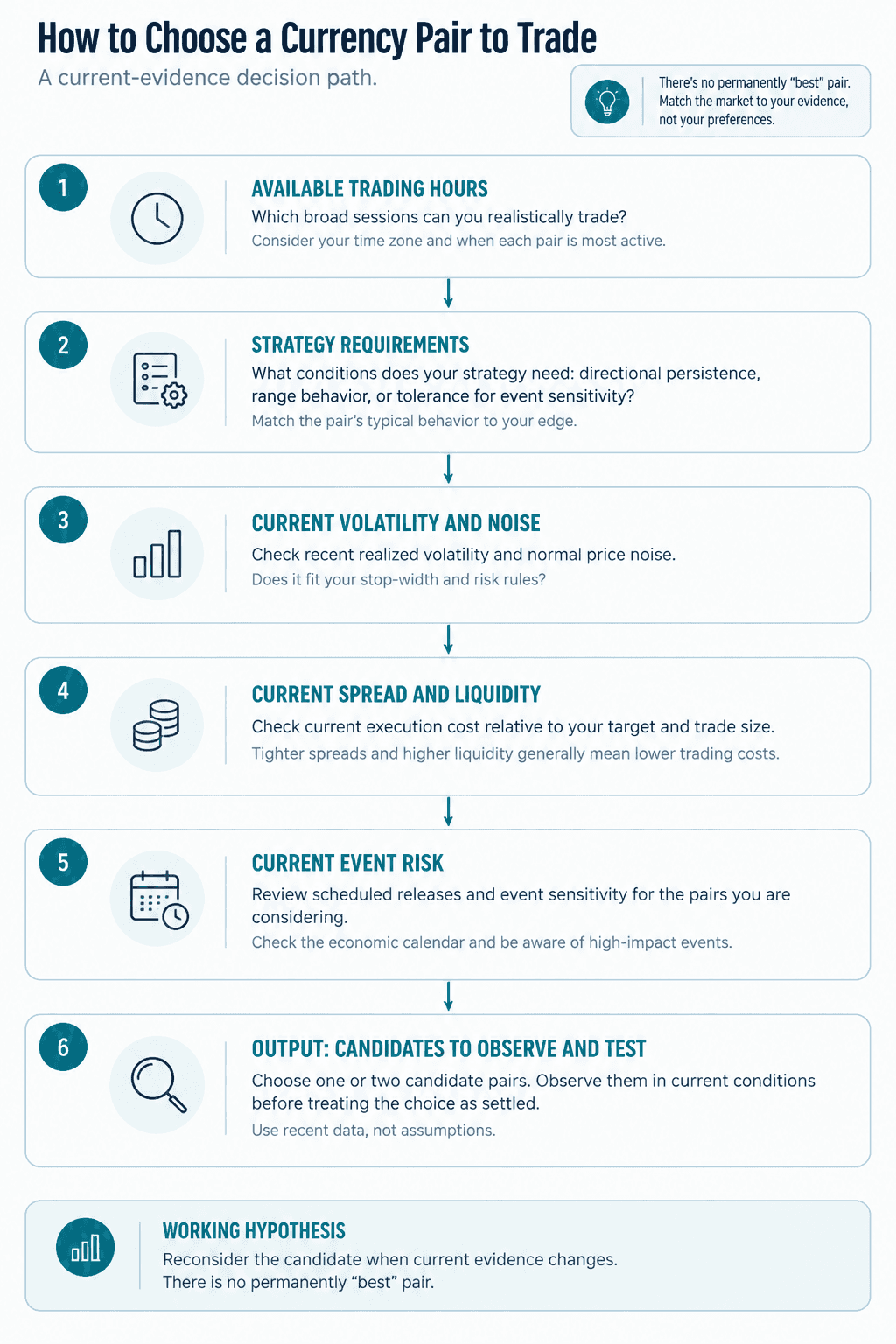
A Simple Framework for Choosing
Answer these four questions:
What hours can I realistically trade? This determines which sessions, which narrows your pair options.
What kind of strategy am I developing? Trending pairs for trend strategies, ranging pairs for range strategies.
What's my risk tolerance? Higher current volatility may require different stop placement or smaller position size under your strategy rules.
What's the spread cost relative to my targets? If the spread consumes a large share of your expected target, transaction costs may make the setup unattractive.
From the answers, you'll typically land on one or two candidates. Start with one. Observe and practice with it long enough to build evidence before adding another.
Scenario Practice
For each profile, choose a reasonable starting pair and justify the choice using schedule, strategy, volatility tolerance, and transaction-cost considerations. There may be more than one defensible answer.
Profile 1: Available 8:00–11:00 AM New York time; learning clean support/resistance and trend structure; moderate volatility preference; prioritizes tight spreads and abundant educational examples.
Profile 2: Available primarily during the Asian session; developing a trend-following strategy; moderate volatility preference; prioritizes meaningful activity during available hours.
Profile 3: Available around London open; developing short-term momentum; comfortable with larger moves but willing to size down; prioritizes active movement and awareness of UK-specific news risk.
Suggested reasoning Profile 1: EUR/USD is a reasonable candidate to investigate because the schedule overlaps European/US activity and the pair is heavily traded and widely studied. The learner should still verify current spread and volatility.
Profile 2: USD/JPY is a reasonable candidate to investigate because JPY markets are active during Asian hours. The learner should compare recent activity, spread, volatility, and event risk with other candidates.
Profile 3: GBP/USD is a reasonable candidate to investigate because the learner is available during UK/European market activity and is comfortable evaluating larger current movement. The learner still needs to check recent volatility, spread, and UK-event risk rather than choosing it simply because it moves more.
Apply It: Choose Your Starting Pair
Answer these questions to turn the criteria into a real, defensible starting choice. This is part of the lesson, not optional enrichment.
Work through these questions:
What hours can you realistically trade?
What strategy type are you currently developing?
How comfortable are you with volatility, and what stop width does your approach typically require?
What is the maximum spread you are willing to accept relative to your expected target?
Which candidate pairs fit those constraints?
Choose one pair. Why does it fit your schedule, strategy, volatility tolerance, and transaction-cost constraints?
Choose one pair you are intentionally rejecting. Why does it not fit your current circumstances?
What evidence would make you reconsider your selected pair after several weeks of observation?
Remember: this is a working hypothesis, not a permanent identity. Pair behavior and market conditions can change.
Reflection
After you select a starting pair, ask: What evidence would make you reconsider this choice after several weeks of observation?
Use evidence from your actual experience rather than excitement or frustration. Consider whether the pair's active hours fit your schedule, whether its typical movement fits your strategy and stop placement, whether transaction costs are reasonable relative to your targets, and whether the pair behaves differently from what you expected.
If your chosen pair starts behaving like an erratic toddler on sugar after three weeks, don’t be afraid to move on to something else. You aren't married to EUR/USD; you're just dating it. Treat your chosen pair like it’s a working hypothesis that can be updated when evidence changes.
Familiarity Is an Edge
One practical advantage of focusing on fewer instruments is familiarity with how their conditions change. You begin to notice when current volatility is unusual, when spreads widen, when activity shifts by session, and when an event produces behavior that differs from your recent observations.
That familiarity is earned by repeated observation and practice, not by scanning a long list of pairs with fresh eyes every day.
Choose a small starting set. Observe it consistently. Add another only when you have a reason.
Depth of understanding in one instrument is worth more than surface familiarity with many.
Next article: The Market Map: What Are You Actually Trading?. That lesson opens up the broader landscape of instruments, futures, CFDs, gold, indices, that sits alongside everything you've just learned about forex. The gold and futures deep dives further down that path are later-stage lessons worth returning to once you've built real comfort trading forex pairs, not something to tackle immediately after this.
Success Criteria
By the end of this lesson, you should be able to select one or two plausible pairs for your circumstances, justify the choice using explicit current evidence and constraints, and identify what evidence would make you reconsider the choice.
Common Misconception
More available pairs means more opportunities.
The Truth: Most platforms list 50 to 80 pairs, and it's tempting to read that as 50 to 80 chances to find a trade. In practice, each pair's current behavior is understood through repeated observation, and splitting attention across many pairs prevents the pattern recognition that comes from watching one closely. More pairs is usually more distraction, not more edge.
FAQ's
Q: Should I even consider minor or exotic pairs at this stage?
Q: How does my available trading time affect which pair I should choose?
Q: Should beginners start with just one currency pair?
Table of Contents
About Me

Krista Weber
After a career as a VP of UX and EdTech executive, I retired early—and quickly realized the traditional world of trading education is fundamentally broken.
As someone with a Master’s in HCI who specialized in the design of e-learning systems, I saw a massive gap: beginners aren't failing because trading is impossible; they’re failing due to massive cognitive overload and terrible instructional design.
This site bridges that gap. I’m applying the principles of learning science, systems thinking, and minimalist UX to strip away the market noise and teach trading the way it actually should be taught.
Stay in Touch
Some of the pages on my travel blog contain affiliate links. Whenever you buy something through one of these links, I get a small commission at no extra cost to you. As an affiliate, I only recommend products and services that I feel are high quality and helpful to my readers. Thanks for your support.
Read More

Open almost any trading platform and you'll see EUR/USD sitting next to XAU/USD, NQ, ES, and a dozen CFDs on stocks you've heard of. They all show up as candlesticks moving left to right, which quietly implies they're all the same kind of thing. They aren't. Before going deeper into any one of them, it's worth drawing the map.
Updated on Sep 6, 2026

Futures are standardized contracts tied to defined specifications and a future settlement date. They can look complex at first, but the mechanics become much clearer once you know what the contract specification controls. Here's what you actually need to know.
Updated on Sep 6, 2026

CFDs appear everywhere in retail trading – but most new traders couldn't explain exactly what they are or why that matters. Here's a plain-language breakdown, including the parts that most introductions skip.
Updated on Sep 6, 2026