
How to Read a Forex Quote
Excerpt: Before you can trade forex, you need to understand what you're actually looking at when you see "EUR/USD 1.0856." This isn't complicated, but getting it clear early prevents a surprising number of costly mistakes down the line.

Learning Path Stage 1: Foundations
Learning Level 3: Application
Primary Learning Objective
By the end of this lesson, you will be able to dissect any forex quote on your platform, identify the bid and ask prices, calculate the spread, and determine which direction price needs to move for your position to profit.
Before You Start
Required: What Are Currency Pairs and How Do They Work? Before you start this article, you should be able to identify the base and quote currencies and explain what buying or selling a pair means before decoding a live quote.
The Basic Structure
A quote on your screen looks like a simple math equation, but it’s actually a exchange rate:
EUR/USD = 1.0856
Translation: 1 Euro = $1.0856 USD. The first currency (Base) is always fixed at 1 unit; the second currency (Quote) tells you how much cash you need to buy that 1 unit.
Reading More Examples
GBP/USD = 1.2745 One British pound = 1.2745 US dollars.
USD/JPY = 149.85 One US dollar = 149.85 Japanese yen.
AUD/USD = 0.6512 One Australian dollar = 0.6512 US dollars.
Notice that USD/JPY is structured differently from the others – the US dollar is the base currency (first), not the quote. This means when USD/JPY goes up, the dollar is strengthening. When EUR/USD goes up, the dollar is weakening. The position of USD in the pair matters.
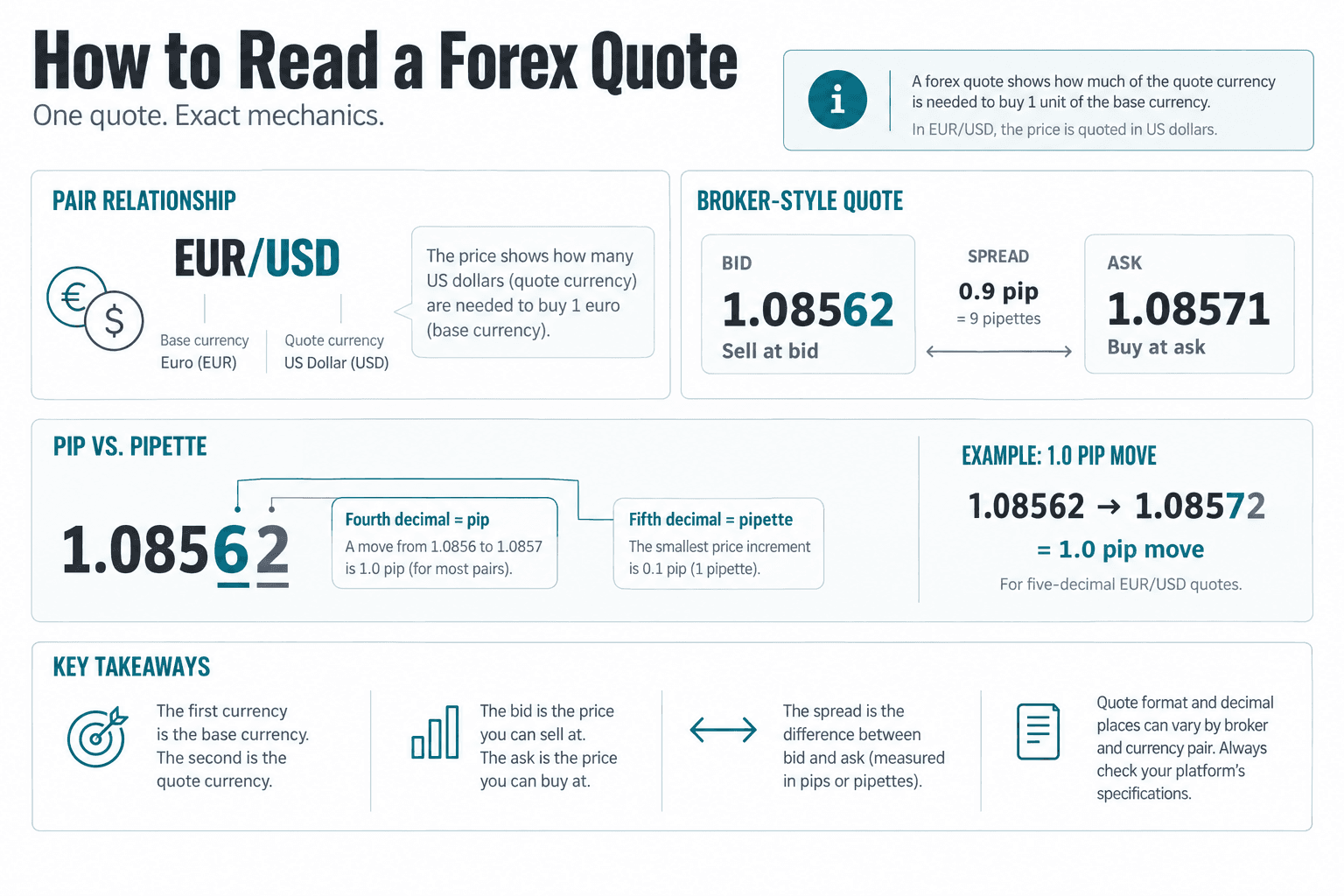
Pips: The Basic Unit of Movement
Think of a pip as the standard unit traders use to describe price movement in a currency pair.
EUR/USD steps from 1.0856 to 1.0857? +1 pip.
USD/JPY ticks from 149.85 to 149.86? +1 pip.
Traders use pips to describe how far a currency pair has moved. The cash value of that movement depends on the pair, your position size, and your account currency, so 20 pips does not automatically mean the same dollar gain or loss on every trade. For now, the important skill is learning to recognize and count pips quickly. We'll deal with pip value and position sizing separately when we get to risk.
The Spread in Practice (Or: Why You Start Every Trade Down)
When your broker shows EUR/USD, you'll typically see two numbers:
Bid: 1.0854 | Ask: 1.0856
The spread here is 2 pips (1.0856 – 1.0854 = 0.0002 = 2 pips).
When you buy (go long EUR/USD): You buy at the ask (1.0856). When you sell (go short EUR/USD): You sell at the bid (1.0854).
The instant you execute a buy order at 1.0856 and turn right around to panic-close it, you sell at the current Bid (1.0854)—instantly handing 2 pips back to the house. That immediate friction is your entry tax.
For day traders who make many trades, spread costs accumulate significantly. For swing traders holding positions for days, 2 pips of spread on a 100-pip target trade is relatively minor. Spread cost is most important to factor for very short-term, high-frequency approaches.
Worked Example: Reading a Forex Quote
Quote: EUR/USD
Bid: 1.0854
Ask: 1.0856
Identify bid and ask: The bid is 1.0854. The ask is 1.0856.
Calculate the spread: 1.0856 - 1.0854 = 0.0002, or 2 pips.
Long entry: A long position enters at the ask, so the long entry price is 1.0856.
Short entry: A short position enters at the bid, so the short entry price is 1.0854.
Profit direction: For a long position, price must rise enough for the bid to move above the entry price. For a short position, price must fall enough for the ask to move below the entry price.
Why the trade begins at a disadvantage: A new long buys at the higher ask but would close at the lower bid; a new short sells at the lower bid but would close at the higher ask. That gap is the immediate transaction cost.
Long vs. Short: What You're Actually Doing
When traders say they're "going long" or "going short," here's what that means in the context of forex pairs:
Going long EUR/USD: You're buying euros and selling dollars. You profit when EUR/USD goes up (euros strengthen vs. dollars). You lose when EUR/USD goes down.
Going short EUR/USD: You're selling euros and buying dollars. You profit when EUR/USD goes down (dollars strengthen vs. euros). You lose when EUR/USD goes up.
Going long USD/JPY: You're buying dollars and selling yen. You profit when USD/JPY goes up (dollars strengthen vs. yen).
Going short USD/JPY: You're selling dollars and buying yen. You profit when USD/JPY goes down (yen strengthens vs. dollars).
A helpful mental shortcut: in any pair, if you go long, you want the number to get bigger. If you go short, you want the number to get smaller.
Practice: Read the Quote
For each quote, identify the bid, ask, spread, pip location, long entry, short entry, and which direction price must move for each position to profit.
EUR/USD: Bid 1.0854 | Ask 1.0856
USD/JPY: Bid 149.84 | Ask 149.87
GBP/USD: Bid 1.27431 | Ask 1.27446
AUD/USD: Bid 0.6512 | Ask 0.6515
EUR/JPY: Bid 162.55 | Ask 162.59
Check your reasoning EUR/USD: Spread = 2 pips. Pip = fourth decimal. Long entry = 1.0856. Short entry = 1.0854. Long needs price to rise; short needs price to fall.
USD/JPY: Spread = 3 pips. Pip = second decimal. Long entry = 149.87. Short entry = 149.84. Long needs price to rise; short needs price to fall.
GBP/USD: Spread = 1.5 pips. The fifth decimal is a fractional pip; the pip is the fourth decimal. Long entry = 1.27446. Short entry = 1.27431. Long needs price to rise; short needs price to fall.
AUD/USD: Spread = 3 pips. Pip = fourth decimal. Long entry = 0.6515. Short entry = 0.6512. Long needs price to rise; short needs price to fall.
EUR/JPY: Spread = 4 pips. Pip = second decimal. Long entry = 162.59. Short entry = 162.55. Long needs price to rise; short needs price to fall.
One Reason Spreads Vary by Pair
Major pairs often have relatively tight spreads because they are heavily traded, while crosses and exotics can be wider. The exact spread you see still depends on the broker, liquidity, and current market conditions. That's worth keeping in mind as you compare quotes across different pairs: a wide spread on an unfamiliar pair isn't a broker being unfair, it's usually just a reflection of thinner liquidity. For what actually distinguishes a major from a cross from an exotic, see What Are Currency Pairs and How Do They Work?
Putting It Together
You see this in your trading platform:
EUR/USD | Bid: 1.0854 | Ask: 1.0856 | Daily Change: +0.0042 (+0.39%)
Reading it:
1 euro currently = approximately 1.0856 dollars (ask)
The spread is 2 pips
Price has moved up 42 pips today (0.0042), which is a 0.39% gain for the euro vs. dollar
If you click "buy" at this moment:
You enter at 1.0856 (the ask)
You need price to move up (above 1.0856) to profit
The spread means you need a 2-pip move just to break even
If you click "sell":
You enter at 1.0854 (the bid)
You need price to move down (below 1.0854) to profit
Same spread consideration applies
This is the most basic transaction in forex. Understanding it clearly makes everything that follows buildable on a solid foundation.
Retrieval Check
Answer without looking back at the lesson.
Which price do you pay when you buy a pair?
Which price do you receive when you sell?
What is the spread?
Where is one pip on EUR/USD and on USD/JPY?
Why does a newly opened trade begin at a small disadvantage?
Answers:
Check your answers You buy at the ask.
You sell at the bid.
The spread is the difference between the ask and bid prices.
On EUR/USD, one pip is the fourth decimal place. On USD/JPY, one pip is the second decimal place.
Buys enter at the higher ask and would close at the lower bid, while sells enter at the lower bid and would close at the higher ask. The spread is the immediate transaction cost.
The forex quote is the vocabulary. Everything else in trading is built from sentences.
Success Criteria
You've successfully completed this lesson if you can look at a live quote, correctly identify the bid, ask, spread, and pip location, determine the correct entry price for a long or short position, and explain which direction price needs to move for the position to profit.
Common Misconception
A forex quote is a single price. Trading platforms often display one number as "the price," so new traders assume that's what they'd pay or receive.
The Truth: Every quote is two prices at once, the bid and the ask, and the gap between them is the spread, effectively a cover charge collected the moment you walk through the door.
FAQ's
Q: What’s the difference between bid and ask price?
Q: Why do some pairs have 4 decimal places and others only have 2?
Q: What does it mean when a currency pair "goes up"?
Table of Contents
About Me

Krista Weber
After a career as a VP of UX and EdTech executive, I retired early—and quickly realized the traditional world of trading education is fundamentally broken.
As someone with a Master’s in HCI who specialized in the design of e-learning systems, I saw a massive gap: beginners aren't failing because trading is impossible; they’re failing due to massive cognitive overload and terrible instructional design.
This site bridges that gap. I’m applying the principles of learning science, systems thinking, and minimalist UX to strip away the market noise and teach trading the way it actually should be taught.
Stay in Touch
Some of the pages on my travel blog contain affiliate links. Whenever you buy something through one of these links, I get a small commission at no extra cost to you. As an affiliate, I only recommend products and services that I feel are high quality and helpful to my readers. Thanks for your support.
Read More

Open almost any trading platform and you'll see EUR/USD sitting next to XAU/USD, NQ, ES, and a dozen CFDs on stocks you've heard of. They all show up as candlesticks moving left to right, which quietly implies they're all the same kind of thing. They aren't. Before going deeper into any one of them, it's worth drawing the map.
Updated on Sep 6, 2026

Futures are standardized contracts tied to defined specifications and a future settlement date. They can look complex at first, but the mechanics become much clearer once you know what the contract specification controls. Here's what you actually need to know.
Updated on Sep 6, 2026

CFDs appear everywhere in retail trading – but most new traders couldn't explain exactly what they are or why that matters. Here's a plain-language breakdown, including the parts that most introductions skip.
Updated on Sep 6, 2026