
What Are Currency Pairs and How Do They Work?
In forex, you're always buying one currency and selling another simultaneously. The two currencies are expressed as a pair – EUR/USD, GBP/JPY, AUD/CAD. Understanding how pairs work, how to read the price, and what you're actually doing when you click buy or sell is the first practical knowledge you need before anything else.

Learning Path Stage 1: Foundations
Learning Level 2: Understanding
Primary Learning Objective
By the end of this lesson, you will be able to identify the base and quote currency in any pair, explain what buying or selling a pair actually does, and place a pair correctly into the major, minor, or exotic category.
Before you can read a chart, map a setup, or manage a trade, you need to understand the fundamental mechanics of what a forex trade actually is. It is simpler than it sounds, and it is important enough to get right before real money is on the line.
The Structure of a Currency Pair
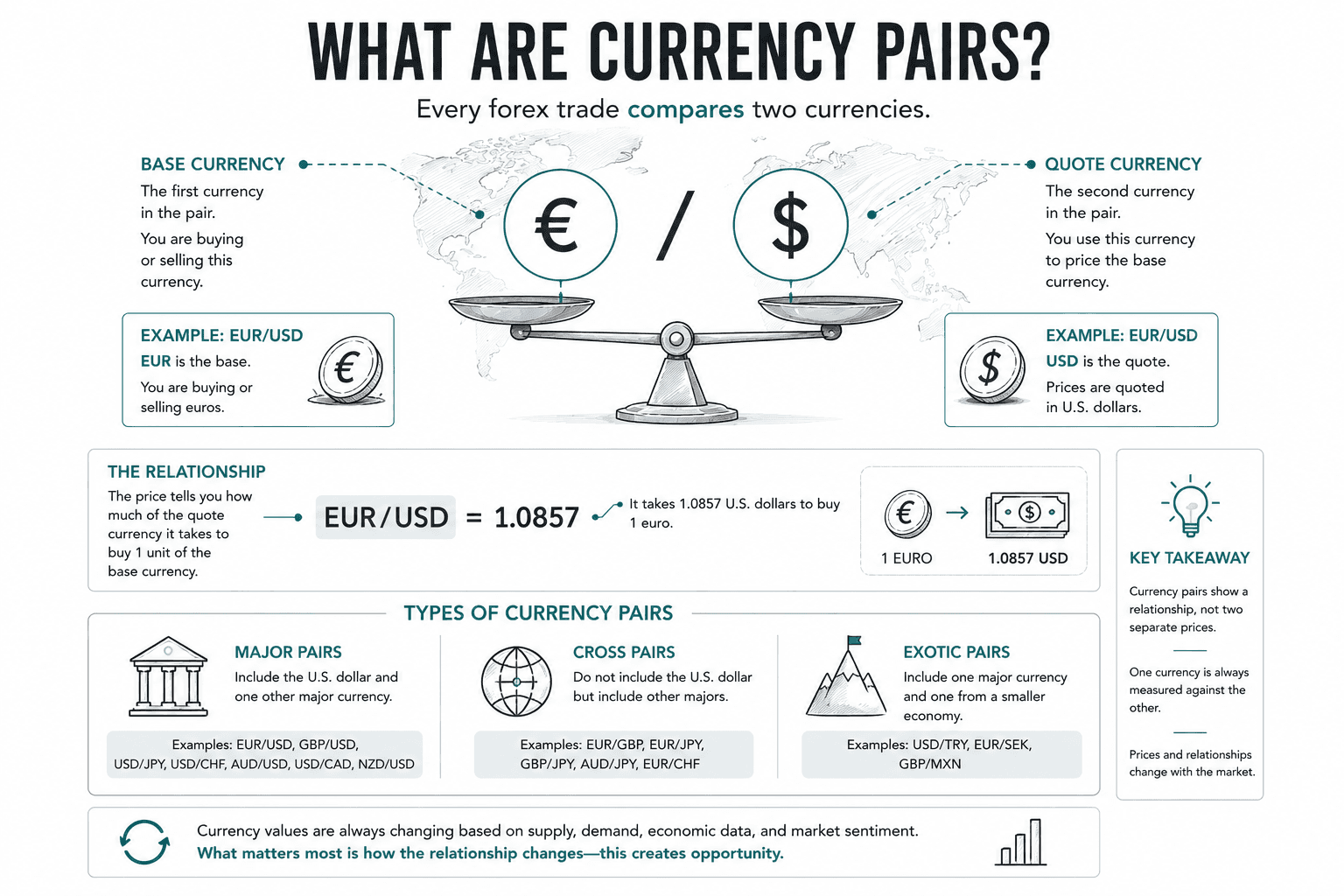
Every forex pair features two currencies separated by a slash: BASE / QUOTE.
EUR/USD: Euro is the base, US Dollar is the quote.
GBP/JPY: British Pound is the base, Japanese Yen is the quote.
AUD/CAD: Australian Dollar is the base, Canadian Dollar is the quote.
The price tag on the pair tells you how many units of the quote currency you need to hand over to buy just one unit of the base currency.
If EUR/USD is sitting at 1.0850, it costs 1.0850 US Dollars to purchase 1 Euro. If USD/JPY is trading at 149.50, it takes 149.50 Japanese Yen to buy 1 US Dollar.
What Buying and Selling Actually Means
When you click Buy on a pair, you are simultaneously:
Buying the base currency
Selling the quote currency
When you click Sell on a pair, you are:
Selling the base currency
Buying the quote currency
Going long on EUR/USD means you are accumulating Euros while dumping US Dollars because you expect the Euro to gain muscle against the Greenback. If EUR/USD goes up, you win.
Going short on GBP/USD means you are dumping British Pounds and holding US Dollars because you expect the Pound to soften. If GBP/USD drops, your account balance goes up.
You do not need physical stacks of cash sitting on your desk to execute this. Your broker handles the currency conversion wizardry in the background. You are simply taking a financial stance on the relative value of one economy versus another.
Majors, Minors, and Exotics
Major Pairs: These always include the US Dollar (EUR/USD, GBP/USD, USD/JPY, USD/CHF, AUD/USD, USD/CAD, NZD/USD). Because USD pairs dominate global financial volume, they offer deep liquidity and tighter spreads. Keep in mind that spreads will still stretch depending on market volatility and your chosen broker.
Minor Pairs (Crosses): These leave the US Dollar out of the party (EUR/GBP, GBP/JPY, EUR/JPY, AUD/JPY). They feature slightly wider spreads than majors, but liquidity remains solid.
Exotic Pairs: This is where a major currency gets paired with an emerging economy (such as USD/TRY or USD/ZAR). Expect wide spreads, erratic price swings, and limited news coverage. Unless you enjoy unnecessary pain, beginners should steer clear.
Beyond this classification, pairs possess unique personalities shaped by daily session volumes, liquidity cycles, and monetary policy shifts.
A Pair Is a Relationship, Not a Thing
It pays to internalize this core design concept: a currency pair is not a standalone asset like a single share of stock. It is a dynamic scorecard tracking the relative power struggle between two distinct economies.
EUR/USD is not a static price tag on the Euro. It is a real-time tug-of-war between Euro strength and Dollar strength. A surprisingly sleepy session for the US Dollar can still produce wild volatility on EUR/USD if the European Central Bank decides to drop unexpected news.
Remembering that you are trading a relationship rather than an isolated object will save you heaps of confusion once you start tracking economic releases.
Practice Exercise:
Decode the Pair
Test your mental model on these quick examples:
EUR/USD = 1.0850
GBP/JPY = 192.40
AUD/CAD = 0.8975
USD/JPY = 149.50
Check Your Answers
EUR/USD: Base = EUR, Quote = USD. One Euro costs 1.0850 US Dollars. Going long means buying Euros and selling US Dollars.
GBP/JPY: Base = GBP, Quote = JPY. One British Pound costs 192.40 Japanese Yen. Going long means buying Pounds and selling Yen.
AUD/CAD: Base = AUD, Quote = CAD. One Australian Dollar costs 0.8975 Canadian Dollars. Going long means buying Australian Dollars and selling Canadian Dollars.
USD/JPY: Base = USD, Quote = JPY. One US Dollar costs 149.50 Japanese Yen. Going long means buying US Dollars and selling Japanese Yen.
How Profit and Loss Work, Briefly
P&L is tracked in pips, and your dollar gain or loss per pip is governed directly by your position sizing. Buying EUR/USD at 1.0850 and exiting at 1.0900 represents a 50-pip run. That is worth $500 on a standard lot, or $5 on a micro lot.
Retrieval Check
Before scrolling past, test your memory on these four core points:
In EUR/USD, which currency is the base?
What does a quote of 1.0850 actually mean?
If you buy GBP/JPY, what are you buying and what are you selling?
Why is a currency pair best understood as a relationship rather than an object?
Check Your Answers
EUR is the base currency.
One Euro costs 1.0850 US Dollars.
You are buying British Pounds and selling Japanese Yen.
A pair measures relative valuation between two currencies, meaning a shift on either side moves the entire quote.
Success Criteria
By the end of this lesson you should successfully be able to read any currency pair and state, in plain language, understand what you'd be buying and selling if you took a position, and be able to explain why that pair's category (major, minor, or exotic) affects the spread you'd pay.
Common Misconception
When you buy a currency pair, you're acquiring the actual physical currency. Many new traders picture euros or yen landing in an account somewhere.
The Truth: You're taking a speculative position on the exchange rate. The broker handles the conversion mechanics in the background, and you never hold physical currency at any point.
FAQ's
Q: If I buy GBP/USD and the Pound weakens, do I lose money?
Q: Do I need physical Euros in my account to trade EUR/USD?
Q: Why is it called EUR/USD and not USD/EUR?
Table of Contents
About Me

Krista Weber
After a career as a VP of UX and EdTech executive, I retired early—and quickly realized the traditional world of trading education is fundamentally broken.
As someone with a Master’s in HCI who specialized in the design of e-learning systems, I saw a massive gap: beginners aren't failing because trading is impossible; they’re failing due to massive cognitive overload and terrible instructional design.
This site bridges that gap. I’m applying the principles of learning science, systems thinking, and minimalist UX to strip away the market noise and teach trading the way it actually should be taught.
Stay in Touch
Some of the pages on my travel blog contain affiliate links. Whenever you buy something through one of these links, I get a small commission at no extra cost to you. As an affiliate, I only recommend products and services that I feel are high quality and helpful to my readers. Thanks for your support.
Read More

Open almost any trading platform and you'll see EUR/USD sitting next to XAU/USD, NQ, ES, and a dozen CFDs on stocks you've heard of. They all show up as candlesticks moving left to right, which quietly implies they're all the same kind of thing. They aren't. Before going deeper into any one of them, it's worth drawing the map.
Updated on Sep 6, 2026

Futures are standardized contracts tied to defined specifications and a future settlement date. They can look complex at first, but the mechanics become much clearer once you know what the contract specification controls. Here's what you actually need to know.
Updated on Sep 6, 2026

CFDs appear everywhere in retail trading – but most new traders couldn't explain exactly what they are or why that matters. Here's a plain-language breakdown, including the parts that most introductions skip.
Updated on Sep 6, 2026