
How to Calculate Your Position Size
You’ve measured movement in pips, priced volume in lots, calculated entry costs with spreads, and unlocked leverage. Now it’s time to pull those pieces together into a single, non-negotiable step: position sizing. Learn the exact math that transforms risk from a stressful gut feeling into a precise number you choose on purpose.

Learning Path Stage 1: Foundations
Learning Level 3: Application
Primary Learning Objective
By the end of this lesson, you will be able to calculate your exact lot size using account risk, stop distance, and pip value, ensuring every trade aligns with a fixed dollar risk target regardless of market structure.
Position sizing is the moment where every theoretical concept in trading finally collides with real money. Pips taught you how to measure movement. Lots showed you how position size dictates dollar value. Spreads laid out your entry fees. Leverage and margin explained what makes holding a position possible.
Position sizing takes all of that context and compresses it into one ultimate decision: how much cash do you actually put on the line?
Skip this step, and you are effectively throwing darts blindfolded. Execute it every time, and risk stops being a stomach twist and turns into a clear choice.
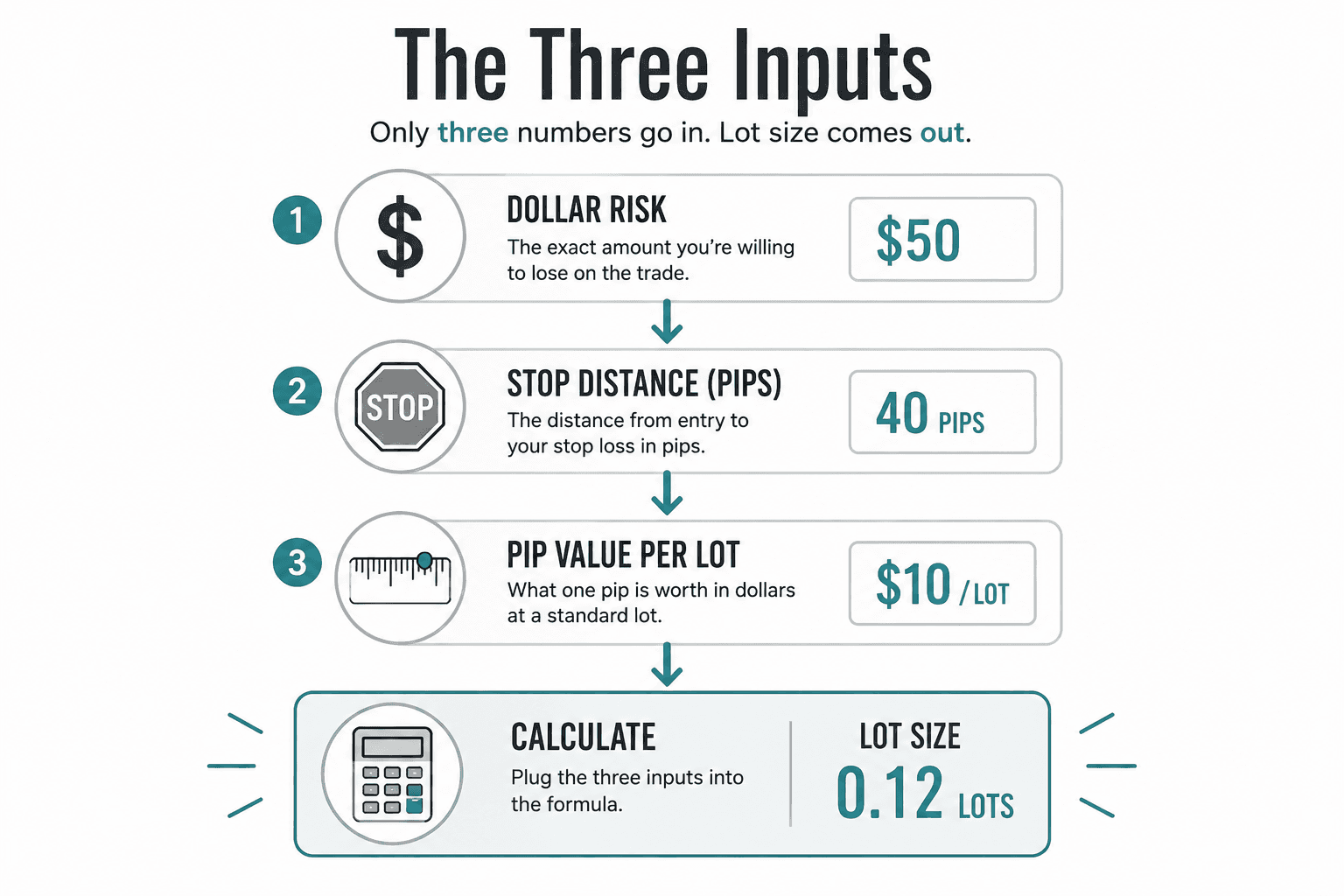
The Three Numbers You Need
Before you touch a position size calculator, you need three specific numbers in this exact sequence:
Risk in dollars: The exact amount of money you are willing to lose if your stop loss gets hit. This is usually expressed as 1% to 2% of your total account balance.
Stop distance in pips: The distance from your entry to your stop loss, dictated strictly by actual chart structure and technical levels, not by a random number that feels cozy.
Pip value per lot: What a single pip movement costs in dollars at a standard lot scale.
Notice what is missing from that list? Lot size. Lot size is never an input. It is the final output. That is the fundamental concept beginner traders get backward every single day.
The Formula
Lot size = Risk in dollars ÷ (Stop distance in pips × Pip value per lot)
That is the entire formula. Everything else comes down to applying it correctly and avoiding the classic traps.
A Full Worked Example
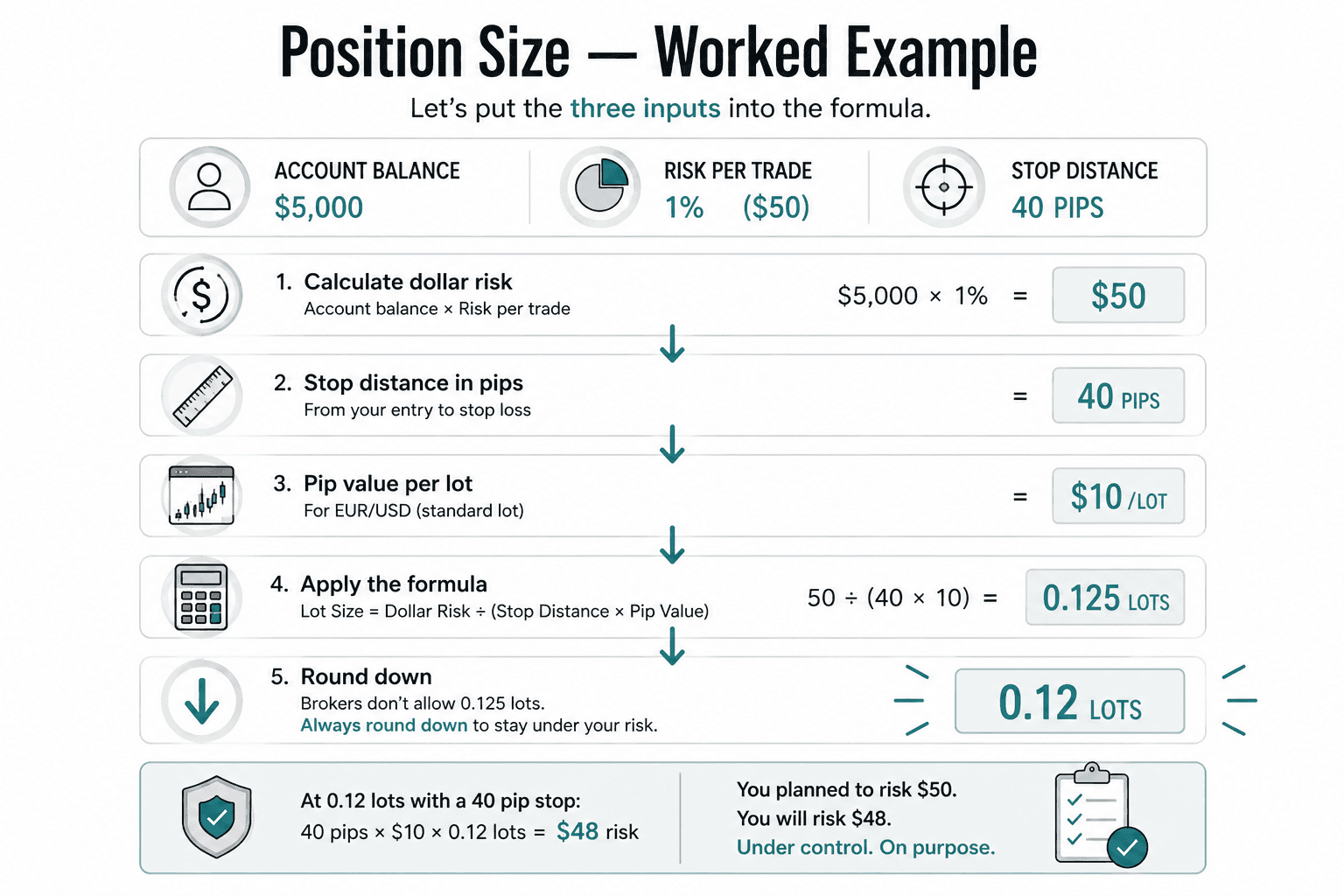
Let's walk through a standard setup:
Account Balance: $5,000
Risk per trade: 1% ($50)
Setup: EUR/USD, with a stop loss placed 40 pips below entry based on a recent swing low
Pip value per standard lot: $10
Lot size=40×1050=0.125 lots
Since your broker won't let you trade 0.125 lots, you round down to 0.12. At 0.12 lots, hitting your stop loss results in a $48 loss, which keeps you safely under your $50 cap.
Compare this disciplined process to the typical beginner routine: open a trading chart, eyeball a random 0.10 lot size because it feels manageable, and then discover later that a 40-pip stop on 0.10 lots risked $40, while an 80-pip stop on that same lot size risked $80. Same lot size, totally different risk profiles. The lot size selection was never protecting your account. The formula was.
Why the Same Lot Size Can Mean Completely Different Risk
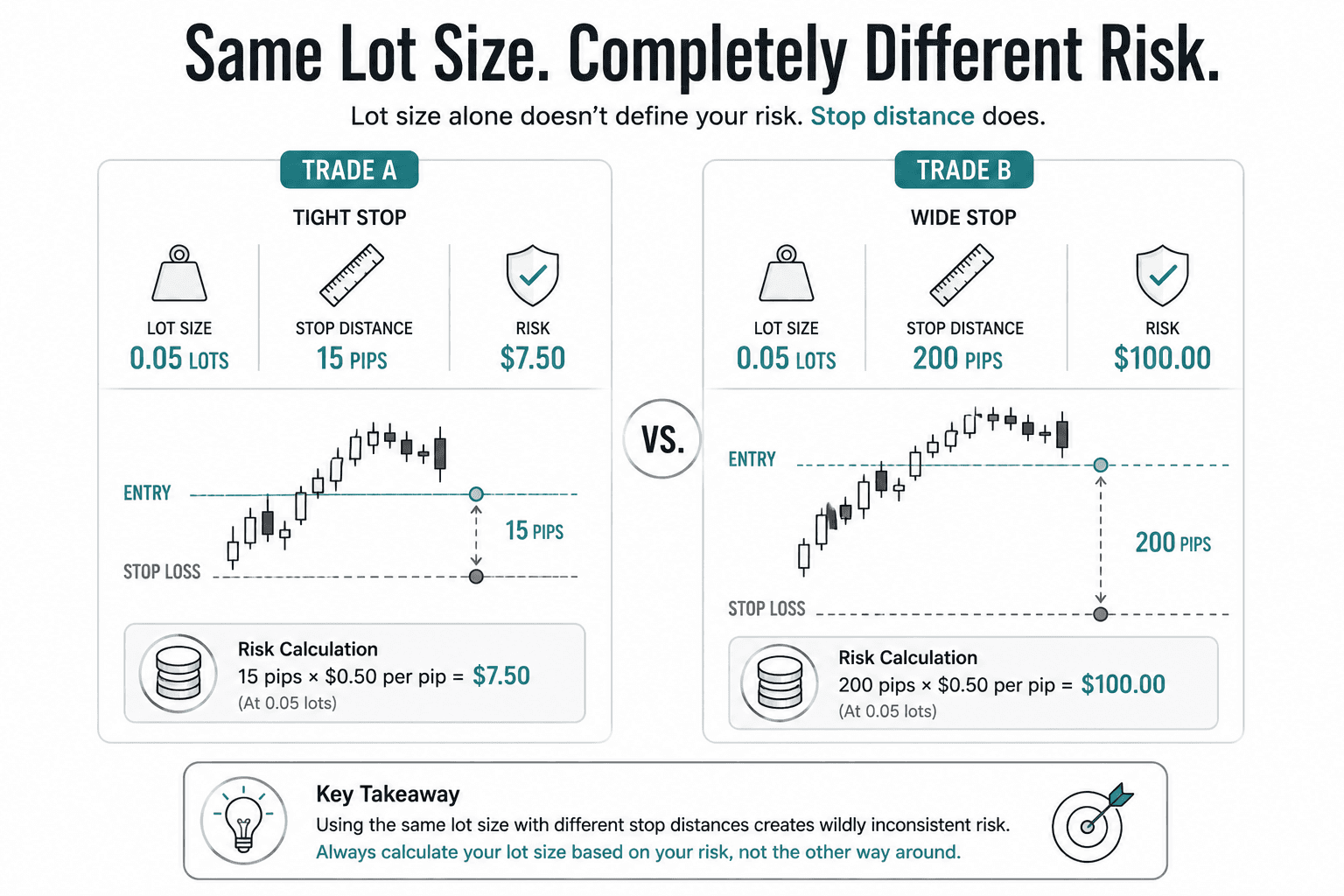
To drive this point home, consider two trades using the exact same lot size:
Trade A: 0.05 lots with a 15-pip stop loss.
Risk=15 pips×$0.50=$7.50Trade B: 0.05 lots with a 200-pip stop loss.
Risk=200 pips×$0.50=$100
Same lot size. Same account. Yet Trade B carries over thirteen times more financial risk than Trade A. If you only focus on the lot size field inside your order window, both trades look identical. Only the calculation reveals the true danger.
This is why defaulting to "I always trade 0.05 lots" isn't a risk management framework. It is just a lucky habit on tight stops that quietly torpedoes your account on wider ones.
Common Mistakes to Avoid
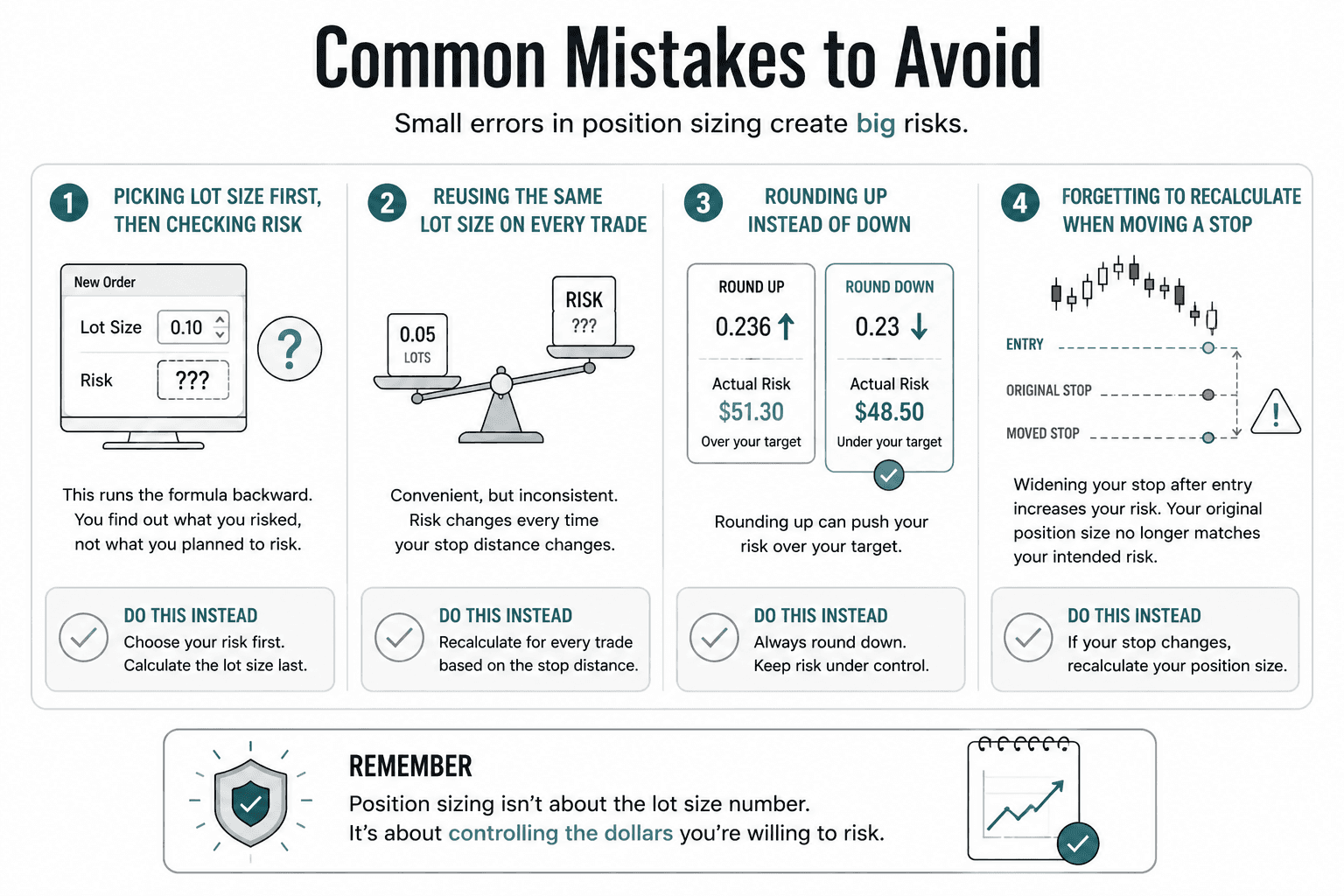
Picking lot size first, then checking risk: This runs the formula backward. It tells you what you happened to risk after the fact, not what you planned to risk.
Reusing the same lot size on every trade: This is convenient, but it only works on the exact stop distance where you ran the math correctly the first time.
Rounding up instead of down: When your broker doesn't support your exact mathematical output, always round toward less risk.
Forgetting to recalculate when moving a stop: If you widen your stop loss post-entry (a separate trading sin entirely), your original position size no longer reflects your intended risk. Your financial exposure just shot up while your lot size stayed identical.
Try It Yourself
Find a live or historical chart setup right now and document the following details:
Your account size and chosen risk percentage
Your stop distance in pips based on real market structure
The pip value per lot for your target currency pair
The final calculated lot size
Run this exact calculation for five different setups with distinct stop distances before placing your next trade. Speed is not the goal here. The first fifty times you run this math, it should feel intentionally methodical. That is how deliberate discipline replaces blind luck.
Success Criteria
You are ready to move on to the next lesson if you can:
Identify the Core Inputs: List the three required variables (dollar risk, stop distance in pips, and pip value per lot) in the correct order before touching a lot size calculator.
Execute the Formula: Calculate the correct lot size for any currency pair and stop distance, applying the "round down" rule to keep actual risk below your target.
Recognize Variable Exposure: Explain in your own words why using a fixed lot size across different stop distances creates wildly inconsistent risk.
Common Misconception
A small lot size is inherently a safe position size.
The Truth: It feels that way, since "small" sounds cautious. But lot size alone doesn't tell you your risk. The stop distance does too. A 0.5 lot position with a 5-pip stop can risk less than a 0.05 lot position with a 200-pip stop. The lot size number by itself is meaningless without knowing how far away your stop is.
FAQ's
Q: How does this change on a pair where USD isn't the quote currency, like USD/JPY?
Q: Should I risk more on setups I feel super confident about?
Q: What if the calculated lot size isn't a size my broker actually offers?
Table of Contents
About Me

Krista Weber
After a career as a VP of UX and EdTech executive, I retired early—and quickly realized the traditional world of trading education is fundamentally broken.
As someone with a Master’s in HCI who specialized in the design of e-learning systems, I saw a massive gap: beginners aren't failing because trading is impossible; they’re failing due to massive cognitive overload and terrible instructional design.
This site bridges that gap. I’m applying the principles of learning science, systems thinking, and minimalist UX to strip away the market noise and teach trading the way it actually should be taught.
Stay in Touch
Some of the pages on my travel blog contain affiliate links. Whenever you buy something through one of these links, I get a small commission at no extra cost to you. As an affiliate, I only recommend products and services that I feel are high quality and helpful to my readers. Thanks for your support.
Read More

Open almost any trading platform and you'll see EUR/USD sitting next to XAU/USD, NQ, ES, and a dozen CFDs on stocks you've heard of. They all show up as candlesticks moving left to right, which quietly implies they're all the same kind of thing. They aren't. Before going deeper into any one of them, it's worth drawing the map.
Updated on Sep 6, 2026

Futures are standardized contracts tied to defined specifications and a future settlement date. They can look complex at first, but the mechanics become much clearer once you know what the contract specification controls. Here's what you actually need to know.
Updated on Sep 6, 2026

CFDs appear everywhere in retail trading – but most new traders couldn't explain exactly what they are or why that matters. Here's a plain-language breakdown, including the parts that most introductions skip.
Updated on Sep 6, 2026