
Trading Gold vs Forex vs Futures
Most beginners start where the content pointed them (usually forex, sometimes futures) without much consideration of whether that instrument is a good fit for their goals, schedule, or psychology. Here's an honest comparison.

Learning Path Stage 6: Find Your Strategy
Learning Level 4: Analysis
Primary Learning Objective
By the end of this lesson, you will be able to compare forex, gold, and futures using current evidence and trader-specific constraints rather than assuming one market is universally best.
The Basics: What You're Actually Trading
Before comparing them, it's worth being precise about what each instrument is.
This is the point where the answer stops being "which market looks coolest on YouTube?" and starts becoming annoyingly specific to your actual constraints.
Forex (Foreign Exchange) You're trading the relative value of one currency against another. EUR/USD is the euro relative to the US dollar. GBP/JPY is the British pound relative to the Japanese yen. Major pairs involve USD, EUR, GBP, JPY, CHF, CAD, AUD, NZD. The forex market is decentralized – there's no single exchange – and trading happens between banks, institutions, and retail brokers over a global network. This means there's no official "tape" – no centralized record of who traded what volume at what price.
Gold (XAU/USD) Gold is a commodity quoted in US dollars, but the product behind an XAU/USD listing depends on the venue, broker, and jurisdiction. A retail platform may offer broker-issued leveraged exposure, while exchange-traded gold futures are a different structure with different mechanics. The price can respond to real-rate expectations, USD conditions, inflation and growth expectations, geopolitical risk, investor demand, central-bank demand, liquidity, and other current factors. No single driver gets permanent custody of the chart.
Futures Futures contracts are standardized agreements tied to a defined contract specification and expiration cycle. When retail traders discuss futures, they often mean equity index futures such as ES, NQ, YM, or RTY, but futures also exist on commodities, currencies, rates, and other underlyings. Exchange-traded futures provide centralized trade and volume data. Expiration, settlement, multiplier, tick size, and margin requirements are contract-specific, so the specification wins every argument.
Volatility and Position Sizing
Do not compare instruments using permanent daily-range numbers. Measure current realized volatility over the same recent window, then translate that movement into dollar risk using the actual position size or contract multiplier available to you. Forex sizing may be highly granular depending on broker and jurisdiction; gold product sizing is provider-specific; NQ and MNQ use standardized exchange multipliers.
The useful comparison is not 'which moves more?' It is 'given the setup's invalidation distance, what dollar risk does the smallest practical position create, and does that fit the trader's plan?'
Less exciting than a market leaderboard. Much more useful.
Session Characteristics
Activity changes through the trading day, but exact session rankings are not permanent facts. Compare the hours you can trade with current liquidity, spread, volatility, scheduled releases, and the hours in which your strategy has actually been tested. Gold and forex trade through global OTC or broker venues, while NQ trades on CME Globex and is also influenced by the U.S. cash-equity session.
Structural Differences Worth Knowing
Spread vs. Commission: Forex brokers typically charge via spread (the difference between buy and sell price), with no separate commission on standard accounts. Futures commonly involve commissions and exchange-related fees, while retail OTC products may charge through spread, commission, financing, or a combination. Compare the actual all-in cost for the product and size you would trade rather than assuming one structure is cheaper.
Volume Data: Futures provide genuine exchange volume – you can see how many contracts traded at each price level. This data is used in Volume Profile analysis and is generally more reliable than tick volume in forex. Forex "volume" is tick volume (how many price updates occurred), which correlates with real volume but isn't actual trade size data.
Overnight Risk: Forex positions held overnight accumulate swap charges (or credits) based on interest rate differentials between the paired currencies. Futures positions roll over at expiration (quarterly) – you need to be aware of expiration dates and roll positions if holding across expirations.
Leverage and margin: Both OTC products and futures can create leveraged exposure. The amount available or required varies by product, broker, exchange, client classification, jurisdiction, and market conditions. Verify current specifications rather than using a fixed leverage or margin number.
Compare the Candidates Using the Same Questions
Dimension | Forex | Gold | Futures |
|---|---|---|---|
Product / structure | Retail product structure varies by broker and jurisdiction | XAU/USD structure varies by venue/provider; gold futures are a separate exchange-traded product | Standardized exchange-traded contracts |
Position-sizing flexibility | Often flexible, but exact minimums are broker-specific | Product-specific; verify lot/contract mechanics | Fixed contract multipliers; micro contracts may change sizing granularity |
Current volatility / noise | Measure the pair and window you plan to trade | Measure current realized volatility; do not assume a permanent ranking | Measure the exact contract and current regime |
Session fit | Compare liquidity and behavior during your available hours | Compare current liquidity and event exposure during your hours | Compare the contract's liquidity and your tested session rules |
Transaction costs / liquidity | Verify spread, commission, financing, and execution | Verify spread/commission/financing for the exact product | Verify commissions, exchange fees, spread, and current liquidity |
Event sensitivity | Depends on the currencies and current macro calendar | Can respond to rates, USD conditions, demand, geopolitics, and other drivers | Depends on the underlying market and scheduled events |
Data availability | Decentralized market; broker/tick-volume data may differ | Depends on the product and venue | Centralized exchange volume is available for exchange-traded contracts |
Contract / expiration | Spot/OTC positions do not use futures-style contract expiration | Depends on structure; futures versions expire | Expiration and rollover are contract-specific requirements |
Choosing Based on Fit
Rather than "which is best," the useful question is: which fits your situation?
Instead of assigning a permanent fit, ask the same questions of each candidate:
Can I size the position to my risk limit at a valid technical invalidation point?
Are current volatility and liquidity compatible with my strategy?
Do the active hours fit my schedule?
What are the actual spread, commission, financing, and data costs?
Which scheduled events or macro drivers matter right now?
Does the product give me the data my strategy requires?
What evidence from simulation would make me keep or reject this candidate?
The output should be one or two instruments to observe or simulate, not a declaration that one market is universally best.
Trading culture loves identities: "I'm an NQ trader." "I only trade gold." Your risk plan is considerably less sentimental.
Decision Framework: Build a Conditional Shortlist
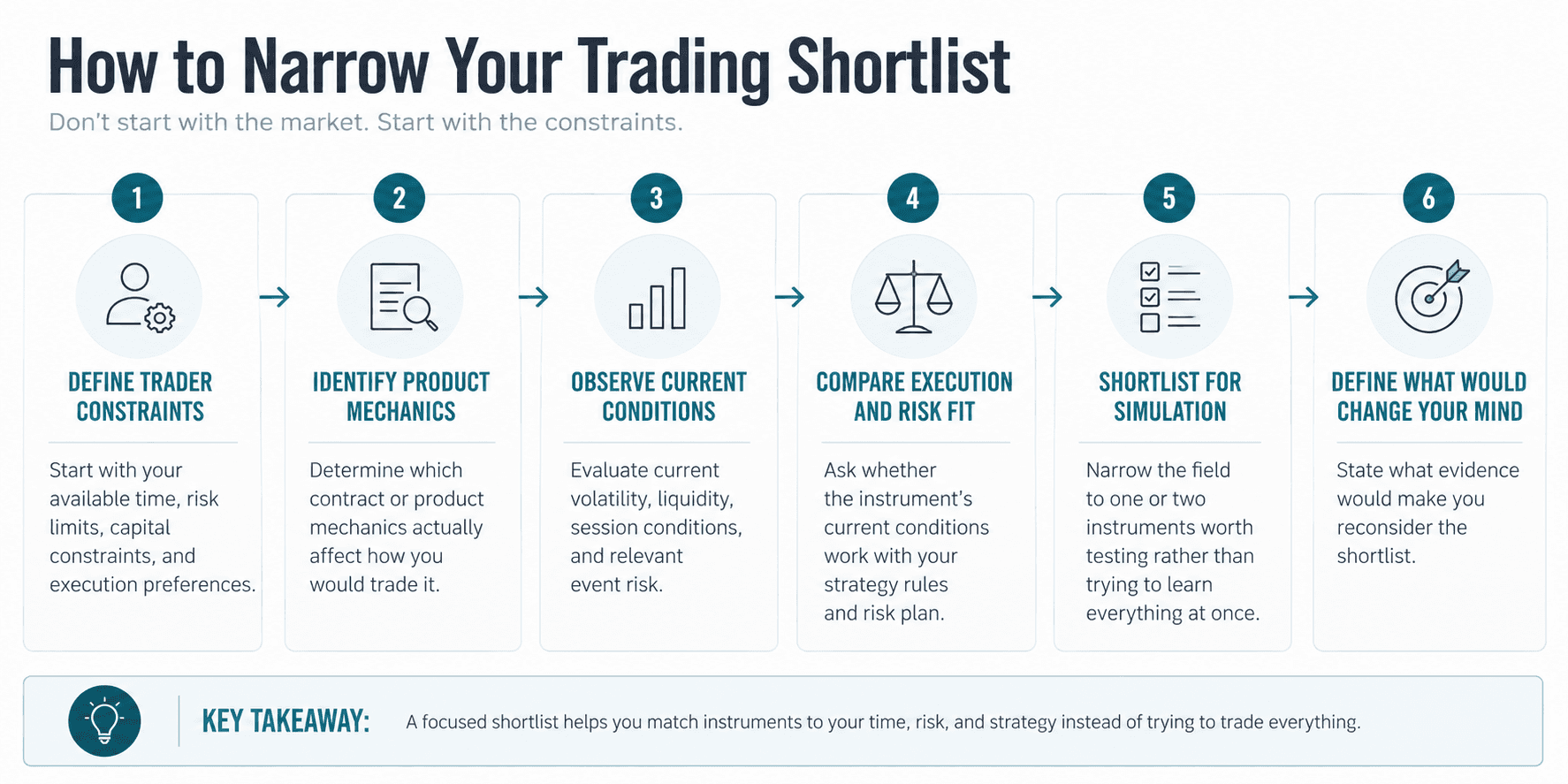
Use this sequence instead of asking which market is “best”:
Define your constraints. Available hours, risk limit, capital/position-sizing constraints, data access, and strategy requirements.
Identify the product mechanics that matter. Contract size, expiration, financing, volume data, counterparty/venue structure, and execution model.
Observe current conditions. Volatility, liquidity, transaction costs, session behavior, and event risk.
Compare execution and risk fit. Can the strategy be executed within its tested assumptions and your risk rules?
Shortlist one or two instruments for observation or simulation. A shortlist is a hypothesis, not a permanent identity.
State what evidence would change the shortlist. Define the conditions that would make you reconsider.
Capstone Scenario Practice
For each trader profile, choose one or two instruments to observe or simulate next. More than one answer may be defensible when the reasoning is explicit.
Profile A: Limited morning window
The trader has a narrow, consistent trading window, wants precise position sizing, and uses a strategy that has only been tested during that window. They do not use centralized volume data.
Profile B: Exchange-data strategy
The trader's process depends on centralized volume and standardized contract mechanics. Their risk limit is small enough that full-size contracts may not always fit the invalidation distance.
Profile C: Macro-context trader
The trader is comfortable monitoring multiple macro evidence streams and wants to study how current rates, USD conditions, demand, and event risk interact with technical structure.
For each profile, justify the shortlist using:
stable personal constraints,
product mechanics,
current conditions that must be checked,
position-sizing implications,
evidence that would make you change the recommendation.
Reflection
Which constraints in your own trading are relatively stable and personal? Which market conditions would you need to recheck each week or session before deciding that an instrument still fits?
Retrieval Check
What is the difference between a structural product difference and a current market condition?
Why is “Which market is best?” a weaker question than “Which candidate fits my constraints and current evidence?”
What evidence should trigger you to reconsider a shortlist you previously made?
The instrument doesn't determine whether you're a good trader. But choosing one that mismatches your capital, schedule, or psychology will make it significantly harder to find out.
This is the last article in the Markets & Instruments series. From here, the next step is applying this instrument knowledge inside a strategy, covered in the Stage 6 strategy-building content.
Success Criteria
Given a trader profile, you can compare the relevant choices across structure, position-sizing flexibility, current volatility, session fit, transaction costs/liquidity, event sensitivity, and data availability, then justify which one or two instruments deserve further observation or simulation and what evidence could change that conclusion.
Common Misconception
There's one objectively "best" instrument for beginners.
The Truth: Forex, gold, and futures each fit different situations: capital available, schedule, tolerance for volatility, and what kind of analysis appeals to you. Asking which is best is less useful than asking which one fits how you actually want to trade.
FAQ's
Q: Is trading Gold harder than trading Forex?
Q: Why do traders choose futures?
Q: Which instrument is best for beginners – forex, gold, or futures?
Table of Contents
About Me

Krista Weber
After a career as a VP of UX and EdTech executive, I retired early—and quickly realized the traditional world of trading education is fundamentally broken.
As someone with a Master’s in HCI who specialized in the design of e-learning systems, I saw a massive gap: beginners aren't failing because trading is impossible; they’re failing due to massive cognitive overload and terrible instructional design.
This site bridges that gap. I’m applying the principles of learning science, systems thinking, and minimalist UX to strip away the market noise and teach trading the way it actually should be taught.
Stay in Touch
Some of the pages on my travel blog contain affiliate links. Whenever you buy something through one of these links, I get a small commission at no extra cost to you. As an affiliate, I only recommend products and services that I feel are high quality and helpful to my readers. Thanks for your support.
Read More

Open almost any trading platform and you'll see EUR/USD sitting next to XAU/USD, NQ, ES, and a dozen CFDs on stocks you've heard of. They all show up as candlesticks moving left to right, which quietly implies they're all the same kind of thing. They aren't. Before going deeper into any one of them, it's worth drawing the map.
Updated on Sep 6, 2026

Futures are standardized contracts tied to defined specifications and a future settlement date. They can look complex at first, but the mechanics become much clearer once you know what the contract specification controls. Here's what you actually need to know.
Updated on Sep 6, 2026

CFDs appear everywhere in retail trading – but most new traders couldn't explain exactly what they are or why that matters. Here's a plain-language breakdown, including the parts that most introductions skip.
Updated on Sep 6, 2026