
Types of Trading Accounts Explained
Choosing a trading account is about more than picking a broker; it determines whether real capital is at risk, who makes the trading decisions, and how overnight fees impact your bottom line. From risk-free demo environments to prop firm challenges and swap-free setups, understanding these structural options helps you protect your capital and build real trading skill.

Learning Path Stage 1: Foundations
Learning Level 1: Recognition
Primary Learning Objective
By the end of this article, readers will be able to evaluate and distinguish between different trading account structures (Demo, Live, Managed/PAMM, Prop Firm, and Swap-Free) to select the account type that aligns with their capital, skill level, and trading strategy.
Why Account Type Matters
When you open a trading account, you are choosing much more than just a broker. You are choosing a structure. You are deciding whether real money is on the line, whether a third party gets to press the buttons for you, and how fees like overnight financing bite into your bottom line.
If you are currently agonizing over Market Maker vs. STP vs. ECN execution models, take a breath. That is a completely separate topic covered in Types of Forex Brokers Explained. You can open almost any of the account structures below under any of those execution models, much like how you can open a checking account at a bank regardless of how that bank spends its own funds.
Understanding your options beforehand is essential foundational research. You want to know what you are getting into before you actually hand over your hard-earned money.
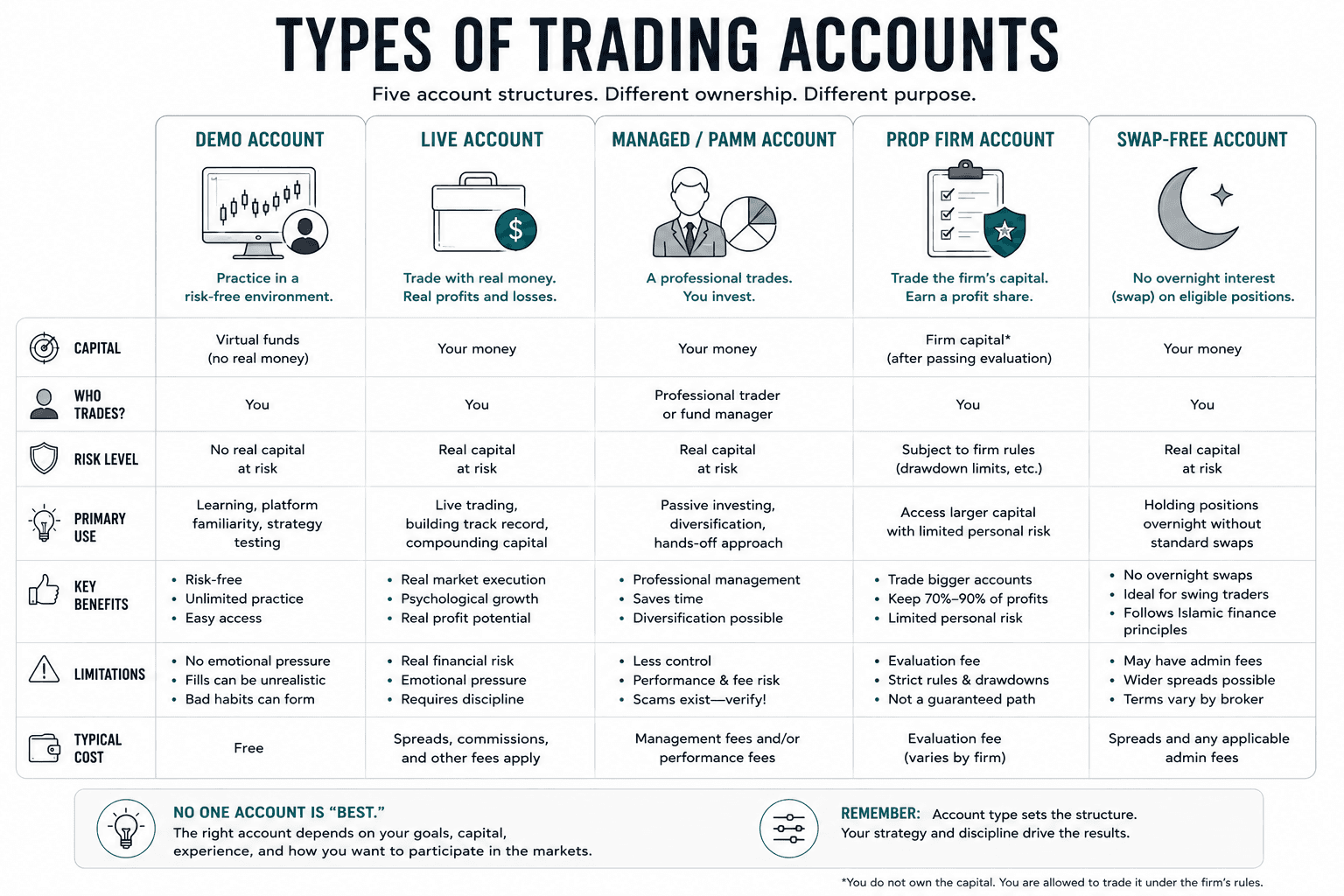
Demo Accounts
What they are: These are simulated accounts loaded with virtual money. The prices reflect live (or slightly delayed) market data, and the mechanics mimic real trading.
Best for: Learning how to use the trading platform without accidentally risking your life savings, testing strategies, and getting comfortable with chart tools and order types.
Limitations: Monopoly money brings zero actual emotional stakes. Demo trading cannot simulate the sweat-inducing panic or thrill of risking actual cash. On top of that, trade fills in a demo environment can be unrealistically forgiving during fast-moving markets.
Access: Usually completely free, available from virtually every broker, and often accessible without jump-starting a full account registration.
Managed and PAMM Accounts
What they are: These accounts hand the steering wheel over to a third party, such as a professional trader or fund manager. A PAMM (Percentage Allocation Management Module) account pools money from multiple investors together and divides the profits proportionally.
Who they are for: Passive investors who prefer to sit back and let someone else do the heavy lifting. If your goal is to build your own trading skills, this is not the route for you.
Caution: The managed account space is unfortunately full of bad actors. If anyone promises guaranteed returns, absurdly high profits, or rushes you to deposit money immediately, run for the hills.
Prop Firm Accounts
What they are: Prop firm accounts give traders access to a firm's trading program after meeting the firm's requirements. Typically, you first complete an evaluation or challenge with specific profit and loss limits. If you meet the requirements, you may receive access to a larger account under the firm's rules and participate in a profit-sharing arrangement.
Who they are for: Traders who have developed a reasonably consistent strategy and want to trade with access to more capital than they have personally available. They are not a substitute for learning how to trade.
What makes them different: Your trading is governed by the firm's rules. These can include maximum daily losses, maximum overall drawdown, position-size limits, prohibited strategies, and requirements around when and how you can trade. A strategy that works perfectly well in a normal live account may not work under a firm's restrictions.
Caution: The evaluation fee is not the only thing to consider. Read the firm's rules carefully and understand exactly how drawdowns, payouts, trading restrictions, and account termination work before paying for an evaluation. Also verify whether the account is actually live capital or a simulated environment, because firms use different structures.
Verdict: Prop firms can provide access to additional trading capital, but they introduce another layer of rules and constraints. They make more sense after you have a tested strategy and consistent execution, not while you are still trying to figure out how to trade.
Swap-Free Accounts
What they are: A swap-free account is an account that does not apply the standard overnight swap or financing charge to eligible positions. These accounts are sometimes called Islamic accounts because they can accommodate Islamic finance principles that prohibit interest (riba).
Who they are for: Traders who regularly hold positions overnight and want an account structure that does not use standard overnight interest charges. They can be particularly relevant to swing traders or anyone whose strategy keeps positions open for multiple days.
What makes them different: Swap-free describes the fee structure, not who controls the account or where the trade is executed. You can still be the person making the trading decisions, just as you would with a standard live account.
Caution: "Swap-free" does not necessarily mean "fee-free." Depending on the broker and account terms, the broker may use administration fees, wider spreads, or other charges instead of standard swap rates. Always read the specific terms before assuming a swap-free account will cost less.
Verdict: If you regularly hold positions overnight, understanding the financing structure can be just as important as comparing spreads and commissions. The right choice depends on how long you hold trades and what the broker actually charges.
A Useful Distinction
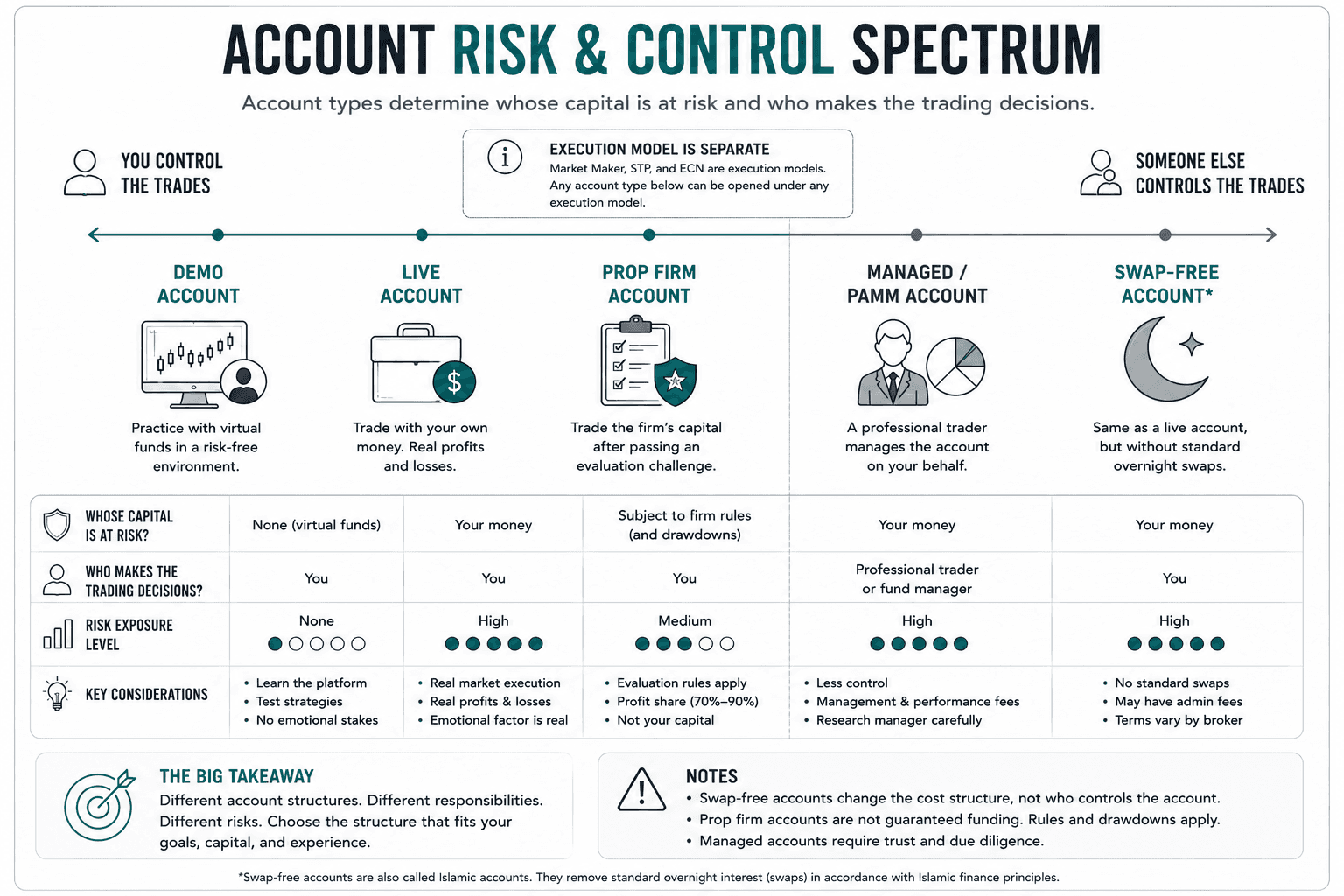
Not all five account options are different in exactly the same way.
Demo, Live, Managed/PAMM, and Prop Firm describe different structures around capital, control, and participation.
Swap-Free describes how overnight financing is handled.
That means a swap-free account can still be a live account, for example. The account type and the fee structure are separate decisions.
When evaluating an account, ask three questions:
Whose capital is at risk?
Who makes the trading decisions?
How does the account charge for the services it provides?
Those three questions will tell you much more than the label on the signup form.
A Quick Note on Execution Models
Most brokers allow you to set up a standard account under a Market Maker, STP, or ECN model. From your side of the screen, the accounts function identically when it comes to depositing, trading, and withdrawing funds. What actually changes is the fee structure (spread-only versus spread plus commission) and who sits on the other end of your trade.
What to Look for When Choosing a Broker
Regardless of the account type you select, keep an eye out for these key factors:
Regulation: Ensure the broker answers to a legitimate authority like the FCA in the UK, ASIC in Australia, CySEC in Cyprus, or the CFTC/NFA in the US. Proper regulation keeps your funds safer.
Fund Segregation: Check if client funds are kept completely separate from the broker’s operational cash. Regulated brokers are legally required to keep them segregated.
Negative Balance Protection: Ask yourself if your account can dip below zero during sudden market drops. Brokers in the EU and UK are required to offer negative balance protection, but brokers outside those jurisdictions might leave you on the hook.
Minimum Deposit: Make sure the entry barrier actually aligns with your available trading capital.
Instruments Available: Verify that the broker actually offers the specific currency pairs or assets you want to trade.
Trading Platform: Whether it is MT4, MT5, cTrader, or a custom proprietary app, make sure the interface fits your personal workflow.
For beginners, starting simple with a standard account at a heavily regulated broker is almost always the smartest move. Save the complex execution setups for later down the road when you actually have a proven strategy worth optimizing.
Your account type dictates your costs and execution rules. It will not magically grant you a trading edge, but it certainly dictates how much of your profit you actually get to keep.
Success Criteria
By the end of this lesson, you will be able to identify the major types of trading accounts and recognize how they differ in capital exposure, trading control, and fee structure.
Common Misconception
Account type is a minor formality you pick once and forget.
The Truth: It reads that way on the signup form, buried under a dropdown menu. In practice it's a structural choice that shapes your costs, your execution, and (for demo vs. live) even how honestly you can evaluate your own trading, since demo performance doesn't carry the psychological pressure of real money.
FAQ's
Q: What is a prop firm account, and should I try one?
Q: What are "swap-free" accounts?
Q: What is the actual difference between a live account and a demo account?
Table of Contents
About Me

Krista Weber
After a career as a VP of UX and EdTech executive, I retired early—and quickly realized the traditional world of trading education is fundamentally broken.
As someone with a Master’s in HCI who specialized in the design of e-learning systems, I saw a massive gap: beginners aren't failing because trading is impossible; they’re failing due to massive cognitive overload and terrible instructional design.
This site bridges that gap. I’m applying the principles of learning science, systems thinking, and minimalist UX to strip away the market noise and teach trading the way it actually should be taught.
Stay in Touch
Some of the pages on my travel blog contain affiliate links. Whenever you buy something through one of these links, I get a small commission at no extra cost to you. As an affiliate, I only recommend products and services that I feel are high quality and helpful to my readers. Thanks for your support.
Read More

Open almost any trading platform and you'll see EUR/USD sitting next to XAU/USD, NQ, ES, and a dozen CFDs on stocks you've heard of. They all show up as candlesticks moving left to right, which quietly implies they're all the same kind of thing. They aren't. Before going deeper into any one of them, it's worth drawing the map.
Updated on Sep 6, 2026

Futures are standardized contracts tied to defined specifications and a future settlement date. They can look complex at first, but the mechanics become much clearer once you know what the contract specification controls. Here's what you actually need to know.
Updated on Sep 6, 2026

CFDs appear everywhere in retail trading – but most new traders couldn't explain exactly what they are or why that matters. Here's a plain-language breakdown, including the parts that most introductions skip.
Updated on Sep 6, 2026