
Understanding Leverage and Margin
Leverage is why forex moves that look tiny on paper can either build an account or obliterate it in hours. It is the single most powerful and dangerous mechanic in trading, making a solid understanding of how it works entirely non-negotiable.

Learning Path Stage 1: Foundations
Learning Level 2: Understanding
Primary Learning Objective
By the end of this lesson, you will be able to clearly distinguish leverage from margin, calculate true dollar risk on any trade, and integrate proper position sizing into your daily trading setup.
The Math of Leverage: Doubling Down or Disappearing
Without leverage, if you put $10,000 into EUR/USD and the market moves 1% in your favor, you make $100. A modest 1% return on $10,000.
With 100:1 leverage, that same $10,000 controls $1,000,000 in currency. A 1% favorable move brings in $10,000 (a 100% gain). However, a 1% move against you vaporizes the entire $10,000 account instantly.
Leverage is an uncompromising amplifier. It multiplies results in both directions without caring which outcome you were praying for.
The Margin Calculation
Required margin follows a straightforward formula:
Margin=LeveragePosition Size=Position Size×Margin Requirement %
Here is how required margin scales across different leverage levels for a $100,000 position:
Leverage | Position Size | Margin Required |
500:1 | $100,000 | $200 |
100:1 | $100,000 | $1,000 |
50:1 | $100,000 | $2,000 |
30:1 | $100,000 | $3,333 |
10:1 | $100,000 | $10,000 |
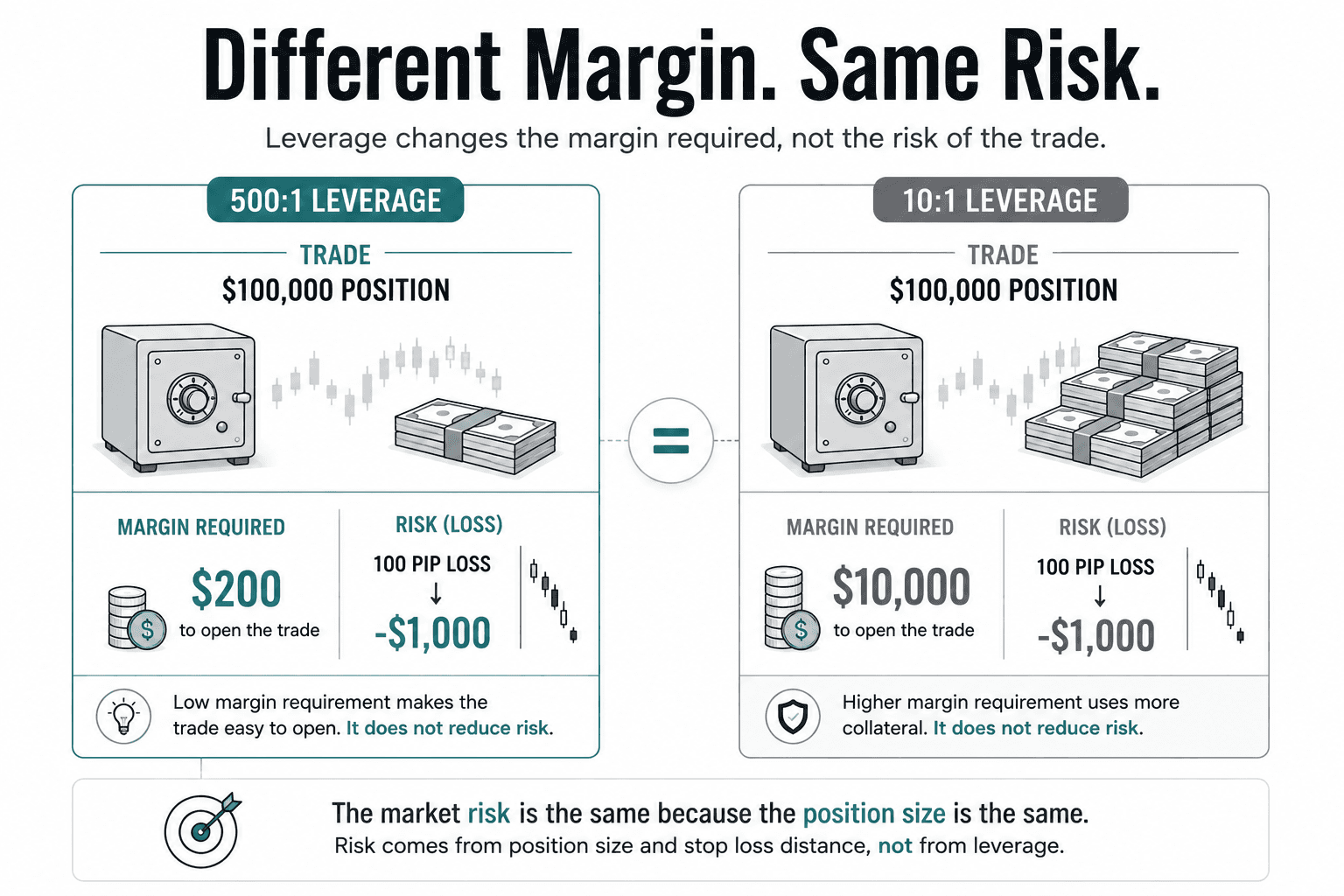
High leverage lowers the ticket price to open a trade, but it does not change the actual position size or the cash value of every pip.
Pip Value Meets Leverage
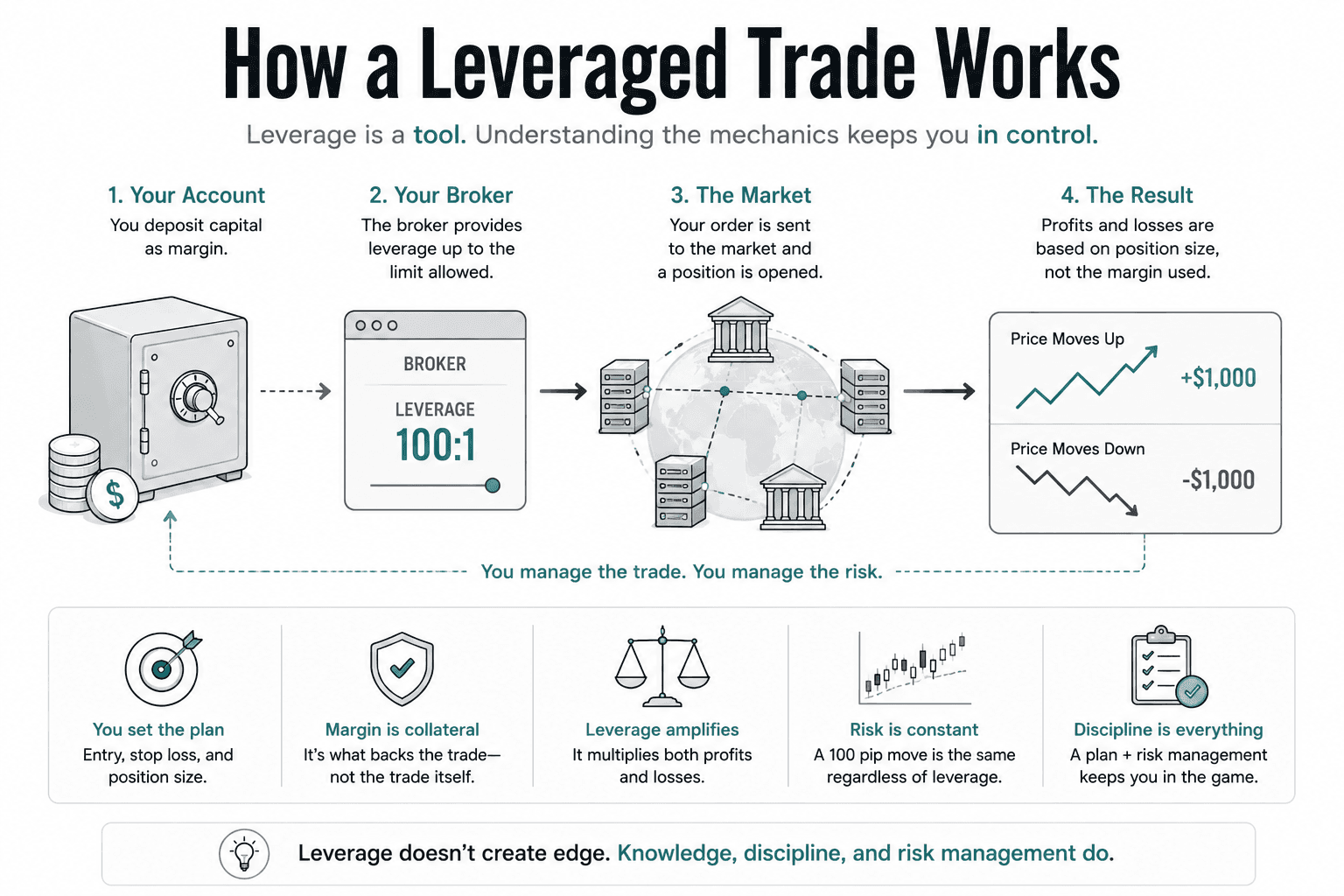
Position size dictates pip value, not leverage.
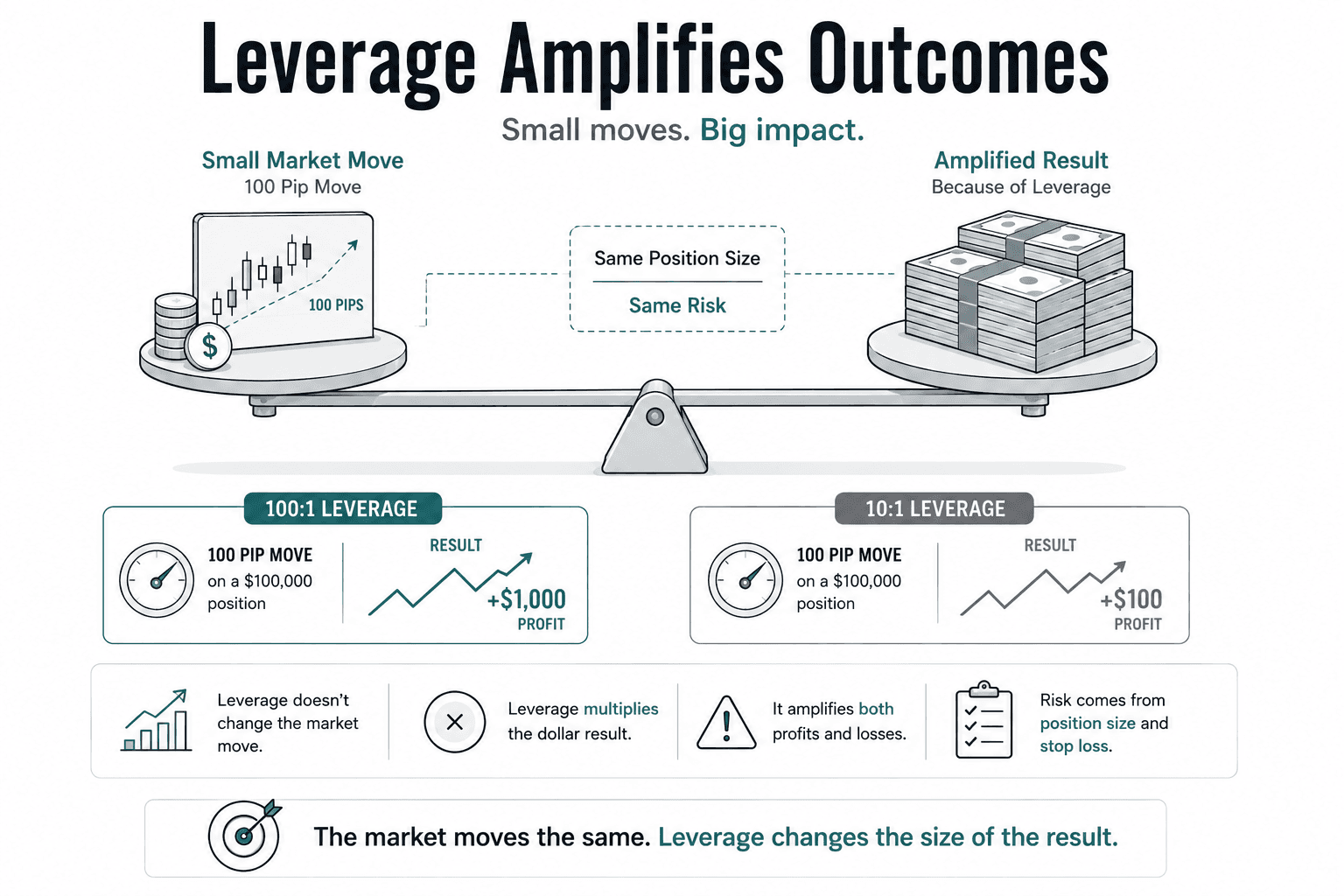
On a standard lot (100,000 units) of EUR/USD, 1 pip equals roughly $10. That stays $10 whether you used 500:1 leverage ($200 margin) or 10:1 leverage ($10,000 margin). Leverage simply determines how much personal capital you lock up to open the door.
If you have a $10,000 account and trade one standard lot ($10 per pip) at 100:1 leverage:
A 100-pip loss equals -$1,000 (10% of your account).
A 200-pip loss equals -$2,000 (20% of your account).
A 500-pip loss equals -$5,000 (50% of your account, right on the edge of liquidation).
Professional traders calculate position size based on pip value relative to account size, aiming to risk 1% to 2% per trade rather than focusing solely on lot sizes.
Why High Leverage Is Not the Grand Prize
Brokers love advertising high leverage with catchy slogans like "trade big with small money!" In reality, well-capitalized traders barely touch their maximum leverage limits.
The real danger is over-leveraging: controlling a massive position relative to account size where normal market fluctuations turn into financial ruin. A 100-pip move on a 1-lot position wipes out a $1,000 account completely, whereas that same move on a $100,000 account is a minor 1% dip.
The golden rule: Ignore leverage when sizing positions. Instead, focus on stop loss distance in pips, pip value per lot, and your 1% to 2% risk limit. Let leverage take care of the background collateral requirements.
A Simple Position Sizing Example
Account Balance: $5,000
Risk Limit: 1% ($50)
Stop Loss: 25 pips
Calculation Steps:
A mini lot (0.1 lot) of EUR/USD has a pip value of roughly $1 per pip.
A $50 risk budget over a 25-pip stop loss allows a $2 per pip risk ($50 / 25 pips).
Trading 2 mini lots (0.2 lots) matches that $2 per pip threshold perfectly ($2/pip × 25 pips = $50).
At 50:1 leverage, the required margin for 0.2 lots ($20,000 position value) is roughly $400, easily covered by the $5,000 account balance.
Risk management dictates position size, while margin remains a secondary requirement.
Key Concepts to Keep Close
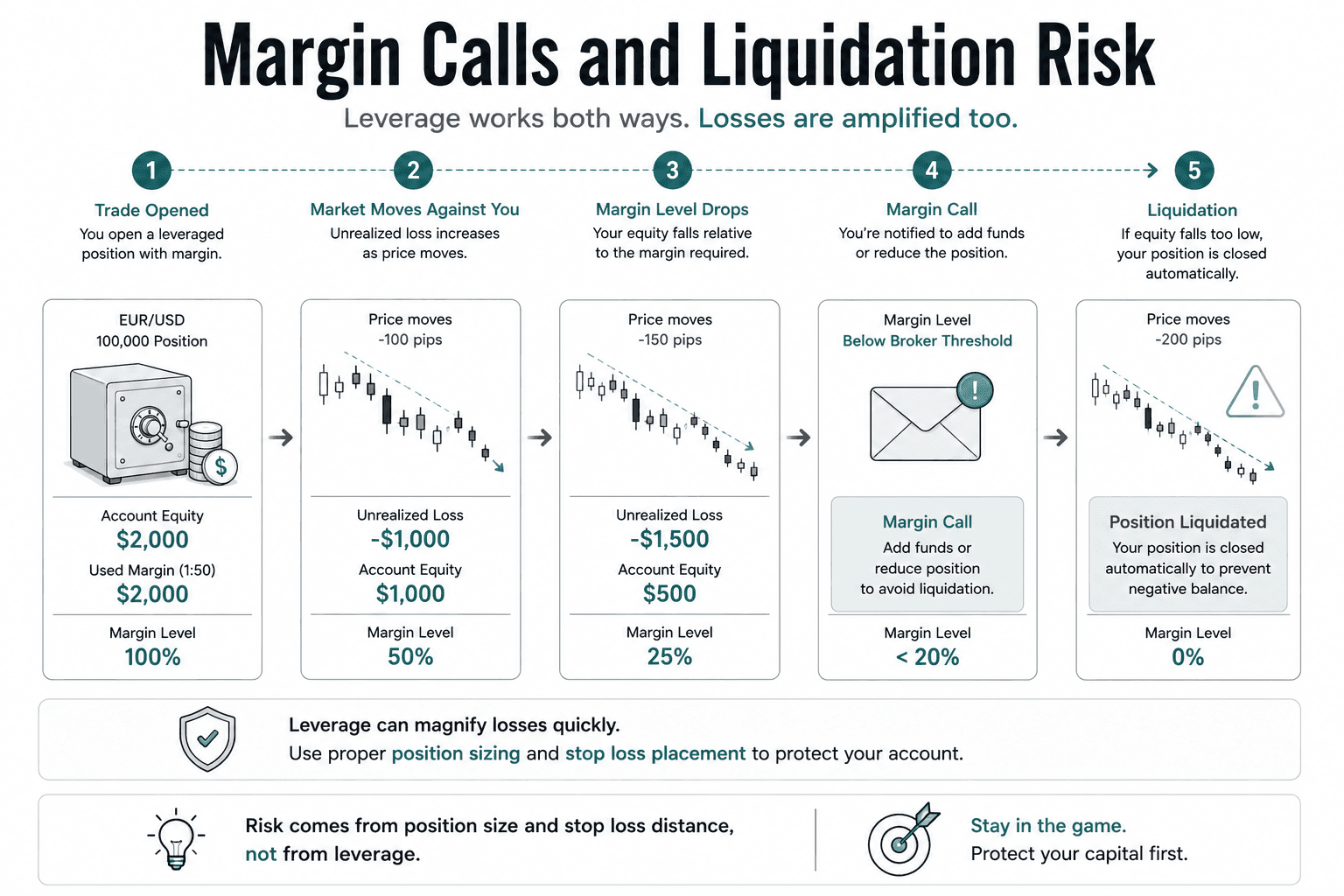
Used Margin: The collateral locked up to hold open trades.
Free Margin: The remaining equity available to open new trades or absorb losses.
Margin Level: (Equity/Used Margin)×100. A 100% margin level puts you in troubled waters, with margin calls usually triggering around 100% and automatic stop-outs around 50%.
Equity: Your total balance plus or minus floating profits and losses.
Leverage turns tiny price ripples into massive waves. Treat it with respect, use it intentionally, and never trade on auto-pilot.
Success Criteria
You have mastered this concept when you can:
Explain in plain English how leverage and margin interact without confusing position size with account risk.
Accurately calculate the margin required and pip value for a trade across different leverage tiers.
Size your positions based on dollar risk and stop-loss distance rather than maximum available leverage.
Common Misconception
The margin required to open a position is a reasonable proxy for how much risk that position carries.
The Truth: The two numbers look related, so it's a natural assumption. But margin required and dollar risk are two different things. At 500:1 leverage, a $100,000 position needs only $200 in margin, but a 100-pip adverse move still costs the same $1,000 it would at any other leverage ratio. Low margin requirement makes a position easy to open. It says nothing about how much you stand to lose.
FAQ's
Q: How do brokers set leverage limits?
Q: Is ultra-high leverage ever a good idea?
Q: What is the difference between leverage and margin?
Table of Contents
About Me

Krista Weber
After a career as a VP of UX and EdTech executive, I retired early—and quickly realized the traditional world of trading education is fundamentally broken.
As someone with a Master’s in HCI who specialized in the design of e-learning systems, I saw a massive gap: beginners aren't failing because trading is impossible; they’re failing due to massive cognitive overload and terrible instructional design.
This site bridges that gap. I’m applying the principles of learning science, systems thinking, and minimalist UX to strip away the market noise and teach trading the way it actually should be taught.
Stay in Touch
Some of the pages on my travel blog contain affiliate links. Whenever you buy something through one of these links, I get a small commission at no extra cost to you. As an affiliate, I only recommend products and services that I feel are high quality and helpful to my readers. Thanks for your support.
Read More

Open almost any trading platform and you'll see EUR/USD sitting next to XAU/USD, NQ, ES, and a dozen CFDs on stocks you've heard of. They all show up as candlesticks moving left to right, which quietly implies they're all the same kind of thing. They aren't. Before going deeper into any one of them, it's worth drawing the map.
Updated on Sep 6, 2026

Futures are standardized contracts tied to defined specifications and a future settlement date. They can look complex at first, but the mechanics become much clearer once you know what the contract specification controls. Here's what you actually need to know.
Updated on Sep 6, 2026

CFDs appear everywhere in retail trading – but most new traders couldn't explain exactly what they are or why that matters. Here's a plain-language breakdown, including the parts that most introductions skip.
Updated on Sep 6, 2026