
Understanding Spreads, Pips, Lots, and Leverage
Four core concepts drive every single forex trade: spread, pip, lot, and leverage. Learn what each term actually means in plain English, how they work together, and how they determine the exact financial stakes of every position you take.

Learning Path Stage 1: Foundations
Learning Level 1: Recognition
Primary Learning Objective
By the end of this lesson, you will be able to define Spreads, Pips, Lots, and Leverage, and explain how their interaction directly impacts risk and trade outcomes in forex trading.
Pip: The Unit of Measurement
Pip stands for "percentage in point" or "price interest point". It is the standard unit for tracking price movement in forex.
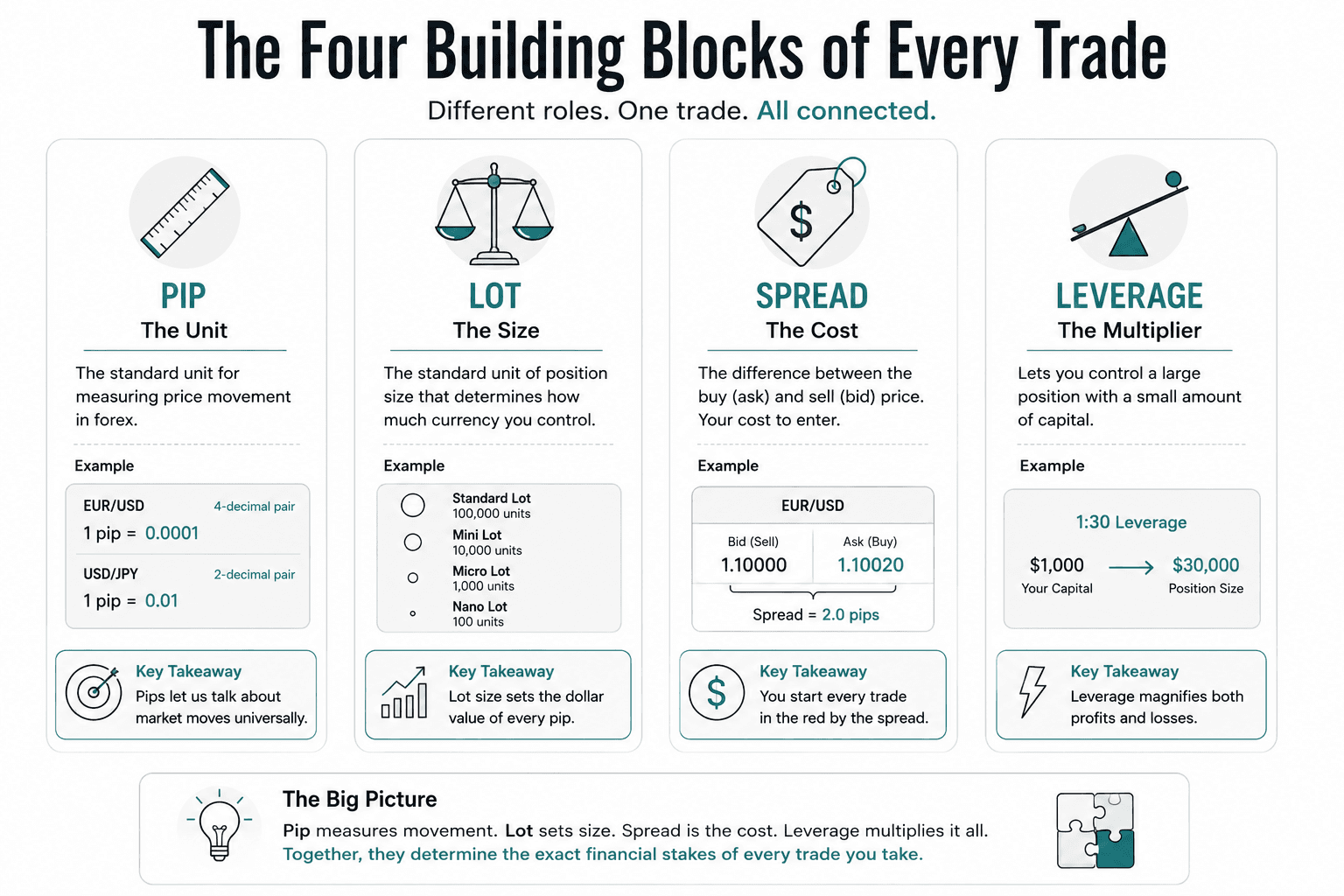
4-Decimal Pairs (EUR/USD, GBP/USD): $1\text{ pip} = 0.0001$. A move from $1.1000$ to $1.1010$ is a $10$-pip move.
2-Decimal Pairs (USD/JPY, EUR/JPY): $1\text{ pip} = 0.01$. A move from $150.00$ to $150.50$ is a $50$-pip move.
Why do we measure in pips instead of dollars? Because the actual dollar value of a move depends on your position size, your account currency, and current exchange rates. Pips give us a universal language to talk about market moves regardless of trade size.
If someone boasts, "I bagged $25$ pips on EUR/USD today," you know the exact scope of their win without needing to pry into their actual account balance.
Lot: The Unit of Position Size
A lot is simply the standard unit of position size, defining how much currency you are actually slinging around.
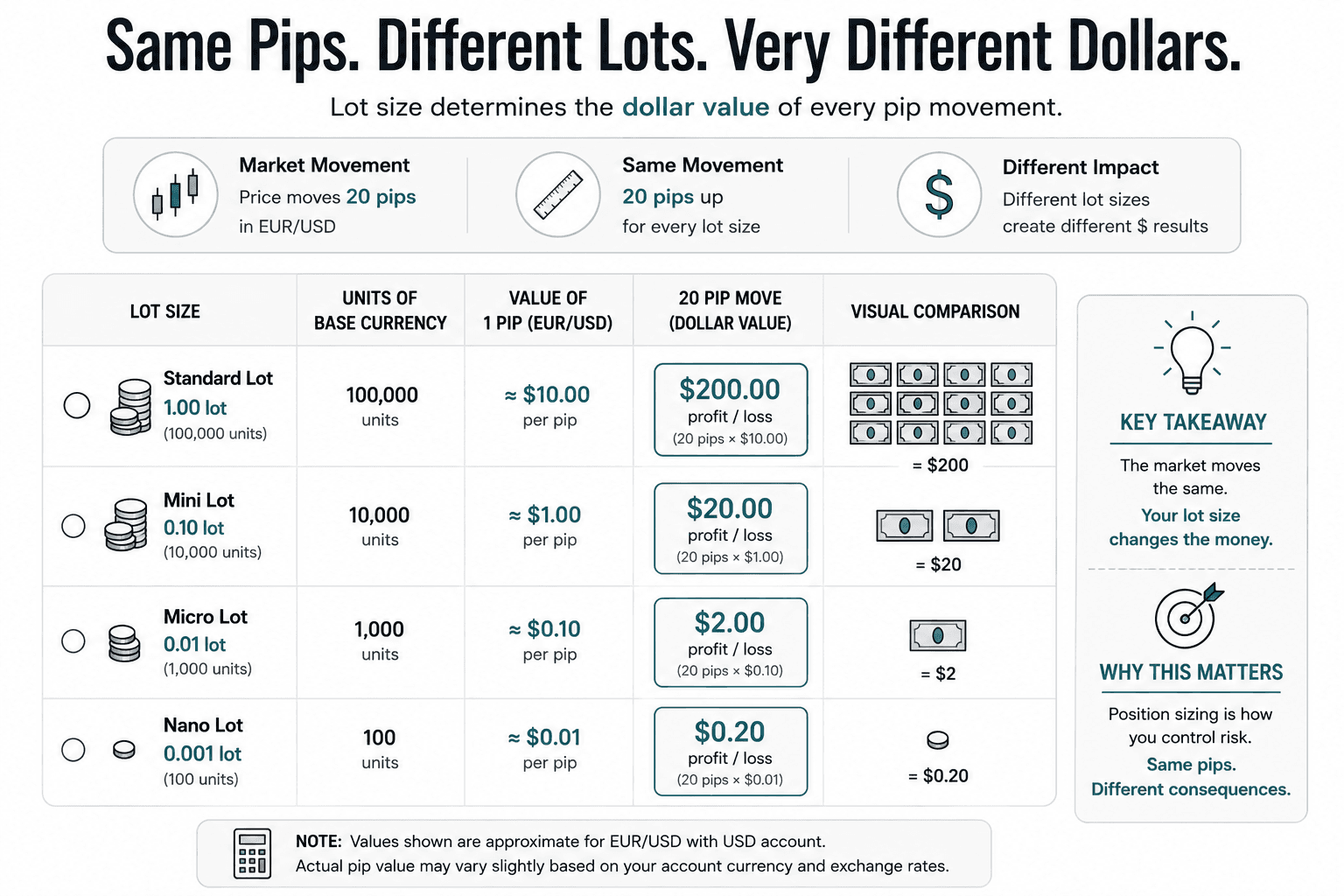
Standard lot: $100{,}000$ units of base currency
Mini lot: $10{,}000$ units ($0.1$ standard lot)
Micro lot: $1{,}000$ units ($0.01$ standard lot)
Nano lot: $100$ units ($0.001$ standard lot, available at select brokers)
Lot size is critical because it dictates the dollar value of every single pip move.
For EUR/USD with a USD account:
$1$ pip on a standard lot ($100{,}000$ units) $\approx \$10$
$1$ pip on a mini lot ($10{,}000$ units) $\approx \$1$
$1$ pip on a micro lot ($1{,}000$ units) $\approx \$0.10$
A $20$-pip win on a standard lot nets you around $\$200$. That exact same $20$-pip win on a micro lot nets you $\$2$. Same exact market movement, entirely different financial reality. This is why position sizing is a non-negotiable skill if you prefer keeping your money.
Spread: The Cost of Entry
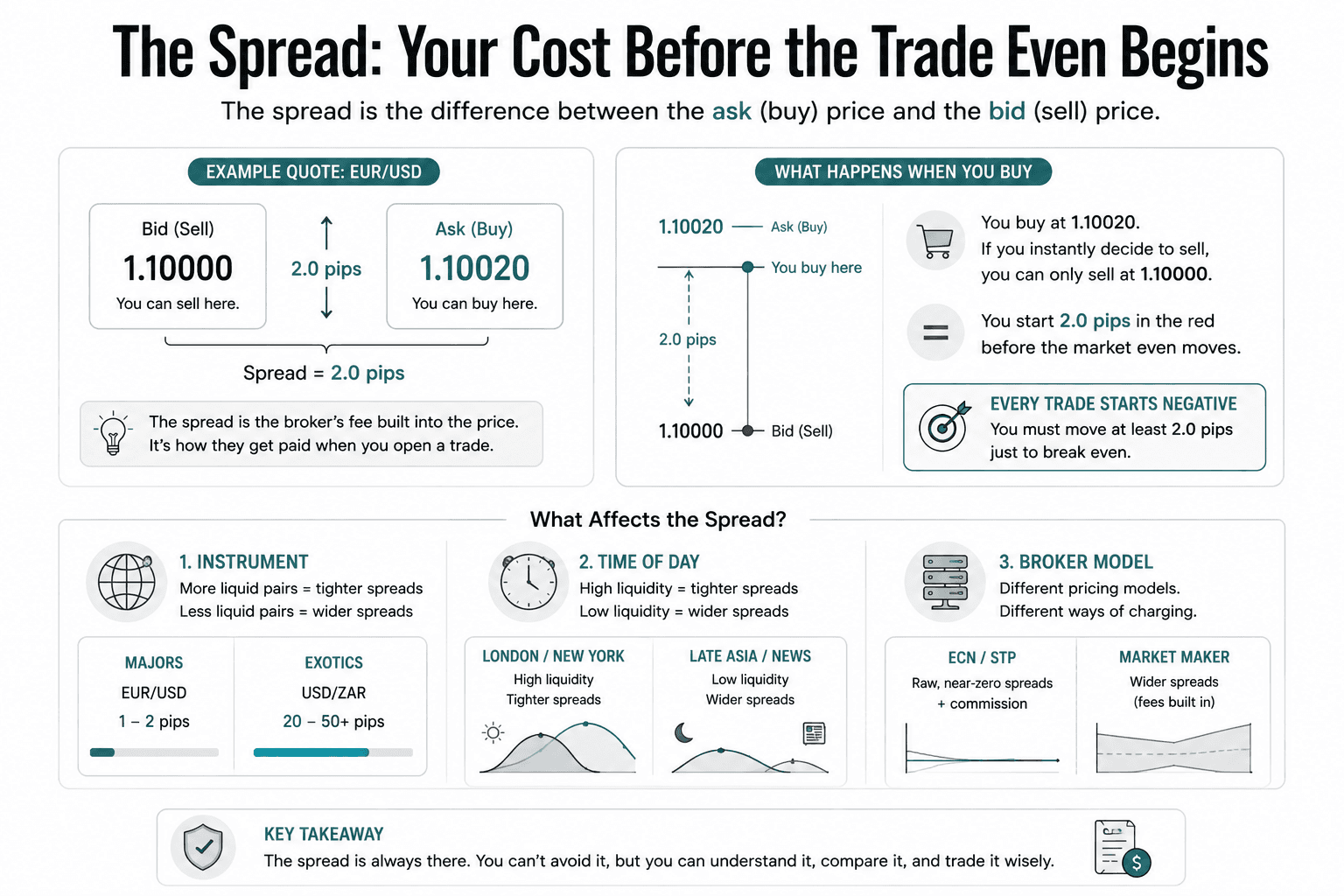
The spread is the difference between the buy price (ask) and the sell price (bid) set by your broker.
If EUR/USD is quoted at $1.10000 / 1.10020$:
Bid (Sell price): $1.10000$
Ask (Buy price): $1.10020$
Spread: $2\text{ pips}$
If you buy at $1.10020$ and instantly change your mind to sell, you sell at $1.10000$. You start $2$ pips in the red before the market even ticks. That $2$-pip gap is effectively the broker's cover charge.
Tighter spreads: Cheaper trades
Wider spreads: Pricier trades
Spreads fluctuate based on three key factors:
Instrument: Majors like EUR/USD offer tight $1\text{--}2$ pip spreads, while exotic pairs like USD/ZAR can stretch to $20\text{--}50+$ pips.
Time of day: Spreads blow out during low-liquidity hours or news events, and shrink during high-volume overlaps like London/New York.
Broker Model: ECN brokers offer raw, near-zero spreads with an explicit commission attached, while Market Makers wrap their fees directly into wider spreads.
Leverage: The Multiplier
Leverage lets you control massive positions with a tiny upfront cash deposit. It is expressed as a simple ratio like $1:10$, $1:50$, or $1:100$.
With $1:100$ leverage on a $\$1{,}000$ account:
You can control $\$100{,}000$ worth of currency ($1$ standard lot of EUR/USD).
$1\text{ pip} \approx \$10$.
A $100$-pip move in the wrong direction vaporizes your whole $\$1{,}000$ deposit.
With $1:10$ leverage on that same $\$1{,}000$ account:
You control $\$10{,}000$ worth of currency.
$1\text{ pip} \approx \$1$.
A $100$-pip move against you only costs $\$100$ ($10\%$ of your account).
Leverage cuts both ways with equal violence. A $50$-pip gain generates $\$500$ profit at $1:100$, but only $\$50$ at $1:10$. The losses follow the exact same scale.
Margin is simply the deposit held by the broker as collateral to keep that leveraged position open. At $1:100$ leverage, holding a $\$100{,}000$ trade requires $\$1{,}000$ in margin.
How They Connect
Every trade combines all four mechanics into one complete equation:
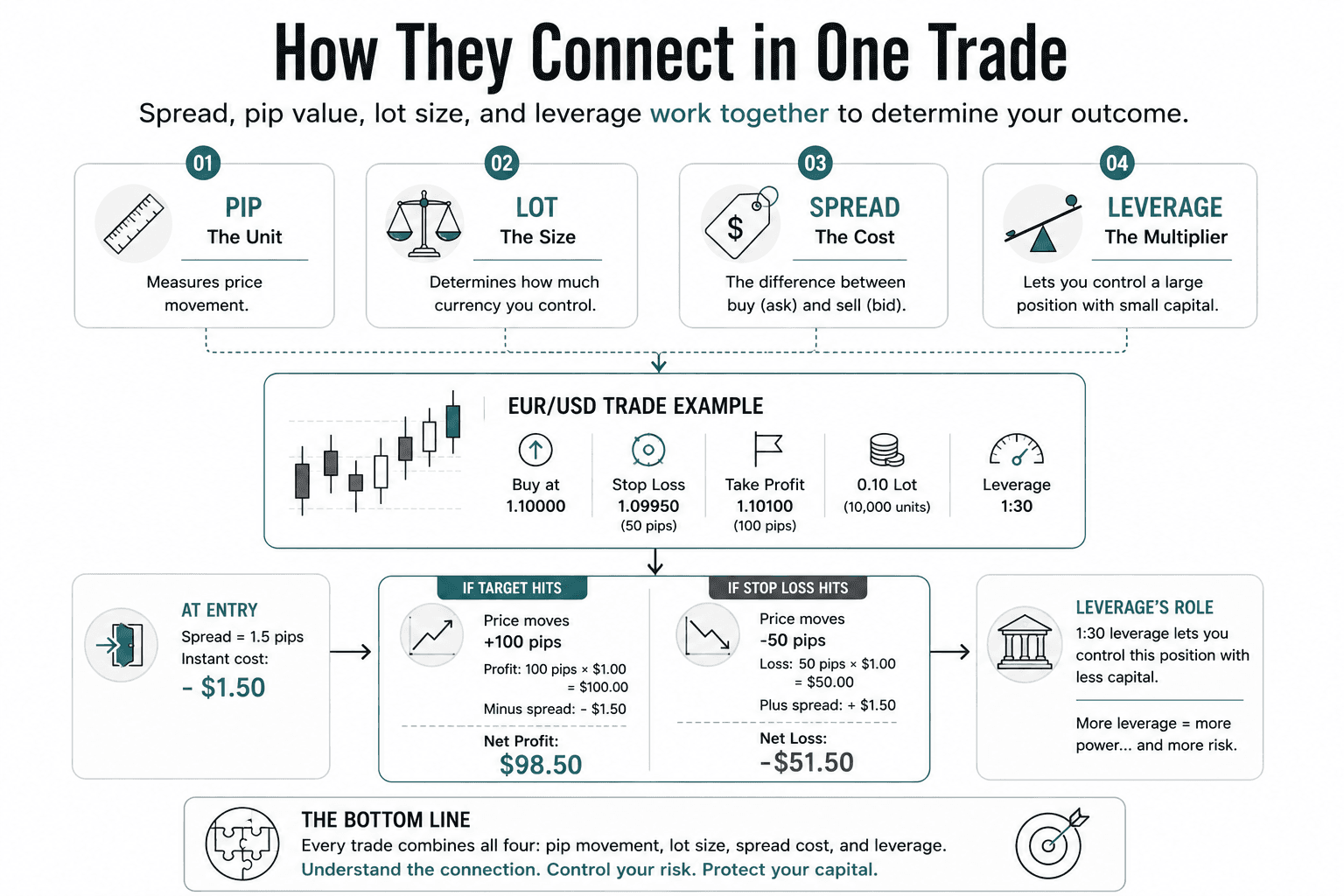
Trade Setup: EUR/USD | Broker spread: $1.5\text{ pips}$ | Position size: $0.1\text{ lot (mini)}$ | Leverage: $1:30$
Parameters: Entry at $1.10000$ | Stop Loss at $1.09950$ ($50\text{ pips}$ below entry) | Initial Risk: $50\text{ pips} \times \$1/\text{pip} = \$50$
At Entry: The $1.5$-pip spread instantly costs you $\$1.50$.
If Target Hits ($1.10100$): You gain $100\text{ pips} \times \$1 = \$100$, minus the $\$1.50$ spread, for a net profit of $\$98.50$.
If Stop Loss Hits ($1.09950$): You lose $50\text{ pips} \times \$1 = \$50$, plus the $\$1.50$ spread, for a net loss of $\$51.50$.
Understanding how spread, pip value, lot size, and leverage play together is the bare minimum for proper risk management.
Every trade has all four elements: spread, pip value, lot size, and the leverage that makes the position possible. Understanding how they interact is foundational to calculating risk before entering any trade. For a step-by-step walkthrough of turning that understanding into an actual lot size, see How to Calculate Your Position Size.
A pip is a unit. A lot is a size. A spread is a cost. Leverage is a multiplier. Together, they determine the actual financial stakes of any position you take.
Success Criteria
You are ready to move on to the next lesson if you can:
Define each of the four core terms (spread, pip, lot, leverage) in your own words.
Identify how lot size directly changes the dollar value of a pip movement.
Calculate the total risk and potential outcome of a trade by factoring in spread, lot size, and leverage before entering a position.
Common Misconception
These four terms are separate boxes to check off.
The Truth: In practice they're one connected picture. Spread, pip value, lot size, and leverage all show up in the math of a single trade at once, and treating them as four unrelated vocabulary items, rather than four inputs to the same risk calculation, is why the "how they connect" walkthrough below is the part worth returning to.
FAQ's
Q: What is the difference between a "pip" and a "pipette"?
Q: Why do brokers offer such insanely high leverage?
Q: Do I need to memorize all of this before I start learning to trade?
Table of Contents
About Me

Krista Weber
After a career as a VP of UX and EdTech executive, I retired early—and quickly realized the traditional world of trading education is fundamentally broken.
As someone with a Master’s in HCI who specialized in the design of e-learning systems, I saw a massive gap: beginners aren't failing because trading is impossible; they’re failing due to massive cognitive overload and terrible instructional design.
This site bridges that gap. I’m applying the principles of learning science, systems thinking, and minimalist UX to strip away the market noise and teach trading the way it actually should be taught.
Stay in Touch
Some of the pages on my travel blog contain affiliate links. Whenever you buy something through one of these links, I get a small commission at no extra cost to you. As an affiliate, I only recommend products and services that I feel are high quality and helpful to my readers. Thanks for your support.
Read More

Open almost any trading platform and you'll see EUR/USD sitting next to XAU/USD, NQ, ES, and a dozen CFDs on stocks you've heard of. They all show up as candlesticks moving left to right, which quietly implies they're all the same kind of thing. They aren't. Before going deeper into any one of them, it's worth drawing the map.
Updated on Sep 6, 2026

Futures are standardized contracts tied to defined specifications and a future settlement date. They can look complex at first, but the mechanics become much clearer once you know what the contract specification controls. Here's what you actually need to know.
Updated on Sep 6, 2026

CFDs appear everywhere in retail trading – but most new traders couldn't explain exactly what they are or why that matters. Here's a plain-language breakdown, including the parts that most introductions skip.
Updated on Sep 6, 2026