
What Is a Lot in Forex?
Discover what a lot is in forex trading, how different lot sizes impact your pip value, and why calculating trade volume based on risk (rather than gut feeling) is the key to trading like a professional.

Learning Path Stage 1: Foundations
Learning Level 1: Recognition
Primary Learning Objective
By the end of this lesson you should be able to understand the structure of forex lot sizes and apply position sizing calculations to align trade volume directly with risk management parameters.
A Standard Unit for a Non-Standard Market
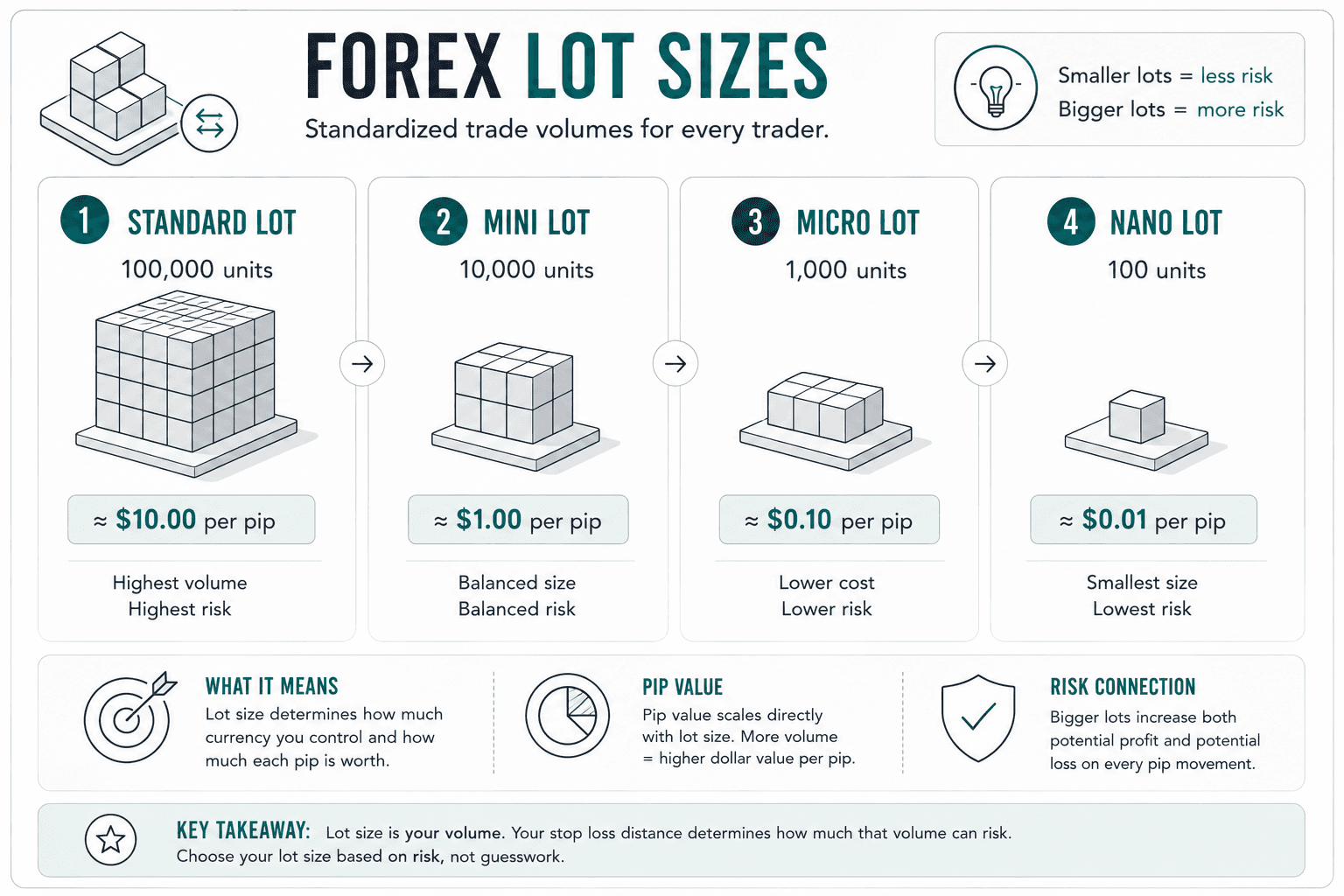
Forex is the biggest financial playground on Earth, moving upwards of $7 trillion every single day. To prevent absolute chaos with numbers that huge, the industry standardized trade sizes into tidy packages called lots.
Without standardization, every single trade would require negotiating the exact quantity from scratch. Lots give traders, brokers, and liquidity providers a universal language.
Here are the four standard sizes:
Lot Type | Units | EUR/USD Pip Value (Approx.) |
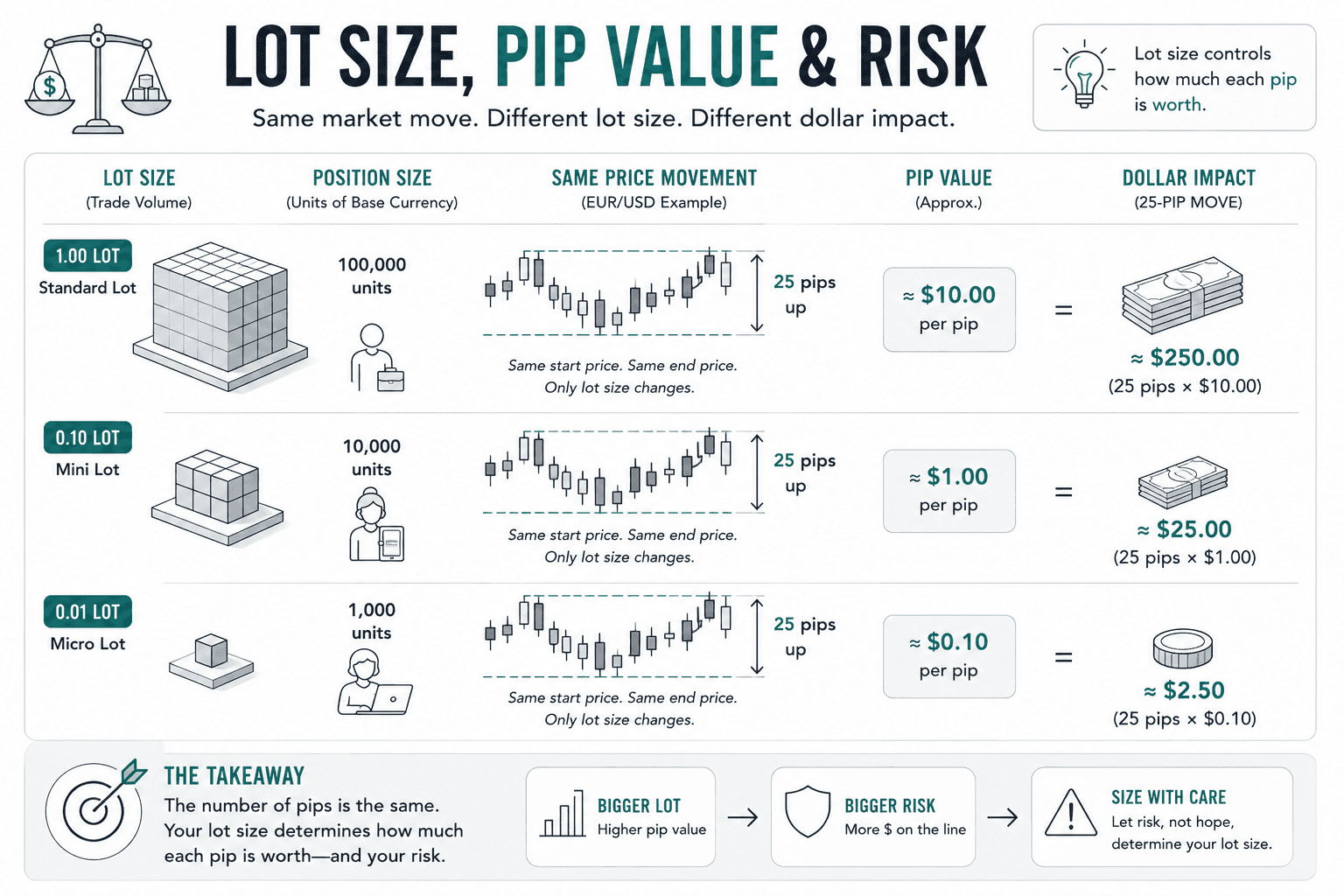
Standard | 100,000 | $10 |
Mini | 10,000 | $1 |
Micro | 1,000 | $0.10 |
Nano | 100 | $0.01 |
(Keep in mind these pip values apply when the quote currency is USD. For other pairs, the math shifts slightly.)
Why Lot Size Matters for Risk
Lot size is the single most critical dial in your risk setup, yet beginners routinely treat it like a random guess. Choosing a lot size based on "what feels right" is like deciding how fast to drive based on your favorite song rather than the posted speed limit and incoming blizzard.
Here is how smart traders order their thoughts:
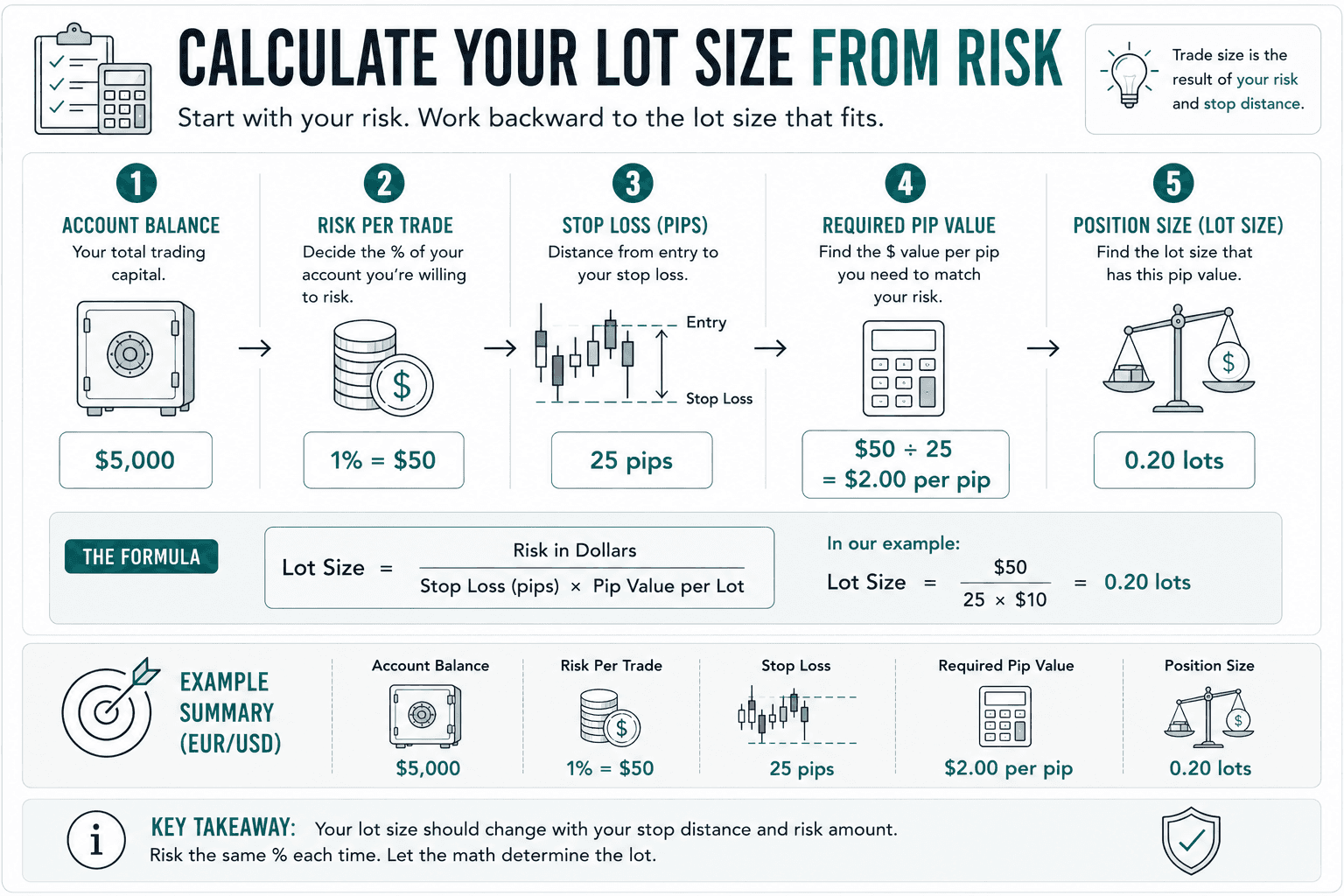
Decide your maximum dollar risk. Figure out the exact dollar amount you are comfortable parting with on the trade.
Determine your stop loss in pips. Measure how far the market can move against your idea before you admit defeat.
Calculate the lot size backward. Work backward to find the exact trade size you need.
Lot size = {Risk in dollars} / {Stop loss in pips} x {Pip value per lot}
Example in Action
Account Balance: $5,000
Risk per Trade: 1% ($50)
Stop Loss: 25 pips
EUR/USD Standard Lot Pip Value: $10
Lot size = 50 / (25 x 10 )= 0.2 lots (2 mini lots)}
Picking a lot size first and hoping your risk stays reasonable is entirely backward. Starting with risk and deriving your lot size is how professionals stay in business. For a deeper look at handling weird rounding math, check out How to Calculate Your Position Size.
Lot Size vs. Leverage
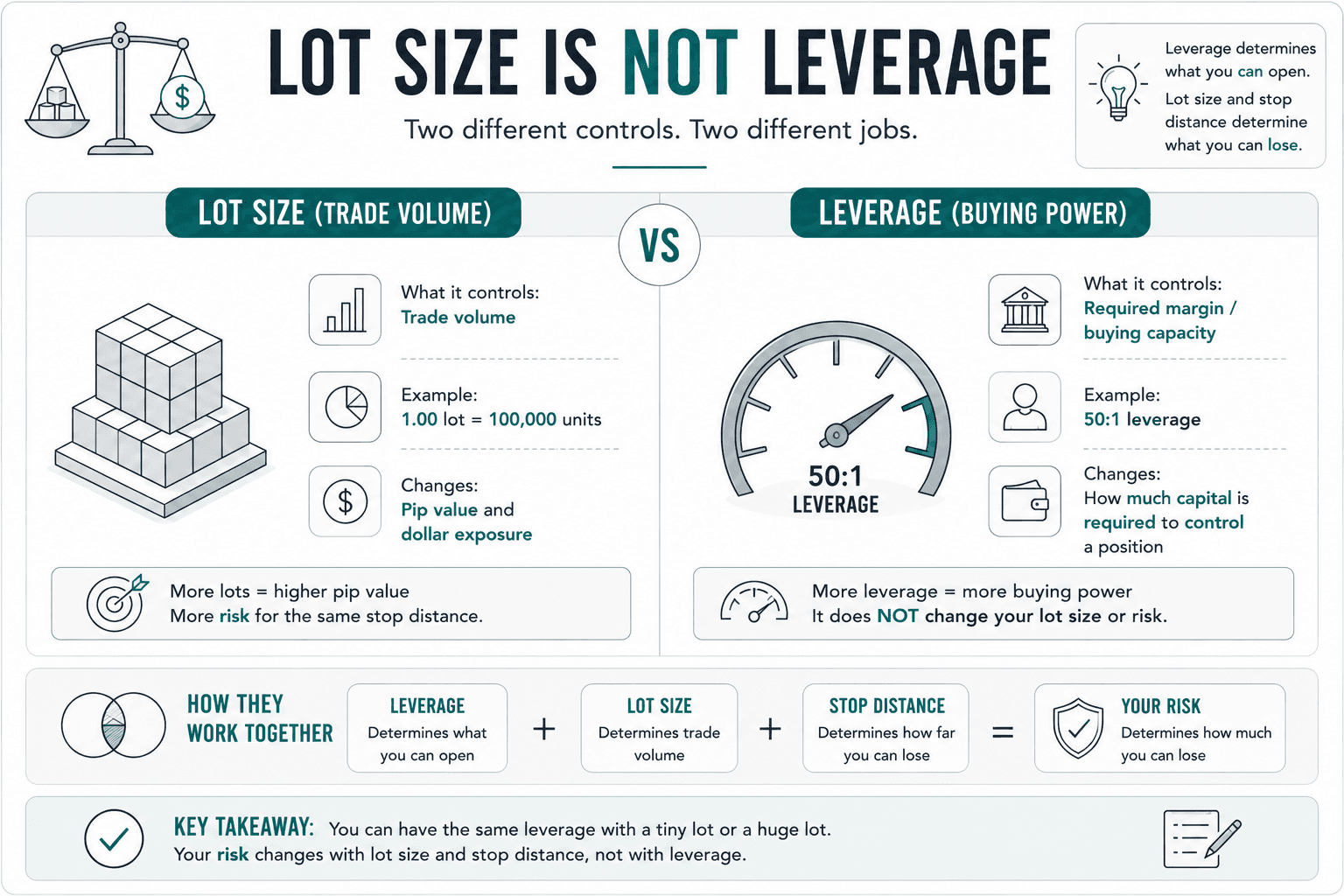
People mix up lot size and leverage all the time, but they perform completely different jobs.
Leverage is the credit line extended by your broker. A ratio of 50:1 simply means you can control $50,000 worth of currency using $1,000 of your own cash.
Lot size is the actual volume you choose to trade. A standard lot remains 100,000 units whether you use 10:1 leverage or 500:1 leverage.
Think of leverage as the capacity of your engine and lot size as how far you press the gas pedal. Leverage dictates whether your balance can open the trade, while lot size combined with stop distance determines how much your account bleeds if things go wrong. Two traders can share identical leverage while trading wildly different lot sizes, or vice versa.
Reading Lot Sizes on Your Trading Platform
When opening an order in MetaTrader 4 or 5, look for the box labeled "Volume." Here is your handy translation key:
Volume 1.0: 1 standard lot (100,000 units)
Volume 0.5: 0.5 standard lots (50,000 units)
Volume 0.1: 1 mini lot (10,000 units)
Volume 0.01: 1 micro lot (1,000 units)
Volume 2.5: 2.5 standard lots (250,000 units)
Most retail brokers set their absolute minimum entry at 0.01 (one micro lot) and let you scale up in increments of 0.01.
Lot Size Guidelines by Account Size
Consider these suggested starting points from experienced traders:
Account Size | Suggested Starting Lot Size |
$500 to $2,000 | Micro lots (0.01 to 0.05) |
$2,000 to $10,000 | Mini lots (0.1 to 0.5) |
$10,000 to $50,000 | Mini to standard lots (0.5 to 2.0) |
$50,000+ | Standard lots and above |
Treat these numbers as general guardrails rather than strict laws. Your actual trade size always boils down to your personal risk tolerance and stop loss width. A trader with a $10,000 account taking a wide 80-pip stop might need a smaller lot size than a trader with $2,000 taking a surgical 10-pip stop.
The Core Connection to Position Sizing
Understanding lots is what unlocks real position sizing. It elevates your trading from random guesswork to disciplined risk control.
Novices pick lot sizes that look nice, feel comfy, or match round numbers. Seasoned traders calculate exact lot sizes that lock in a controlled, predefined maximum loss percentage.
To nail that calculation every time, you just need three details:
What a single pip is worth at your target lot size.
How to convert your stop loss distance in pips into a target dollar figure.
How to target that exact dollar risk and reverse engineer your entry volume.
Lots are simply the tool. Capital protection is the objective. Never ask how many lots your account can afford to trade; ask how many lots you should trade based on the stop loss you have set.
Success Criteria
You will be ready to move on to the next lesson if you can:
Define Lot Types: Identify and distinguish between standard (100,000 units), mini (10,000 units), micro (1,000 units), and nano (100 units) lot sizes.
Evaluate Pip Values: Determine the approximate dollar value per pip for EUR/USD across various lot sizes.
Calculate Position Sizes: Correctly apply the position sizing formula to find the appropriate lot size given a specific account balance, risk percentage, and stop loss distance.
Distinguish Volume from Leverage: Clearly explain the functional difference between account leverage and lot size.
Common Misconception
Lot size is a fixed choice you make once, when you fund the account, and then reuse trade after trade because it's simpler that way.
The Truth: It shouldn't be fixed at all. Lot size should vary trade to trade, based on your stop distance and the percentage of account you're willing to risk.
FAQ's
Q: How do lot sizes affect pip value?
Q: Can I trade fractional lots?
Q: What is a lot in forex trading?
Table of Contents
About Me

Krista Weber
After a career as a VP of UX and EdTech executive, I retired early—and quickly realized the traditional world of trading education is fundamentally broken.
As someone with a Master’s in HCI who specialized in the design of e-learning systems, I saw a massive gap: beginners aren't failing because trading is impossible; they’re failing due to massive cognitive overload and terrible instructional design.
This site bridges that gap. I’m applying the principles of learning science, systems thinking, and minimalist UX to strip away the market noise and teach trading the way it actually should be taught.
Stay in Touch
Some of the pages on my travel blog contain affiliate links. Whenever you buy something through one of these links, I get a small commission at no extra cost to you. As an affiliate, I only recommend products and services that I feel are high quality and helpful to my readers. Thanks for your support.
Read More

Open almost any trading platform and you'll see EUR/USD sitting next to XAU/USD, NQ, ES, and a dozen CFDs on stocks you've heard of. They all show up as candlesticks moving left to right, which quietly implies they're all the same kind of thing. They aren't. Before going deeper into any one of them, it's worth drawing the map.
Updated on Sep 6, 2026

Futures are standardized contracts tied to defined specifications and a future settlement date. They can look complex at first, but the mechanics become much clearer once you know what the contract specification controls. Here's what you actually need to know.
Updated on Sep 6, 2026

CFDs appear everywhere in retail trading – but most new traders couldn't explain exactly what they are or why that matters. Here's a plain-language breakdown, including the parts that most introductions skip.
Updated on Sep 6, 2026