
What Is a Spread in Forex?
The spread is the hidden baseline cost built into every forex trade, representing the gap between the price you buy at and the price you sell at. Whether you are scalping small moves or holding positions long-term, understanding how spreads work (and how brokers charge for them) is essential to keeping your trading costs from eating up your profits.

Learning Path Stage 1: Foundations
Learning Level 1: Recognition
Primary Learning Objective
By the end of this lesson, you will be able to identify the bid, ask, and spread and recognize the spread as a built-in cost of entering a forex trade.
The Invisible Cost
When you open a trade in forex, nobody sends you an invoice or charges your debit card. The cost is stealthily embedded directly into the prices, which makes the spread ridiculously easy to overlook.
Every currency pair displays two prices at any given moment:
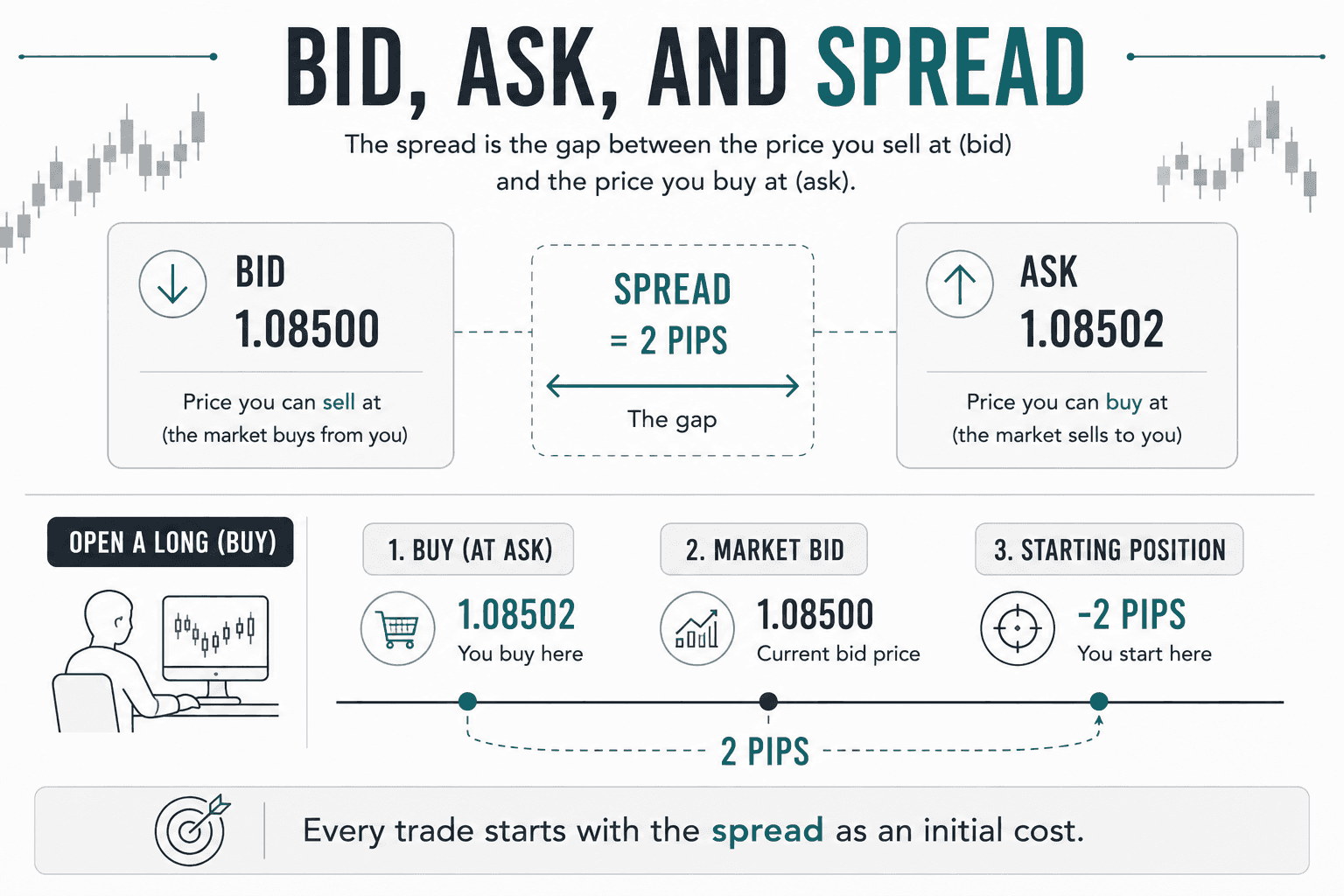
Bid: The price at which you can sell (the market buys from you).
Ask: The price at which you can buy (the market sells to you).
The bid is always lower than the ask, and the difference between them is the spread.
If EUR/USD shows a bid of 1.08500 and an ask of 1.08502, the spread is 0.00002, or 2 pips. Open a long position, and you enter at 1.08502. The current market price might be quoted at 1.08500. Congratulations: you are officially in the red by 2 pips the literal millisecond your trade opens.
That is your cost of entry. It never shows up as a separate itemized deduction on a receipt. It just sits inside the price, working quietly behind the scenes every single time.
Why the Bid-Ask Gap Exists
The spread is not just brokers being greedy or arbitrary. It exists because currency trading requires a market maker or liquidity provider on the other side of your order, taking on the risk of holding that trade.
The bid-ask gap compensates them for:
Inventory risk: Holding a currency position they never explicitly asked to hold.
Execution risk: The market moving against them before they can offset your trade.
Operational costs: Maintaining high-speed infrastructure to execute trades without crashing.
In highly liquid, heavily traded pairs like EUR/USD, intense competition keeps spreads paper-thin, often between 0.5 and 2 pips. In exotic pairs like USD/TRY or EUR/PLN, liquidity is sparse, inventory risk is higher, and spreads widen noticeably.
Spreads also change based on the clock. During the London and New York overlap, EUR/USD spreads are at their absolute tightest. During quiet overnight hours, they stretch out. Right around major news events, spreads can balloon 10 to 20 times higher than normal as liquidity providers duck for cover.
Two Broker Models
Most retail forex brokers structure their pricing using one of two approaches:
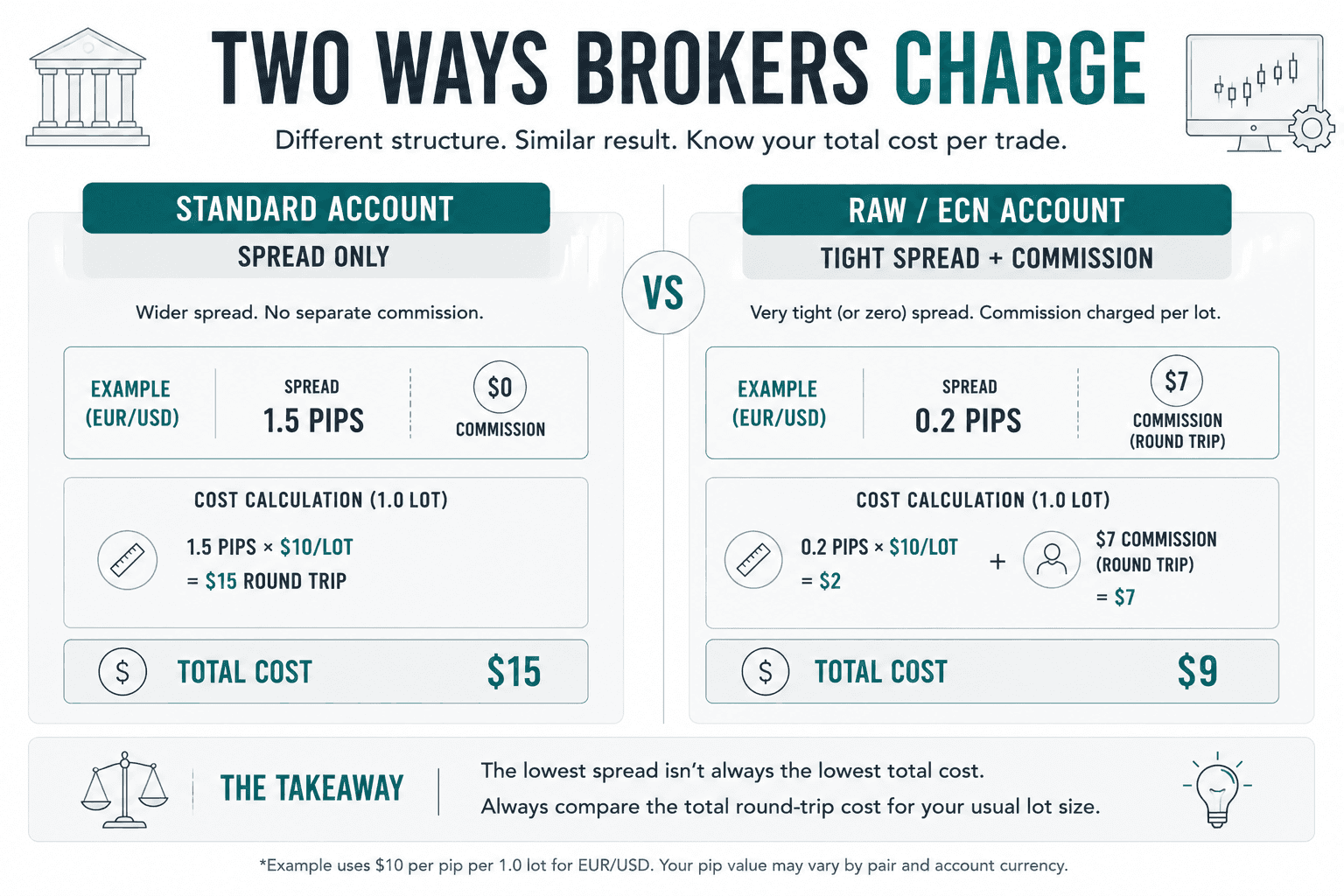
Standard account (spread-only): No visible commission. Brokers make their profit purely off a wider spread, typically showing EUR/USD around 1.2 to 2.5 pips. Their profit margin is already baked into the price.
Raw/ECN account (spread + commission): Spreads are kept extremely low, often between 0.0 and 0.2 pips. In exchange, you pay a explicit fixed commission per lot, usually around $3 to $7 per standard lot per side ($6 to $14 round-trip).
To compare the actual math:
Standard: 1.5 pip spread × $10/pip on a standard lot = $15 per trade
Raw: 0.2 pip spread + $7 commission = $2 + $7 = $9 per trade
In this scenario, the raw account wins, but the math shifts depending on your exact trade volume and your broker's fee schedule. Neither option is universally superior, so do the math for your own position sizes and trading style.
Spread Cost as a Percentage of Target
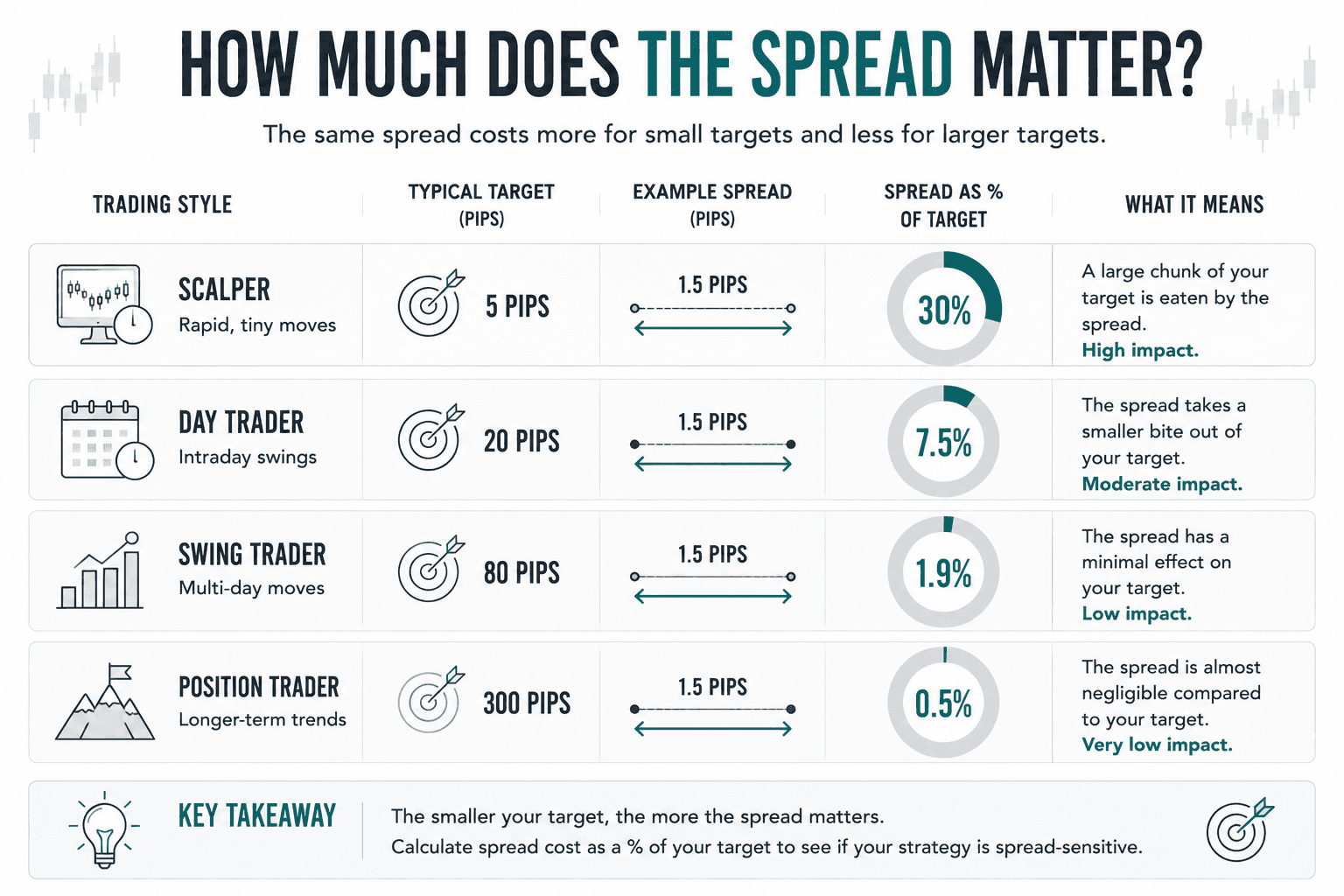
The ultimate question is simple: how big of a slice does the spread take out of your profit pie?
Strategy | Typical Target | Spread (EUR/USD) | Spread as % of Target |
Scalper | 5 pips | 1.5 pips | 30% |
Day trader | 20 pips | 1.5 pips | 7.5% |
Swing trader | 80 pips | 1.5 pips | 1.9% |
Position trader | 300 pips | 1.5 pips | 0.5% |
Trying to scalp on a wide-spread pair is a losing battle before the market even moves an inch. The entry cost is simply way too huge compared to your profit target.
Scalping can still work, but the math demands a very precise setup: ultra-tight spreads, a low-commission raw ECN account, and razor-sharp execution.
Variable vs. Fixed Spreads
Some brokers offer fixed spreads, where the gap stays identical no matter what chaos unfolds in the market. More commonly, brokers offer variable spreads that widen and narrow based on live market liquidity.
Variable spreads are usually tighter during calm market hours, but they can stretch dramatically during:
Major economic announcements (NFP, CPI, or central bank interest rate decisions)
Daily market open and close transitions
Sunday evening market reopenings
Unexpected geopolitical curveballs
If you trade around high-impact news, pay close attention to your broker's typical spread behavior during volatile moments. A stop-loss triggered inside a temporary spread spike can cost significantly more than you planned for.
Checking Your Real Cost
Here is how the spread translates into actual dollar amounts per trade on EUR/USD:
Standard lot (100,000 units): 1 pip ≈ $10, so a 1.5 pip spread costs $15.00 per trade.
Mini lot (10,000 units): 1 pip ≈ $1, so a 1.5 pip spread costs $1.50 per trade.
Micro lot (1,000 units): 1 pip ≈ $0.10, so a 1.5 pip spread costs $0.15 per trade.
These figures seem tiny in isolation. However, if you execute 200 standard-lot trades in a year with a 1.5-pip spread, you are paying $3,000 in trading friction alone before accounting for a single losing trade.
What to Look for in a Broker
Spreads should be near the top of your broker evaluation list, right next to regulation, execution speed, and overall platform stability.
A broker promising "0.0 pips" is almost certainly making their money back via commissions, while a broker shouting "Zero Commissions!" is simply building their profit into a wider spread. Neither marketing claim makes a broker automatically better. Simply calculate the total all-in cost for your specific trade volume.
Keep in mind that spread is just the entry fee. Commissions, overnight swap rates, and potential slippage complete the total cost picture.
The spread is the baseline cover charge for every forex trade. Understanding it will not make it disappear, but it will help you trade with open eyes, choosing pairs, position sizes, and strategies that respect the true cost of getting into the market.
Every trade starts in a small hole. How you dig your way out is entirely up to you.
Success Criteria
You will be ready to move on to the next lesson if you can:
Conceptual Clarity: Readers can clearly define bid, ask, and spread in forex terms, and understand why positions open in a slight deficit.
Cost Comprehension: Readers understand the practical differences between standard (spread-only) and raw/ECN (spread + commission) broker accounts.
Strategy Impact: Readers can calculate spread cost as a percentage of their profit target to determine whether a given trading strategy (e.g., scalping vs. swing trading) is spread-sensitive.
Actionable Evaluation: Readers gain a realistic framework for calculating total round-trip trading friction (including spreads, commissions, swaps, and slippage) when selecting a broker.
Common Misconception
The advertised or "typical" spread is what you'll actually pay.
The Truth: Real spreads vary by session and can spike 10 to 20 times wider during news releases or thin liquidity, so a headline "1-pip" rate is a best case, not a guarantee.
FAQ's
Q: Why do brokers charge a spread?
Q: How does the spread affect my trading strategy?
Q: What exactly is the spread in forex?
Table of Contents
About Me

Krista Weber
After a career as a VP of UX and EdTech executive, I retired early—and quickly realized the traditional world of trading education is fundamentally broken.
As someone with a Master’s in HCI who specialized in the design of e-learning systems, I saw a massive gap: beginners aren't failing because trading is impossible; they’re failing due to massive cognitive overload and terrible instructional design.
This site bridges that gap. I’m applying the principles of learning science, systems thinking, and minimalist UX to strip away the market noise and teach trading the way it actually should be taught.
Stay in Touch
Some of the pages on my travel blog contain affiliate links. Whenever you buy something through one of these links, I get a small commission at no extra cost to you. As an affiliate, I only recommend products and services that I feel are high quality and helpful to my readers. Thanks for your support.
Read More

Open almost any trading platform and you'll see EUR/USD sitting next to XAU/USD, NQ, ES, and a dozen CFDs on stocks you've heard of. They all show up as candlesticks moving left to right, which quietly implies they're all the same kind of thing. They aren't. Before going deeper into any one of them, it's worth drawing the map.
Updated on Sep 6, 2026

Futures are standardized contracts tied to defined specifications and a future settlement date. They can look complex at first, but the mechanics become much clearer once you know what the contract specification controls. Here's what you actually need to know.
Updated on Sep 6, 2026

CFDs appear everywhere in retail trading – but most new traders couldn't explain exactly what they are or why that matters. Here's a plain-language breakdown, including the parts that most introductions skip.
Updated on Sep 6, 2026