
Understanding Spreads and Trading Costs
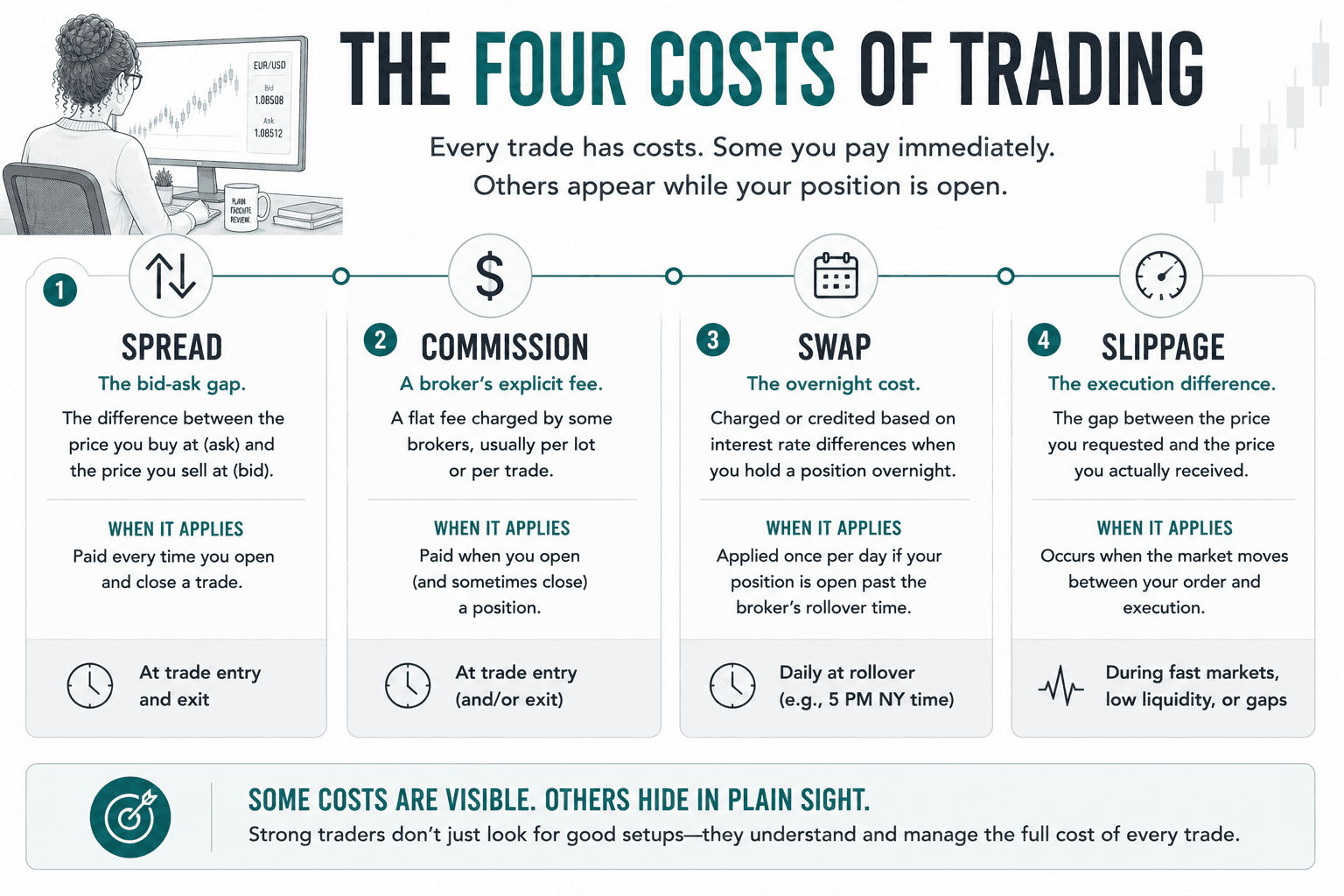
Every trade has a price tag, but the spread is just the entry ticket. While shiny charts and trade setups get all the spotlight, overlooked costs like commissions, overnight swaps, and slippage silently chip away at your profits. Learn how the full cost stack works so you can protect your bottom line like a seasoned pro.

Learning Path Stage 1: Foundations
Learning Level 2: Understanding
Primary Learning Objective
By the end of this lesson, you will be able to evaluate the full cost structure of a forex trade, including spreads, commissions, swap rates, and slippage, and calculate its impact on your overall trading strategy and profitability.
If you read What Is a Spread in Forex?, you already know that the spread is a real cost built directly into every trade. What it forgot to mention: the spread is usually just the smallest expense in a whole stack of hidden fees. The other three (commission, overnight swap, and slippage) are painfully easy to ignore until they start eating your account balance for breakfast.
New traders spend all their time obsessing over entries and exits—the flashy, dramatic parts of trading. Experienced traders spend just as much time staring at costs, mostly because trading costs are one of the very few guarantees in this market. You never know for sure if a trade will win, but you always know down to the cent what it will cost you to take it.
Here is a full breakdown of what it actually costs to trade retail forex.
The Spread: The Primary Cost
The spread is simply the difference between the bid price (what you can sell for) and the ask price (what you pay to buy). Since you always buy at the ask and sell at the bid, you enter every single trade slightly in the red.
Example: EUR/USD is quoted at Bid 1.08508 / Ask 1.08512. Spread = 0.4 pips.
The second you click "Buy," you pay 1.08512. To break even, the price must immediately move up to 1.08512. If the market sits dead still, you would have to sell at the bid (1.08508), handing over a 0.4-pip loss without anything actually happening.
The spread is your cover charge at the door. It is unavoidable, and you pay it every time.
What drives spread size up or down?
Liquidity: Major pairs like EUR/USD, USD/JPY, and GBP/USD feature tiny spreads because they are constantly traded. Exotic and minor pairs feature wider spreads because nobody is around to take the other side of your order.
Session: Spreads are tightest during the London-New York overlap, which is peak trading volume. Spreads widen significantly during off-hours, such as late in the US session heading into Asia.
Market Events: Liquidity providers hate uncertainty. Right before big news releases, they pull their orders back, causing spreads to jump sky-high before slowly settling back down.
Commission: The Alternative Model
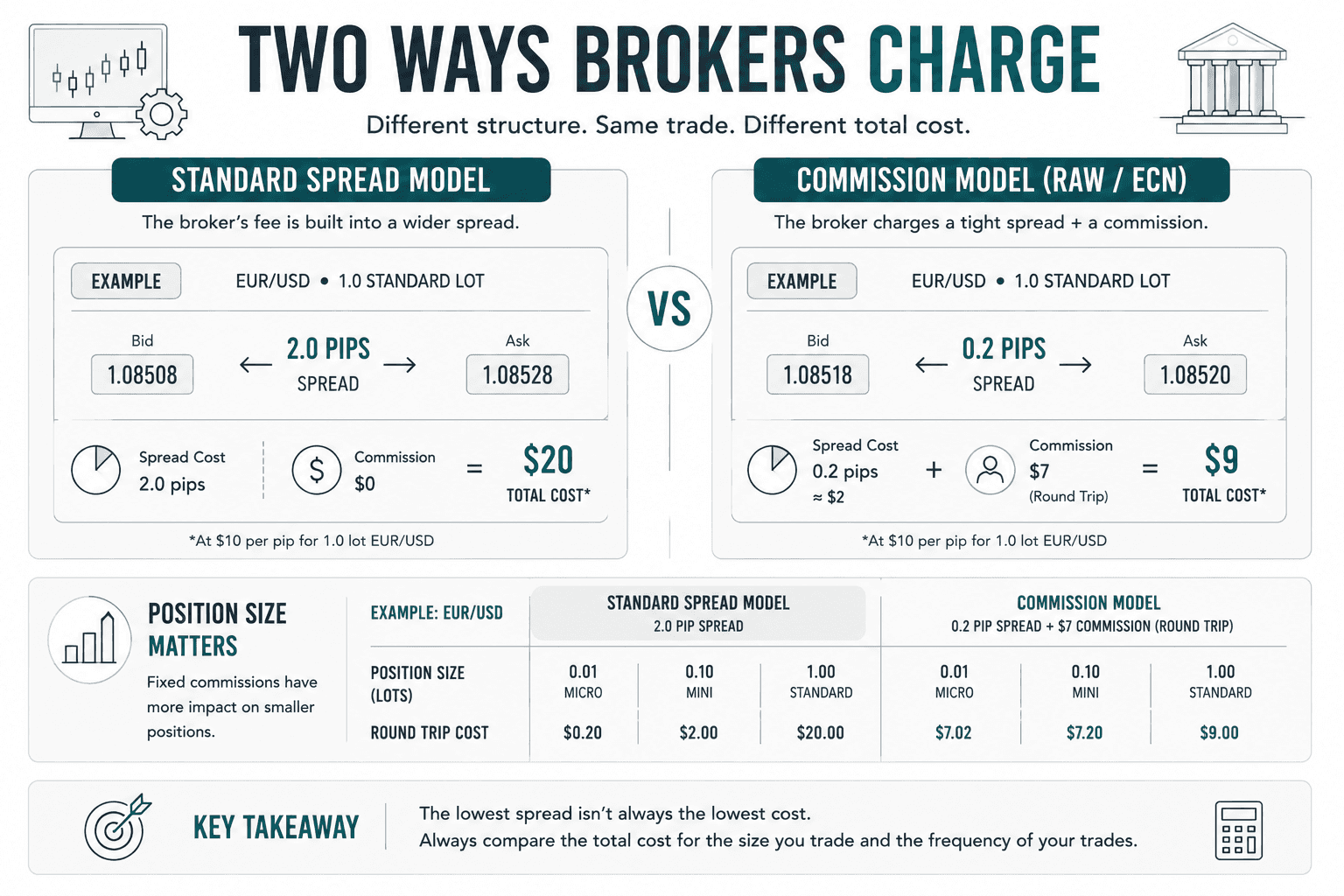
Instead of charging a wide spread, some brokers charge a flat commission fee per lot. ECN brokers, for instance, offer near-zero spreads but charge around $5 to $10 per standard lot for a round-trip trade.
Let's look at the math for a single standard lot position:
Spread Model: A 2-pip spread on EUR/USD equals $20 in costs (at $10 per pip).
Commission Model: A 0.2-pip spread plus a $7 commission equals $2 + $7 = $9 in total costs.
In this setup, the commission model saves you a lot of money. However, if you trade smaller sizes, the advantage vanishes fast. On a micro lot (0.01 lots), a flat $7 fee is brutally expensive relative to your trade. Commissions are great for heavy hitters, but spread models tend to work better for smaller accounts.
Swap Rates: The Overnight Rent
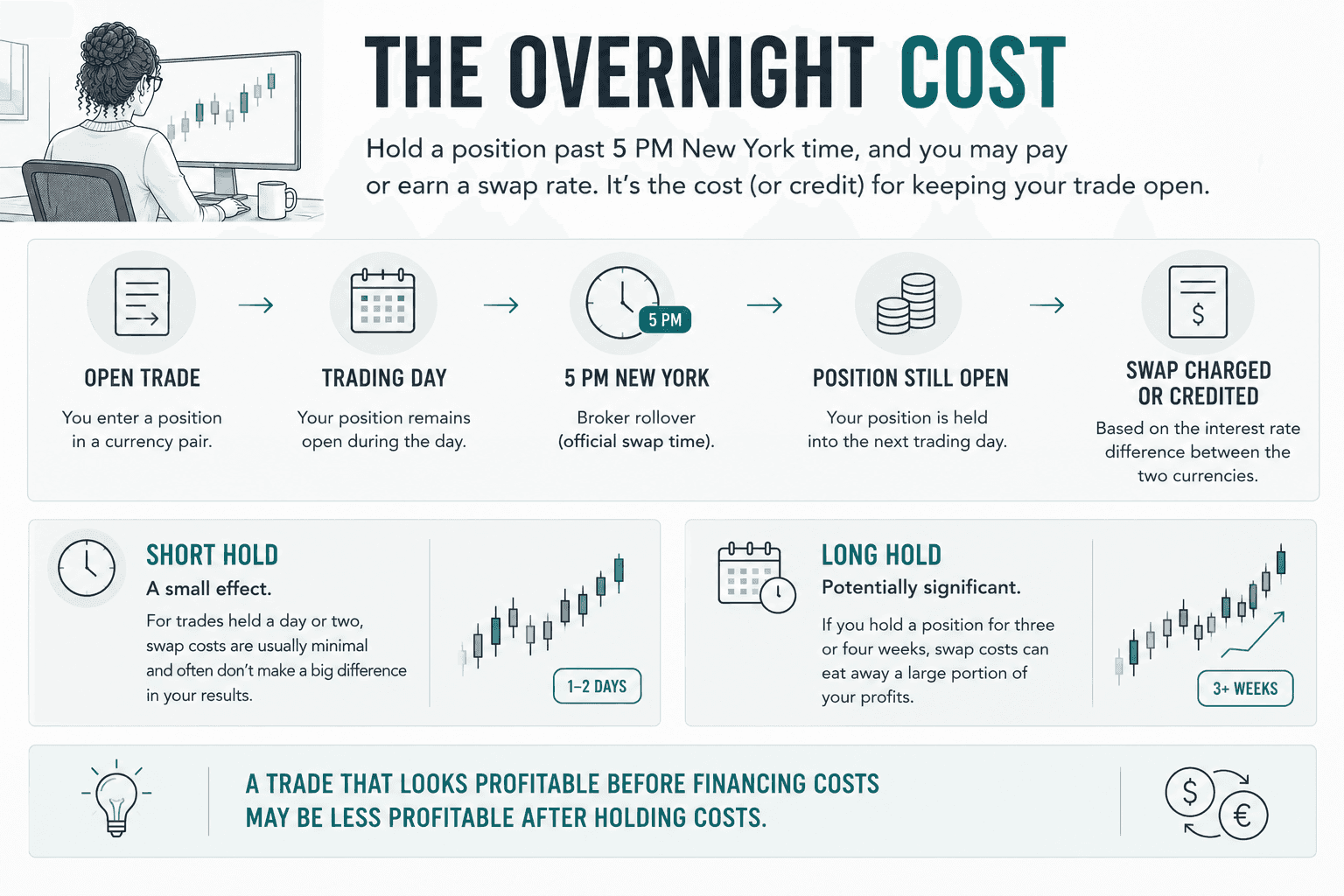
If you hold a trade past 5 PM New York time (the official broker rollover hour), you will either pay or earn an overnight swap rate.
Swaps are calculated using the interest rate difference between the two currencies in a pair. If you go long EUR/USD, you are holding Euros and borrowing US Dollars. If European interest rates are lower than US rates, you pay a daily fee to hold the position. If European rates are higher, you get a small credit.
In reality, brokers usually mark swap rates down to their favor, so retail traders end up paying fees on most positions. On short-term trades of a day or two, swaps barely matter. But if you hold a trade open for three or four weeks, swap costs can eat away a huge chunk of your profits.
Slippage: The Surprise Expense
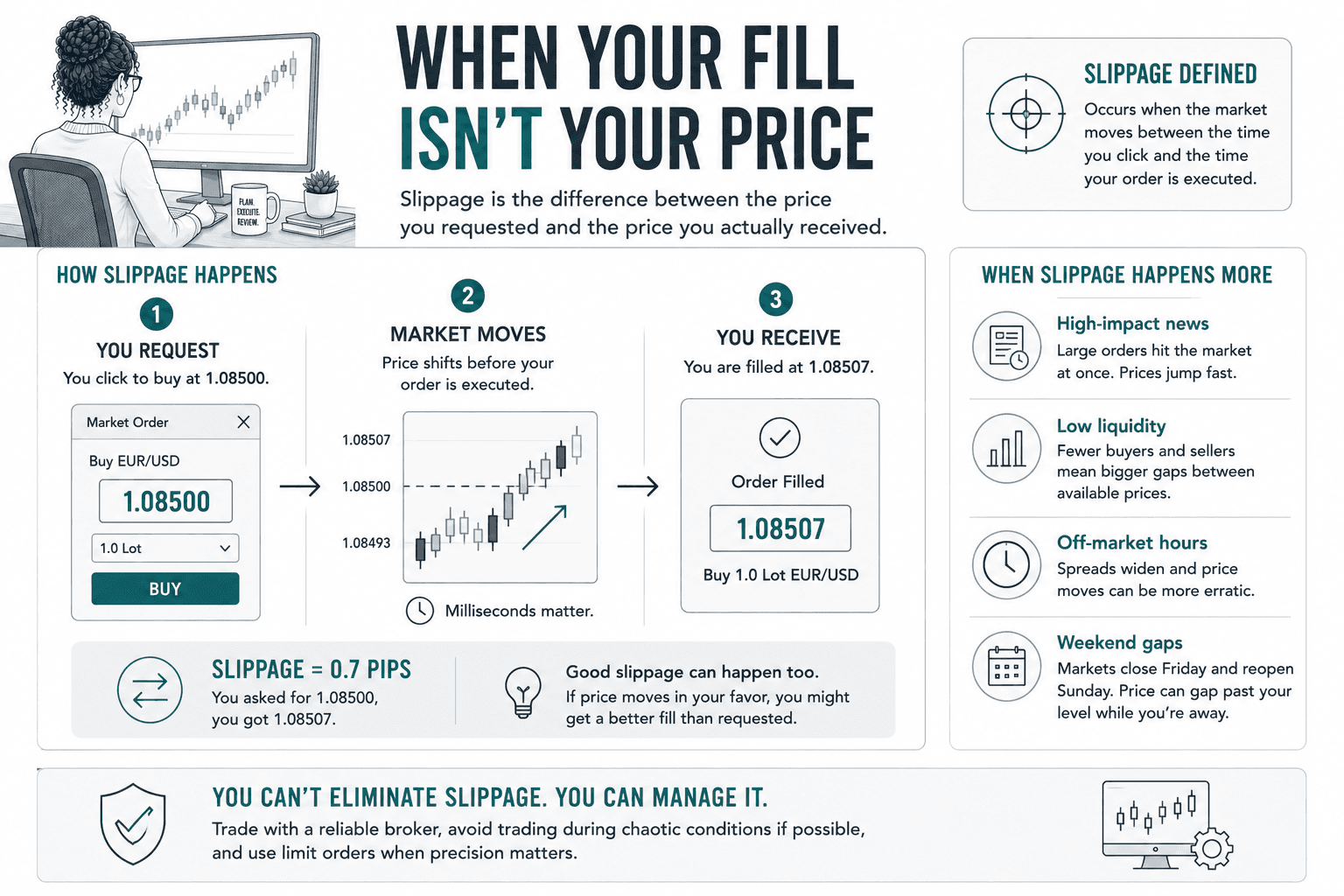
Slippage is the unpleasant difference between the price you requested and the price you actually got.
When you place a market order, slippage happens if the price shifts in the milliseconds between your mouse click and execution. Fast markets, low liquidity, or a laggy broker setup all contribute to bad fills.
Slippage is usually minor during normal conditions, but it gets ugly fast during:
High-impact news releases
Low-liquidity hours (like holiday trading or weekend gaps)
High-volume periods paired with slow brokers
If a market gaps past your stop loss order over a weekend, you will be filled at the next available price, which could be way worse than the level you set.
Calculating Your Total Cost Per Trade
Let's walk through an example: an account with $5,000 taking a 0.2 mini lot (2,000 units) trade on EUR/USD.
Spread: 1.5 pips × $1 per pip per mini lot × 0.2 mini lots = $0.30
Commission: $7 per standard lot × 0.02 lots = $0.14
Total Entry Cost: ~$0.44
Fifty cents might sound like loose change, but over 100 trades, that is $44 in guaranteed costs before accounting for wins or losses. If that same trader inappropriately trades 1 standard lot per trade, costs skyrocket to $15 to $25 per trade, adding up to $1,500 to $2,500 across 100 trades.
Spreads, commissions, swaps, and slippage do not care if your trade analysis was brilliant. They collect their fee either way.
Success Criteria
You will be ready to move on to the next lesson if you can:
Identify the four main costs associated with forex trading (spread, commission, swap, slippage) and explain when each applies.
Calculate the total transaction cost for both spread-based and commission-based position sizes.
Determine how trading costs alter a strategy's expected value, effective risk-to-reward ratio, and required break-even win rate.
Common Misconception
The spread is the broker's only cost.
The Truth: It's the one you see on every quote, so it's the one that gets all the attention. Swap rates on held positions and slippage in fast markets can exceed spread costs significantly, and both are much easier to miss.
FAQ's
Q: Should I just pick the broker with the absolute lowest spreads?
Q: How do spreads affect the win rate I need to break even?
Q: How do I check if my strategy makes money after accounting for costs?
Table of Contents
About Me

Krista Weber
After a career as a VP of UX and EdTech executive, I retired early—and quickly realized the traditional world of trading education is fundamentally broken.
As someone with a Master’s in HCI who specialized in the design of e-learning systems, I saw a massive gap: beginners aren't failing because trading is impossible; they’re failing due to massive cognitive overload and terrible instructional design.
This site bridges that gap. I’m applying the principles of learning science, systems thinking, and minimalist UX to strip away the market noise and teach trading the way it actually should be taught.
Stay in Touch
Some of the pages on my travel blog contain affiliate links. Whenever you buy something through one of these links, I get a small commission at no extra cost to you. As an affiliate, I only recommend products and services that I feel are high quality and helpful to my readers. Thanks for your support.
Read More

Open almost any trading platform and you'll see EUR/USD sitting next to XAU/USD, NQ, ES, and a dozen CFDs on stocks you've heard of. They all show up as candlesticks moving left to right, which quietly implies they're all the same kind of thing. They aren't. Before going deeper into any one of them, it's worth drawing the map.
Updated on Sep 6, 2026

Futures are standardized contracts tied to defined specifications and a future settlement date. They can look complex at first, but the mechanics become much clearer once you know what the contract specification controls. Here's what you actually need to know.
Updated on Sep 6, 2026

CFDs appear everywhere in retail trading – but most new traders couldn't explain exactly what they are or why that matters. Here's a plain-language breakdown, including the parts that most introductions skip.
Updated on Sep 6, 2026