
What Is Leverage, and Why It Matters More Than You Think
Leverage can turn a tiny deposit into a massive market footprint, but without strict risk management, it can also vaporize your account before you can even react. This guide breaks down what leverage actually means, how the math works in real trading scenarios, and why understanding effective leverage is essential for surviving the market.

Learning Path Stage 1: Foundations
Learning Level 1: Recognition
Primary Learning Objective
By the end of this lesson, you will be able to explain the mechanics of leverage, differentiate between broker-offered leverage and effective leverage, and apply proper position sizing principles to protect your trading account from excessive risk.
Why Leverage Matters More Than You Think
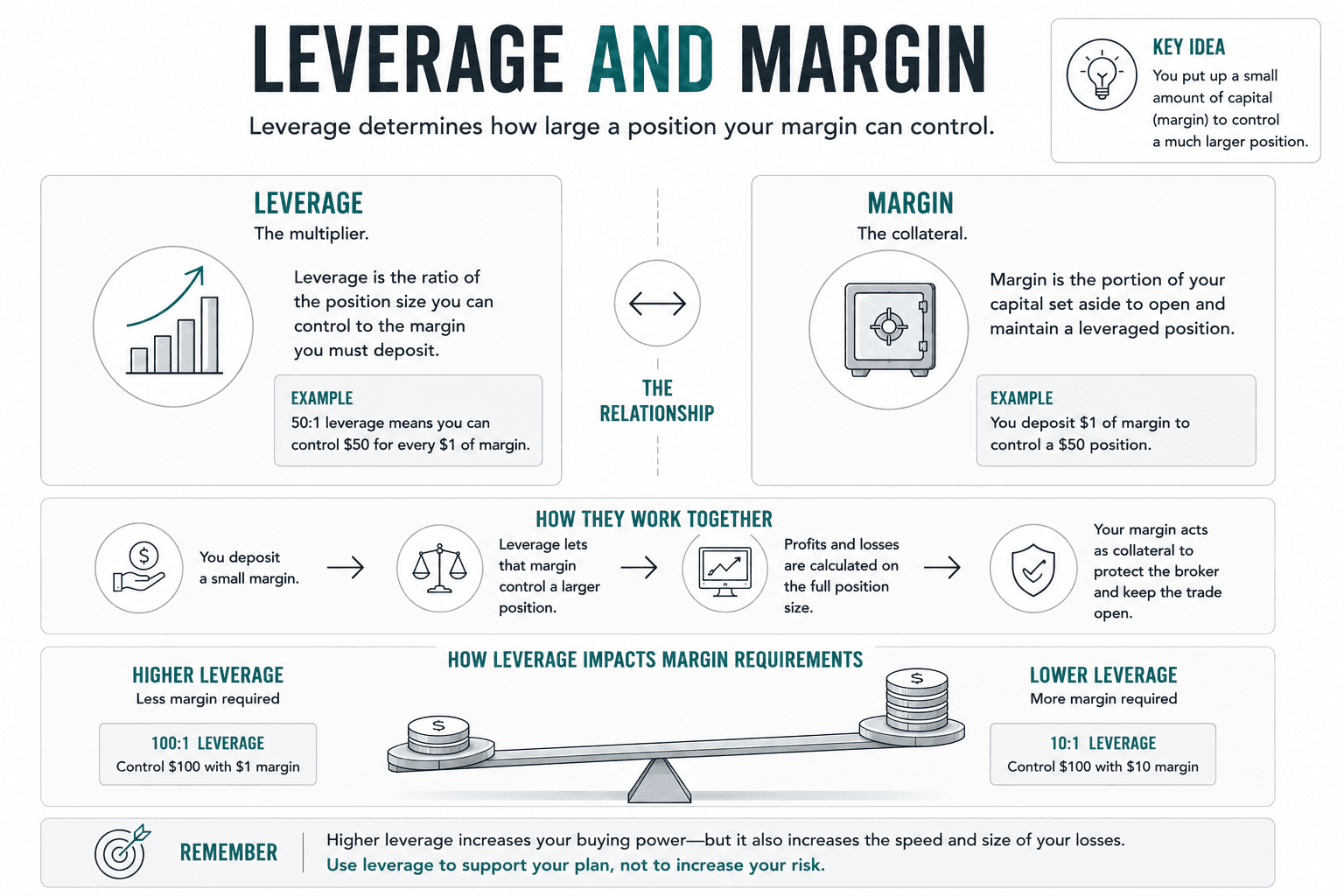
Leverage lets you control trades far larger than your actual deposit. A 50:1 ratio means controlling $50 for every $1 in your account. A 10:1 ratio means controlling $10 for every $1.
The mechanism behind this magic trick is called margin. Instead of paying full price for an asset, you put down a small cash deposit (margin) as collateral, and your broker covers the rest. But here is the catch: your profits and losses are calculated using the full position size, not just your deposit.
Leverage is completely symmetrical. It doubles down on your brilliant calls and your embarrassing missteps with the exact same enthusiasm.
How the Math Works out in the Wild
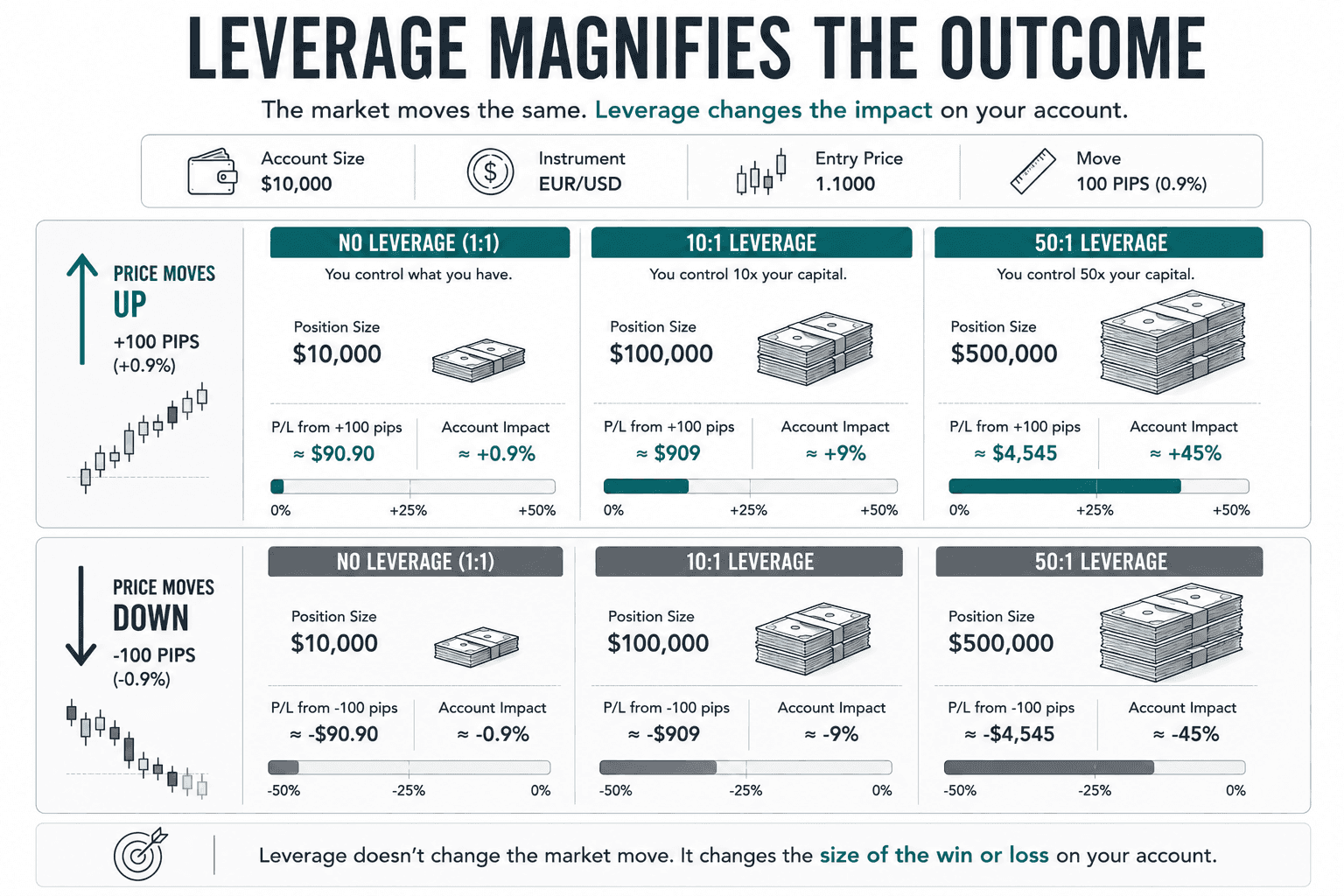
Let us run a simple scenario with a $10,000 account trading EUR/USD at 1.1000, assuming price moves up 100 pips (+0.9%) to 1.1100:
No Leverage: You buy $10,000 of currency. A +100 pip move nets you about $90.90. That is a modest +0.9% gain. Nothing to write home about, but you can still afford lunch.
10:1 Leverage: You control $100,000 worth of currency. That same +100 pip move yields about $909, or a clean +9% gain on your account.
50:1 Leverage: You control $500,000. That +100 pip move prints roughly $4,545, giving your account a massive 45% boost.
Now let us look at what happens when the market goes the wrong way by -100 pips:
10:1 Leverage: You lose $909 (-9% of your account). Ouch, but survivable.
50:1 Leverage: You lose $4,545 (-45.45% of your account).
A single bad trade with 50:1 leverage wipes out nearly half your money. Two bad trades in a row and you are basically applying for a job delivering pizzas.
The Dreaded Margin Call
When your trade losses swallow too much of your deposited margin, the broker issues a margin call. This is an urgent request to either add more cash or watch the broker automatically close your trades ("stop you out") at whatever terrible price the market currently offers.
While specific threshold rules vary by broker, the core concept remains unchanged: leverage lets your potential loss outgrow your account balance, so brokers shut down trades early to protect their own funds.
Getting a margin call is not a normal part of disciplined trading. It is a full-blown failure of risk management. Proper position sizing and clear stop-loss rules exit trades long before margin is ever threatened. Understanding margin calls simply highlights why risk control is non-negotiable.
How Much Leverage Should You Really Use?
The short answer: use the absolute minimum needed to take your planned position size while keeping risk under control.
Here is a quick reality-check calculation:
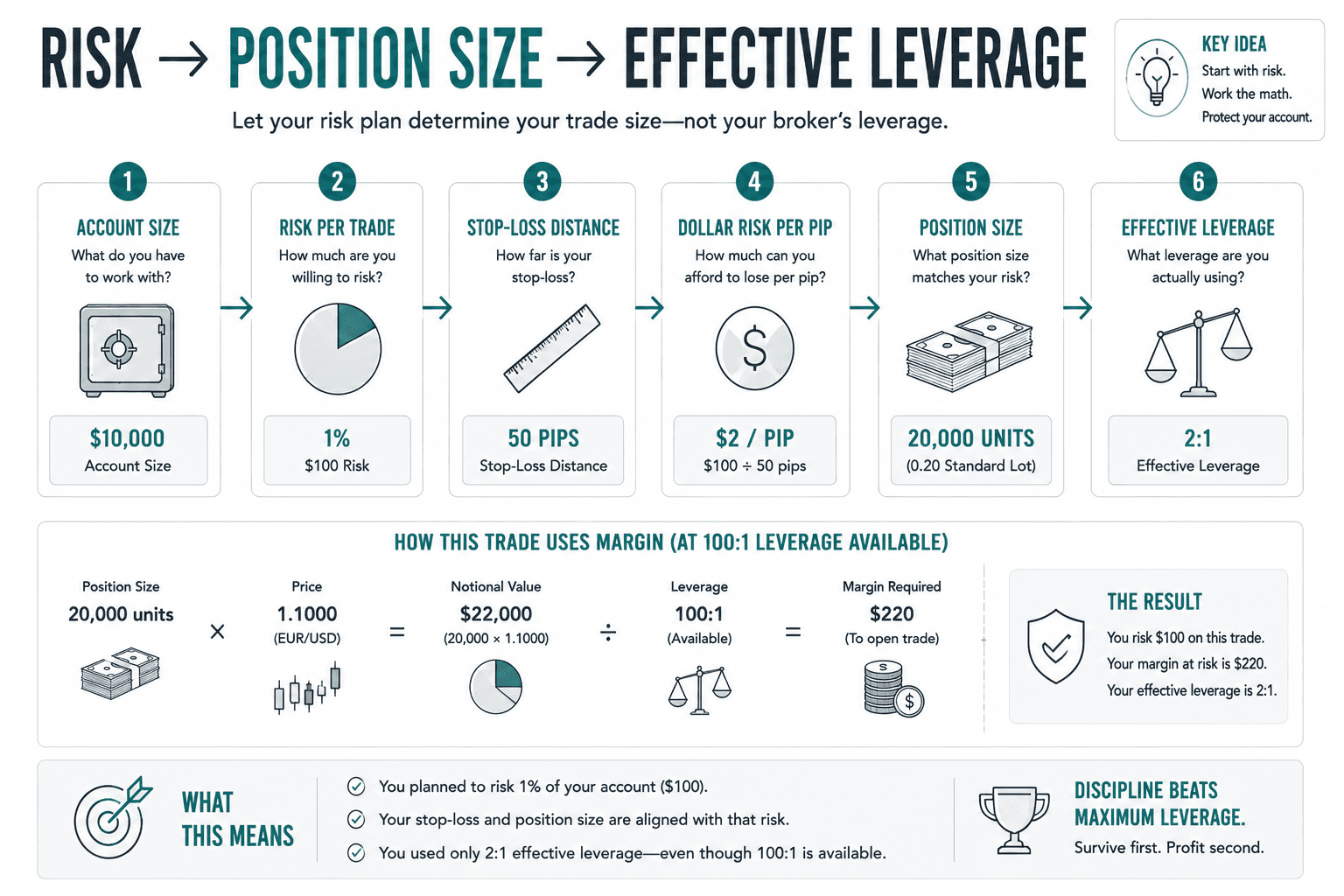
You have a $10,000 account and decide to risk 1% ($100) on a trade.
Your stop-loss is set 50 pips away.
To risk exactly $100 over 50 pips, you need a position size that moves $2 per pip ($2/pip × 50 pips = $100 risk).
On EUR/USD, a standard lot (100,000 units) moves $10 per pip, while a mini lot (10,000 units) moves $1 per pip. So you need roughly 20,000 units to hit your target.
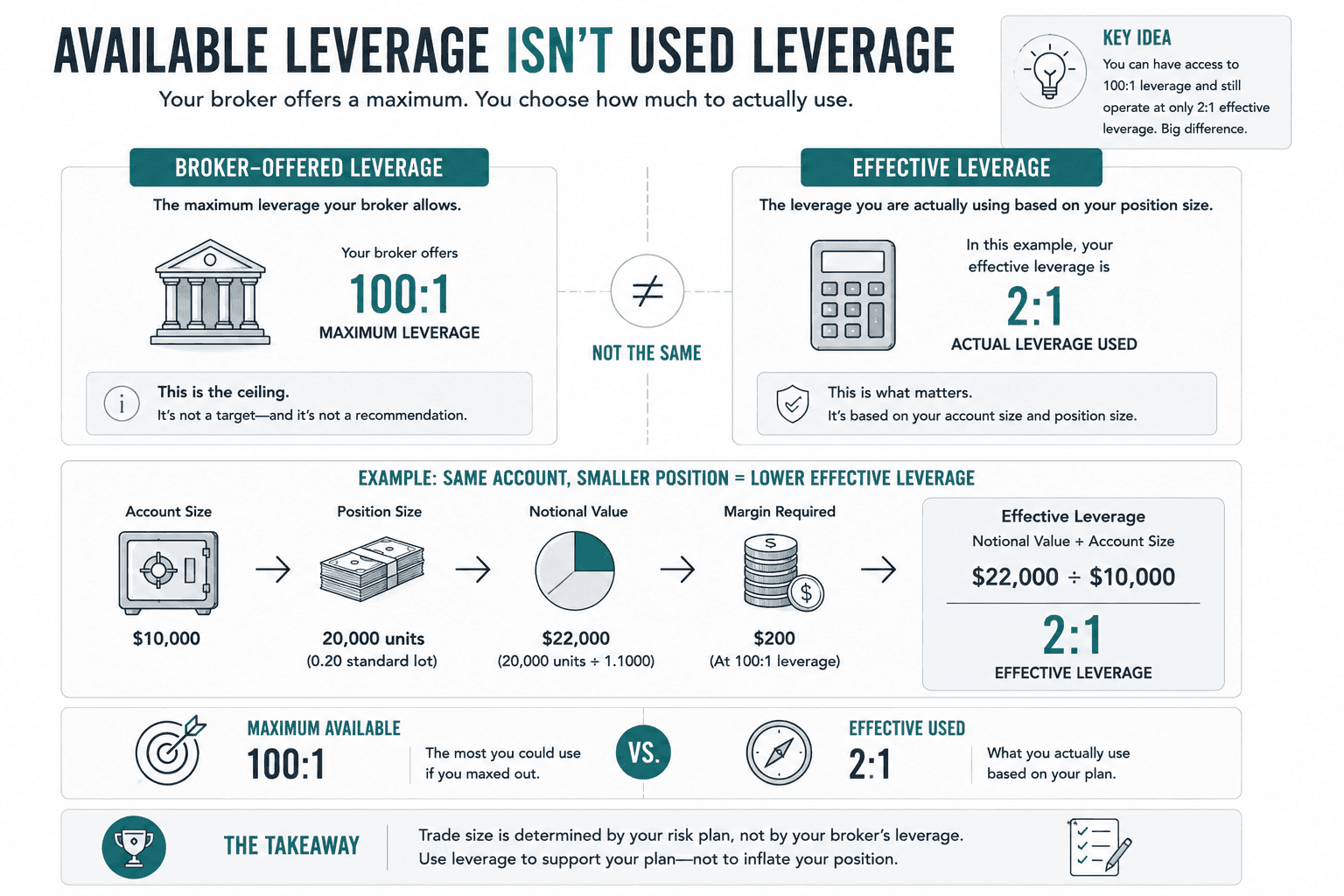
Controlling 20,000 units of EUR/USD requires around $200 in margin at 100:1 available leverage. On a $10,000 account, that means your effective leverage is only 2:1, regardless of what maximum leverage your broker advertises.
Pro traders view leverage as a tool that enables sensible sizing, not as a shortcut to maximize trade volume.
The Psychological Toll
Leverage does not just inflate your account balance; it inflates your stress levels.
A 50-pip loss that costs $100 (1% risk) is easy to shrug off. That same 50-pip loss costing $1,000 (10% risk due to over-leveraging) triggers panic. Panic leads directly to terrible habits like moving stop-losses further away, closing winning trades early, or revenge trading.
Terrible trading decisions almost always trace back to positions that were too big for the account. Proper sizing keeps your blood pressure down and your head clear.
This applies to entire strategies too. A simple strategy with a 50% win rate and a 1:1 risk-to-reward ratio breaks even over time. With low effective leverage, riding out a normal losing streak is just standard procedure. With sky-high leverage, that same statistically normal losing streak destroys your entire account before your strategy even gets a chance to work. High leverage does not improve your strategy's win rate; it just amplifies the damage of standard market fluctuations.
A Simple Rule of Thumb
Position size should be determined by predefined account risk and stop distance, not by the maximum leverage a broker makes available. Most experienced retail traders stay between 2:1 and 10:1 effective leverage, even when their broker offers 50:1 or 100:1.
The leverage offered by your broker is an upper safety limit, not a recommended setting. The leverage you actually use should be determined strictly by your position size and risk rules.
Leverage is just a power tool. Used carefully, it gets the job done efficiently. Used carelessly, you end up in the emergency room.
Success Criteria
You are ready to move on to the next lesson when you can:
Identify & Define: Clearly explain what leverage and margin are and how they amplify both gains and losses.
Calculate Risk: Determine your actual position size and effective leverage based on your defined account risk percentage and stop-loss distance.
Distinguish Leverage Types: Differentiate between maximum broker-offered leverage and your account's effective leverage.
Practical Application: Define at least one rule-based risk management habit (such as keeping effective leverage below 5:1) to implement in your own trading routine.
Common Misconception
Higher leverage gives you more opportunity.
The Truth: It's an appealing idea, more leverage, more room to grow a small account fast. In reality, higher leverage amplifies losses exactly as much as gains, and most experienced traders use only a small fraction of what's actually available to them.
FAQ's
Q: Is leverage the same as borrowing money?
Q: Why do some brokers offer way higher leverage than others?
Q: What does "100:1 leverage" actually mean?
Table of Contents
About Me

Krista Weber
After a career as a VP of UX and EdTech executive, I retired early—and quickly realized the traditional world of trading education is fundamentally broken.
As someone with a Master’s in HCI who specialized in the design of e-learning systems, I saw a massive gap: beginners aren't failing because trading is impossible; they’re failing due to massive cognitive overload and terrible instructional design.
This site bridges that gap. I’m applying the principles of learning science, systems thinking, and minimalist UX to strip away the market noise and teach trading the way it actually should be taught.
Stay in Touch
Some of the pages on my travel blog contain affiliate links. Whenever you buy something through one of these links, I get a small commission at no extra cost to you. As an affiliate, I only recommend products and services that I feel are high quality and helpful to my readers. Thanks for your support.
Read More

Open almost any trading platform and you'll see EUR/USD sitting next to XAU/USD, NQ, ES, and a dozen CFDs on stocks you've heard of. They all show up as candlesticks moving left to right, which quietly implies they're all the same kind of thing. They aren't. Before going deeper into any one of them, it's worth drawing the map.
Updated on Sep 6, 2026

Futures are standardized contracts tied to defined specifications and a future settlement date. They can look complex at first, but the mechanics become much clearer once you know what the contract specification controls. Here's what you actually need to know.
Updated on Sep 6, 2026

CFDs appear everywhere in retail trading – but most new traders couldn't explain exactly what they are or why that matters. Here's a plain-language breakdown, including the parts that most introductions skip.
Updated on Sep 6, 2026