
What Is Margin and How Does It Work?
Margin isn't a fee. It is the security deposit that lets you trade with leverage. Understanding how margin works, how margin levels are calculated, and when stop-out mechanisms trigger is essential for protecting your capital and sizing trades safely.

Learning Path Stage 1: Foundations
Learning Level 1: Recognition
Primary Learning Objective
By the end of this lesson, you will be able to explain how margin acts as collateral in leveraged trading, calculate key margin metrics (including free margin and margin level), and identify how stop-out mechanisms protect accounts from falling into negative balances.
Forex and derivatives markets are leveraged markets. Leverage allows you to control a position larger than the actual cash sitting in your account. Margin is the invisible glue holding this deal together, and it is also the bouncer enforcing risk limits when things start going sideways.
Understanding margin is essential if you want to avoid blowing up your account, figure out what a "margin call" actually means, and size your positions without accidentally setting off financial landmines.
What Margin Actually Is
Margin is not a fee or a cost. Think of it as a security deposit. It is a slice of your account balance that your broker holds hostage as collateral while your trade stays open.
If you want to control a $100,000 position using 100:1 leverage, you only need $1,000 in your account to open the deal. That $1,000 is your margin, and your broker effectively fronts the remaining $99,000 for the duration of the trade.
Here is the catch: profit and loss are always calculated on the full $100,000 position size, not just your $1,000 deposit. If the market moves in your favor, you collect profits based on the full amount. If the market goes against you, the losses hit your real balance just as hard.

Key Margin Terminology
Required Margin (Initial Margin): The entry fee to open a trade, expressed as a percentage of the total position size. With a 1% margin requirement, you need $1,000 down to control $100,000.
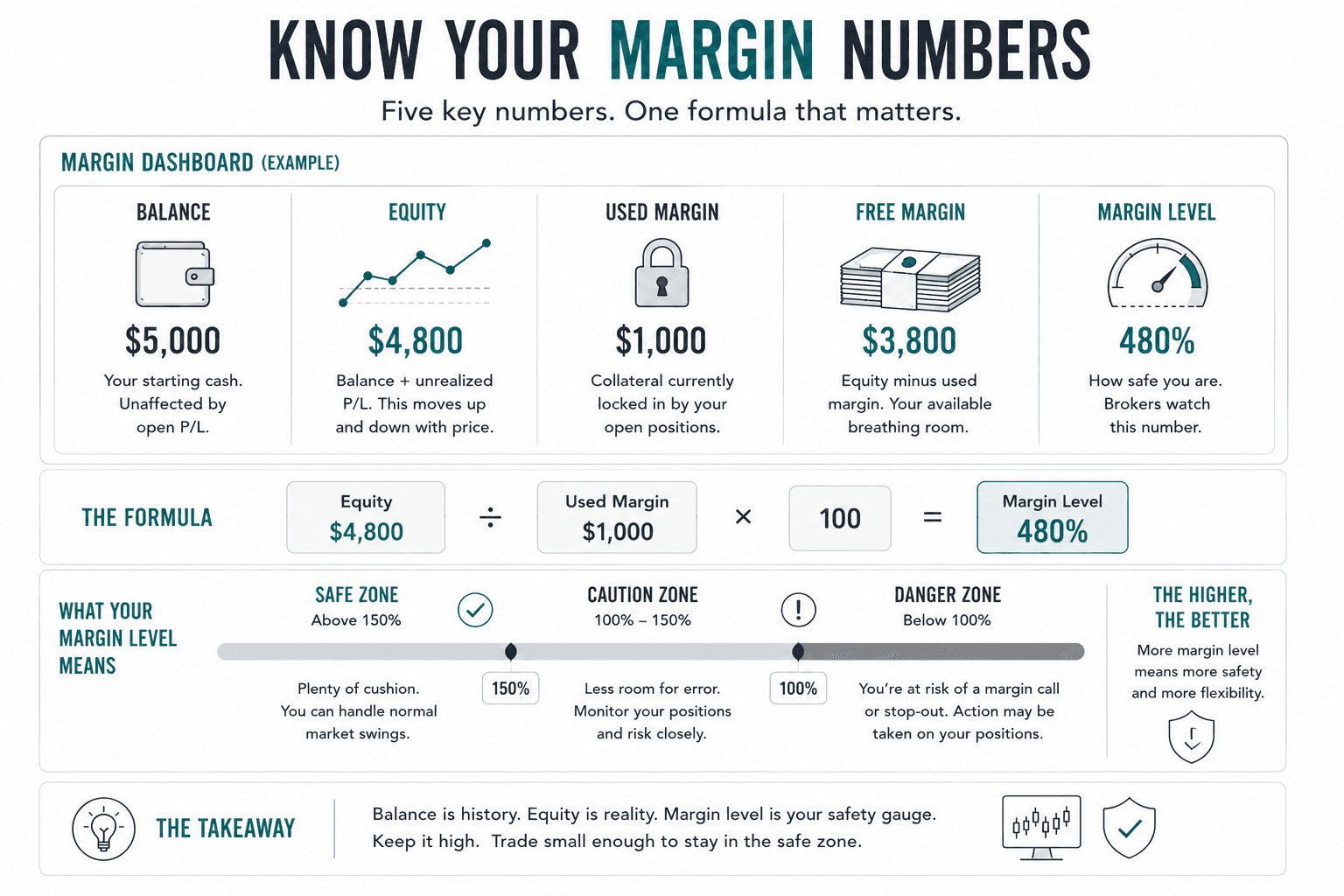
Used Margin: The combined total of all collateral currently locked up across every open trade in your account.
Free Margin: Your remaining breathing room. This is your account balance minus used margin, showing how much cash is left to open new trades or absorb open losses.
Margin Level: The percentage resulting from your equity divided by your used margin. Brokers monitor this number like a hawk. A high percentage means you are cruising safely; a low percentage means trouble is knocking at the door.
Margin Call Level: The threshold where your broker sends a polite (or automated) warning that your account is bleeding out. Common levels sit at 100% or 50%, depending on your platform.
Stop-Out Level: The emergency ejection seat. This is the margin level where your broker steps in and automatically starts liquidating your trades (usually the biggest loser first) to prevent your account from dropping into the negative zone.
What Happens When Margin Gets Low
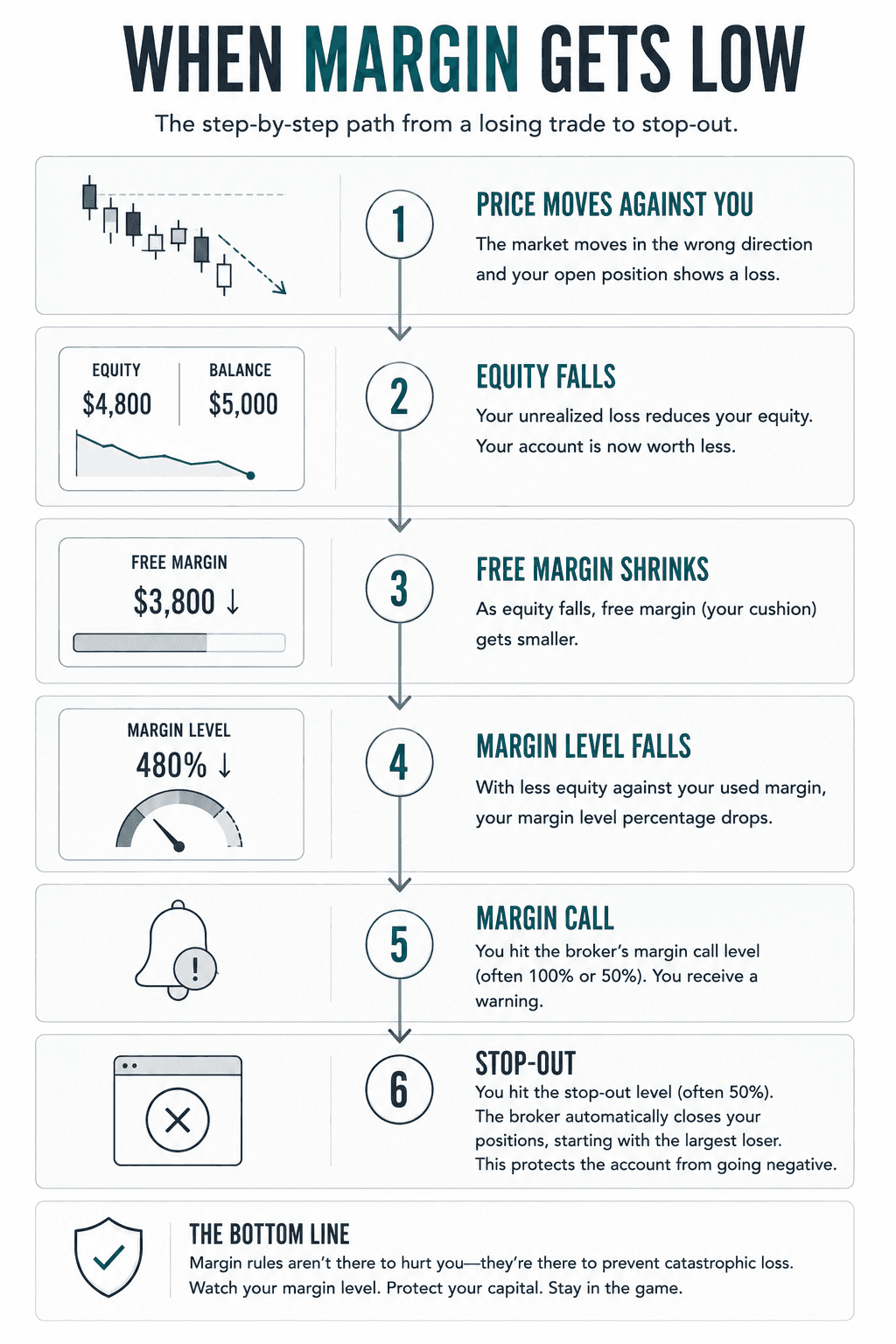
When a trade goes south, a predictable sequence of events unfolds:
The Dip: Price moves against you, and your account equity drops.
The Squeeze: Your free margin shrinks, leaving you with less breathing room.
The Slide: Your overall margin level percentage plummets.
The Warning: You hit the margin call level. Modern systems rarely send a dramatic phone call anymore; usually, your account dashboard just starts flashing red.
The Ejection: You hit the stop-out level, and the broker starts closing your positions automatically.
This sequence is the exact blueprint for blowing up an account. The stop-out mechanism fires, positions close at a loss, and you are left staring at a tiny fraction of your original balance.
Why This Matters for Position Sizing
Margin is far more than an abstract technical rule. It dictates how much punches your account can take before getting knocked out.
Imagine a trader with a $5,000 balance who opens a standard lot controlling $100,000 in currency at 100:1 leverage. The required margin is $1,000, leaving $4,000 in free margin.
If the market moves 200 pips against the trade, that costs roughly $200 on standard pairs. That represents a mild 4% dent in the account, leaving plenty of free margin intact.
However, if a sudden market shock drives price 2,000 pips in the wrong direction, that translates to a $2,000 loss. That knocks out 40% of the account balance and sends the margin level tumbling.
Position sizing, leverage, and margin work together to dictate how much room a trade has to move before forced liquidation kicks in. Always size your trades relative to your overall account, not just the entry requirements.
Margin isn't the danger. It's the smoke detector. Ignore it and the fire was never the surprise.
Success Criteria
You will be ready to move on to the next lesson when you can:
Define Margin: Accurately explain margin as collateral rather than a transaction fee or cost.
Distinguish Margin Metrics: Differentiate between required margin, used margin, free margin, and margin level.
Recognize Risk Triggers: Describe the step-by-step sequence from price drawdown to margin calls and automated stop-outs.
Apply Safe Position Sizing: Use margin level dynamics to determine appropriate position sizes relative to your total account balance rather than just entry requirements.
Common Misconception
Margin is a fee you pay, like a spread or commission.
The Truth: It isn't. It's collateral you get back when the position closes, minus or plus whatever the trade made or lost. What you should actually watch isn't your account balance in isolation, it's your margin level: the ratio that determines whether a stop-out happens, and it can drop fast even while your balance looks fine on paper.
FAQ's
Q: What does a 50% stop-out level mean in practice?
Q: Can I lose more than my initial deposit?
Q: Is margin the same as leverage?
Table of Contents
About Me

Krista Weber
After a career as a VP of UX and EdTech executive, I retired early—and quickly realized the traditional world of trading education is fundamentally broken.
As someone with a Master’s in HCI who specialized in the design of e-learning systems, I saw a massive gap: beginners aren't failing because trading is impossible; they’re failing due to massive cognitive overload and terrible instructional design.
This site bridges that gap. I’m applying the principles of learning science, systems thinking, and minimalist UX to strip away the market noise and teach trading the way it actually should be taught.
Stay in Touch
Some of the pages on my travel blog contain affiliate links. Whenever you buy something through one of these links, I get a small commission at no extra cost to you. As an affiliate, I only recommend products and services that I feel are high quality and helpful to my readers. Thanks for your support.
Read More

Open almost any trading platform and you'll see EUR/USD sitting next to XAU/USD, NQ, ES, and a dozen CFDs on stocks you've heard of. They all show up as candlesticks moving left to right, which quietly implies they're all the same kind of thing. They aren't. Before going deeper into any one of them, it's worth drawing the map.
Updated on Sep 6, 2026

Futures are standardized contracts tied to defined specifications and a future settlement date. They can look complex at first, but the mechanics become much clearer once you know what the contract specification controls. Here's what you actually need to know.
Updated on Sep 6, 2026

CFDs appear everywhere in retail trading – but most new traders couldn't explain exactly what they are or why that matters. Here's a plain-language breakdown, including the parts that most introductions skip.
Updated on Sep 6, 2026