
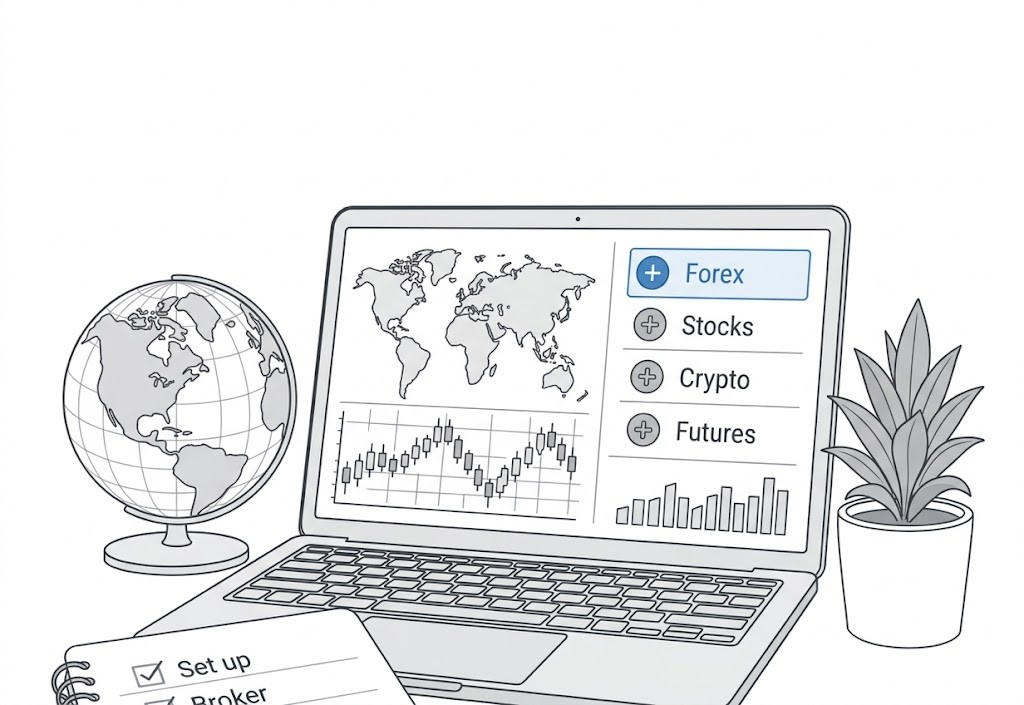
Stage 1: Foundations
Before you can read charts or develop a strategy, you need to build a solid foundation. These learning paths introduce the markets, realistic expectations, paper trading, platforms, terminology, and the skills that every trader needs.
Beginner Trading Series
Build the mindset and learning habits that set successful traders apart. Learn how to practice safely, avoid common beginner mistakes, and develop realistic expectations.
12 Lessons
Forex and Broker Basics
Understand the brokers, accounts, costs, and mechanics behind a forex trade before you start analyzing charts.
14 Lessons
Currency Pairs
Learn how base and quote currencies work, decode the important parts of a forex quote, compare major pairs using observable conditions such as volatility, session activity, spreads, liquidity, and event sensitivity, and choose a starting pair based on evidence rather than someone else’s favorite ticker.
4 Lessons
Markets & Instruments
This topic helps you separate three ideas traders often blur together: the market, the underlying exposure, and the trading structure.
6 Lessons
Latest Articles from Stage 1: Foundations

What Are CFDs? Contracts for Difference Explained
CFDs appear everywhere in retail trading – but most new traders couldn't explain exactly what they are or why that matters. Here's a plain-language breakdown, including the parts that most introductions skip.
Date Published:
Read Time:
9
minutes

What Are Futures? A Plain-Language Introduction
Futures are standardized contracts tied to defined specifications and a future settlement date. They can look complex at first, but the mechanics become much clearer once you know what the contract specification controls. Here's what you actually need to know.
Date Published:
Read Time:
8
minutes

The Market Map: What Are You Actually Trading?
Open almost any trading platform and you'll see EUR/USD sitting next to XAU/USD, NQ, ES, and a dozen CFDs on stocks you've heard of. They all show up as candlesticks moving left to right, which quietly implies they're all the same kind of thing. They aren't. Before going deeper into any one of them, it's worth drawing the map.
Date Published:
Read Time:
10
minutes

How to Choose a Currency Pair to Trade
With dozens of currency pairs available, beginners often trade too many at once – or choose pairs that don't match their schedule, strategy, or account size. Choosing the right pair is a form of strategic clarity most traders underestimate.
Date Published:
Read Time:
5
minutes

How Major Currency Pairs Behave Differently
EUR/USD, GBP/USD, and USD/JPY are all major forex pairs, but the conditions around them can differ. Instead of memorizing a permanent "personality," learn to compare what you can observe now: volatility, session activity, spread and liquidity, event sensitivity, and directional persistence.
Date Published:
Read Time:
5
minutes

How to Read a Forex Quote
Excerpt: Before you can trade forex, you need to understand what you're actually looking at when you see "EUR/USD 1.0856." This isn't complicated, but getting it clear early prevents a surprising number of costly mistakes down the line.
Date Published:
Read Time:
5
minutes

What Are Currency Pairs and How Do They Work?
In forex, you're always buying one currency and selling another simultaneously. The two currencies are expressed as a pair – EUR/USD, GBP/JPY, AUD/CAD. Understanding how pairs work, how to read the price, and what you're actually doing when you click buy or sell is the first practical knowledge you need before anything else.
Date Published:
Read Time:
5
minutes
How to Calculate Your Position Size
You’ve measured movement in pips, priced volume in lots, calculated entry costs with spreads, and unlocked leverage. Now it’s time to pull those pieces together into a single, non-negotiable step: position sizing. Learn the exact math that transforms risk from a stressful gut feeling into a precise number you choose on purpose.
Date Published:
Read Time:
5
minutes
Understanding Spreads, Pips, Lots, and Leverage
Four core concepts drive every single forex trade: spread, pip, lot, and leverage. Learn what each term actually means in plain English, how they work together, and how they determine the exact financial stakes of every position you take.
Date Published:
Read Time:
6
minutes
Understanding Leverage and Margin
Leverage is why forex moves that look tiny on paper can either build an account or obliterate it in hours. It is the single most powerful and dangerous mechanic in trading, making a solid understanding of how it works entirely non-negotiable.
Date Published:
Read Time:
5
minutes
Read More Stage 1 Articles

You’ve measured movement in pips, priced volume in lots, calculated entry costs with spreads, and unlocked leverage. Now it’s time to pull those pieces together into a single, non-negotiable step: position sizing. Learn the exact math that transforms risk from a stressful gut feeling into a precise number you choose on purpose.
Updated on Jul 22, 2026

Four core concepts drive every single forex trade: spread, pip, lot, and leverage. Learn what each term actually means in plain English, how they work together, and how they determine the exact financial stakes of every position you take.
Updated on Jul 22, 2026

Leverage is why forex moves that look tiny on paper can either build an account or obliterate it in hours. It is the single most powerful and dangerous mechanic in trading, making a solid understanding of how it works entirely non-negotiable.
Updated on Jul 22, 2026