
Stage 1: Foundations
Before you can read charts or develop a strategy, you need to build a solid foundation. These learning paths introduce the markets, realistic expectations, paper trading, platforms, terminology, and the skills that every trader needs.
Beginner Trading Series
Build the mindset and learning habits that set successful traders apart. Learn how to practice safely, avoid common beginner mistakes, and develop realistic expectations.
12 Lessons
Forex and Broker Basics
Understand the brokers, accounts, Costst, and mechanics behind a forex trade before you start analyzing charts.
14 Lessons
Latest Articles from Stage 1: Foundations

How to Choose a Currency Pair to Trade
With dozens of currency pairs available, beginners often trade too many at once – or choose pairs that don't match their schedule, strategy, or account size. Choosing the right pair is a form of strategic clarity most traders underestimate.
Date Published:
Read Time:
5
minutes

How Major Currency Pairs Behave Differently
EUR/USD, GBP/USD, and USD/JPY are all major forex pairs, but the conditions around them can differ. Instead of memorizing a permanent "personality," learn to compare what you can observe now: volatility, session activity, spread and liquidity, event sensitivity, and directional persistence.
Date Published:
Read Time:
5
minutes

How to Read a Forex Quote
Excerpt: Before you can trade forex, you need to understand what you're actually looking at when you see "EUR/USD 1.0856." This isn't complicated, but getting it clear early prevents a surprising number of costly mistakes down the line.
Date Published:
Read Time:
5
minutes

What Are Currency Pairs and How Do They Work?
In forex, you're always buying one currency and selling another simultaneously. The two currencies are expressed as a pair – EUR/USD, GBP/JPY, AUD/CAD. Understanding how pairs work, how to read the price, and what you're actually doing when you click buy or sell is the first practical knowledge you need before anything else.
Date Published:
Read Time:
5
minutes

Trading Is a Skill, Not a Side Hustle
Trading gets marketed as passive income or a side hustle. It's neither. It's a skill-intensive discipline with a multi-year learning curve. Understanding this upfront changes how you approach everything that comes next.
Date Published:
Read Time:
5
minutes

Why Learning Trading Takes Longer Than People Think
Learning trading takes longer than most people expect. Not because the material is overly complex, but because understanding something and being able to operate inside it are two very different things. Early progress feels real, but it’s mostly recognition. The actual learning begins later, when decisions happen under uncertainty, feedback is inconsistent, and nothing behaves as cleanly as the explanation did.
Date Published:
Read Time:
7
minutes

Why Buying Information Won't Make You a Better Trader
The trading education industry is worth billions of dollars. Most of it exchanged for information freely available elsewhere. Understanding why paid courses are usually a bad deal for beginners, and where the genuinely good free resources are, saves money and time.
Date Published:
Read Time:
5
minutes
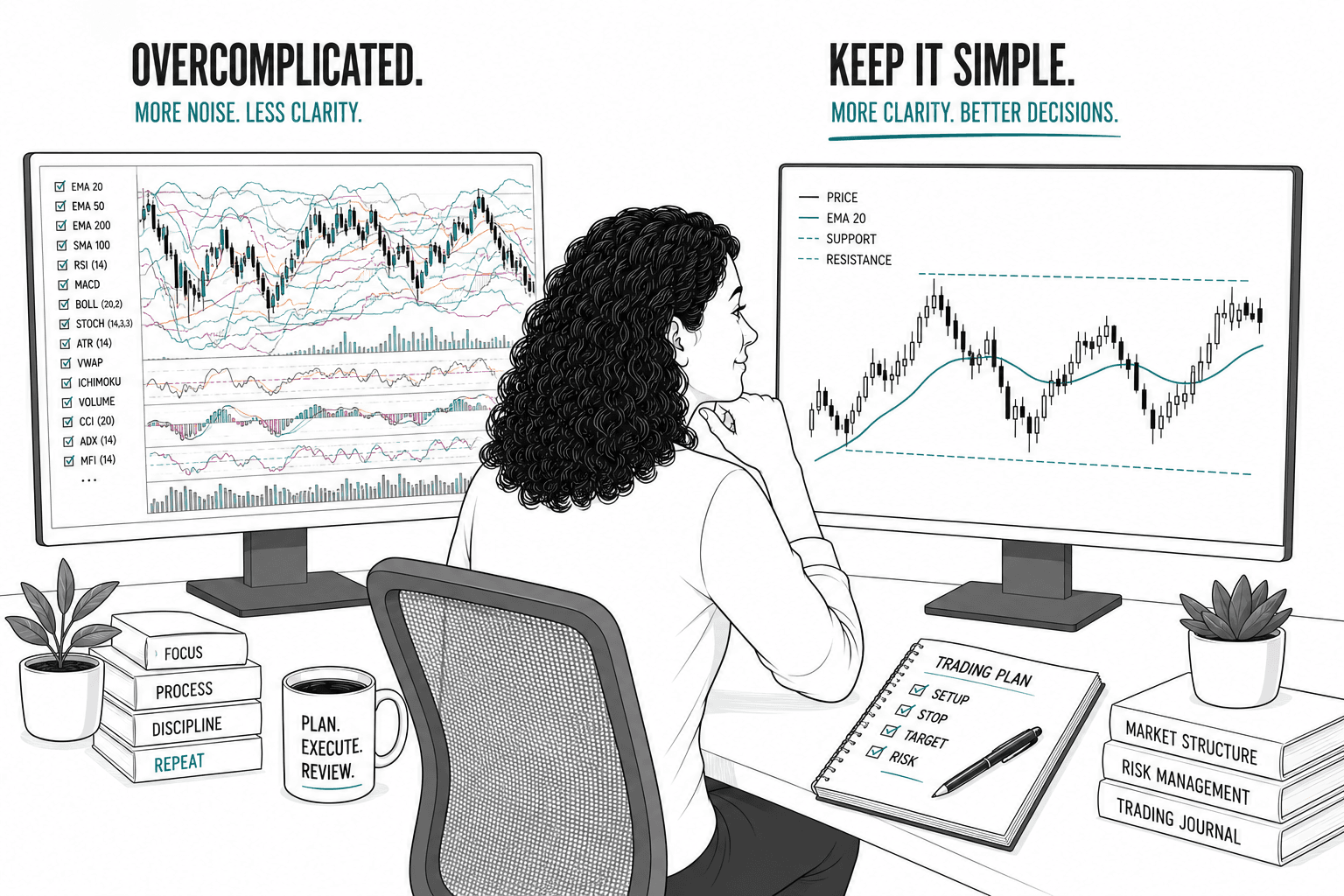
Why Most Beginner Traders Overcomplicate Everything (And How to Stop)
New traders tend to add complexity (more indicators, more strategies, more analysis) believing that sophistication leads to better results. It almost never does. Here's why simplicity wins and complexity costs more than it gives.
Date Published:
Read Time:
5
minutes

Stop Studying. Start Charting. (That’s How You Actually Learn to Trade)
Consuming trading content feels like progress. It often isn't. Here's how to distinguish between the two, and what to do when you realize you've been in consumption mode for months.
Date Published:
Read Time:
5
minutes

How to Evaluate Trading Resources Before You Trust Them
The internet contains an almost infinite amount of trading content, and a significant proportion of it ranges from mediocre to actively harmful. This lesson introduces a simple three-filter framework for evaluating trading educators, courses, videos, and communities before you invest your time or money.
Date Published:
Read Time:
5
minutes
Read More Stage 1 Articles
EUR/USD, GBP/USD, and USD/JPY are all major forex pairs, but the conditions around them can differ. Instead of memorizing a permanent "personality," learn to compare what you can observe now: volatility, session activity, spread and liquidity, event sensitivity, and directional persistence.
Updated on Aug 28, 2026
In forex, you're always buying one currency and selling another simultaneously. The two currencies are expressed as a pair – EUR/USD, GBP/JPY, AUD/CAD. Understanding how pairs work, how to read the price, and what you're actually doing when you click buy or sell is the first practical knowledge you need before anything else.
Updated on Aug 28, 2026

You’ve measured movement in pips, priced volume in lots, calculated entry costs with spreads, and unlocked leverage. Now it’s time to pull those pieces together into a single, non-negotiable step: position sizing. Learn the exact math that transforms risk from a stressful gut feeling into a precise number you choose on purpose.
Updated on Jul 22, 2026